The Complete Guide to Protecting Critical Infrastructure
Published by Hall-Fast Industrial Supplies | Hafren Fasteners
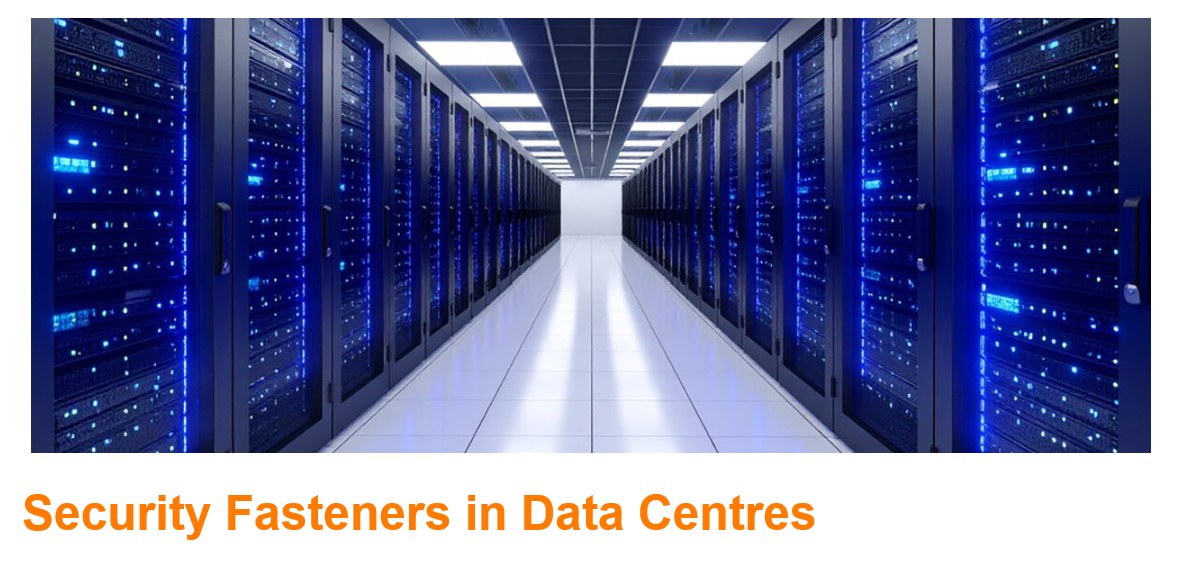
Data centres are among the most security-sensitive environments on the planet. They house the servers, networking equipment, and storage systems that underpin everything from global financial transactions to national health records, cloud platforms and government communications. The physical security of these facilities is not merely a compliance consideration — it is a fundamental engineering requirement. And at the core of that physical security is something easily overlooked: the fastener.
Security fasteners for data centres represent a specialised category of hardware engineered to resist tampering, deter unauthorised access, and ensure the integrity of critical equipment enclosures. Whether you are specifying fixings for server racks, cable management systems, access panels, raised floor tiles, perimeter cabinets, or cooling infrastructure, choosing the correct security fastener is as important as any other element of your data centre design.
This guide covers everything procurement managers, data centre engineers, facilities managers, and IT infrastructure teams need to know about selecting, specifying, and sourcing security fasteners for data centre applications. For a comprehensive supply of specialist fasteners, visit Hall-Fast's Hafren Fasteners range — a trusted UK source of high-quality security and specialist fasteners across a wide range of industries.
Why Security Fasteners Matter in Data Centre Environments
Standard fasteners — the kind used in general construction, automotive, or domestic applications — are designed for convenience and economy. They are intended to be installed and removed easily, using commonly available tools. In the context of a data centre, this convenience becomes a vulnerability.
A standard Phillips or slotted screw can be removed in seconds by anyone with a basic screwdriver. In an environment where server racks contain sensitive client data, proprietary hardware configurations, or classified information, this represents an unacceptable risk. Security fasteners are specifically engineered to defeat this kind of opportunistic or deliberate tampering.
The Scale of the Physical Security Problem
The threat model for modern data centres has evolved considerably. Beyond the obvious external threat of physical intrusion, organisations must also guard against insider threats, social engineering attacks targeting physical access, and supply chain interference. Industry research consistently finds that a significant proportion of data centre outages and security incidents involve some element of physical access failure — and in many cases, improperly secured hardware enclosures are a contributing factor.
CCTV, biometric access control, and mantrap entrances address perimeter security. But once an individual has legitimate access to a data hall — as a contractor, cleaning operative, or visiting engineer — the secondary layer of physical protection becomes critical. Security fasteners on cabinets, server chassis, patch panels, and access panels form a vital part of this secondary barrier.
Regulatory and Compliance Drivers
Data centres operating under frameworks such as ISO 27001, SOC 2, PCI DSS, and the UK Cyber Essentials Plus scheme are expected to demonstrate physical security controls at all levels of their infrastructure stack. Auditors increasingly scrutinise physical access controls, and the use of tamper-evident or tamper-resistant fasteners can form part of a documented physical security programme.
Similarly, data centres hosting government or defence clients may be subject to additional requirements under standards such as JSP 440 (UK Ministry of Defence physical security) or NIST SP 800-53, which mandates physical and environmental protection controls. The use of appropriate security fasteners supports compliance with these requirements and provides an auditable evidence trail of physical security measures.
Key insight: Security fasteners are not merely a physical product — they are a documented control within your information security management system (ISMS). Their selection, installation, and audit trail should be managed as part of your broader security programme.
Types of Security Fasteners Used in Data Centres
The market for security fasteners is remarkably diverse, reflecting the wide range of applications, threat levels, and environmental conditions encountered across different data centre configurations. Understanding the main categories is essential for making informed procurement decisions.
1. Tamper-Resistant Screw Heads
Tamper-resistant screws are the most widely deployed category of security fastener in data centre environments. They feature drive recesses incompatible with standard tools, requiring specialist bits or entirely bespoke drivers. Key variants include:
• Torx Plus (IP) — Features a central pin or post preventing standard Torx bits from engaging. Widely used in IT equipment chassis and server enclosures, these are among the most common security fasteners in data centre environments.
• Pentalobe — A five-lobed star-shaped drive that cannot be engaged by standard Torx or Phillips drivers. Increasingly specified for premium server hardware and enterprise networking equipment.
• Tri-Wing — A three-winged drive recess used extensively in data networking equipment. The asymmetric design defeats standard flathead and Phillips tools effectively.
• Spanner (Snake-Eye) — Features two small round holes rather than a conventional drive recess. Requires a dedicated spanner bit. Frequently used on access panels, junction boxes, and electrical enclosures within data halls.
• One-Way (Clutch) Screws — Designed with an asymmetric drive that engages on installation but strips out on attempted removal with a standard driver. Used where permanent installation is required.
• Sentinel (Pin-in-Hex or Pin-in-Torx) — A standard hex or Torx recess with a central security pin that prevents normal hex keys or Torx bits from engaging. Balances security with semi-controlled access using dedicated bits.
2. Tamper-Evident Fasteners
Tamper-evident fasteners may not always prevent removal, but they provide clear visual or physical evidence that removal has been attempted or accomplished. In data centre applications they serve a forensic function — allowing security teams to identify which enclosures have been accessed.
• Breakaway bolt caps — Plastic caps that shatter or deform permanently when tools are applied, leaving clear evidence of attempted removal.
• Tamper-evident labels over screw heads — Specialist versions incorporating holographic or void-on-removal features provide an evidence layer over standard or security screws.
• Sealing screws with lacquer witness marks — A coloured compound applied over the installed fastener creates a mark that cracks or displaces on any rotation, providing immediate visual evidence of interference.
3. Rack and Cabinet Security Fasteners
Server rack and cabinet fasteners present a unique specification challenge. Rack-mount equipment must comply with EIA-310 standards for 19-inch rack systems, which define the hole pattern, spacing, and thread specifications for rack nuts and cage nuts. Security variants allow data centres to maintain standard rack compatibility while adding tamper resistance.
• Security cage nuts — Standard M6 cage nuts with a tamper-resistant recess. Compatible with all standard 19-inch rack systems.
• Security rack bolts — M6 rack bolts featuring Torx Plus or similar security drives. Used in conjunction with security cage nuts or threaded rack strips.
• Captive panel screws — Used on server chassis panels and blade server enclosures. The screw remains captive when fully loosened, preventing loss while making reinstallation more controlled.
• Quarter-turn security fasteners — Mechanisms with security drive heads providing rapid but controlled access to server panels. Widely used in high-density environments where legitimate maintenance access must be possible but uncontrolled access deterred.
4. Raised Floor and Structural Fasteners
Data centre raised access floors house critical cable management infrastructure, power distribution, and cooling airflow pathways. The fasteners securing floor tiles must balance accessibility for cabling work with resistance to casual tampering or opportunistic access beneath the floor.
• Raised floor tile security screws — Specific fasteners for pedestal attachment and tile locking systems. Often feature key-operated mechanisms or tamper-resistant screw heads.
• Pedestal locking bolts — Structural fasteners securing raised floor pedestals to the subfloor. High-strength, corrosion-resistant variants with security heads resist both tampering and environmental degradation.
5. Locking Cable and Conduit Fasteners
Data centre cable management systems — including tray, ladder rack, and conduit runs — must be secured in a way that prevents casual interference with critical data and power cabling. Security fasteners for these applications must often be compatible with plastic and thin-gauge metal materials while providing meaningful tamper resistance.
• Security cable tie mounts — Mounting bases for cable ties that incorporate tamper-resistant screw fixing.
• Conduit clamp security screws — Specialist screws for conduit retention that resist removal by standard tools.
6. Stainless Steel and Specialist Material Security Fasteners
Data centres may house sensitive equipment in environments with elevated humidity, chemical exposure risks, or electromagnetic compatibility (EMC) requirements demanding specific materials. Stainless steel security fasteners — typically A2 or A4 grade — offer corrosion resistance without compromising the security drive feature. Brass security fasteners are used where non-magnetic properties are required.
Material Selection for Data Centre Security Fasteners
Material choice for security fasteners in data centre environments is determined by a combination of functional, environmental, and regulatory factors.
Carbon Steel with Surface Treatment
The most economical option for internal data centre environments with controlled humidity and temperature. Standard carbon steel security fasteners are typically finished with zinc plating, black oxide, or dacromet coating. These provide adequate corrosion resistance for controlled indoor environments and the wide availability of carbon steel security fasteners in all drive types makes them the default choice for most internal cabinet and rack applications.
Stainless Steel (A2 and A4)
A2 (304) stainless steel is the most commonly specified grade for security fasteners requiring elevated corrosion resistance. Suitable for most indoor environments, including those adjacent to cooling infrastructure. A4 (316) stainless steel, which contains molybdenum for enhanced corrosion resistance, is preferred in coastal data centres, those with seawater cooling systems, or where cleaning chemicals may contact the fastener surfaces.
Brass and Aluminium
Brass security fasteners are specified where non-magnetic properties are required — for example, in proximity to sensitive magnetic storage media or specialist defence facilities. Aluminium security fasteners are used in weight-critical applications, particularly in portable or modular data centre deployments. Anodised aluminium offers good corrosion resistance while remaining significantly lighter than steel equivalents.
Procurement tip: Always specify material grade, surface treatment, and drive type together. A 'stainless steel security screw' without further specification may arrive as A2 or A4, with any one of a dozen drive types. Precise specifications save time and prevent costly substitutions.
Selecting the Right Security Level for Your Application
Not every fastener in a data centre needs to achieve the same security level. A tiered approach — matching security fastener specification to the sensitivity of the asset being protected — is both more economical and more practical from a maintenance perspective.
Tier 1: Low Security / Access Control Only
Applications: Non-critical storage enclosures, general facilities equipment, exterior mechanical plant rooms. Deters casual interference and requires a non-standard tool but can be opened relatively easily with a specialist bit available from trade suppliers. Appropriate fastener types: Standard Torx (T-drive without pin) or Robertson (square drive).
Tier 2: Medium Security / Restricted Access
Applications: Network patch panels, cable management infrastructure, server cabinet side panels, raised floor tiles. Requires a dedicated specialist bit not commonly available from retail or trade sources. Appropriate fastener types: Torx Plus (IP), Spanner/Snake-Eye, Tri-Wing, or Pin-in-Hex variants.
Tier 3: High Security / Tamper Deterrence
Applications: Primary server chassis, storage array enclosures, network core equipment, classified facility installations. Should be effectively non-removable without specialist tools unavailable through normal commercial channels. Evidence of attempted removal should be immediately apparent. Appropriate fastener types: One-way clutch screws, proprietary security drives with restricted bit supply, or fasteners used with tamper-evident compounds.
Tier 4: Critical Infrastructure / Forensic Evidence
Applications: Colocation customer cabinets with contractual physical security obligations, government or defence data centre installations, financial sector primary data halls. Removal should be impossible without destruction of the fastener or cabinet, and any attempt should generate immediate forensic evidence. Appropriate fastener types: Security screws with tamper-evident lacquer marks, breakaway bolt caps, or proprietary locking mechanisms with logged access.
Installation Best Practice for Data Centre Security Fasteners
Torque Control
Security fasteners in data centre applications are typically installed in relatively thin sheet metal — server chassis, rack panels, and cabinet structures are commonly 1.0mm to 2.0mm steel or aluminium. Overtorquing will strip threads, deform sheet material, or crack the drive recess. Use calibrated torque drivers where available, particularly for M3 and M4 security screws in electronics enclosures. Most manufacturers publish recommended torque values; follow these carefully.
Thread-Locking Compounds
In high-vibration environments — such as data centres with CRAC unit vibration, generator rooms, or facilities in areas prone to seismic activity — security fasteners may benefit from medium-strength (blue) thread-locking compound. This provides resistance to vibration loosening without making future removal impossible for authorised personnel with the correct tools.
Corrosion Prevention at Installation
Where stainless steel security fasteners are installed into carbon steel threads — or carbon steel security fasteners into aluminium — there is a risk of galvanic corrosion over time. Apply an appropriate anti-galling compound or thread paste at installation to prevent seizing and to ensure future removability by authorised engineers.
Documentation and Tool Management
Each security fastener installation should be documented as part of the data centre asset management programme. Record the fastener type, drive specification, thread size, quantity, installation location, and date. The security benefit of tamper-resistant fasteners is only maintained if the corresponding specialist tool bits are themselves controlled. Specialist security driver bits should be treated as controlled items — signed in and out, stored securely, and inventoried regularly.
Data Centre-Specific Applications: A Detailed Review
Server Cabinet and Rack Security
The standard 19-inch server rack is the fundamental unit of data centre organisation. Standard M6 rack bolts feature a Phillips or slotted drive — the easiest possible head for an opportunistic intruder to defeat. Replacing these with M6 security rack bolts featuring Torx Plus IP drives immediately elevates the security posture of every rack. For colocation facilities, where individual cabinets are leased to different clients, security cage nuts and rack bolts ensure that neighbouring clients cannot access each other's equipment.
Server Chassis and Blade Enclosures
Modern server chassis feature multiple access panels — top covers, drive bays, PCIe slot covers, and I/O panel blanks. Each represents a potential ingress point for data theft via physical device insertion (such as rogue USB devices, keyloggers, or Wi-Fi adapters). Factory fasteners on server chassis are invariably standard Phillips M3 or M4 screws. Replacing these with security equivalents — Torx Plus, Pentalobe, or Tri-Wing as appropriate — significantly raises the bar for physical attack.
Network Patch Panels and Cabling
Patch panels represent a particularly attractive target for physical interception attacks, as rerouting or splicing patch cables provides access to network traffic without triggering electronic intrusion detection systems. Securing patch panel mounting hardware with security fasteners and using tamper-evident labels over patch panel frames reduces this risk significantly. Cable tray and ladder rack fixings should similarly incorporate security fastener variants.
KVM and Out-of-Band Management Infrastructure
KVM switches and out-of-band management infrastructure such as console servers and IPMI controllers provide direct hardware-level access to servers, bypassing all software-level access controls. Physical security of these systems is therefore paramount. Security fasteners on KVM chassis and mounting hardware, combined with locked cabinet placement, form the physical layer of out-of-band management security.
Power Distribution and UPS Infrastructure
PDUs and UPS systems within data halls are critical single points of failure. Tampering with PDU outlet configurations, fuse or breaker positions, or UPS battery connections can cause immediate, widespread outages. Security fasteners on PDU mounting hardware and access panels, combined with remote monitoring, provide physical protection for this critical infrastructure.
Physical Access Control Infrastructure
Access control readers, door strike mechanisms, and CCTV camera mounting hardware are themselves targets for physical tampering. An attacker who can remove or redirect CCTV cameras, or defeat an electronic door strike, has undermined the entire perimeter security investment. All physical access control hardware should be secured with anti-tamper fasteners, with fastener heads hidden behind installed hardware where possible.
Standards and Specifications for Security Fasteners
ISO and EN Standards
ISO 10664 defines the Torx Plus (Hexalobular Internal) drive recess, which underpins many of the most widely used security fastener drive types in IT equipment. The standard specifies drive recess dimensions across the full size range, ensuring dimensional consistency between fasteners from different manufacturers and bits from different tool suppliers.
Thread Standards and EIA-310 Rack Compliance
Data centre fasteners span both metric and unified thread standards. Server racks typically use M6 metric threads for rack nuts and bolts per EIA-310, while many server chassis use M3 or M4 metric threads for panel screws. Legacy and North American equipment may use 10-32 UNF or 12-24 UNC threads. Security fasteners are available in all these thread forms, but specifiers must confirm thread form along with drive type and material.
RoHS and REACH Compliance
Data centres operating in or supplying services to the EU, or those subject to UK RoHS regulations, must ensure fasteners comply with the Restriction of Hazardous Substances directive and REACH chemical compliance requirements. This is particularly relevant for surface treatments — certain zinc-nickel plating processes and some thread-locking compounds may contain restricted substances. Always obtain RoHS and REACH declarations from fastener suppliers.
Procurement Considerations: Building a Security Fastener Supply Strategy
Supplier Selection Criteria
When selecting a supplier for data centre security fasteners, evaluate the following criteria:
• Range breadth — Does the supplier stock security fasteners in all required drive types, thread sizes, materials, and lengths? A single-source supplier reduces the risk of specification drift.
• Technical support — Can the supplier provide material certificates, dimensional data sheets, and compliance declarations (RoHS, REACH) on request?
• Stock availability — Confirm the supplier holds adequate stock of your critical SKUs, or can support kanban or scheduled delivery arrangements.
• Quality consistency — Security fasteners from different production batches must be dimensionally consistent to ensure tool compatibility. ISO 9001 certification is a baseline expectation.
• Specialist expertise — A supplier with specialist expertise in security fastener applications can provide valuable guidance on drive type selection, material specification, and installation.
Inventory Management for Security Fasteners
The controlled nature of security fasteners requires more careful inventory management than standard fasteners. Maintain a documented register of all security fastener SKUs in use across the facility, the locations where they are installed, and the corresponding tool bits required for their removal. Review this register annually or following any significant infrastructure change.
Establish minimum stock levels for all critical security fastener SKUs and trigger replenishment orders before stock falls below these levels. In a large data centre, unexpected hardware changes, maintenance activities, or security incidents may require access to security fasteners at short notice.
Sourcing Security Fasteners from Hall-Fast
For organisations seeking a reliable UK supplier of specialist security and technical fasteners, visit Hall-Fast's Hafren Fasteners range. Hall-Fast offers a comprehensive selection of specialist fastening solutions suitable for demanding technical applications including data centre infrastructure, IT equipment, and related industries.
Hall-Fast has established itself as a trusted industrial supplies partner across a wide range of sectors, bringing together deep product knowledge, competitive pricing, and a commitment to consistent quality. The Hafren Fasteners range is specifically positioned to serve technical and specialist applications where standard fastener ranges fall short — precisely the kind of application represented by data centre security fastener requirements.
Whether you are specifying fasteners for a new data centre build, retrofitting security fasteners to an existing facility, or establishing a maintained supply relationship for ongoing maintenance needs, the team at Hall-Fast can support your requirements. Explore the full range at hall-fast.com/fasteners-small-components/hafren-fasteners or contact the Hall-Fast team at sales@hall-fast.com or 01623 645645.
Future Trends in Data Centre Physical Security and Fastener Technology
Smart and Connected Security Hardware
Emerging fastener technologies incorporate electronic tamper detection — small RFID tags or embedded sensors within fastener heads that trigger alerts when disturbed. While not yet mainstream, these systems are in development and pilot deployment in high-security government and financial sector facilities. The integration of physical fastener status with building management systems (BMS) and security information and event management (SIEM) platforms represents a significant step forward in physical-cyber security convergence.
Additive Manufacturing and Proprietary Drive Systems
3D printing technology is enabling data centre operators and security hardware manufacturers to develop genuinely proprietary fastener drive profiles — geometries that cannot be replicated by standard tool manufacturers because the drive bit itself must also be 3D printed. This creates a genuinely closed supply chain for the most sensitive applications, where even knowledge of the drive type does not enable an attacker to obtain the necessary tool.
Modular and Prefabricated Data Centre Security
The growth of prefabricated modular data centres — containerised or skid-mounted facilities deployed rapidly in edge computing and hyperscale expansion scenarios — is creating new requirements for security fasteners. These facilities must be designed for rapid deployment and reconfiguration while maintaining the same physical security standards as permanent facilities.
Sustainability and Circular Economy Considerations
Data centre operators are under increasing pressure to address the sustainability of their hardware supply chains, including fasteners. The circular economy principle — designing for disassembly and reuse — creates a tension with permanent or one-way security fasteners. The industry is beginning to explore security fasteners that can be removed by authorised personnel and reused in new deployments, reducing waste without compromising security.
Creating a Security Fastener Policy for Your Data Centre
The most effective approach to data centre security fasteners is a documented, organisation-wide policy that covers specification, procurement, installation, audit, and review. Without a formal policy, individual engineers and facilities managers make inconsistent decisions that undermine the overall security posture.
Key Elements of a Security Fastener Policy
• Scope definition — Define which areas and assets are subject to security fastener requirements. Define zones (data halls, meet-me rooms, raised floors, external plant) and the security tier applicable to each.
• Specification standards — For each defined zone, specify the permitted fastener drive types, materials, and surface treatments. Create a reference document listing approved SKUs.
• Approved supplier list — Define which suppliers are approved to supply security fasteners and the criteria for approval, including quality management certification.
• Tool control procedure — Define how specialist driver bits are stored, signed out, and returned. Specify who may authorise access to tool bits and under what circumstances.
• Installation standards — Define torque specifications, thread-locking requirements, and documentation obligations for security fastener installation.
• Audit schedule — Define how frequently installed security fasteners are inspected and how results are recorded.
• Change control — Define the process for approving changes to the security fastener specification and updating the approved SKU reference document.
• Incident response — Define how incidents involving suspected fastener tampering are reported, investigated, and remediated.
Training and Awareness
Security fastener policies are only effective if personnel responsible for data centre maintenance and facilities management understand them. Include security fastener awareness in data centre induction training for all technical staff and contractors. Ensure that maintenance contractors who work within the data hall are briefed on the security fastener policy and the requirement to report any anomalies.
Summary: Building Physical Security From the Ground Up
Data centre physical security is a layered discipline. Perimeter access control, CCTV surveillance, mantraps, biometric authentication, and security operations centres all play their part. But none of these controls can compensate for inadequate physical protection at the hardware level — the point where racks, servers, network equipment, and cables are fixed in place.
Security fasteners for data centres are the last line of physical defence for the most sensitive hardware in the modern digital economy. Selecting, specifying, installing, and managing these components with the same rigour applied to electronic security controls closes a critical gap in the physical security architecture.
The key principles to take forward are:
• Match security fastener tier to asset sensitivity — not every fastener needs the highest security specification, but every security-relevant fastener should be formally specified.
• Control the tools as carefully as the fasteners — the best tamper-resistant screw provides no benefit if the matching bit is freely available.
• Document everything — installation records, audit trails, and incident logs make security fasteners part of your formal ISMS evidence base.
• Work with specialist suppliers who understand the application — technical guidance from an expert supplier is as valuable as the product itself.
• Review and update your specification regularly — technology, threat landscapes, and regulatory requirements all evolve.
To source high-quality security and specialist fasteners for data centre and other critical infrastructure applications, visit Hall-Fast's Hafren Fasteners range. Hall-Fast's team of industrial supply specialists can help you build the right security fastener strategy for your facility — from initial specification through to ongoing supply and technical support.
—
About Hall-Fast Industrial Supplies: Hall-Fast is a leading UK industrial supplies company offering a comprehensive range of fasteners, small components, workwear, PPE, and industrial equipment. The Hafren Fasteners range provides specialist fastening solutions for technical and security-critical applications. Call: 01623 645645 | Email: sales@hall-fast.com
Visit: https://www.hall-fast.com/fasteners-small-components/hafren-fasteners