Forklifts are among the most useful pieces of equipment in any warehouse — and among the most dangerous. The Health and Safety Executive consistently identifies forklift-related incidents as a significant cause of workplace injury and fatality in the UK warehouse sector. Forklift safety equipment exists to manage these risks: protecting pedestrians from forklift impact, protecting infrastructure from forklift contact, protecting forklift drivers from accidents, and helping forklifts and pedestrians coexist safely in shared workspaces. This comprehensive guide walks through the full landscape of forklift safety equipment used in UK warehouses today.
Hall-Fast Industrial Supplies is one of the UK's leading distributors of forklift safety equipment. From Rack Armour upright protectors to bollards, barriers, mirrors, floor markings, signage, and PPE, we supply the full range. Browse our brand portfolio, learn about Hall-Fast on the About page, or get in touch via the contact page. The Hall-Fast price promise applies on every authentic Rack Armour product: if you find a better price, let us know and we will match it.
Why forklift safety equipment matters
In an average year in the United Kingdom, hundreds of forklift-related workplace incidents are reported to the Health and Safety Executive. The most common incident types include: pedestrian struck by forklift, pedestrian struck by load falling from forklift, forklift driver injured in tip-over or collision, racking collapse caused by forklift impact, and crush injuries between forklift and fixed structure. The combination of vehicle mass, vehicle speed, narrow operating spaces, and mixed pedestrian-vehicle environments creates significant risk in any warehouse running forklifts at meaningful volumes.
The legal framework
UK warehouse operators have legal duties under the Health and Safety at Work Act 1974 and associated regulations to manage forklift risks. The Provision and Use of Work Equipment Regulations 1998 (PUWER) require equipment to be safe and properly maintained. The Management of Health and Safety at Work Regulations 1999 require risk assessments and the implementation of suitable control measures. The HSE publication L117 'Rider-operated lift trucks: Operator training and safe use' provides specific guidance on forklift safety. Compliance with these duties typically requires investment in forklift safety equipment alongside training and operational procedures.
The economic case
Beyond the legal duty and the moral obligation to protect staff and visitors, forklift safety equipment delivers a strong economic return. Avoided injuries reduce compensation claims, insurance premiums, and absence costs. Avoided infrastructure damage reduces repair costs and operational disruption. Avoided incidents reduce HSE involvement, internal investigation time, and reputational damage. Most safety equipment investments pay back many times over across the multi-year service life of the products.
Categories of forklift safety equipment
Forklift safety equipment falls into several main categories: pedestrian-vehicle separation, infrastructure protection, visibility aids, traffic management, driver-side equipment, and personal protective equipment (PPE). A comprehensive safety programme typically includes products from each category, layered together to address risk from multiple angles.
Pedestrian-vehicle separation
Physically separating pedestrians from forklifts is the single most effective safety measure where the warehouse layout permits. Continuous rail barriers along walkways, A-frame barriers at aisle ends, hoop barriers around equipment, and bollards in critical zones all contribute to physical separation. The principle is that pedestrians and forklifts share the warehouse but rarely occupy the same metre of floor at the same time.
Infrastructure protection
Protecting the warehouse infrastructure from forklift contact prevents the racking collapses, wall failures, and column damage that create the most serious safety incidents. Polymer upright protectors such as Rack Armour preserve pallet racking integrity. Bollards protect critical columns. Wall and corner protection absorb cumulative contact damage. The infrastructure protection layer keeps the warehouse structurally sound.
Visibility aids
Many forklift incidents happen because the driver did not see the obstacle — pedestrian, other forklift, low-hanging structure, fixed equipment — in time to avoid it. Visibility aids reduce these incidents at source: convex mirrors at intersections, hi-vis floor markings, hi-vis vests for pedestrians, hi-vis equipment colours, and good warehouse lighting all contribute. Modern forklifts increasingly include onboard visibility aids — proximity sensors, projected light warnings, and cameras.
Traffic management
Traffic management equipment controls how forklifts move through the warehouse. Speed bumps slow trucks in pedestrian-shared zones. Floor markings define traffic lanes and stop points. Signage warns of upcoming hazards. Traffic mirrors at intersections support safer entry. One-way systems and designated pedestrian crossings formalise the traffic flow.
Driver-side equipment
Forklift drivers themselves benefit from a range of safety equipment integrated into the truck or worn while operating. Seatbelts, overhead guards, load backrests, and rear posts protect the driver in the event of tip-over or impact. Modern trucks include orange flashing beacons, reversing alarms, and projected blue safety lights. Driver-worn PPE includes hi-vis garments, safety footwear, and hard hats where overhead risk exists.
Personal protective equipment
Pedestrians and other staff working in or near forklift zones rely on PPE as the last line of defence. Hi-vis vests are essential for visibility. Safety footwear protects against pallet drops and crush injuries. Hard hats may be required in zones with overhead lifting. Gloves, eye protection, and hearing protection address other workplace hazards but are not specific to forklift risk.
Deep dive: Rack Armour and pallet racking protection
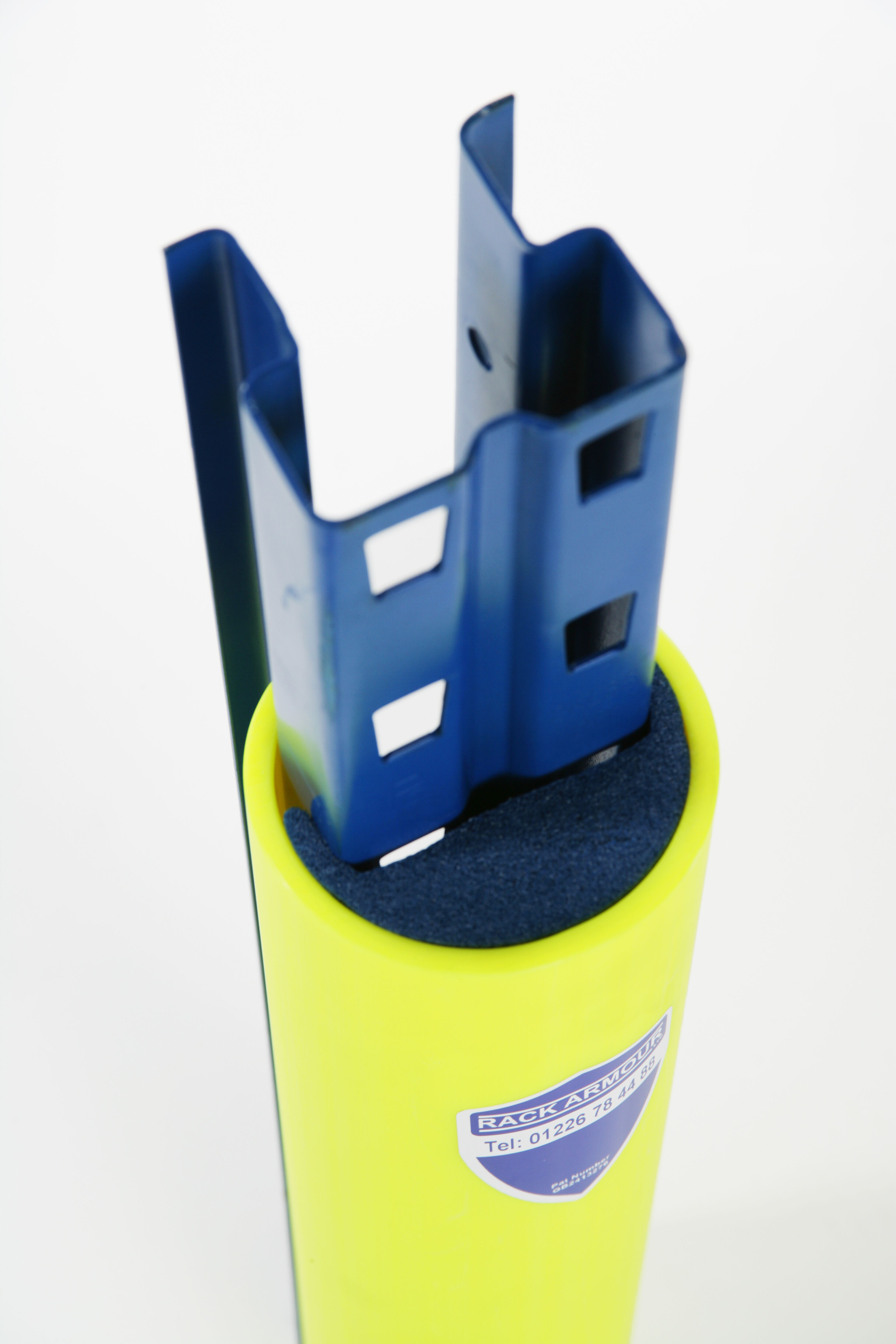
Pallet racking is the most common piece of warehouse infrastructure and the most frequently impacted by forklifts. Damaged racking is also potentially the most dangerous — a buckling upright can cause a bay collapse with catastrophic consequences for staff and stock. Rack Armour, the UK's leading polymer upright protector, addresses this risk efficiently and economically.
How Rack Armour protects safety as well as cost
Rack Armour preserves the structural integrity of pallet racking by absorbing forklift impact energy before it damages the steel uprights. The structural-integrity benefit is critical for safety — a racking system with damaged uprights is at risk of catastrophic failure under load, and a catastrophic failure can cause serious injury or fatality. Rack Armour reduces the rate of upright damage by 80 to 95 per cent in real-world UK warehouses, and the bays that do still get hit show damage to the protector rather than the steel. The safety case for upright protection is at least as strong as the cost case.
Sizes for every racking type
Rack Armour is supplied in five sizes — Small, Medium, Large, XL, and XXL — to fit every standard pallet racking section used in the UK. Browse the Hall-Fast Rack Armour brand page or contact our team for sizing advice.
Visibility through hi-vis colour
Rack Armour is available in safety yellow and hi-vis yellow. The hi-vis variant marks the upright base clearly even in shadowed aisles, low-light cold stores, and night-shift operations — adding a visibility-aid benefit on top of the impact protection. Many warehouses choose hi-vis for safety-critical bays as a deliberate visibility choice.
Easy retrofit installation
Rack Armour installs onto loaded racking using a dedicated tool — the Small/Medium installation tool or the Large/XL installation tool. Your warehouse staff can install the protection without specialist contractors and without taking the racking offline.
Deep dive: bollards and column guards
Bollards and column guards protect free-standing vertical structures — building columns, machinery, doorway frames, and pedestrian zones — from forklift impact. The protection is doubly important for safety because building columns carry essential structural loads, and damage to a column can have building-wide consequences.
Steel bollards
Steel bollards anchored into the floor slab provide the strongest physical barrier. They will physically stop a fully-laden forklift, transferring the impact energy into the floor and the concrete fixings. Steel bollards are the right choice for protecting building columns, doorway frames, high-value equipment, and pedestrian zones where forklift entry must be physically prevented. Powder-coated or galvanised finishes resist corrosion.
Polymer-faced and rubber-buffered bollards
Hybrid bollards combine a steel core with an outer polymer or rubber layer that absorbs some of the impact energy. The construction reduces damage to the bollard itself and to whatever is behind it. These products work well in zones where impacts are likely but full stopping power is not strictly required — for example, at the ends of aisles where pedestrian access is occasionally needed.
Column guards for building columns
Column guards specifically protect building columns from forklift impact. They wrap around or sit alongside the column with a stand-off that allows the polymer or rubber to absorb impact energy before it reaches the column itself. Column protection is critical because the structural consequence of column damage can extend far beyond the visible damage zone.
Deep dive: barriers for pedestrian-vehicle separation
Barriers are the primary tool for keeping pedestrians and forklifts apart in shared workspaces. The right barrier system creates physical separation, visual definition, and operational discipline.
A-frame barriers
A-frame barriers are angled steel barriers anchored into the floor at the ends of pallet racking aisles, at pedestrian crossing points, and around equipment that needs protection. The angled face deflects a forklift away from the protected zone rather than absorbing the impact head-on. A-frame barriers are very common in goods-in/goods-out zones and at the ends of high-density pallet racking aisles.
Hoop barriers
Hoop barriers are inverted-U steel barriers that protect equipment, machinery, and pedestrian zones from forklift contact. Lighter than A-frames and suited to medium-duty applications, they are common around free-standing equipment such as wrapping machines, weighing stations, and conveyor terminals.
Continuous rail barriers
Continuous rail barriers run along walkways and traffic lanes, defining the route and preventing encroachment. They are the right choice for separating pedestrian walkways from forklift traffic in shared zones such as picking aisles and assembly areas. Heavy-duty continuous rails can stop a forklift; lighter rails primarily provide visual definition and a low-energy physical barrier.
Pedestrian gates
Pedestrian gates at controlled crossing points formalise the pedestrian-forklift interaction. Self-closing gates ensure pedestrians actively choose to enter the traffic zone rather than wandering into it. Some operations install interlock systems that pause forklift traffic when the pedestrian gate is opened.
Deep dive: visibility aids
Visibility aids reduce the rate of forklift incidents by improving sightlines, drawing attention to risk zones, and supporting better situational awareness for both drivers and pedestrians.
Convex mirrors
Convex mirrors mounted at aisle intersections, blind corners, and goods-in/goods-out access points eliminate blind spots. The wide-angle reflection compresses a large field of view into a small mirror surface, letting forklift drivers see oncoming traffic and pedestrians before entering the intersection. Mirror selection depends on viewing distance and field of view required — Hall-Fast can advise on the right mirror for each location.
Floor marking tape and paint
Floor marking tape and paint define traffic lanes, pedestrian walkways, exclusion zones, and stop points in highly visible colours. Standard convention uses yellow for general caution, red for prohibited zones, white or green for walkways, and contrasting borders to define edges. The visual cue is processed by drivers and pedestrians without conscious attention, supporting safer behaviour without requiring active thought.
Hi-vis personal garments
Hi-vis vests, jackets, and trousers are the standard pedestrian PPE in any zone where forklifts operate. Class 2 garments are typical for indoor warehouse use; Class 3 for outdoor yards and heavy-traffic environments. Hi-vis helmets and footwear add additional visibility for high-risk roles.
Hi-vis equipment marking
Hi-vis tape and paint applied to fixed equipment, the lower edges of overhead structures, and the corners of stationary objects help drivers spot them in peripheral vision. Reflective hi-vis is particularly useful in areas with directional task lighting where shadows can hide objects.
Lighting
Good warehouse lighting underpins all the other visibility aids. Modern LED warehouse lighting provides high-lumen output with even distribution, eliminating the dark spots that can hide pedestrians and obstacles. Lighting upgrades often deliver safety benefits as well as energy savings.
Deep dive: traffic management
Traffic management equipment controls how forklifts move through the warehouse, supporting safer interactions with pedestrians and other vehicles.
Speed bumps and humps
Speed bumps installed in pedestrian-shared zones, near goods-in/goods-out doors, at aisle exits, and at any location where excessive speed creates risk enforce a speed reduction that signage alone cannot reliably achieve. Polymer speed bumps designed for indoor warehouse use slow forklifts without damaging the truck or the floor. The bump profile matters — too aggressive can damage forklift wheels and risk dropped loads; too gentle and the speed reduction is inadequate.
Stop signs and yield signs
Stop signs and yield signs at intersections formalise the right-of-way and reduce the cognitive load on drivers. Standardised signage following recognisable conventions (octagonal red stop signs, triangular yield signs) is processed quickly and reliably by trained drivers.
One-way systems
One-way traffic systems in narrow aisles eliminate head-on encounters between forklifts. Combined with floor markings showing the traffic direction, mirrors at the entry and exit, and signage reinforcing the rule, one-way systems significantly reduce the risk of forklift-forklift collisions.
Designated pedestrian crossings
Pedestrian crossings clearly marked on the warehouse floor formalise where pedestrians are expected to cross forklift traffic lanes. Combined with mirrors at the crossing, signage warning drivers, and good lighting, the designated crossing concentrates the pedestrian-forklift interaction at a controlled point rather than dispersing it across the warehouse.
Deep dive: forklift-mounted safety equipment
Modern forklifts include or accept a range of mounted safety equipment that supports safer operation.
Beacons and warning lights
Orange flashing beacons mounted on the overhead guard alert pedestrians to forklift presence at distance. The flashing pattern is more effective than steady illumination because the change attracts attention. Some operations use blue safety lights projected onto the floor in front of and behind the forklift to give pedestrians additional warning of approaching vehicles.
Reversing alarms
Reversing alarms — usually a beeping audible alert when the forklift is in reverse — warn pedestrians when the truck is moving backwards. The alarm is particularly important because the driver's view to the rear is limited and the truck approaches faster relative to the driver's reaction time.
Cameras and sensors
Modern forklifts increasingly include rear-view cameras, side-view cameras, and proximity sensors. The technology supports the driver's awareness of pedestrians and obstacles, particularly in blind-spot zones around the truck. Aftermarket camera and sensor kits are widely available for older trucks.
Seatbelts and operator restraints
Seatbelts are mandatory on most forklift types and play a critical role in protecting drivers from injury in tip-over incidents. The driver's natural instinct in a tip-over is to jump clear, but the truck typically falls onto and crushes the jumping driver. The seatbelt holds the driver inside the protective overhead guard cage, which is engineered to survive the tip-over.
Speed limiters
Speed limiters cap the maximum forklift speed at a level appropriate to the warehouse layout. Some operations use tiered speed zones — different maximum speeds in different parts of the warehouse — implemented through telematics-based speed control.
Building a comprehensive forklift safety equipment plan
Effective forklift safety planning works through the warehouse zone by zone, identifying the risks in each zone and matching the equipment to address them.
Step 1: Risk assessment
Conduct a structured risk assessment covering every zone of the warehouce. Identify the forklift activities, the pedestrian activities, the points of interaction, the worst-credible scenarios, and the controls already in place. The risk assessment is a legal requirement under the Management of Health and Safety at Work Regulations 1999 and provides the foundation for the safety equipment plan.
Step 2: Apply the hierarchy of controls
Use the hierarchy of controls: eliminate the risk if possible, substitute with a lower-risk alternative, engineer controls (including safety equipment), administer controls (training, procedures), and provide PPE as the last line of defence. Most forklift safety risks cannot be fully eliminated — the operation needs forklifts and pedestrians to coexist — so engineering controls (safety equipment) and administrative controls (training and procedures) carry most of the load.
Step 3: Specify the equipment
For each identified risk, specify the appropriate safety equipment. Pallet racking → Rack Armour upright protectors. Building columns → bollards or column guards. Pedestrian zones → barriers and floor markings. Blind intersections → convex mirrors. Speed-sensitive zones → speed bumps. Pedestrian PPE → hi-vis garments and safety footwear.
Step 4: Plan implementation
Plan the implementation in phases starting with the highest-priority risks. The high-priority installations typically deliver most of the risk reduction in a small fraction of the time. Subsequent phases extend coverage to lower-priority zones over time as budget allows.
Step 5: Train and brief
Brief all warehouse staff on the new safety equipment, what it is for, and how it changes operating practice. Forklift drivers need to understand the new traffic flows, mirrors, and barriers. Pedestrians need to understand the walkways, crossings, and exclusion zones. Visitors need to be given the safety briefing on arrival.
Step 6: Inspect and maintain
Add the safety equipment to the routine warehouse inspection regime. Damaged or missing equipment defeats the safety system; prompt repair and replacement keep the protection active. Document the inspections and maintenance for the audit and inspection record.
Common mistakes in forklift safety equipment specification
After many years of supplying forklift safety equipment to UK warehouses, Hall-Fast has seen the same handful of mistakes recur.
Mistake 1: PPE-first thinking
Some operations rely too heavily on PPE — hi-vis vests, safety footwear, hard hats — as the primary control. PPE is the last line of defence in the hierarchy of controls, not the first. Engineering controls (barriers, separation, protection) and administrative controls (training, procedures) should carry most of the safety load.
Mistake 2: Protection without prevention
Installing infrastructure protection (bollards, Rack Armour, wall protection) without supporting prevention (mirrors, floor markings, speed bumps) misses the opportunity to reduce incident rates at source. The combined approach delivers better safety outcomes than protection alone.
Mistake 3: One-time install thinking
Safety equipment needs maintaining over time. Damaged barriers, missing floor markings, faded signage, and broken mirrors all defeat the safety system. Operations that treat the install as one-time and forget the maintenance see the safety benefits decay.
Mistake 4: Insufficient barriers
Some operations install partial pedestrian-vehicle separation that leaves gaps. The gaps become the primary risk because pedestrians and vehicles re-converge there. Comprehensive separation — full walkways with continuous barriers and controlled crossings — delivers the safety benefit; partial separation may create a false sense of security.
Mistake 5: Ignoring driver feedback
Forklift drivers see the warehouse from a unique viewpoint and notice safety issues that managers don't. Operations that don't actively solicit driver feedback miss the opportunity to identify and address risks before they cause incidents. A simple monthly driver safety meeting or anonymous reporting channel captures most of the value.
Mistake 6: Buying low-quality equipment
Imported low-grade safety equipment sometimes looks attractive on price but typically delivers shorter service life, less reliable performance, and more frequent replacement. Authentic Rack Armour, quality bollards and barriers, durable mirrors, and robust signage all deliver better long-term value.
Hall-Fast and the price promise
Hall-Fast operates a price promise on every authentic Rack Armour product we supply. If you find a better price anywhere on the internet, or if you receive a quotation from another supplier that beats ours, let us know and we will match the price. The promise applies across the full Rack Armour range — all five sizes, both colour finishes, the installation tools, and bulk orders.
Why the price promise matters for safety
Safety equipment investment competes with other operational priorities for budget. Lower equipment cost translates directly into more equipment installed for the same budget — meaning more risks addressed, more zones protected, and a stronger safety outcome overall. The price promise lets you specify authentic high-quality Rack Armour without the risk of paying more than necessary.
Comprehensive product range
Hall-Fast supplies the full breadth of forklift safety equipment from a single source, simplifying procurement and supporting consistent specification across the warehouse. Browse our brand portfolio to see the range, or contact us via the contact page for a comprehensive specification quote.
Specifier support
Our team has specified comprehensive forklift safety programmes for warehouses across the UK. We can advise on equipment selection, sizing, quantity, and installation. There is no charge for the specification advice, and the support continues through implementation and beyond.
Frequently asked questions
What is the most important piece of forklift safety equipment?
There is no single most-important piece — effective forklift safety relies on layered combinations of pedestrian-vehicle separation, infrastructure protection, visibility aids, traffic management, driver-side equipment, and PPE. That said, in a warehouse with significant pallet racking, polymer upright protectors such as Rack Armour deliver one of the highest-return safety investments because they prevent the racking damage that can lead to catastrophic bay collapse.
How do I prioritise the safety equipment investment?
Start with a structured risk assessment to identify the highest-risk zones and the most likely incident scenarios. Address the highest-risk items first. Follow the hierarchy of controls — eliminate, substitute, engineer, administer, PPE — putting most of the investment into engineering controls (separation, protection, visibility aids) rather than relying on PPE alone.
How long does forklift safety equipment last?
Service life varies by product type. Polymer upright protectors typically last 10 years or more. Steel bollards and barriers can last 15-20 years if not severely impacted. Wall protection panels typically last 5-10 years. Floor markings need refreshing every 2-5 years depending on traffic. Mirrors last 10 years or more. PPE lifecycles depend on garment type, use intensity, and wash cycles.
Who is responsible for forklift safety in my warehouse?
Under UK health and safety law, the warehouse operator (employer) carries the primary responsibility. This typically delegates to the warehouse manager or operations manager day-to-day. Specific duties exist for forklift drivers, supervisors, and safety officers. Visitors and contractors must be briefed on the safety arrangements. The HSE publication L117 provides specific guidance for rider-operated lift trucks.
Do I need professional installation for safety equipment?
Most forklift safety equipment can be installed by competent in-house staff. Rack Armour installs with a snap-on tool. Wall protection mounts with standard fixings. Floor markings apply with surface-prep and tape application. Mirrors and signage mount conventionally. Heavy-duty bollards and barriers usually need chemical-fix anchoring into the floor, which some operations contract out — but the bulk of the work can be in-house.
How quickly can I get forklift safety equipment?
Hall-Fast holds stock of the most commonly ordered safety equipment and ships within one to two working days for most orders. Larger orders or specialist products may take longer; we will quote a firm delivery date at the point of order. Urgent requirements can usually be expedited.
Sector-specific safety equipment priorities
Different warehouse sectors place different priorities on forklift safety equipment because of different operating patterns and regulatory requirements.
3PL and logistics
Multi-shift, high-throughput, varied loads. Comprehensive Rack Armour, A-frame barriers, mirrors at every intersection, full floor marking, hi-vis PPE.
Food and beverage
Hygiene, cold-store conditions, audit pressure. Hi-vis Rack Armour for cold-store visibility, washable wall protection, comprehensive PPE.
Retail distribution
Seasonal peaks, network-wide consistency. Comprehensive specification with multi-site standardisation.
Manufacturing
Production-line adjacency, machinery protection. Bollards on critical equipment, Rack Armour on production-area racking, comprehensive driver training.
E-commerce fulfilment
Pedestrian-shared picking aisles. Continuous rail separation, mirrors, floor markings, speed bumps, comprehensive Rack Armour.
Pharmaceutical
GDP compliance, audit pressure. Wipeable surfaces, comprehensive Rack Armour, documented inspection regime.
About Hall-Fast Industrial Supplies
Hall-Fast Industrial Supplies is a long-established UK distributor of industrial products to warehouses, factories, and distribution centres across the United Kingdom. Find out more about us on the About Hall-Fast page. Forklift safety equipment is one of our core product areas, and we supply the full range — Rack Armour, bollards, wall protection, barriers, mirrors, floor markings, signage, speed bumps, PPE, and more — from a single source.
Browse the full Rack Armour range, explore our brand portfolio, or contact us via the contact page. Our team brings deep specifier experience to every safety equipment project, supported by UK stock for fast despatch and our price promise on Rack Armour.
Training and procedures: the human element
Safety equipment alone does not create a safe operation — it works in combination with effective training, clear procedures, and a strong safety culture. UK regulations and HSE guidance require that forklift drivers are trained to a recognised standard, that procedures are documented and followed, and that the operation is reviewed and improved continuously.
Driver training
Forklift drivers must be trained to operate their specific truck type safely. Recognised training providers — accredited by bodies such as ITSSAR, RTITB, AITT, NPORS, or LANTRA — deliver initial training, refresher training, and conversion training to switch between truck types. Training covers theoretical knowledge (regulations, safety principles, equipment) and practical skills (manoeuvring, load handling, hazard recognition). Refresher training is recommended every 3 to 5 years.
Pedestrian briefing
Pedestrians working in or visiting forklift zones need to understand the safety arrangements: where they can walk, where they cannot, what the floor markings mean, what to do if they encounter a forklift, and what PPE they must wear. The briefing should be part of staff induction for new starters and a refresher requirement for existing staff. Visitors should be briefed on arrival before being allowed into operational zones.
Standard operating procedures
Documented standard operating procedures (SOPs) for forklift operations cover topics such as: pre-shift truck inspection (the daily check); load handling (lifting, lowering, transporting); refuelling or charging; reporting incidents and near-misses; reporting defects; and end-of-shift parking. Clear SOPs reduce variation in driver behaviour and provide a basis for accountability when procedures are not followed.
Incident and near-miss reporting
A culture of incident and near-miss reporting is critical to safety improvement. Every reported near-miss — a close call that did not result in injury or damage but easily could have — represents a learning opportunity. Reporting should be encouraged, not punished; staff who report incidents should be supported, not blamed. Aggregated incident data identifies patterns that drive safety improvements.
Toolbox talks and safety briefings
Regular brief safety conversations — toolbox talks — keep safety front-of-mind for the warehouse team. Topics rotate through forklift safety, manual handling, slips and trips, PPE compliance, and the warehouse safety arrangements generally. The cumulative effect of repeated brief conversations is more powerful than occasional long training sessions.
Safety equipment for specific high-risk activities
Some warehouse activities carry particularly high risk and benefit from specific additional safety equipment beyond the general warehouse provision.
Goods-in/goods-out and loading dock activities
Loading docks combine forklift activity, vehicle movement, pedestrian activity, and time pressure — a high-risk combination. Specific equipment includes dock leveller safety devices, vehicle-restraint wheel chocks or trailer locks (preventing trailer creep during unloading), dock lights showing when it is safe to enter the trailer, and traffic management for visiting drivers. Comprehensive wall protection, A-frame barriers around pedestrian areas, and clear floor markings complete the picture.
Working at height adjacent to forklifts
Operations such as order picking from raised platforms, mezzanine working, and elevated stock checks combine working-at-height risks with forklift-traffic risks. Specific equipment includes mezzanine safety gates, pallet gates, and edge protection that prevent falls into forklift zones. Hi-vis PPE for elevated workers helps forklift drivers spot them. Coordination procedures ensure forklifts do not pass beneath workers at height.
Cold store operations
Cold store operations combine reduced lighting, low temperatures, restricted PPE compatibility, and tight aisles. Specific equipment includes hi-vis Rack Armour engineered to retain its impact-absorbing properties at cold-store temperatures, additional lighting, cold-store-rated PPE, and appropriate forklift specifications (cold-store trucks with cab heaters and battery management for cold conditions).
Narrow-aisle operations
Narrow-aisle racking operations using turret trucks or VNA forklifts carry specific risks because of the tight tolerances and the elevated operator position. Specific equipment includes guide rails along the aisle (preventing truck contact with racking), end-of-aisle stop systems, comprehensive Rack Armour through the aisle, and specialist driver training for the truck type.
Yard and outdoor operations
Outdoor forklift operations face additional risks from weather, uneven surfaces, and shared traffic with road vehicles. Specific equipment includes outdoor-grade hi-vis garments, all-weather signage, weatherproof traffic markings, and outdoor-rated barriers. Coordination with HGV traffic in the yard requires clear pedestrian crossings and visual separation. Yard operations also benefit from designated truck waiting areas separated from forklift activity, marked vehicle and pedestrian routes, and clear signage at site entrances communicating the safety arrangements to visiting drivers.
Battery charging and refuelling areas
Forklift battery charging and refuelling stations carry specific risks — hydrogen gas from charging lead-acid batteries, fire risk from gas-powered trucks, chemical exposure from battery acid. Specific equipment includes ventilation systems, eyewash stations, fire extinguishers, spill kits, and clear separation from the main warehouse activity. PPE for charging and refuelling staff includes face shields, chemical-resistant gloves, and aprons. Lithium-ion battery operations have a different but equally important risk profile, requiring fire-suppression systems specifically rated for lithium fires and clear procedures for handling damaged batteries. Bollards or impact protection around the charging area protects the electrical equipment from forklift contact during the charging or pre-charging manoeuvring, and clearly marked exclusion zones prevent unauthorised pedestrian access during charging cycles. Hot-zone signage and gas-detection equipment add further protection in higher-risk applications.
Conclusion
Forklift safety equipment is the foundation of safe warehouse operation. Effective programmes layer multiple product categories — pedestrian-vehicle separation, infrastructure protection, visibility aids, traffic management, driver-side equipment, and PPE — to address risk from multiple angles. The economic case is strong, the legal framework requires proportionate investment, and the moral obligation to protect staff and visitors makes the investment essential.
Hall-Fast Industrial Supplies is your UK partner for comprehensive forklift safety equipment. Authentic Rack Armour, quality bollards and barriers, professional-grade visibility aids, robust traffic management products, and the full range of supporting equipment — all stocked in the UK, supported by expert specification advice, and backed by our price promise on Rack Armour.
Get started today by browsing the Hall-Fast Rack Armour brand page, exploring our brand portfolio, or contacting us via the contact page. Whether you are specifying a single piece of equipment or a comprehensive multi-site safety programme, we can help you specify, source, and implement the right solution.