Impact and wall protection products absorb the impact energy that would otherwise damage warehouse infrastructure — building walls, columns, doorways, machinery, and the ends of pallet racking aisles. The category covers a range of specialist products engineered for specific applications: wall protection panels, corner guards, door frame protectors, bollards, column guards, A-frame barriers, hoop barriers, and continuous rail systems. Together, they form the impact-protection envelope that keeps warehouse buildings, equipment, and pedestrians safe from the inevitable contact with forklifts, pallet trucks, and other moving equipment. This comprehensive guide walks through every aspect of impact and wall protection for UK warehouses and industrial facilities.
Hall-Fast Industrial Supplies is one of the UK's leading distributors of impact and wall protection products. Our flagship Rack Armour range provides industry-leading polymer protection for pallet racking uprights, complemented by a wide range of bollards, barriers, wall protection, and other impact-protection products. Browse our brand portfolio, learn about Hall-Fast on the About page, or get in touch via the contact page. Our price promise applies on every authentic Rack Armour product: if you find a better price, let us know and we will match it.
The case for comprehensive impact and wall protection
Every warehouse, factory, and distribution centre that operates forklifts or other industrial vehicles will experience impact incidents. The question is not whether contact will happen between vehicles and infrastructure, but how severe the consequences are when it does. Impact and wall protection products absorb the contact energy and protect the structure behind them, dramatically reducing the cumulative damage that builds up over years of operation.
The cost of unprotected facilities
Without impact protection, the cumulative damage to walls, doors, columns, and other infrastructure adds up to substantial annual costs. Visible damage drives plastering, painting, repair, and replacement work; less visible damage drives structural concerns, audit findings, and insurance issues. The total economic impact of unprotected facilities is typically several times the direct repair bill, factoring in operational disruption, lost capacity, and management time.
The economic case for protection
Impact and wall protection products are typically inexpensive compared to the damage they prevent. A wall panel that costs a modest amount per metre prevents damage that costs many times more to repair. Bollards that cost a fraction of building column repair work prevent column damage that would otherwise require structural assessment and remediation. Comprehensive protection programmes typically pay back within months and continue delivering value across the multi-year service life of the protection products.
Beyond the direct cost
Beyond the direct cost-avoidance benefit, comprehensive impact and wall protection contributes to: better insurance underwriting position, cleaner audit and inspection reports, stronger safety culture, reduced operational disruption, longer building service life, and improved property value at lease renewal or sale. The wider benefits compound over time and add to the direct economic case.
The categories of impact and wall protection
Impact and wall protection comprises several distinct product categories, each engineered for specific applications. A comprehensive protection programme typically combines products from multiple categories, layered together to address risk from multiple angles.
Wall protection panels
Wall protection panels are sheet products fixed to the wall surface in impact-prone zones. They absorb contact energy through compression and protect the wall structure behind. Panels come in various heights, thicknesses, and materials depending on the impact severity — heavier panels for high-energy zones, lighter panels for general protection.
Corner guards
Corner guards protect external building corners from being chipped or damaged by passing forklifts and trolleys. The 90-degree corner is particularly vulnerable because vehicles cutting the corner contact the corner edge first, and repeated low-energy contact accumulates damage over time.
Door frame and door protection
Door frames and doors are common impact victims, particularly in doorway entries to cold stores, internal walls, and goods-in/goods-out areas. Specialist door frame protection profiles wrap the frame to absorb contact energy. Door bumper strips fit to the door itself.
Bollards
Bollards are vertical posts, typically anchored into the floor, that protect free-standing structures from forklift impact. Steel bollards transfer impact energy into the floor and concrete fixings; polymer-faced and rubber-buffered variants offer additional energy absorption.
Column guards
Column guards are specifically engineered to wrap around or sit alongside building columns. They absorb impact energy that would otherwise damage the column itself, protecting the structural element from cumulative wear or sudden severe damage.
A-frame and traffic barriers
A-frame barriers and other traffic barriers protect specific zones — the ends of pallet racking aisles, machinery surrounds, pedestrian crossings, and goods-in/goods-out areas. The barriers absorb or deflect impact energy to prevent forklifts entering the protected zone.
Pallet racking upright protectors
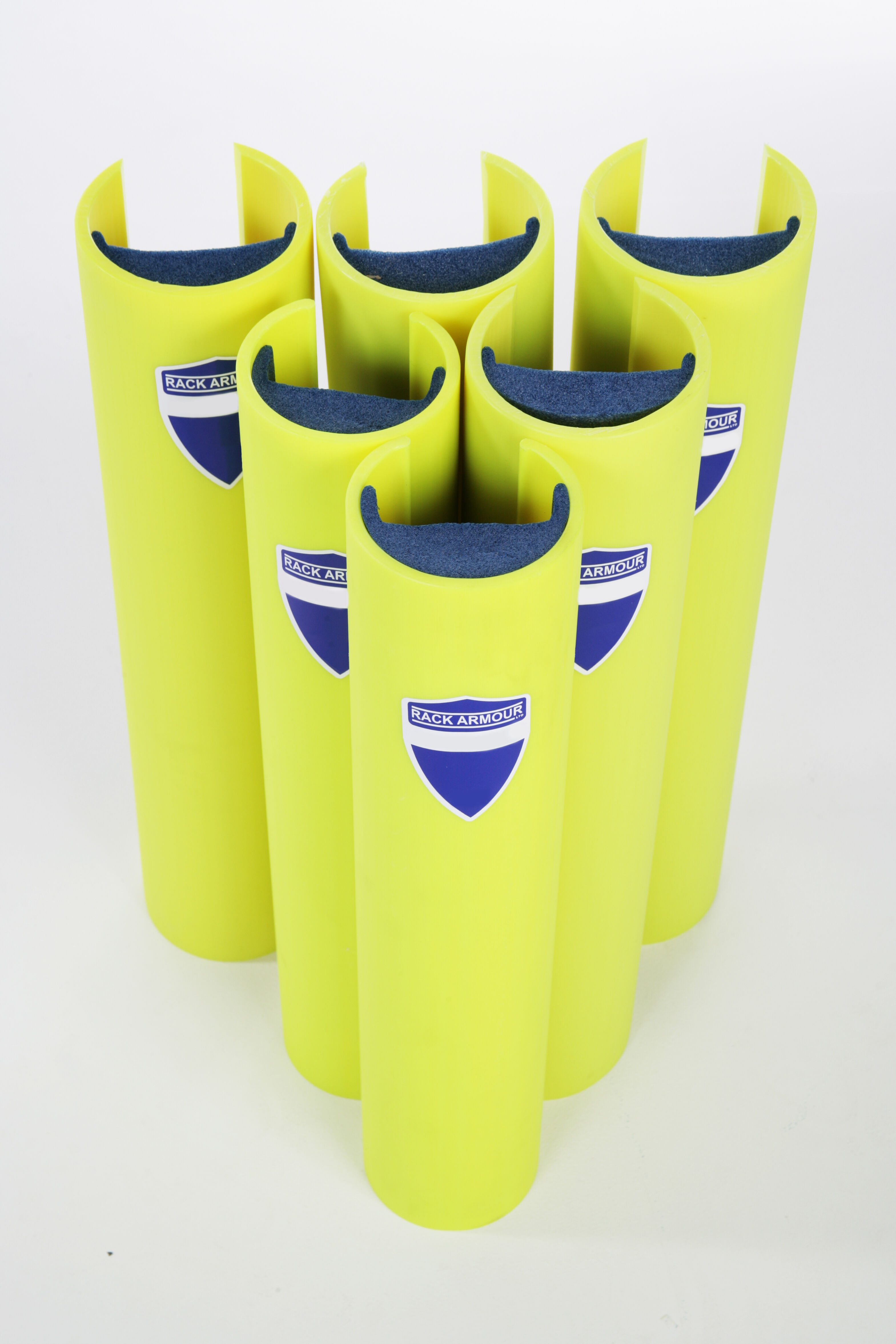
Polymer pallet racking upright protectors such as Rack Armour wrap the lower section of pallet racking uprights to absorb forklift impact energy. They preserve the racking integrity and avoid the cost of upright replacement after every contact incident.
Continuous rail systems
Continuous rail systems run along walkways and traffic lanes to define routes and prevent encroachment. Heavy-duty rails can stop a forklift; lighter rails primarily provide visual definition and a low-energy physical barrier.
Floor-mounted impact bumpers
Floor-mounted impact bumpers are localised products that protect specific equipment, machinery, or zones from forklift contact. They are typically rubber or polymer products fixed to the floor at strategic points where contact is likely.
Deep dive: wall protection panels
Wall protection panels are the workhorse of warehouse wall protection programmes. The right panel in the right place absorbs cumulative low-energy contact and protects the wall structure for years.
Material options
Wall protection panels are made from various materials, each suited to different applications. Solid PVC panels are durable, hygienic, and easy to clean — common in food, pharma, and clinical environments. Polyethylene panels are tough and impact-resistant — common in heavy-duty industrial applications. Rubber panels offer the best impact absorption — used in zones with frequent or higher-energy contact. Stainless-steel-faced panels combine durability with hygiene compatibility.
Height options
Wall protection panel height should match the height range where impacts typically occur. For pallet truck and pedestrian-trolley contact, low panels (300-600 mm) cover the relevant zone. For forklift mast and load contact, higher panels (1.0-1.5 metres) are needed. For zones with potential overhead contact (such as where high stacks of pallets pass close to walls), full-height panels may be appropriate.
Thickness and impact rating
Panel thickness drives impact absorption capacity. Light-duty panels (5-8 mm) suit pedestrian-shared zones with occasional low-energy contact. Medium-duty panels (10-15 mm) suit general warehouse use. Heavy-duty panels (20+ mm) suit goods-in/goods-out zones with frequent forklift contact. The right thickness matches the actual impact severity of the location.
Colour options
Wall protection panels are available in a range of colours. Yellow and other hi-vis colours emphasise the protected zone and act as visual cues for drivers. Neutral colours (grey, white, beige) blend with the building finish for a cleaner aesthetic. Some operations colour-code panels by zone or function. The colour choice should support both the safety and aesthetic objectives.
Installation
Wall protection panels typically install with mechanical fixings (screws or bolts) into the wall structure, often supplemented with construction adhesive for additional bond. Aluminium top and bottom rails provide neat finishing and improved fixing. End caps and corner trims complete the installation. Most installations can be done by competent in-house staff with standard tools.
Deep dive: corner guards
Corner guards protect the 90-degree external corners that are particularly vulnerable to forklift and trolley contact.
Why corners need protection
External corners — where two walls meet at 90 degrees — are vulnerable for several reasons. Vehicles cutting the corner contact the corner edge first, concentrating impact energy on a small area. The corner itself is structurally weaker than the wall midspan because the masonry or finishes terminate at the edge. Repeated low-energy contact at the corner builds up cumulative damage that becomes visible as chipped paint, cracked plaster, or worn cladding.
Material options
Corner guards come in similar materials to wall protection panels: solid PVC, polyethylene, rubber, and stainless steel. The material choice depends on the impact severity, the cleaning requirements, and the aesthetic preferences. For most warehouse applications, polyethylene or rubber corner guards offer the right balance of durability, impact absorption, and cost.
Profile options
Corner guard profiles vary in their geometry. Wrap-around profiles cover both faces of the corner. Single-face profiles cover only the most-impacted face. Bumper-style profiles include a stand-off space between the corner guard and the wall, providing energy absorption through the gap. The profile choice depends on the impact severity and the available space.
Heights
Corner guards typically come in 1-metre or 1.2-metre lengths, with longer continuous corner protection assembled from multiple sections. The height should match the impact zone — lower sections only for pedestrian-trolley contact, taller sections for forklift contact.
Deep dive: door frame and door protection
Doors and door frames take significant impact damage because they sit at the natural pinch points where forklifts and pallet trucks must pass through narrow openings.
Door frame protectors
Door frame protectors are extruded profiles that wrap around the door frame to absorb impact energy from passing vehicles. They protect both the steel or timber frame structure and the wall reveal next to the frame. Materials include rubber, polyethylene, and stainless-steel-faced products. The profile is typically full-height to cover the entire vulnerable zone.
Door edge protectors
Door edge protectors fit to the leading edge of the door itself, absorbing the contact energy from forklifts that swing past or graze the door as they pass through. The protection prevents the door edge from being chipped, dented, or damaged enough to compromise the door's seal or operation.
Door panel protection
In addition to the frame and edge, the door panel itself can be protected with mounted bumper strips, kick plates, or full-height panels. The right combination depends on the door type, its impact exposure, and the operational sensitivity of the doorway (for example, cold-store doors need to maintain seal integrity).
Roller shutter and high-speed door protection
Roller shutter doors and high-speed roll-up doors used in goods-in/goods-out zones face specific protection challenges. Side-frame protection bollards, anti-collision sensors, and impact-resistant slat designs all contribute to keeping these doors operational despite frequent contact. Hall-Fast can advise on the right combination for your specific door type.
Deep dive: bollards
Bollards are vertical posts that protect free-standing structures from impact. The right bollard in the right place is one of the most effective forms of impact protection.
Steel bollards
Steel bollards anchored into the floor slab provide the strongest physical barrier. They will physically stop a fully-laden forklift, transferring the impact energy into the floor and the concrete fixings. Steel bollards are the right choice for protecting building columns, doorway frames, high-value equipment, and pedestrian zones where forklift entry must be physically prevented. Powder-coated or galvanised finishes resist corrosion.
Polymer-coated steel bollards
Polymer-coated steel bollards combine a steel core with an outer polymer layer. The polymer absorbs some of the impact energy, reducing damage to the bollard itself and to the impacting vehicle. The polymer also provides better aesthetic options (colour, finish) than bare or powder-coated steel.
Rubber-buffered bollards
Rubber-buffered bollards have a rubber outer layer over a steel core. The rubber absorbs significant impact energy, reducing damage and noise. Rubber bollards work particularly well in zones where forklift contact is likely (rather than emergency-only), making them suitable for routine traffic-management applications rather than just last-resort protection.
Polymer bollards
Polymer bollards are typically lighter-duty than steel-cored alternatives but suit applications where moderate impact protection is sufficient. They are easier to install (lighter to handle) and easier to replace if damaged. Many polymer bollards are designed to flex on impact and return to position rather than remaining rigid.
Bollard heights and diameters
Bollard height typically ranges from 600 mm to 1200 mm, with 900 mm being the most common. Diameter typically ranges from 100 mm to 300 mm depending on the impact resistance required. Taller, larger bollards provide more visible deterrence and more impact absorption capacity.
Bollard installation
Steel and polymer-coated steel bollards typically install with chemical-fix anchors driven into the floor slab. The anchor depth and pattern must support the bollard's impact rating. Lighter polymer bollards can sometimes be installed with mechanical anchors. Surface-mounted bollards (resin-bonded to the floor without drilling) are available for some applications but offer less stopping power.
Deep dive: column guards
Building columns carry essential structural loads. Damage to a column from forklift impact can have consequences far beyond the visible damage zone, potentially compromising structural integrity over a wider area.
Why columns need specific protection
Columns are vulnerable for several reasons: they sit at the corners of bays where forklift turning manoeuvres bring loads close to the column; they are typically clad with relatively soft materials (plasterboard, plywood, or thin steel sheet) that show damage easily; and the underlying steel or concrete column is critical to building structure. Protecting columns specifically — rather than treating them as part of general wall protection — is appropriate for these reasons.
Wrap-around column guards
Wrap-around column guards completely encircle the column, providing protection from all directions. They typically include energy-absorbing material (rubber or polymer) on the outside and a structural framework that holds the protection in place. Wrap-around guards work for square, rectangular, or circular columns of various sizes.
Stand-off column guards
Stand-off column guards sit slightly proud of the column, with a gap between the guard and the column itself. The gap provides additional energy absorption — the guard can deform inward before contacting the column. Stand-off guards offer the best protection for the highest-energy impacts.
Bollard-and-guard combinations
Some installations combine bollards with column guards: bollards positioned around the column to take any direct vehicle impact, with column guards on the column itself for any contact that bypasses the bollards. The combination is appropriate for the highest-priority columns in heavy-traffic zones.
Deep dive: traffic barriers
Traffic barriers protect specific zones from vehicle entry — the ends of pallet racking aisles, around machinery, at pedestrian crossings, and in goods-in/goods-out areas.
A-frame barriers
A-frame barriers are angled steel barriers anchored into the floor at the ends of pallet racking aisles, in pedestrian crossing points, and around equipment that needs protection. The angled face is engineered to deflect a forklift away from the protected zone rather than absorbing the impact head-on. A-frame barriers are very common in goods-in/goods-out zones and at the ends of high-density pallet racking aisles.
Hoop barriers
Hoop barriers are inverted-U steel barriers that protect equipment, machinery, and pedestrian zones from forklift contact. They are typically lighter than A-frame barriers and suit medium-duty applications. Hoop barriers are common around free-standing equipment such as wrapping machines, weighing stations, and conveyor terminals.
Continuous rail barriers
Continuous rail barriers run along walkways and traffic lanes to define routes and prevent encroachment. Heavy-duty continuous rails can stop a forklift; lighter rails primarily provide visual definition and a low-energy physical barrier. The choice depends on the level of physical separation required.
Pedestrian protection barriers
Specific pedestrian protection barriers — typically continuous rail systems — separate pedestrian walkways from forklift traffic. The barriers provide physical and visual separation, supporting safer interactions in shared zones. End-of-rail terminations connect to walls or other fixed structure.
Specifying impact and wall protection: a structured approach
Effective specification works through the warehouse zone by zone, identifying the risks and matching the products.
Step 1: Walk the facility
Walk the entire facility and identify every location where impact damage occurs or is likely. Look at walls (particularly in goods-in/goods-out zones, around doors, in narrow corridors), doors and door frames, columns, machinery, racking aisle ends, pedestrian crossings, and any other vulnerable infrastructure. Note each identified risk.
Step 2: Assess the impact severity
For each identified risk, assess the impact severity: what kind of vehicle, at what speed, with what frequency? Pedestrian trolleys at low speed need light-duty protection; forklifts at moderate speed need medium-duty; loaded HGVs in yard zones need heavy-duty. Match the protection to the actual impact severity.
Step 3: Match products to risks
Wall protection panels for general wall impact zones. Corner guards on external corners. Door frame protectors on doorways. Bollards on critical columns and free-standing structures. Column guards on building columns. A-frame barriers at racking aisle ends. Hoop barriers around equipment. Continuous rail barriers separating pedestrian walkways. Rack Armour upright protectors on pallet racking. The right product for each identified risk.
Step 4: Plan phasing
Few operations install everything at once. Plan the rollout in phases starting with the highest-priority zones identified in Step 1 and validated by Step 2. The first phase typically delivers most of the risk reduction. Subsequent phases extend coverage over time as budget allows.
Step 5: Specify and order
With the product list defined, contact Hall-Fast for specification advice and pricing. Our team has specified comprehensive protection programmes for warehouses across the UK.
Hall-Fast for impact and wall protection
Hall-Fast supplies the full breadth of impact and wall protection products from a single source. From Rack Armour upright protectors through wall protection panels, corner guards, door frame protectors, bollards, column guards, and barriers — we are a single point of supply for comprehensive protection programmes.
The Rack Armour price promise
Hall-Fast operates a comprehensive price promise on every authentic Rack Armour product we supply. If you find a better price on Rack Armour anywhere on the internet, or if you receive a quotation from another supplier that beats ours, let us know and we will match the price. Combined with the wider impact and wall protection range, the price promise means a comprehensive specification at the most competitive total cost.
Stock and despatch
Hall-Fast holds significant UK stock of impact and wall protection products, supporting fast despatch on most orders. Larger orders for new-build warehouse fit-outs are quoted with firm delivery dates.
Specifier support
Our team can advise on product selection, sizing, quantity, and installation across the full impact and wall protection range. There is no charge for the specification advice. Get in touch via the Hall-Fast contact page to discuss your requirement.
Frequently asked questions
What is the most important impact protection product?
The most important product depends on your specific facility, but for most UK warehouses with significant pallet racking, polymer upright protectors such as Rack Armour deliver the strongest economic return. Beyond that, wall protection in goods-in/goods-out zones, bollards on critical columns, and traffic barriers at pedestrian crossings are typically high-priority next steps.
How long does impact and wall protection last?
Service life varies by product and application. Polymer upright protectors typically last 10 years or more. Steel bollards and barriers can last 15-20 years if not severely impacted. Wall protection panels typically last 5-10 years. Door frame and corner guards have similar service lives. Heavy-duty industrial products generally outlast lighter-duty alternatives.
Can my own staff install impact and wall protection?
Most products can be installed by competent in-house staff. Rack Armour installs with a snap-on tool. Wall panels mount with standard fixings. Corner guards and door frame protectors mount conventionally. Heavy-duty bollards and barriers usually require chemical-fix anchoring into the floor, which some operations contract out — but the bulk of the work can be in-house.
How quickly can I get protection products?
Hall-Fast holds stock of the most-ordered products and ships within one to two working days for most orders. Larger orders or specialist products may take longer; we will quote a firm delivery date at the point of order. Urgent requirements can usually be expedited.
How do I prioritise the protection investment?
Start with the highest-risk zones — typically the bays and walls that have already shown damage, plus the goods-in/goods-out zones that see the heaviest activity. The first phase of investment in these zones typically delivers most of the immediate risk reduction. Subsequent phases extend coverage to lower-priority zones over time.
Will impact protection affect my forklift operating tolerances?
Most products are designed to fit within standard warehouse operating tolerances. Wall panels add only a few millimetres to the wall thickness. Corner guards and door frame protectors similarly add minimal profile. Bollards and barriers are positioned where they don't impede normal forklift manoeuvres.
Industry sectors and protection priorities
3PL and logistics
3PL warehouses with high pallet movement and varied loads typically install comprehensive Rack Armour, A-frame barriers at aisle ends, wall protection in goods-in/goods-out zones, and bollards on critical columns. The contractual liability for client stock makes the case particularly strong.
Food and beverage distribution
Food and beverage operations need hygiene-compatible wall protection (wipeable surfaces, sealed seams), comprehensive Rack Armour (with hi-vis option for cold stores), and corner guards in food-handling zones. Audit pressure makes the case strong.
Retail distribution centres
Retail DCs with seasonal peaks and network-wide standards typically specify comprehensive Rack Armour, wall protection in dock zones, and barriers throughout. Multi-site standardisation supports consistent operations.
Manufacturing
Manufacturing facilities with adjacent production lines need bollards on critical equipment, Rack Armour on all production-area racking, and wall protection in dock zones. Production downtime cost makes the case very strong.
E-commerce fulfilment
E-commerce fulfilment with pedestrian-shared aisles needs comprehensive Rack Armour, continuous rail pedestrian separation, A-frame barriers at aisle ends, and wall protection in dock zones.
Pharmaceutical
Pharma warehouses operating to GDP standards need wipeable wall protection, comprehensive Rack Armour, and documented inspection regimes. Audit consequences amplify the case.
About Hall-Fast Industrial Supplies
Hall-Fast Industrial Supplies is a long-established UK distributor of industrial products to warehouses, factories, and distribution centres across the United Kingdom. Find out more about us on the About Hall-Fast page. Impact and wall protection products are central to our offering — Rack Armour as our flagship range, alongside bollards, wall protection, barriers, corner guards, door frame protectors, and column guards from leading manufacturers.
Browse our Rack Armour range, explore our wider brand portfolio, or contact us via the contact page to discuss your impact and wall protection specification.
Common mistakes when specifying impact and wall protection
After many years of supplying impact and wall protection products to UK warehouses, Hall-Fast has seen the same handful of specification mistakes recur. Avoiding these saves time, money, and rework.
Mistake 1: Reactive rather than proactive specification
Operations that install protection only where damage has already occurred protect the bay or wall section that has been hit but leave statistically similar locations unprotected. Comprehensive proactive protection of whole zones is more economic over the medium term and addresses the underlying risk pattern.
Mistake 2: Wrong product for the impact severity
Light-duty wall protection in heavy-duty zones fails quickly; heavy-duty protection in light-duty zones is over-investment. Match the product specification to the actual impact severity of each location through careful zone-by-zone assessment.
Mistake 3: Forgetting the corners
Wall protection installed only on flat wall sections leaves the external corners — which are statistically more impacted than flat walls — unprotected. Corner guards should be specified alongside wall panels for complete protection.
Mistake 4: Inadequate column protection
Building columns are sometimes treated as part of general wall protection rather than getting specific bollards and column guards. The structural significance of columns warrants dedicated protection, particularly in zones with significant forklift traffic.
Mistake 5: Choosing on price alone
Impact and wall protection is a long-life investment. Choosing imported low-grade products to save a small amount on the initial spend often results in higher total cost — products that need replacing more often, perform less well in real impacts, or fade and degrade in the warehouse environment. Authentic, validated, well-engineered protection products supplied with a price promise that removes the price-shopping motive deliver better long-term value.
Mistake 6: Forgetting routine maintenance
Even the best protection requires periodic inspection and replacement of damaged units. Operations that install protection and forget about it see the benefits decay over time as damaged units accumulate without replacement.
Mistake 7: Skipping installation quality
Poorly installed protection — wall panels with inadequate fixings, bollards with insufficient anchor depth, barriers misaligned to the protected zone — performs significantly worse than the same products correctly installed. Good installation practice is essential to realising the full protection benefit.
Maintenance and inspection of impact and wall protection
Impact and wall protection is largely maintenance-free, but periodic inspection and prompt replacement of damaged units keep the protection working over its full service life.
Routine inspection
Add the impact and wall protection to your routine warehouse safety inspection regime — typically a quarterly visual check by warehouse staff. Look for: panels that have been damaged or pulled away from the wall; corner guards that have moved out of position; bollards that show severe deformation; barriers that have been misaligned; door frame protectors that have come loose. Most checks find no significant action needed.
Replacement of damaged units
When a unit is damaged severely enough to need replacement, address it promptly. The replacement cost is typically a small fraction of the cost of the damage that would occur if the protection were left missing or compromised. Keep a small stock of common replacement items on site for rapid refits.
Cleaning
Most impact and wall protection products clean with standard warehouse cleaning products. Polymer panels and bollards are particularly easy to clean. Stainless steel surfaces require appropriate cleaners. Avoid abrasive cleaners that could damage protective finishes.
Documentation
Document the impact and wall protection installation in the warehouse asset register — products installed, locations, dates, sizes. Documentation supports insurance and audit positions and makes it easier to extend or refresh protection over time.
Periodic refresh
Plan to refresh consumable elements (such as colour finishes that have faded, or sacrificial wear strips) periodically as part of the warehouse maintenance cycle. Treat the refresh as an opportunity to review the protection scheme and address any gaps that have emerged as the operation has evolved.
Building the business case for protection
Securing budget for an impact and wall protection investment usually requires building a business case for the operations director, finance team, or facility manager.
Quantify the historical damage
Pull the historical damage records for the past 12 to 24 months. Capture: wall repair costs (plastering, painting, replacement); door and frame repair costs; bollard replacement costs; column repair work; pallet racking damage; building cladding repair. Sum the direct costs.
Estimate the indirect costs
Add the indirect costs: operational disruption during repairs, lost capacity in repair zones, management and admin time on incident handling, insurance excesses, audit findings remediation. The indirect costs typically run 1.5x to 3x the direct costs.
Calculate the prevention potential
Estimate the proportion of historical damage that comprehensive protection would have prevented. For most damage categories, comprehensive protection prevents 70-95 per cent of historical damage. Apply this rate to the historical cost to estimate the avoided cost going forward.
Cost the protection programme
Specify the protection products needed and price the supply and installation. Hall-Fast can provide a tailored quotation based on your specific requirement.
Calculate the payback
Compare the avoided cost to the programme cost. The simple payback is the time for avoided cost to equal investment. For most warehouses, comprehensive protection programmes pay back in well under one year, often just a few months for the highest-priority elements.
Present the long-term return
A 10-year ROI projection typically shows comprehensive protection as one of the highest-return investments available to warehouse operations — multiples of the initial investment in cumulative avoided cost over the service life of the products. Including the wider benefits — improved insurance position, cleaner audit reports, stronger safety culture, reduced operational disruption — strengthens the case further.
Phased investment approach
For operations that cannot fund comprehensive protection in a single budget cycle, a phased approach delivers strong returns. Phase 1 addresses the highest-priority risks (typically the goods-in/goods-out zone wall protection and the most-impacted pallet racking bays). Phase 2 extends to lower-priority zones once the phase 1 case is proven. Phase 3 completes the programme. Many operations find that the savings from phase 1 fund phase 2, and so on — with the entire programme effectively self-funding from avoided damage costs over 3-5 years.
Multi-site programmes
Multi-site operations gain significant benefits from coordinated protection programmes across the network. Consistent specification simplifies procurement, supports staff transfers, and provides aggregated reporting. Hall-Fast frequently supports multi-site programmes by maintaining consistent product specifications, pricing, and stock availability across all sites in a customer's portfolio. Standardised network-wide protection schemes also support audit consistency and safety culture transfer between sites — the same colours, the same products, the same expectations everywhere staff might work. Centralised procurement under a network framework agreement supports cost control and consistent quality across the portfolio, with dedicated account management for multi-site customers and quarterly review meetings to track progress and plan upcoming requirements across the entire network and supporting sites in a structured and continuously improving way over time.
Conclusion
Impact and wall protection is one of the highest-return investments available to UK warehouse and industrial operators. The right combination of wall protection panels, corner guards, door frame protectors, bollards, column guards, traffic barriers, and pallet racking upright protectors creates a comprehensive protection envelope that preserves the building, the equipment, and the people who work in it.
Hall-Fast Industrial Supplies is your UK partner for comprehensive impact and wall protection. Authentic Rack Armour, quality wall protection products, full bollard and barrier ranges, and the full set of supporting products — all stocked in the UK, supported by expert specification advice, and backed by our price promise on Rack Armour.
Get started today by browsing the Hall-Fast Rack Armour brand page, exploring our brand portfolio, or contacting us via the contact page for tailored specification advice and pricing. Whether you are protecting a single high-risk zone or specifying a comprehensive multi-site programme, our team can help you specify, source, and implement the right solution.