When standard pallet trucks meet unpaved ground, gravel yards, construction sites, or uneven warehouse floors, they fail. Wheels jam, loads tip, and productivity grinds to a halt. That's exactly the problem that rough terrain pallet trucks were engineered to solve — and in 2025, they've become one of the most in-demand pieces of materials handling equipment across the UK's construction, agricultural, and logistics sectors.
Whether you're moving heavy pallets across a muddy building site, navigating a gravel-covered outdoor storage yard, or transporting goods across an uneven factory floor, a rough terrain pallet truck gives you the capability, safety, and efficiency that a standard hydraulic pump truck simply cannot deliver.
In this complete guide, we'll cover everything from how rough terrain pallet trucks work and who needs them, to the key features to look for, the industries that rely on them most, and how to choose the right model for your specific application. We've also included links to Hall-Fast's range of rough terrain pallet trucks — one of the UK's leading suppliers of materials handling equipment — so you can find the right solution quickly and with confidence.
What Is a Rough Terrain Pallet Truck?
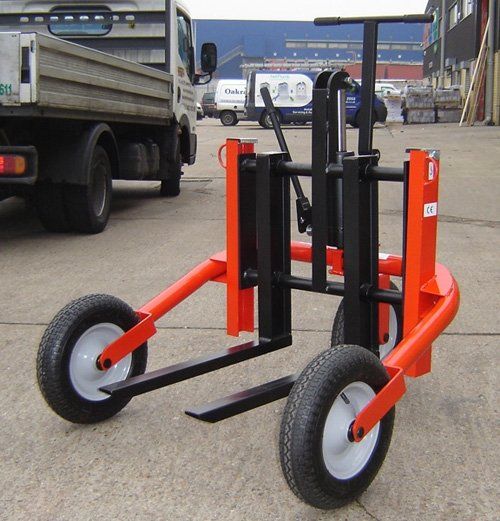
A rough terrain pallet truck is a heavy-duty manual or powered lifting device specifically designed to operate on surfaces that would defeat a standard pallet truck. While conventional pallet trucks rely on small, hard nylon or polyurethane wheels that are perfectly suited to smooth warehouse floors, rough terrain models are fitted with large-diameter pneumatic or solid rubber tyres that can roll across gravel, compacted earth, grass, cobblestones, uneven concrete, and other challenging surfaces.
At their most basic, rough terrain pallet trucks use the same hydraulic lifting principle as standard pump trucks — a handle is pumped to raise the forks, which lift the pallet clear of the ground so it can be moved. The key difference lies in the chassis design, the wheel configuration, and the materials used in construction.
Rough terrain models tend to be significantly more robust than their warehouse counterparts. They're typically built from heavy-gauge steel, feature wider fork spacing to improve stability on uneven ground, and are fitted with larger, more durable wheels capable of absorbing shocks and bumps without damaging the load or the equipment.
Some rough terrain pallet trucks are fully manual, requiring the operator to pump the handle and pull or push the truck by hand. Others are semi-electric, featuring a powered lift mechanism combined with manual movement. There are also fully powered rough terrain pallet trucks — sometimes called rough terrain powered pallet movers — that use electric drive motors to propel the truck and the load across difficult ground with minimal operator effort.
You can browse Hall-Fast's full selection of rough terrain pallet trucks here, including manual, semi-electric, and fully powered options suited to a wide range of industries and load capacities.
Why Standard Pallet Trucks Don't Work on Rough Ground
To understand why rough terrain pallet trucks are so valuable, it helps to first understand the limitations of standard pallet trucks on anything other than a flat, smooth surface.
A typical warehouse pallet truck has small-diameter wheels — usually between 80mm and 180mm — made from nylon, polyurethane, or cast iron. These materials are hard and non-compressible, which is perfect for smooth concrete floors because they offer low rolling resistance and efficient load transfer. But on uneven or soft ground, these characteristics become liabilities.
On gravel, the small wheels sink between stones, making the truck almost impossible to move even with a modest load. On compacted earth or grass, the wheels dig in and the truck bogs down. On uneven concrete — common on older industrial sites and construction projects — the rigid wheels transmit every bump directly into the chassis, making the truck uncomfortable to operate and potentially dangerous if the load begins to shift.
The low ground clearance of standard pallet trucks compounds the problem further. When the forks are in their lowest position, they sit just a few centimetres above the ground. On rough or uneven surfaces, the forks or the chassis can catch on raised sections of ground, causing the truck to stop suddenly or tip forward.
Perhaps most critically, standard pallet trucks lack the stability needed for rough ground. When one wheel drops into a dip or rises over a bump, the chassis can flex or tip in ways that put the load — and the operator — at risk.
Rough terrain pallet trucks address every one of these limitations by design, which is why they're an essential tool for anyone who needs to move palletised loads outside of a controlled warehouse environment.
How Rough Terrain Pallet Trucks Work
The fundamental mechanics of a rough terrain pallet truck are similar to a standard hydraulic pump truck, but with significant enhancements to cope with demanding conditions.
The Hydraulic System
At the heart of every manual rough terrain pallet truck is a hydraulic pump system. The operator pumps the handle up and down, forcing hydraulic fluid into a cylinder that drives the lifting mechanism. The forks rise, lifting the pallet clear of the ground. When the operator is ready to lower the load, a release valve is opened — either by tilting the handle to a certain angle or by operating a separate control — allowing the hydraulic fluid to return to the reservoir and the forks to descend under the weight of the load.
In powered rough terrain pallet trucks, this pumping action is replaced by an electric motor and a battery-powered hydraulic pump. The operator uses a simple control panel or thumb lever to raise and lower the forks, removing the physical effort of manual pumping and making it much easier to handle heavier loads repeatedly.
The Wheel System
The wheels are what truly set rough terrain pallet trucks apart. Most use large pneumatic tyres — air-filled rubber tyres similar to those found on wheelbarrows and small vehicles — that can compress and flex to absorb shocks and roll over obstacles. Pneumatic tyres also spread the weight of the load over a larger footprint, reducing ground pressure and making it easier to roll across soft or loose surfaces.
Some models use solid rubber foam-filled tyres, which offer the same rough terrain capability as pneumatics without the risk of puncture — an important consideration on building sites where sharp debris is common.
The wheels on a rough terrain pallet truck are significantly larger in diameter than those on standard trucks, typically ranging from 250mm to 400mm or more. This larger diameter allows the wheel to roll over obstacles rather than being stopped by them, and provides greater ground clearance for the chassis and forks.
The Frame and Forks
Rough terrain pallet trucks are built from heavier-gauge steel than standard models to cope with the additional stresses of operating on uneven ground. The forks are typically wider and more robust, and the overall chassis is designed to flex slightly to maintain contact with uneven ground while keeping the load stable.
Many models also feature adjustable fork widths, allowing the truck to accommodate a variety of pallet sizes and styles — including non-standard pallets commonly used in agriculture and construction.
Key Features to Look For When Buying a Rough Terrain Pallet Truck
Not all rough terrain pallet trucks are created equal. When you're choosing a model for your business, there are several important features and specifications to consider.
1. Load Capacity
Load capacity is the most fundamental specification. Rough terrain pallet trucks are generally available with capacities ranging from around 1,000kg up to 2,500kg or more. It's important to choose a truck whose rated capacity comfortably exceeds your typical load weight — working at or near the maximum rated capacity on rough ground puts additional stress on the equipment and increases the risk of accidents.
Consider not just your current load weights but also any future requirements. It's often more cost-effective to purchase a truck with a slightly higher capacity than you need today than to replace it a year or two later when your needs change.
2. Tyre Type
As discussed above, the choice between pneumatic and solid foam-filled tyres depends on your working environment. Pneumatic tyres offer superior ride quality and shock absorption, making them ideal for very rough or uneven terrain. Solid foam-filled tyres are puncture-proof and maintenance-free, making them the better choice for sites where sharp debris could cause puncture damage.
Some rough terrain pallet trucks are available with a choice of tyre types, allowing you to specify the most appropriate option for your site.
3. Fork Length and Width
Standard pallet forks are typically 1,150mm long and 685mm wide, designed to fit standard EUR pallets. If you're handling non-standard pallets — common in agriculture, construction, and outdoor storage — you may need a truck with longer or wider forks, or one with adjustable fork widths.
Check the fork dimensions carefully against the pallets you'll be handling, and don't forget to consider whether the truck needs to fit through any doorways or access points on your site.
4. Handle Design
The handle design affects both comfort and control. Look for an ergonomic, padded handle that allows the operator to maintain a comfortable grip during extended use. The handle should give the operator good leverage for pumping and steering, and the release mechanism should be easy to operate without requiring excessive force.
On powered models, the control layout should be intuitive and easy to use, with controls positioned so that the operator can maintain a safe posture while operating the truck.
5. Ground Clearance
Ground clearance — the distance between the underside of the chassis or forks and the ground when the forks are fully lowered — is critical on rough terrain. More ground clearance means the truck can pass over larger obstacles without getting stuck. Check the manufacturer's specifications and, where possible, compare them against the typical obstacles and terrain features on your site.
6. Weight of the Truck Itself
Rough terrain pallet trucks are heavier than standard models due to their more robust construction and larger tyres. This isn't usually a problem when the truck is being used, but it can be a consideration when it comes to transporting the truck between sites or storing it when not in use. Check the weight of the truck and make sure you have appropriate means of loading and unloading it if it needs to be moved between locations.
7. Lift Height
Most rough terrain pallet trucks are designed primarily for moving loads across the ground rather than for high lifting. However, there is some variation in maximum lift height between models. If you need to load pallets onto vehicles or stack them to any height, check that the truck's maximum lift height meets your requirements.
8. Certification and Safety Standards
Any pallet truck used in a professional context in the UK should comply with relevant safety standards. Look for CE marking as a minimum, and check that the manufacturer provides full technical documentation including load capacity charts and safe operating instructions. If the truck will be used by employees, you'll also need to ensure that appropriate risk assessments and operator training are in place.
You can find a range of certified, compliant rough terrain pallet trucks at Hall-Fast, with full product specifications and expert support to help you choose the right model.
Industries and Applications That Rely on Rough Terrain Pallet Trucks
Rough terrain pallet trucks are used across a surprisingly wide range of industries. Any business that needs to move palletised goods in an outdoor or semi-outdoor environment, or on surfaces that fall short of a perfect warehouse floor, can benefit from having the right rough terrain equipment.
Construction and Building Sites
Construction sites are arguably the most demanding environment for any materials handling equipment. Surfaces change constantly as the build progresses — from bare earth and mud in the early stages, to hardcore, compacted gravel, and eventually rough concrete. Access routes are often narrow, uneven, and cluttered with debris.
Rough terrain pallet trucks are used on construction sites to move pallets of bricks, blocks, bagged cement, tiles, timber, insulation materials, and a wide variety of other building products. They're also used to move materials from delivery vehicles to storage areas, and from storage areas to the point of use — tasks that would otherwise require a forklift or a team of workers carrying materials by hand.
The ability to move materials efficiently and safely across rough ground can make a significant difference to productivity on a building site, particularly when deliveries need to be moved quickly and a forklift isn't available or practical.
Agriculture and Farming
Agricultural environments present many of the same challenges as construction sites, with the added complexity of soft ground that can become extremely muddy and waterlogged in wet weather. Farmers and agricultural contractors use rough terrain pallet trucks to move pallets of animal feed, fertiliser, seed, and other agricultural inputs around yards, barns, and fields.
The pneumatic tyres that are standard on most rough terrain pallet trucks are particularly well-suited to agricultural use, as they can cope with the soft, wet ground that is common on farms without sinking in or becoming stuck. The robust construction of these trucks also means they can withstand the harsh outdoor conditions typical of a working farm.
Garden Centres and Horticulture
Garden centres are a classic rough terrain pallet truck environment. The combination of outdoor display areas, gravel paths, and the need to move heavy pallets of compost, aggregate, paving stones, and plants makes a robust, outdoor-capable pallet truck essential.
Standard pallet trucks are almost useless in a typical garden centre setting — the wheels sink into gravel, the low ground clearance catches on uneven paving, and the trucks are simply not robust enough for regular outdoor use. Rough terrain models solve all of these problems, allowing garden centre staff to move products efficiently and safely regardless of the surface.
Outdoor Events and Festivals
The events industry relies heavily on rough terrain pallet trucks for setting up and breaking down large outdoor events. Festival sites, outdoor concerts, sporting events, and agricultural shows all require the movement of large quantities of equipment — staging, barriers, catering equipment, generators, and more — across grass, mud, and other non-ideal surfaces.
Rough terrain pallet trucks are lighter and more manoeuvrable than forklifts, making them ideal for use in areas where a full-size forklift would be too large or too heavy. They can be transported between sites in a van or on a trailer, making them a practical choice for event companies that work at multiple venues.
Logistics, Haulage, and Distribution
Even in primarily indoor logistics operations, rough terrain pallet trucks earn their place. Loading bays, yard areas, and the areas immediately around warehouse entrances are often surfaced with rough or uneven materials, and standard pallet trucks can struggle in these transition zones.
Haulage companies and distribution depots use rough terrain trucks to move pallets between lorries and storage areas, across yard surfaces, and in loading areas that may not have the perfect smooth flooring of the main warehouse. The ability to use a single truck type across indoor and outdoor areas simplifies operations and reduces the need to transfer loads between different pieces of equipment.
Utilities and Infrastructure
Utility companies — water, gas, electricity, and telecoms — regularly need to move equipment and materials around outdoor sites, substations, pumping stations, and infrastructure projects. These environments often have poor or non-existent hard surfacing, making standard pallet trucks impractical.
Rough terrain pallet trucks provide a cost-effective solution for utilities companies that need to move palletised equipment and materials without the expense of hiring a forklift for every job.
Waste Management and Recycling
Waste management and recycling sites are typically large outdoor environments with hard-wearing but uneven surfaces. Moving heavy skips, bales, and containers across these sites requires equipment that can cope with the conditions, and rough terrain pallet trucks are a practical and cost-effective option for lighter handling tasks.
Rough Terrain Pallet Trucks vs. Other Equipment: Which Is Right for You?
When considering a rough terrain pallet truck, it's worth comparing them to the alternatives to make sure you're choosing the most appropriate solution for your needs.
Rough Terrain Pallet Truck vs. Standard Pallet Truck
As we've established, a standard pallet truck is simply not suitable for rough, uneven, or outdoor surfaces. If your operation takes place entirely on a smooth, flat warehouse floor, a standard truck is perfectly adequate and considerably cheaper. But if you need to operate on anything other than ideal indoor flooring, a rough terrain model is the only practical choice.
Rough Terrain Pallet Truck vs. Forklift Truck
A forklift truck can handle rough terrain (depending on the model) and offers much greater lift height and load capacity. However, forklifts are significantly more expensive to purchase and operate, require trained and licenced operators, need regular maintenance and inspection, and are subject to more onerous regulatory requirements.
For many applications — particularly where loads need to be moved horizontally across the ground rather than lifted to height, or where a forklift would be too large or expensive to justify — a rough terrain pallet truck is a far more practical and cost-effective solution.
Rough Terrain Pallet Truck vs. Pallet Mover / Electric Powered Pallet Truck
Standard electric pallet trucks — sometimes called pallet movers or ride-on pallet trucks — are designed for smooth warehouse floors and share the same outdoor limitations as manual pump trucks. They should not be confused with powered rough terrain pallet trucks, which are specifically designed for outdoor use.
If you need the convenience and reduced operator effort of a powered unit, look specifically for powered rough terrain models — these combine electric drive and lift systems with the robust construction and large-diameter tyres that make outdoor use practical.
Safety Considerations When Using Rough Terrain Pallet Trucks
Safety is paramount when using any lifting and handling equipment, and rough terrain pallet trucks present some specific safety considerations that operators and managers need to be aware of.
Operator Training
Although rough terrain pallet trucks do not require the same formal licensing as forklift trucks, operators should still receive appropriate training before using them. This training should cover the basic operating principles of the truck, how to check the truck before use, how to safely manoeuvre loaded and unloaded trucks on rough terrain, and what to do in the event of an incident or near-miss.
Risk Assessment
Before deploying rough terrain pallet trucks on a site, a thorough risk assessment should be carried out. This should identify the specific hazards present — including steep gradients, soft ground, obstacles, crossing points, and areas of pedestrian activity — and set out the control measures needed to manage those risks.
Load Stability
Loads should always be stable and secure before the truck is moved. On rough terrain, the risk of a load shifting or toppling is greater than on a smooth floor, so particular attention should be paid to ensuring that pallets are in good condition, that loads are properly stacked, and that any loose or awkwardly shaped items are secured before moving.
Gradient Limits
Rough terrain pallet trucks should only be used on gradients that are within the manufacturer's specified limits. Attempting to move a loaded truck up or down a slope that exceeds these limits puts both the operator and the load at risk. Check the product specifications before deploying a truck on sloped ground.
Regular Inspection and Maintenance
Like all mechanical equipment, rough terrain pallet trucks should be inspected before each use and regularly maintained in accordance with the manufacturer's recommendations. Key areas to check include the hydraulic system for leaks, the tyres for damage or deflation (on pneumatic models), the forks for damage or deformation, and all moving parts for wear and correct function.
In the UK, thorough examinations of lifting equipment — including pallet trucks — are required under the Lifting Operations and Lifting Equipment Regulations 1998 (LOLER). These examinations should be carried out by a competent person at intervals specified in the regulations and the manufacturer's guidelines.
The Cost of Rough Terrain Pallet Trucks
One of the major advantages of rough terrain pallet trucks is their cost-effectiveness compared to alternatives like forklifts and powered pallet movers. Manual rough terrain pallet trucks represent a relatively modest capital investment, with no ongoing fuel or electricity costs, low maintenance requirements, and long service lives when properly looked after.
Prices vary depending on the specification, load capacity, and features of the truck. Entry-level manual rough terrain pallet trucks are available at prices that make them accessible to small businesses and sole traders, while heavy-duty powered models represent a more significant investment that is justified by the productivity gains and reduced operator effort they deliver in high-throughput applications.
When calculating the cost of a rough terrain pallet truck, it's important to consider the total cost of ownership rather than just the purchase price. This includes any maintenance costs, replacement parts (particularly tyres on pneumatic models), and operator training. In most cases, the total cost of ownership of a rough terrain pallet truck is significantly lower than that of a forklift or other powered handling equipment, making them excellent value for money across a wide range of applications.
For competitive pricing on a comprehensive range of rough terrain pallet trucks, visit Hall-Fast's rough terrain pallet truck category where you'll find options to suit a variety of budgets and requirements.
Maintaining Your Rough Terrain Pallet Truck: Tips for a Long Service Life
Proper maintenance is the key to getting the best performance and longest possible service life from your rough terrain pallet truck. Here are the most important maintenance tasks to keep on top of.
Daily Pre-Use Checks
Before each shift or use, operators should carry out a visual inspection of the truck. This should include checking the forks for damage or deformation, checking the tyres for damage or loss of pressure (on pneumatic models), checking the hydraulic cylinder and connections for leaks, testing the lift and lower functions, and checking the handle and control mechanisms for smooth, correct operation.
Any defects identified during a pre-use check should be reported immediately and the truck taken out of service until the defect is rectified. Never use a truck that has a known defect — the consequences of a failure under load on rough terrain can be serious.
Hydraulic Fluid
The hydraulic system should be checked regularly for correct fluid level and for any signs of contamination or leaks. Hydraulic fluid should be changed at the intervals specified by the manufacturer. Using the correct grade of hydraulic fluid is important — using the wrong fluid can damage seals and other components, leading to leaks and loss of lift performance.
Tyre Maintenance
On pneumatic-tyred models, tyre pressure should be checked regularly and maintained at the pressure specified by the manufacturer. Over-inflated tyres can burst, while under-inflated tyres make the truck harder to manoeuvre and can damage the tyre sidewalls. Inspect tyres regularly for cuts, punctures, and excessive wear, and replace them when they reach the end of their serviceable life.
On foam-filled solid tyre models, inspect tyres for cuts and damage. While these tyres cannot go flat, significant damage to the tyre body can affect performance and safety.
Lubrication
Moving parts such as wheel bearings, pivot points, and the handle mechanism should be lubricated at the intervals specified by the manufacturer. Using the correct lubricant is important — check the manufacturer's recommendations and use a suitable product.
Storage
When not in use, rough terrain pallet trucks should be stored in a dry, sheltered location where possible. While these trucks are designed for outdoor use, prolonged exposure to the elements — particularly moisture — can accelerate corrosion of steel components. Lowering the forks fully when the truck is stored relieves pressure on the hydraulic seals and extends their service life.
Why Buy Your Rough Terrain Pallet Truck from Hall-Fast?
When it comes to sourcing rough terrain pallet trucks in the UK, Hall-Fast is one of the country's most trusted and experienced suppliers of materials handling and industrial equipment.
Hall-Fast has built its reputation on offering a genuinely comprehensive product range, expert advice, competitive pricing, and outstanding customer service. Whether you're a small business looking for your first rough terrain pallet truck, or a large contractor needing to equip an entire team, Hall-Fast has the knowledge, stock, and support infrastructure to help you find the right solution quickly and confidently.
A Wide Range of Options
Hall-Fast's rough terrain pallet truck range covers a variety of load capacities, tyre types, and operational configurations, from basic manual models for occasional use to heavy-duty units designed for demanding daily use in challenging environments. You won't be forced into an off-the-shelf compromise — if you have specific requirements, the Hall-Fast team can help you find or source the most appropriate product.
Expert Guidance
The materials handling equipment market can be complex, with a wide range of products at different price points and specification levels. Hall-Fast's team of experts can help you cut through the complexity and identify the products that will genuinely meet your needs and represent the best value for your investment.
Competitive Pricing
Hall-Fast is committed to offering competitive pricing across its entire product range. By working directly with leading manufacturers and maintaining efficient logistics operations, they're able to offer excellent value without compromising on product quality or customer service.
Fast UK Delivery
Hall-Fast offers fast delivery across the UK, so you can get the equipment you need when you need it. For urgent requirements, it's worth contacting the team directly to discuss delivery options and timescales.
After-Sales Support
Buying from Hall-Fast doesn't end at the point of purchase. Their team can provide ongoing support and advice throughout the lifetime of your equipment, helping you get the most from your investment and resolve any issues quickly and effectively.
To explore the full range and take advantage of Hall-Fast's expertise, visit https://www.hall-fast.com/rough-terrain-pallet-trucks today.
Frequently Asked Questions About Rough Terrain Pallet Trucks
Q: Can rough terrain pallet trucks be used indoors?
A: Yes — rough terrain pallet trucks can be used on indoor surfaces, including smooth warehouse floors. However, their large tyres mean they have a higher rolling resistance on smooth surfaces than standard pallet trucks, so they may be slightly harder to push when unloaded on smooth floors. Many businesses that operate across both indoor and outdoor areas find that a rough terrain model provides the versatility to handle both environments effectively.
Q: Do I need a licence to operate a rough terrain pallet truck?
A: In the UK, there is no formal licensing requirement for manual pallet trucks, including rough terrain models. However, operators should receive appropriate training and instruction before using the equipment, and employers are required under the Health and Safety at Work Act 1974 and the Provision and Use of Work Equipment Regulations 1998 (PUWER) to ensure that equipment is used safely and by trained individuals.
Q: What is the maximum gradient a rough terrain pallet truck can be used on?
A: This varies by model and manufacturer. As a general rule, most rough terrain pallet trucks should not be used on gradients exceeding around 10-15% (approximately 6-9 degrees) when loaded. Always check the specific product data sheet for the truck you're using and never exceed the manufacturer's specified gradient limit.
Q: How much does a rough terrain pallet truck weigh?
A: The weight of a rough terrain pallet truck varies depending on its size, load capacity, and construction. Most manual models weigh between 100kg and 200kg, with powered models being heavier. Check the product specifications carefully if you need to transport the truck between sites, and ensure you have appropriate means of loading and unloading it.
Q: How do I know which capacity I need?
A: As a general rule, your truck's rated capacity should exceed your maximum typical load weight by a meaningful margin — many experts recommend choosing a truck with a capacity at least 20% higher than your maximum load. This provides a safety margin and reduces wear on the equipment. If in doubt, the team at Hall-Fast can advise on the most appropriate specification for your application.
Q: Can rough terrain pallet trucks be used in wet conditions?
A: Most rough terrain pallet trucks are designed to cope with outdoor conditions including rain and wet ground. However, very wet or icy conditions can significantly affect traction and stability, and extra caution should be exercised when operating in these conditions. Ensure that operators are aware of the additional risks posed by wet weather and that appropriate PPE including non-slip footwear is worn.
Q: How often should a rough terrain pallet truck be serviced?
A: Service intervals vary by manufacturer and model, but as a general guide, most rough terrain pallet trucks should receive a thorough inspection and service at least once a year, with more frequent checks if they're used heavily or in particularly demanding conditions. Under LOLER regulations, a thorough examination by a competent person is required at least every 12 months for most lifting equipment, including pallet trucks.
Q: What's the difference between a rough terrain pallet truck and a rough terrain forklift?
A: A rough terrain pallet truck is a ground-level handling device — it can raise a pallet just enough to move it across the ground, but it's not capable of high-level stacking or racking. A rough terrain forklift can lift loads to significant heights and is a much more capable — but also much more expensive and complex — piece of equipment. For most outdoor pallet-moving tasks that don't involve high-level stacking, a rough terrain pallet truck is a more practical and cost-effective solution.
Top Tips for Getting the Most From Your Rough Terrain Pallet Truck
Investing in the right rough terrain pallet truck is only part of the equation. To get the best possible performance, longest service life, and greatest return on your investment, it's worth following these practical tips.
Match the truck to the terrain. Not all rough terrain is the same. Take the time to assess the specific surfaces and conditions your truck will encounter and choose a model whose specification — particularly tyre type and ground clearance — is well-matched to those conditions. A truck that's ideal for a gravel yard may not be the best choice for a muddy agricultural environment.
Train your operators properly. Even the best equipment can be dangerous in untrained hands. Invest in proper operator training and make sure all users understand not only how to operate the truck but also how to recognise and respond to hazards specific to rough terrain.
Don't overload. Always respect the rated load capacity of your truck. Overloading on rough terrain dramatically increases the risk of tipping, mechanical failure, and operator injury. If you regularly need to move loads that are close to or at the limit of your truck's capacity, consider upgrading to a higher-capacity model.
Plan your routes. Before moving a load, take a moment to assess the route. Identify any potential hazards — steep gradients, soft ground, obstacles, pedestrian crossing points — and plan a safe path that avoids unnecessary risks.
Keep it maintained. A well-maintained truck is a safe, reliable, and productive truck. Stick to the manufacturer's recommended maintenance schedule, carry out daily pre-use checks, and address any defects or concerns promptly.
Store it properly. When your truck isn't in use, store it in a dry, sheltered location with the forks fully lowered. This protects the hydraulic seals, reduces corrosion, and ensures the truck is ready to perform when you need it.
Final Thoughts: Invest in the Right Equipment and Work Smarter
Rough terrain pallet trucks are one of those pieces of equipment that can genuinely transform the way you work — particularly if you've been struggling with standard pump trucks in challenging outdoor environments. The difference between wrestling a standard pallet truck across a gravel yard and gliding the same load across the same surface on a purpose-designed rough terrain model is dramatic, and the productivity gains, reduced operator fatigue, and improved safety outcomes speak for themselves.
The UK market offers a good range of rough terrain pallet trucks at various price points and specifications, but choosing the right one for your specific application requires careful consideration of load capacity, tyre type, ground clearance, and the specific demands of your working environment.
For expert guidance, competitive pricing, and a comprehensive range of options, Hall-Fast is an excellent starting point. Their team understands the challenges of outdoor and rough terrain materials handling and can help you find a solution that delivers real-world value day after day.
Whether you're equipping a construction site, a farm, a garden centre, or an events business, the right rough terrain pallet truck is out there — and with the right advice and the right supplier, finding it doesn't have to be complicated.
Ready to find your ideal rough terrain pallet truck? Visit Hall-Fast today at https://www.hall-fast.com/rough-terrain-pallet-trucks and speak to their expert team about your requirements.
This article is provided for informational purposes. Always consult the manufacturer's specifications and relevant safety regulations before using any lifting and handling equipment.
Related searches: rough terrain pallet truck UK, outdoor pallet truck, heavy duty pallet truck for rough ground, pneumatic tyre pallet truck, all terrain pallet truck, construction site pallet truck, agricultural pallet truck, pallet truck for gravel, manual rough terrain pallet truck, powered rough terrain pallet truck