The Australian Safety Boot Setting New Standards in UK Workplaces
Introduction: Why the Munka Taurus Is the Boot UK Trade Professionals Are Talking About
In the world of professional safety footwear, certain models develop a reputation that travels by word of mouth — from worker to worker, site to site, workshop to workshop. The boots that earn this kind of organic professional endorsement are the ones that genuinely deliver in the conditions where it matters most. The boots that fit properly straight out of the box. The boots that stay comfortable at hour 10 of a 12-hour shift. The boots that survive year after year of genuinely demanding work without falling apart. The boots that combine certified safety with the practical features professionals actually need.
The Munka Taurus Side Zip Work Boots have rapidly become exactly this kind of boot in UK trade and industry. From construction sites to manufacturing facilities, from warehouses to agricultural operations, from service trades to industrial maintenance, the Taurus is earning its place on UK feet through one specific, simple mechanism: it does what professionals need their boots to do, and it does it consistently.
This comprehensive guide is dedicated entirely to the Munka Taurus — examining every aspect of this Australian-engineered side-zip safety boot in the depth that helps you make a fully informed buying decision. We'll explore the design philosophy, the construction details, the safety certifications, the practical features that distinguish the Taurus from competitor boots, the colour options available, the sizing and fit considerations, the workplace applications, and the care and maintenance that maximise the working life of these excellent boots.
Throughout, we'll explain why Hall-Fast is the right place to buy your Munka Taurus boots — backed by our unconditional price promise, our decades of trade expertise, and our commitment to authentic product supply and exceptional customer service.
Whether you're considering the Munka Taurus for the first time, comparing the Taurus against competitor models, or ready to order and want to confirm you're making the right choice, this guide will give you the comprehensive information you need.
View the Munka Taurus Side Zip Work Boots in Wheat at Hall-Fast: https://www.hall-fast.com/brands/munka-work-boots/munka-taurus-side-zip-work-boots-wheat
View the Munka Taurus Side Zip Work Boots in Black at Hall-Fast: https://www.hall-fast.com/safety-at-work/workwear/munka-work-boots/munka-taurus-side-zip-work-boots-black
Browse the complete Munka Work Boots range: https://www.hall-fast.com/safety-at-work/workwear/munka-work-boots
The Munka Taurus: A Boot Built Around Solving Real Working Problems
Before diving into the specifications and features, it's worth understanding the design philosophy behind the Munka Taurus. This isn't a boot that started as a marketing concept and then had features added to justify the price. It's a boot designed around specific working problems that professional users were experiencing — and solving those problems while maintaining full safety certification.
The Problem the Taurus Solves
Traditional safety boots fall into two broad categories, each with their own limitations:
Lace-Up Safety Boots — the classic configuration. Lace-ups offer excellent fit adjustability, secure closure, and a smart traditional appearance. But they take significant time to put on and take off properly, the laces wear out from constant tying and untying, and for trades involving frequent boot removal (entering customer homes, transitioning between work areas, getting in and out of vehicles), they're slow and inconvenient.
Pull-On Safety Boots — the convenient alternative. Pull-ons are fast to put on and take off — just slide your foot in and you're ready. But they sacrifice fit accuracy (the boot is either generally fitted or generally loose, with limited adjustment), they can be insecure for foot retention during active work, and they often suffer from heel slip and other fit issues.
The Munka Taurus solves this dilemma by combining both approaches in a single boot:
- Traditional lace-up styling for proper fit adjustment — laces let you dial in exactly the fit your foot needs
- Side-zip closure for daily on/off operation — once your fit is set with the laces, the zip handles the convenience aspect
The result is a boot that fits properly AND operates quickly. You set your fit once with the laces, and then use the zip for daily entry and exit. You get the fit accuracy of laces with the convenience of pull-ons — without sacrificing either.
This isn't just a clever feature addition — it's a fundamental design philosophy that genuinely solves real working problems. And once you've used a properly fitted side-zip boot, going back to either pure lace-ups or pure pull-ons feels like a step backward.
Why This Matters in Real Working Life
The practical benefits of the Taurus design accumulate across the working day:
For Service Trades: A plumber, electrician, or HVAC engineer might enter and exit their boots 8-12 times in a working day, between vehicle, customer premises, and various working positions. With lace-ups, this is 5-10 minutes of cumulative boot operation time daily. With the Taurus, it's under a minute. Across a year of working days, that's 20-40 hours saved.
For Trades With Clean/Dirty Transitions: Workers transitioning between clean work areas and contaminated work zones often need to swap boots or clean boots between transitions. The quick on/off capability of the Taurus makes these transitions practical rather than productivity-destroying.
For Workers With Mobility Issues: Anyone with arthritis, back problems, hip issues, or other conditions affecting hand or back mobility finds lace-up boots increasingly difficult. The Taurus design preserves working ability for these users.
For Hot/Cold Climate Operations: Putting boots on in cold weather (when fingers are numb and laces are stiff) or in hot conditions (when you're already sweating and don't want to bend over fiddling with laces) is dramatically easier with the side-zip design.
For Reduced Lace Wear: Constantly tying and untying laces is the major cause of premature lace failure. The Taurus design means lace operation maybe once weekly instead of multiple times daily — extending lace life from weeks to months or longer.
Munka Taurus Construction: Built for the Long Haul
The Munka Taurus is built to a standard that genuinely delivers years of working life. Let's examine the construction in detail.
Full-Grain Leather Upper
The upper material is full-grain leather — the top tier of leather quality. Understanding why this matters helps explain why the Taurus outlasts lesser boots.
Leather is graded by how it's processed from the original hide:
- Full-grain leather — uses the entire grain layer of the hide, including the surface where the hair grew. This is the strongest, most durable, most water-resistant leather. It develops a working patina over time that many users actually prefer to the as-new appearance. Full-grain leather can be conditioned and maintained to extend working life significantly.
- Top-grain leather — has the very top surface sanded off to remove imperfections, then a coating applied. Less durable than full-grain, less water-resistant, but smoother appearance.
- Corrected-grain leather — has more significant surface processing to create uniform appearance from lower-grade hides. Less durable, less water-resistant.
- Split leather — the lower layers of the hide after the top is split off. Substantially less durable, used in budget products.
The Munka Taurus uses full-grain leather throughout the upper — the most durable, most weather-resistant, most maintainable option. This is one of the specific reasons the Taurus survives genuinely demanding professional use.
Quality Stitching and Construction Details
The Taurus uses bonded thread stitching in high-stress areas, with multiple rows of stitching where structural strength matters. Bonded threads resist the abrasion, oil contamination, and chemical exposure that destroys conventional threads. This means the boot stays together long after stitching on lesser boots has failed.
The welt construction (where the upper meets the sole) is designed for repeated heavy use. Sole separation — where the upper and sole start to come apart — is one of the most common failure modes in lower-quality work boots. The Taurus is engineered specifically to resist this failure mode.
Reinforcement is provided at the toe and heel areas — the zones that experience the highest wear in working environments. These reinforcements extend working life in the areas that destroy lesser boots first.
Side-Zip Mechanism Quality
The side-zip mechanism in the Munka Taurus is built to professional standards. This isn't a thin consumer-grade zip — it's a substantial closure designed for repeated heavy operation in working conditions.
Key design features include:
- Heavy-gauge zip teeth rated for repeated heavy operation
- Protective storm flap behind the zip preventing dust, debris, and water ingress
- Quality pull tab that's easy to operate even with gloved hands or in cold conditions
- Properly attached zip with stitching designed to resist failure under stress
Zip failure is one of the concerns sometimes raised about side-zip boots, but this concern applies primarily to inexpensive boots with consumer-grade zips. Professional-grade boots like the Munka Taurus use commercial-grade zips designed for the working environment.
Internal Lining and Comfort Engineering
The internal construction of the Taurus prioritises comfort and foot health:
- Moisture-wicking lining — moves perspiration away from the foot, keeping the boot interior drier and the foot healthier
- Padded collar — prevents the rubbing and chafing on the ankle that destroys comfort over long shifts
- Padded tongue — distributes pressure from laces evenly across the top of the foot
- Anatomically-shaped insole — supports the foot's natural geometry rather than forcing the foot to conform to a generic shape
- Energy-absorbing footbed — reduces fatigue from the cumulative impact of walking on hard surfaces
Outsole Construction
The outsole is engineered specifically for working environment performance:
- Slip-resistant rubber compound — formulated for grip on the surfaces and contaminants encountered in real working conditions
- Tread pattern — designed to provide grip while shedding mud and debris that would otherwise reduce traction
- Heat resistance — appropriate for occasional contact with warm surfaces in working environments
- Oil and chemical resistance — resists degradation from oils, fuels, and common workplace contaminants
Penetration-Resistant Midsole
A critical safety feature: the penetration-resistant midsole protects against sharp objects from below. This is essential for construction, demolition, fabrication, and any environment with nails, broken glass, or sharp metal debris on the ground.
The Taurus's penetration-resistant midsole meets the EN ISO 20345 standard, providing certified protection against the 1100N test penetration force. In practical terms, this means the boot can resist standing on a nail or sharp object that would otherwise penetrate the boot and injure the foot.
Safety Certifications: What the Taurus Actually Protects Against
The Munka Taurus is certified to EN ISO 20345 S3 SRC — providing comprehensive workplace safety footwear protection. Let's break down what this actually means.
EN ISO 20345
This is the European standard defining safety footwear requirements. Certification under EN ISO 20345 means the boot has been independently tested and verified to meet specific protection standards. UK workplaces typically specify EN ISO 20345 compliance as the requirement for safety footwear.
The S3 Classification
S3 is one of the most commonly specified ratings for industrial and construction work, providing:
- 200J toe cap impact protection — protects against impact loads up to 200 joules
- 15kN toe cap compression protection — protects against static crushing loads up to 15 kilonewtons
- Anti-static properties — provides dissipation of static electricity for general workplace antistatic needs
- Energy absorption in heel region (at least 20J) — reduces impact transmission during walking
- Closed seat region — the heel area is fully enclosed by upper material for protection
- Water-resistant upper — protects against water penetration through the boot upper
- Penetration-resistant midsole — protects against sharp objects from below
- Cleated outsole — designed for outdoor and varied surface use with effective grip
The SRC Slip Resistance Rating
SRC is the highest slip resistance rating under EN ISO 20345, requiring successful testing on:
- Ceramic tile with sodium lauryl sulphate detergent (SRA test) — simulating wet contaminated indoor floors
- Steel surface with glycerol (SRB test) — simulating contaminated industrial steel surfaces
SRC rating provides verified slip resistance across the two most challenging standardised test surfaces, giving confidence that the boot will perform on the varied surfaces of real working environments.
What This Certification Actually Means for You
Practically speaking, the Munka Taurus's S3 SRC certification means:
- Your toes are protected against impact loads up to 200J — equivalent to a 20kg weight falling from 1 metre
- Your toes are protected against compression up to 15kN — equivalent to a significant static crushing load
- Static electricity dissipates safely through the boot to ground, preventing static buildup in sensitive environments
- Walking impact is reduced by the energy-absorbing heel construction
- Sharp objects underfoot can't penetrate the midsole and reach your foot
- Wet conditions don't immediately penetrate through the boot upper
- Slip resistance is verified on the most challenging test surfaces
This combination addresses the major foot injury risks in most professional working environments — making the Taurus appropriate for the majority of UK trade and industrial work.
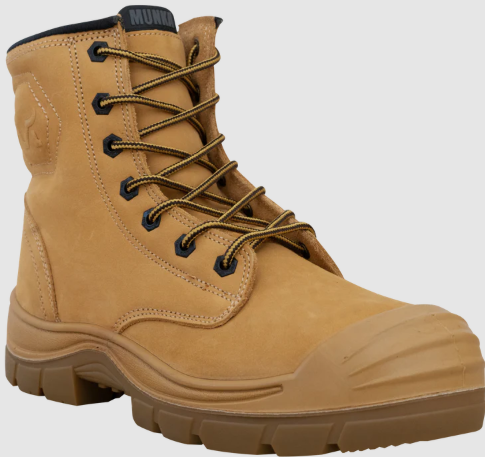
Munka Taurus Side Zip Work Boots in Wheat: The Distinctive Working Colourway
The wheat-coloured variant of the Munka Taurus offers a distinctive professional appearance with practical advantages for many working environments.
View the wheat Taurus at Hall-Fast: https://www.hall-fast.com/brands/munka-work-boots/munka-taurus-side-zip-work-boots-wheat
Why Wheat?
The wheat colourway — also called honey, tan, or natural — has been associated with quality work boots for over a century. There are specific reasons this colour has endured as a work boot classic:
Practical Advantages:
- Shows wear gracefully — wheat leather develops a working patina that many users actually prefer to as-new appearance. Marks, scratches, and weathering blend into the natural variation of the leather rather than standing out against a uniform colour.
- Hides minor damage — small scuffs and marks are less visible on wheat leather than on darker colours
- Versatile across environments — appropriate for outdoor work, construction, agriculture, and general trade work
- Heritage appeal — there's a reason traditional work boots have used this colour for generations
Aesthetic Advantages:
- Distinctive professional appearance — stands out from the sea of generic black safety boots
- Develops character over time — well-conditioned wheat leather develops depth and richness that black leather doesn't
- Pairs well with traditional workwear — chambray shirts, canvas trousers, denim, and traditional trade clothing
- Recognisably "real work boots" — looks like proper working footwear rather than fashion-adjacent products
Wheat Munka Taurus Specifications
The wheat variant offers identical safety and engineering features to the black variant — the choice between them is fundamentally aesthetic and contextual.
Construction:
- Full-grain wheat-coloured leather upper
- Side-zip closure with traditional lacing retained
- Quality bonded thread stitching
- Reinforced toe and heel zones
- Substantial commercial-grade side zip with storm flap
- Padded collar and tongue
- Moisture-wicking lining
- Anatomically-shaped cushioned footbed
- Penetration-resistant midsole
- Slip-resistant cleated outsole
Certifications:
- EN ISO 20345 S3 — comprehensive safety footwear standard
- SRC slip resistance — highest standardised slip rating
- 200J toe cap impact protection
- 15kN toe cap compression protection
- Anti-static properties
- Water-resistant upper
- Cleated outsole
Who Chooses the Wheat Taurus?
The wheat variant has particular appeal for:
Construction Workers — the traditional work boot appearance, combined with the wear-resistant colour that ages gracefully through site conditions.
Agricultural Workers — wheat-coloured boots are particularly associated with agricultural and land-based work. The colour shows mud and dirt less obviously than darker boots, and ages well through the variety of outdoor exposure.
Tradespeople Who Value Distinctive Appearance — workers who prefer not to wear generic black boots, who want their footwear to reflect quality and care rather than just compliance.
Traditionalists — workers who appreciate the heritage of classic working footwear and prefer the traditional colour palette of professional work boots.
Outdoor Workers — surveyors, forestry workers, utility workers, and other outdoor trades where the boot will see significant outdoor exposure.
Munka Taurus Side Zip Work Boots in Black: The Classic Professional Choice
The black-coloured variant of the Munka Taurus offers identical engineering in a colour that suits more environments and dress code requirements.
View the black Taurus at Hall-Fast: https://www.hall-fast.com/safety-at-work/workwear/munka-work-boots/munka-taurus-side-zip-work-boots-black
Why Black?
Black work boots have their own specific advantages:
Practical Advantages:
- Workplace dress code compatibility — many industrial, manufacturing, and service environments specify black footwear in their uniform standards
- Maintains smart appearance — black leather ages with less visible wear than lighter colours, maintaining a more professional appearance throughout the boot's working life
- Versatile across contexts — transitions easily between work and non-work environments if needed
- Service trade appropriate — appropriate for customer-facing work where professional appearance matters
Aesthetic Advantages:
- Classic professional appearance — black work boots are the universal professional standard
- Smarter overall look — pairs well with smart workwear including dress trousers in some service trade contexts
- Less obvious wear — small scuffs and marks are less visible on black leather
- Authoritative appearance — for roles where commanding professional appearance is part of the work
Who Chooses the Black Taurus?
The black variant has particular appeal for:
Service Trades — plumbers, electricians, HVAC engineers, IT installation specialists, telecoms engineers, and others who work in customer environments where appearance matters alongside protection.
Industrial Workers — many industrial and manufacturing workplaces specify black footwear in their PPE standards.
Workers Wanting Smarter Appearance — professionals who prefer their work boots to look smart rather than rugged.
Mixed-Use Buyers — workers who occasionally want their boots to look appropriate outside work contexts.
Compliance-Driven Workplaces — environments where specific colour requirements are part of uniform compliance.
The Side-Zip Design: A Deep Dive Into Why It Matters
We've touched on the side-zip design throughout this guide, but it's worth examining this design feature in more detail because it's such a significant differentiator for the Munka Taurus.
How the Side-Zip Works in Practice
The Taurus side-zip is located on the inside of the boot — typically on the inside of the ankle. This positioning is specific and intentional:
- Inside positioning prevents the zip from catching on external objects, equipment, or clothing
- Ankle area location provides easy access for hand operation without bending awkwardly
- Protected position keeps the zip away from the most aggressive wear and contamination zones
Daily operation involves:
- Unlock the zip pull (some designs have a small locking feature to prevent accidental opening)
- Pull the zip down smoothly — the boot opens at the ankle/upper area
- Slide foot in or out through the opened boot
- Pull the zip up to close, locking if applicable
The whole operation takes 3-5 seconds per boot — versus 30+ seconds for properly tying laces.
The Lacing System Working Alongside the Zip
The traditional lacing system on the Taurus serves a specific purpose alongside the zip:
- Initial fit setting — when you first get the boots, you lace them up to achieve your preferred fit, with the laces adjusted for your specific foot shape and personal preference
- Long-term fit maintenance — periodic lacing adjustment ensures the boot continues to fit properly as it conforms to your foot over time
- Secondary security — the lacing provides additional foot security beyond the zip alone, ensuring the boot stays properly positioned during active work
- Fit fine-tuning — small adjustments to lacing can address specific fit issues without requiring different boot sizes
You don't tie and untie the laces daily — you set them once for your fit, then use the zip for daily operation.
Common Concerns About Side-Zip Boots (And Why They Don't Apply to the Taurus)
Some workers express concerns about side-zip boots based on experience with lower-quality side-zip footwear. Here's how these concerns relate to the Munka Taurus specifically.
Concern: "Side-zip boots have weak zips that fail."
Lower-quality boots use consumer-grade zips that aren't designed for the working environment. The Munka Taurus uses a commercial-grade zip rated for repeated heavy operation in working conditions. With proper care, the zip can outlast the rest of the boot.
Concern: "Side-zip boots don't fit as well as lace-ups."
This is true for pure pull-on boots without lacing. The Munka Taurus combines a side zip WITH traditional laces — you get the fit accuracy of laces plus the convenience of zip operation. You don't sacrifice fit for convenience.
Concern: "Side-zip boots aren't as durable."
The construction of the Munka Taurus is identical to comparable lace-up safety boots — same leather, same stitching, same sole construction. The zip is an additional feature, not a substitute for any structural element. Durability is equivalent to comparable lace-up boots.
Concern: "Side-zip boots aren't appropriate for serious work."
Quality side-zip safety boots like the Taurus meet identical safety certifications to lace-up safety boots. The side-zip feature is a convenience addition that doesn't affect safety performance.
When Side-Zip Boots Are Particularly Valuable
While the Taurus suits a wide range of professional applications, side-zip boots are particularly valuable in:
Service Trades — plumbers, electricians, HVAC engineers, IT installers, telecoms engineers, appliance repair specialists, and other trades involving multiple daily entry/exit operations.
Mobile Workers — anyone whose work involves frequent vehicle entry and exit, including delivery drivers (where safety footwear is required), mobile mechanics, fleet maintenance workers, and field service technicians.
Hygiene-Critical Environments — food preparation, pharmaceutical manufacturing, clean room operations, healthcare facilities, and other environments where boots may need removal at specific points.
Workers With Mobility Issues — arthritis, back problems, hip issues, knee issues, or other conditions affecting hand or back mobility all make traditional lace-up operation difficult.
Cold Climate Workers — operating laces with numb fingers in cold conditions is genuinely difficult. Side-zip operation works regardless of finger temperature.
Workers With Time Pressure — emergency response, urgent maintenance, and other time-pressure scenarios benefit from the rapid boot operation of side-zip designs.
Workplace Applications: Where the Taurus Excels
The Munka Taurus suits a remarkably wide range of UK trade and industrial applications. Here's a detailed look at specific industries and roles.
Construction Industry
UK construction work involves substantial foot injury risks: impact from materials, compression from equipment, penetration from sharp debris, slips on varied surfaces, water and mud exposure, oil and chemical contact. The Taurus's S3 SRC rating addresses these risks comprehensively.
Specific construction applications:
- General building work — bricklayers, carpenters, general labourers
- Civil engineering — groundworkers, drainage installers, road workers
- Roofing — particularly during access and material handling
- Demolition — though the highest-risk demolition work may need additional features like metatarsal protection
- Plant and machinery operation — particularly involving frequent vehicle entry/exit
- Site management and supervision — combining safety needs with the smarter appearance of black variant
Manufacturing and Industrial
Manufacturing environments vary enormously, but most general manufacturing work suits the Taurus's S3 SRC specification:
Specific manufacturing applications:
- General assembly — automotive, electronics, white goods
- Metal fabrication — welding, cutting, finishing
- Food manufacturing — particularly with appropriate hygiene considerations
- Packaging operations — production and warehousing
- Maintenance — across manufacturing environments
For specific high-risk manufacturing environments (foundries with hot floor exposure, severe chemical exposure, etc.), additional certifications may be needed beyond standard S3.
Warehousing and Logistics
Modern UK warehousing involves long hours of walking and standing, frequent handling of palletised goods, forklift truck interaction, varied floor surfaces, and often electrostatic concerns:
Specific warehouse applications:
- Picking and packing — long-duration walking and standing
- Goods inwards/outwards — handling and movement
- Forklift operation — with appropriate protection
- Inventory and stocktaking — extensive walking on warehouse floors
- Distribution centre work — across all functional roles
The comfort engineering of the Taurus is particularly valuable for the long-shift nature of warehouse work.
Service Trades
The service trades benefit specifically from the side-zip design alongside the safety certification:
Specific service trade applications:
- Plumbing and heating — frequent customer site entry/exit, varied working conditions
- Electrical installation — customer-facing work with safety requirements
- HVAC engineering — installation and service work
- IT and telecoms installation — customer site work with safety needs
- Appliance installation and repair — customer homes and businesses
- Window cleaning and exterior services — outdoor work with safety needs
The black Taurus is particularly popular for service trades requiring smarter appearance.
Agriculture and Outdoor Work
UK agriculture and outdoor trade work present unique challenges that the Taurus addresses well:
Specific agricultural applications:
- General farm work — varied conditions across the working day
- Livestock handling — protection from impact and compression
- Machinery operation — frequent vehicle entry/exit
- Outdoor maintenance — fencing, drainage, infrastructure
- Forestry work — though some forestry applications need additional cut protection
The wheat Taurus is particularly associated with agricultural and outdoor work.
Workshop and Trade Work
Independent trade workshops and small-scale operations have their own characteristic working patterns:
Specific workshop applications:
- Motor vehicle workshops — varied conditions, occasional fluid exposure, frequent vehicle entry/exit
- Furniture making and joinery — with appropriate dust and material considerations
- Engineering workshops — varied work, occasional hot work
- Welding and fabrication — with appropriate additional features for hot work environments
- Small-scale manufacturing — across various trades
Industrial Maintenance
Industrial maintenance work involves varied environments and varied risks:
Specific maintenance applications:
- Building maintenance — varied tasks and conditions
- Facility management — across various building types
- Specialist maintenance contractors — varying client environments
- Utilities maintenance — water, gas, electrical (with appropriate additional features for live electrical work)
- Industrial cleaning — with appropriate water resistance considerations
Sizing and Fit: Getting Your Taurus Right
Proper fit is essential for both safety performance and comfort. Here's a comprehensive guide to getting your Munka Taurus sizing right.
Munka Sizing Conventions
The Munka Taurus uses standard UK sizing. Munka boots tend to fit slightly more generously in width than continental European brands, which works well for many UK users — particularly those with wider feet who've struggled with continental European safety footwear.
If you're transitioning to Munka from a continental brand and have been wearing your usual size with discomfort in width, Munka may fit better in your usual size. If continental brands have always fit you well, you should be on your standard size with Munka.
The Complete Sizing Process
Step 1: Time Your Measurement Correctly
Your feet swell during the day from normal use. Measurements taken in the morning will give you boots that are too tight by end of shift. Always measure or try on safety boots at the end of the working day.
Step 2: Use the Right Socks
The socks you wear when measuring or trying on boots dramatically affect fit. Thick work socks make the boot fit tighter; thin liner socks make it fit looser. Always use the socks you'll wear at work.
Step 3: Measure Both Feet
Most people have one foot slightly larger than the other. Measure both feet and size for the larger foot. If the difference is significant, this may affect your choice between two sizes.
Step 4: Check Toe Box Room
When you stand in the boots, you should have approximately one finger's width of room between your longest toe and the toe cap. Too little room causes:
- Pressure on toes during walking
- Blackened toenails (often called "subungual haematoma")
- Premature toe nail damage
- Foot fatigue
Too much room causes:
- Foot sliding within the boot
- Heel slip
- Blisters on the heel and ball of foot
- Reduced control during walking
Step 5: Check Heel Fit
With the boot properly laced and the zip closed, your heel should feel secure with minimal movement during walking. Some heel movement (perhaps 1/4 inch) is normal in new boots and reduces as the boot conforms to your foot. Excessive heel slip indicates the boot is too large or too wide for your heel.
Step 6: Walk and Test
Spend at least 5-10 minutes walking around in the boots before committing. Pay attention to:
- Pressure points anywhere on the foot
- Heel security during walking
- Toe box adequacy when walking
- Arch support comfort
- Overall feel
Step 7: Trust First Impressions
Quality work boots like the Munka Taurus should feel comfortable from the first try-on. There's some minor break-in as the leather conforms to your specific foot shape, but you should not need to "suffer through" a painful break-in period. If the boots are significantly uncomfortable from the start, the size or shape isn't right for your foot.
Munka Taurus Specific Fit Considerations
The Side-Zip Affects Fit Slightly
The side-zip design means the boot opening is slightly different from pure lace-ups. This affects:
- How you put the boots on (slide foot in through opened zip rather than pulling tongue forward)
- How the boot conforms initially (the zip area conforms slightly differently from the tongue area)
- How sizing feels (some users find Taurus fits slightly differently from standard lace-ups in their usual size)
The Lacing Setting Matters
Because you'll set the laces once and then use the zip for daily operation, taking time to get the lacing exactly right initially is impo