The Complete Industrial Guide to 8 Drum Steel Spill Containment Pallets — Compliance, Protection & Best Practice for UK Operations
Introduction: Why Spill Containment Is the Most Important Equipment You Hope You'll Never Need
There's a particular category of industrial equipment that, when it works perfectly, you almost forget you have. Spill containment pallets are the ultimate example. Properly specified, properly installed, and properly maintained, they sit in your facility doing their job quietly — supporting your hazardous liquid drums, providing the regulatory compliance documentation your auditors expect, and waiting patiently for the day they're genuinely needed. And the day they're genuinely needed, they prevent disaster: containing a drum failure, a forklift accident, a vandalism incident, or any of the dozens of scenarios that can transform a routine industrial day into an environmental catastrophe and a six-figure remediation invoice.
The unfortunate reality is that many UK operations underinvest in spill containment until something forces the issue. An HSE inspection. An environmental audit. An insurance review. Or, worst of all, an actual spill incident that demonstrates with brutal clarity why proper containment matters. The cost of waiting until one of these events forces action is invariably far higher than the cost of getting it right in the first place — both in direct remediation costs and in regulatory consequences, business disruption, and reputational damage.
This comprehensive guide is written for the people responsible for getting it right in the first place. Whether you're a facilities manager evaluating containment options, a health and safety professional specifying compliant equipment, an environmental officer ensuring regulatory compliance, a procurement specialist managing capital purchases, or a business owner understanding your operational responsibilities, this guide will give you everything you need to make informed decisions about 8-drum steel spill containment pallets.
We'll explore why 200-litre drum storage demands proper containment, the regulatory framework governing UK hazardous liquid storage, what to look for in quality spill containment equipment, the specific 8 x 200L Drum Painted Steel Spill Containment Pallet (HFJRS028) available from Hall-Fast, installation and operational best practices, inspection and maintenance requirements, and how to think about spill containment as an integrated part of your overall workplace safety and environmental protection strategy.
Browse Hall-Fast's spill containment range: https://www.hall-fast.com
The Real Costs of Inadequate Spill Containment
Before diving into specifications, let's understand what's at stake. The costs of inadequate spill containment in UK operations are documented, real, and often devastating.
Direct Remediation Costs
When a hazardous liquid spill occurs without adequate containment, immediate remediation costs typically include:
Emergency Response: Specialist spill response contractors charging £1,000-£5,000+ per day for emergency callouts, with substantial mobilisation fees and equipment hire on top. Major spills routinely require multi-day responses.
Contaminated Material Disposal: Hazardous waste disposal costs of £200-£500+ per tonne, depending on contamination type. A single 200-litre drum spill contaminating soil and absorbent materials can easily generate 5-10 tonnes of hazardous waste requiring specialist disposal.
Site Decontamination: Specialist cleaning of affected areas including concrete cutting and removal for badly contaminated surfaces, soil removal and replacement, drain cleaning, and potential surface water clean-up. Major incidents routinely run to £20,000-£100,000+.
Environmental Damage Assessment: Where contamination has spread beyond immediate spill area, professional environmental assessment is typically required — additional £5,000-£25,000+ depending on incident scale.
Regulatory Consequences
UK regulators take environmental incidents seriously. Direct consequences can include:
Environment Agency Investigation: Major spills automatically trigger investigation. Costs of cooperating with investigation, providing documentation, and managing the regulatory process typically run to £5,000-£25,000+ in management time and consultant fees.
Improvement and Enforcement Notices: Regulators may issue notices requiring specific remediation actions, additional protective measures, or operational changes. Compliance costs can be substantial.
Prosecution: Serious environmental offences can result in unlimited fines under current sentencing guidelines. Major industrial environmental prosecutions routinely result in fines of £100,000+ and have reached millions for the most serious incidents.
Operating Permit Implications: Environmental permit holders may face permit reviews, restrictions, or even revocation following significant incidents.
Business Disruption Costs
Beyond direct costs, business disruption can be substantial:
Operational Shutdown: Affected work areas typically cannot operate during clean-up, often costing more in lost productivity than the direct remediation costs.
Insurance Implications: Major incidents trigger insurance investigations that can result in coverage disputes, increased premiums, or in worst cases, withdrawal of coverage.
Reputation Damage: Customer and community relationships can suffer lasting damage from environmental incidents — particularly damaging for operations marketing themselves on environmental credentials.
Staff Morale and Safety Concerns: Major incidents affect workforce confidence and can drive staff departures, training requirements, and recruitment challenges.
The Compound Effect
These costs compound. A "minor" 200-litre drum spill that escalates due to inadequate containment can easily generate combined costs of £50,000-£250,000 across direct remediation, regulatory response, and business disruption. Major incidents routinely exceed £1,000,000 in total cost.
By comparison, proper spill containment equipment represents a tiny fraction of these potential costs. The HFJRS028 8-drum containment pallet, for example, costs a small fraction of even the cheapest spill incident scenario — making it one of the most cost-effective risk management investments any operation can make.
The UK Regulatory Framework for Hazardous Liquid Storage
Understanding the regulatory framework is essential for ensuring genuine compliance — not just hoping you've got it right. UK operations storing hazardous liquids face a complex web of regulations, each addressing different aspects of safe and environmentally responsible storage.
Control of Substances Hazardous to Health (COSHH)
The COSHH Regulations 2002 (as amended) establish the foundational duty for employers to assess and control risks from hazardous substances in the workplace. For hazardous liquid storage, COSHH requires:
- Risk assessment identifying the hazards posed by stored substances
- Hierarchy of control measures to eliminate or reduce risks
- Specific control measures including containment, ventilation, and protective equipment
- Information and training for workers handling hazardous substances
- Monitoring and health surveillance where appropriate
- Emergency procedures for accidental release scenarios
Spill containment forms a fundamental control measure under COSHH for hazardous liquid storage. Without proper containment, the risk assessment cannot conclude that adequate control measures are in place.
Dangerous Substances and Explosive Atmospheres Regulations (DSEAR)
DSEAR 2002 addresses risks from dangerous substances that could cause fire or explosion. For flammable liquid storage, DSEAR requires:
- Hazardous area classification for areas where flammable atmospheres may exist
- Specific control measures appropriate to the hazard level
- Equipment specifications appropriate to the hazardous area classification
- Workplace organisation to minimise risks
- Emergency procedures for fire and explosion scenarios
For flammable liquid drum storage, proper bunded containment forms a key element of the integrated control measures DSEAR requires.
Environmental Permitting Regulations
Operations holding environmental permits (under the Environmental Permitting (England and Wales) Regulations 2016, with equivalent regulations in Scotland and Northern Ireland) face specific containment requirements:
- Permit conditions typically specify containment requirements for stored hazardous substances
- Best Available Techniques (BAT) must be applied for permit compliance
- Documentation of containment provisions for regulatory inspection
- Notification of any containment failures or near-misses
The HFJRS028's UNI EN ISO 3834-2:2021 watertight testing provides the documented evidence that permit holders typically need for compliance demonstration.
Control of Pollution (Oil Storage) Regulations
For oil storage specifically, the Control of Pollution (Oil Storage) (England) Regulations 2001 (with equivalent regulations elsewhere in the UK) require:
- Secondary containment for stored oil
- Containment capacity of 110% of the largest container, or 25% of total stored volume (whichever is greater)
- Specific containment construction standards
- Maintenance and inspection requirements
The HFJRS028's 555-litre containment capacity comfortably exceeds these requirements for 8 x 200L drum storage.
Workplace (Health, Safety and Welfare) Regulations
These regulations require employers to maintain safe working environments, which includes:
- Slip hazard control — preventing slips from spilled substances
- Workplace cleanliness standards
- Adequate ventilation for hazardous substance areas
- Emergency exit access maintained even with hazardous substance storage
Proper containment prevents the spill scenarios that would create the workplace hazards these regulations address.
Environmental Protection Act
The Environmental Protection Act 1990 creates duties to prevent environmental contamination, with various offences and enforcement mechanisms applying when contamination occurs. Adequate containment is essential for meeting these duties.
Carriage of Dangerous Goods Regulations
For operations receiving, storing, and dispatching hazardous liquids, the Carriage of Dangerous Goods regulations apply throughout the supply chain. Compliant storage forms part of overall compliance management.
Industry-Specific Regulations
Various industries have additional specific requirements:
- Petroleum — Specific licensing and storage requirements for fuel storage
- Pharmaceuticals — MHRA requirements for chemical storage in pharmaceutical operations
- Food and beverage — Food safety requirements affecting chemical storage near food production
- Aviation — CAA requirements for aviation fuel and chemical storage
- Marine — MCA requirements for marine fuel and chemical storage
The HFJRS028 supports compliance with these various regulatory frameworks through its certified construction, documented testing, and substantial containment capacity.
What to Look for in Quality Spill Containment Pallets
The spill containment market includes products at vastly different quality levels and price points. Understanding what genuinely matters for spill containment performance helps you make informed decisions.
Construction Material and Method
Steel vs Plastic:
Plastic (typically polyethylene) and steel are the two main material options for spill containment pallets. Both have appropriate applications:
- Plastic — Suitable for some chemicals (particularly acids and certain corrosive chemicals), generally lower cost, lighter weight, but limited chemical resistance to solvents and some petroleum products, lower temperature resistance, and shorter expected service life
- Steel — Suitable for most industrial chemicals including oils, fuels, solvents, and many other hazardous liquids; higher initial cost but longer service life; excellent durability; appropriate surface treatment provides good general chemical resistance
For industrial drum storage involving oils, fuels, solvents, paints, and general industrial chemicals, steel construction is typically the appropriate choice — providing the durability and chemical compatibility these applications demand.
Welded vs Bolted Construction:
For steel pallets, construction method matters significantly:
- Welded construction — Genuine watertight integrity, no joints to fail over time, long-term reliability
- Bolted construction — Gaskets and seals create potential failure points, integrity can degrade over time, more economical but less reliable for long-term containment
Quality spill containment pallets use welded construction with appropriate quality assurance testing of weld integrity. The HFJRS028's compliance with UNI EN ISO 3834-2:2021 provides this certified quality assurance.
Surface Treatment
Steel pallets require appropriate surface treatment for both corrosion protection and chemical resistance:
Powder Coating:
- Multi-stage powder coating provides good general chemical resistance
- Excellent corrosion protection
- UV resistance for outdoor or partially-outdoor installation
- Cleaning compatibility for decontamination procedures
- Long service life with proper maintenance
Galvanizing:
- Maximum corrosion protection through zinc coating
- Excellent performance with aggressive chemicals
- Superior outdoor performance
- Higher initial cost but extreme durability
The HFJRS028 features multi-stage powder coating as standard, with galvanized version available on request for applications requiring maximum chemical resistance or extreme environmental exposure.
Containment Capacity
Adequate containment capacity is essential for both regulatory compliance and practical effectiveness:
Regulatory Minimum:
- Oil storage: 110% of largest container OR 25% of total stored volume (whichever is greater)
- General hazardous substances: Often 110% of largest container, but specific regulations may apply
Practical Considerations:
- Safety margin above regulatory minimum is sensible
- Capacity for rainwater management if installed outdoors
- Capacity for multiple drum failure scenarios
- Working capacity (allowing for some height for drum support)
The HFJRS028's 555-litre containment capacity for 8 x 200L drums provides:
- Total stored volume: 1,600 litres
- Required containment (25%): 400 litres
- HFJRS028 capacity: 555 litres (39% above regulatory minimum)
This provides meaningful safety margin while maintaining practical pallet dimensions.
Drum Loading and Handling
Spill containment pallets must integrate practically with your drum handling operations:
Direct Drum Loading:
- Drums sit directly on the pallet grating
- Maximum drum density for the pallet footprint
- Easy access for filling, dispensing, inspection
Pallet-on-Pallet Configurations:
- Drums on standard pallets placed on the spill containment pallet
- Allows forklift handling of drums while maintaining containment
- Supports operations using pallet-based drum movement
Mixed Configurations:
- Some drums on grating, some on internal pallets
- Maximum flexibility for varied operational needs
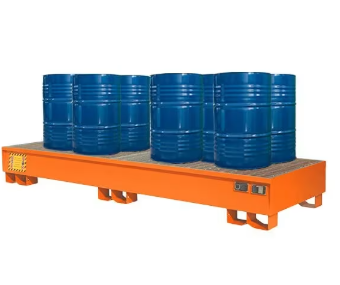
The HFJRS028 supports all these configurations:
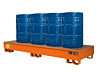
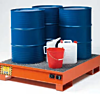
- 8 drums directly on grating
- 6 drums on 3 europallets
- 8 drums on 2 x 1200x1200mm pallets
Testing and Certification
Quality spill containment pallets undergo testing and certification that provides documented assurance of performance:
UNI EN ISO 3834-2:2021: European standard for quality requirements in fusion welding of metallic materials. Compliance demonstrates appropriate weld quality for containment integrity.
Watertight Testing: Individual pallet testing to verify actual containment performance, not just claims based on design.
Documentation: Certificates of compliance and testing for regulatory and audit purposes.
The HFJRS028 provides UNI EN ISO 3834-2:2021 watertight testing certification — documented evidence that each pallet meets the certified standard.
The 8 x 200L Drum Painted Steel Spill Containment Pallet (HFJRS028) in Detail
The HFJRS028 addresses every quality consideration discussed above, providing a comprehensive 8-drum spill containment solution for UK industrial operations.
Construction Quality
Material: Welded steel construction providing genuine long-term durability and watertight integrity. No gaskets, seals, or bolted joints to fail over time.
Manufacturing Standard: UNI EN ISO 3834-2:2021 compliant manufacturing with certified watertight testing for each pallet — documented evidence of genuine containment performance.
Surface Treatment: Multi-stage powder coating providing chemical resistance, corrosion resistance, UV resistance, and cleaning compatibility. Galvanized version available on request for the most demanding applications.
Structural Design: Engineered to handle the substantial weight of 8 fully loaded 200-litre drums (approximately 1,600kg loaded weight) while maintaining containment integrity.
Capacity Specifications
Drum Capacity: 8 x 200-litre drums
Containment Capacity: 555 litres — exceeds the 25% rule (400 litres) for 1,600 litres of stored product
Footprint: 2720 x 1250mm — substantial but practical for industrial drum storage
Height: 300mm — comfortable working height for drum access and operations
Loading Configurations
The HFJRS028's substantial footprint and engineered design provide flexible loading options:
8 Drums on Grid: Direct drum loading on the integrated grating, maximising drum density within the pallet footprint. Suitable for operations where drums are placed directly without intermediate pallets.
6 Drums on 3 Europallets: For operations using 1200 x 800mm europallets for drum handling, the HFJRS028 accommodates 3 europallets with 2 drums each (6 drums total). Maintains forklift handling capability for the drum-on-pallet configuration.
8 Drums on 2 x 1200x1200mm Pallets: For operations using larger 1200 x 1200mm pallets, the HFJRS028 accommodates 2 pallets with 4 drums each (8 drums total). Suitable for bulk drum operations using larger pallet systems.
This loading flexibility means the HFJRS028 integrates with virtually any drum handling system rather than forcing operations to change their handling approach.
Suitable Stored Substances
The HFJRS028 is appropriate for storage of drums containing the full range of common industrial hazardous liquids:
- Petroleum products — oils, fuels, lubricants, hydraulic fluids
- Waste oils — used oils awaiting recycling or disposal
- Solvents — degreasers, cleaning solvents, paint thinners
- Paints and coatings — solvent-based paints, industrial coatings
- Alkaline solutions — caustic chemicals, cleaning alkalis
- Many acids — subject to specific drum-pallet compatibility verification
- Industrial chemicals — process chemicals across industries
- Coolants and antifreeze — automotive and industrial coolants
For specific aggressive chemicals or unusual applications, consult Hall-Fast customer service to verify suitability and recommend the appropriate variant (standard powder-coated or galvanized).
Installation Best Practices
Proper installation maximises the HFJRS028's containment performance and service life.
Location Selection
Surface Requirements:
- Firm, level surface capable of supporting the loaded weight (approximately 1,800kg total including pallet and drums)
- Concrete or other impermeable surface preferred
- Adequate drainage if installed in areas where water collection could be a concern
Environmental Considerations:
- Distance from drains, water courses, and other environmentally sensitive features
- Distance from ignition sources for flammable liquid storage
- Adequate ventilation for vapour management with volatile substances
- Weather protection appropriate to the substances stored (outdoor installation may require cover for some applications)
Operational Considerations:
- Access for drum delivery vehicles
- Working space around the pallet for drum handling
- Distance from other operations to prevent contamination cross-over
- Access for inspection and maintenance
- Emergency response access
Regulatory Considerations:
- Hazardous area classifications under DSEAR
- Distances from buildings and boundaries per fire safety guidance
- Permit conditions for permitted operations
- Local authority planning considerations if applicable
Loading Procedures
Initial Loading:
- Verify pallet integrity before first use
- Inspect drum condition before loading
- Use appropriate drum handling equipment
- Position drums securely with adequate spacing
- Document loaded contents for inventory and emergency response
Ongoing Loading:
- Inspect drums before each loading operation
- Maintain inventory records of contents
- Avoid mixing incompatible substances on the same pallet
- Ensure drum identification labels are visible
Maximum Capacity:
- Do not exceed 8 x 200L drums (or equivalent loading configuration)
- Avoid overloading individual drums (each drum should not exceed 200L net capacity)
- Consider total weight implications for floor loading
Drum Handling Equipment
Appropriate drum handling equipment is essential for safe operation:
- Drum trolleys — for moving drums to and from the pallet
- Forklift drum attachments — for forklift-based drum handling
- Drum tippers — for dispensing from drums while on the pallet
- Drum lifting equipment — for safe positioning on the pallet
- Drum spanners — for opening drums for dispensing or sampling
Operational Best Practices
Day-to-day operation of the HFJRS028 should integrate with broader workplace safety and environmental protection practices.
Daily Inspection Routine
Visual Inspection:
- Check for any visible spills or leaks
- Verify drum condition (no obvious damage, leaks, or deterioration)
- Confirm drum labels and identification are visible
- Check pallet condition for any visible damage
- Verify drainage is clear (no debris blocking the containment area)
Documentation:
- Maintain daily inspection records
- Document any issues identified and corrective actions
- Track product movement (drums added/removed)
- Note any near-miss incidents
Spill Response
Even with proper containment, spills can occur. Effective response procedures should include:
Immediate Response:
- Personal protection — appropriate PPE based on substance involved
- Source isolation — stop any continuing leak if safe to do so
- Spread prevention — prevent contamination spread beyond the containment pallet
- Notification — alert appropriate personnel per emergency procedures
Containment:
- The HFJRS028's bunded design contains spills automatically
- Verify spill is fully contained within the pallet
- Prevent overflow if substantial spill volume
Clean-up:
- Use appropriate absorbent materials compatible with the substance
- Transfer contaminated absorbent to appropriate waste storage
- Decontaminate the containment area following clean-up
- Document the incident for compliance records
Investigation:
- Determine root cause of the spill
- Identify any equipment failures requiring attention
- Review procedures and training requirements
- Implement preventive measures
Inventory Management
Active inventory management of pallet contents supports both operational efficiency and emergency response:
Documentation:
- Maintain current inventory of drums stored on each pallet
- Document substance identification for each drum
- Track quantities for usage monitoring
- Note dates for substance shelf-life management
Rotation:
- First-in-first-out (FIFO) rotation for substances with shelf-life concerns
- Regular use of oldest stock to prevent extended storage
- Disposal of expired or contaminated stock
Emergency Response Information:
- Current inventory available for emergency responders
- Safety data sheets (SDS) accessible for stored substances
- Emergency contact information for hazardous waste disposal
- Compatibility information for emergency response planning
Inspection and Maintenance Programmes
Long-term containment performance requires systematic inspection and maintenance.
Weekly Inspection
More thorough than daily checks, weekly inspections should include:
- Detailed visual inspection of pallet condition
- Drum-by-drum assessment of each drum's condition
- Drainage verification including any drain plug functionality
- Pallet stability verification
- Workspace condition around the pallet
- Documentation review of weekly logs and any incidents
Monthly Inspection
Monthly inspection adds more detailed assessment:
- Coating condition assessment for any damage requiring repair
- Structural integrity verification including welds and joints
- Capacity verification confirming containment volume is unobstructed
- Drum integrity assessment including any signs of corrosion or deterioration
- Inventory reconciliation against records
- Procedural compliance review of operational practices
Annual Inspection
Annual inspection provides comprehensive assessment:
- Full structural assessment including coating condition, weld integrity, deformation, and corrosion
- Capacity testing if appropriate and feasible
- Documentation audit of all inspection records and maintenance history
- Risk assessment review of pallet location, contents, and operations
- Maintenance planning for the coming year
- Compliance verification against current regulatory requirements
Maintenance Requirements
Regular maintenance maintains containment performance:
Coating Maintenance:
- Touch up any damaged coating areas promptly
- Address rust or corrosion before it spreads
- Full recoating periodically as appropriate
Structural Maintenance:
- Address any structural damage immediately
- Maintain weld integrity through monitoring
- Replace components as needed
Cleaning:
- Regular cleaning to prevent debris accumulation
- Decontamination following any spill incidents
- Cleaning agents compatible with the coating and any stored substances
Replacement:
- Plan for eventual pallet replacement based on condition
- Don't extend service beyond reasonable working life
- Document replacement decisions for compliance records
Integrating Spill Containment Into Broader Safety Strategy
The HFJRS028 should integrate with your broader workplace safety and environmental protection strategy, not function as an isolated equipment item.
Risk Assessment Integration
Your COSHH risk assessments should explicitly address spill containment:
- Hazard identification for stored substances
- Risk evaluation including spill scenarios
- Control measures including containment provision
- Residual risk assessment with containment in place
- Monitoring of control measure effectiveness
- Review schedule for ongoing assessment
Emergency Procedures
Site emergency procedures should address spill scenarios:
- Recognition procedures for identifying spills
- Notification protocols for alerting appropriate personnel
- Response procedures appropriate to spill type and scale
- Resources including spill kits, PPE, and response equipment
- External support including emergency services and specialist contractors
- Communication with regulators and other stakeholders
Training Programmes
Staff training should cover:
- Substance hazards for materials stored
- Operational procedures for drum handling and storage
- Inspection requirements for daily and periodic checks
- Spill response procedures and equipment use
- PPE requirements for various scenarios
- Documentation requirements for compliance
Documentation and Records
Maintain comprehensive records supporting compliance:
- Equipment specifications including manufacturer documentation