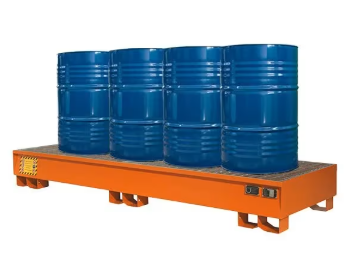
Wall-Mounted Compliance for Space-Constrained UK Operations
Introduction: When Standard Spill Containment Pallets Just Don't Fit
Walk into any small-to-medium UK workshop, garage, manufacturing unit, or laboratory and you'll find a recurring problem: nominally adequate floor space that's actually entirely committed once you account for equipment, work bays, walkways, parts storage, and the dozens of other functional requirements competing for every square metre. Now try to fit a standard 4-drum spill containment pallet — typically 1340 x 1250mm — into that already-saturated space. The math frequently doesn't work. The pallet either dominates available floor area, blocks essential walkways, prevents access to equipment, or simply cannot be installed at all.
This is the practical reality that drives many UK operations to delay or avoid implementing proper spill containment compliance — not because they don't want to comply, but because the conventional pallet formats simply don't fit into their working environment. And the consequences are predictable: continued non-compliance with hazardous liquid storage regulations, ongoing exposure to spill incident risks, and the constant nagging awareness that something needs to be done but no good solution presents itself.
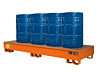
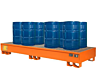
The 4 x 200L Drum Painted Steel Spill Containment Pallet (HFJRS027) is engineered specifically to solve this problem. With its distinctive inline 2660 x 850mm footprint, the HFJRS027 fits where conventional square-format pallets simply cannot — along walls, in narrow aisles, under work benches, beside production lines, and in the dozens of other locations where space constraints have prevented proper spill containment implementation. With a substantial 442-litre containment capacity, full UNI EN ISO 3834-2:2021 certification, welded steel construction, and multi-stage powder coating, the HFJRS027 delivers genuine professional spill containment in a format designed for the real spatial realities of UK industrial operations.
This comprehensive guide is written for the UK operator who's been wrestling with the "we know we need spill containment but nothing fits" problem. We'll explore why conventional pallet formats often fail in real working environments, the specific applications where inline pallets like the HFJRS027 transform what's possible, the regulatory framework that makes spill containment compliance non-negotiable, the detailed specifications and engineering of the HFJRS027, installation strategies for space-constrained environments, and why Hall-Fast is the right supplier for your spill containment needs.
Browse Hall-Fast's complete range of industrial equipment: https://www.hall-fast.com
The Space Problem in UK Industrial Operations
Let's start by being honest about a problem that affects a significant proportion of UK industrial operations: the space available in real working environments is consistently smaller and more contested than the space that equipment designers assume.
Why Workshops and Workspaces Are Always Smaller Than They Appear
Several factors combine to make real-world workspace constraints worse than they look on paper:
Historical Building Stock: Much of UK industrial space exists in buildings designed decades ago, before modern compliance requirements expanded the equipment footprint operations need to accommodate. A workshop built in 1985 wasn't designed around modern PPE storage, fire safety equipment, dust extraction systems, parts inventory, and the dozens of other modern requirements competing for space.
Equipment Accumulation: Operations accumulate equipment over time — lifts, hoists, presses, machine tools, diagnostic equipment, parts cleaning systems, compressors, dust extractors, racking, work benches, mobile equipment, and storage systems. Each generation of new equipment claims its share of available space, with old equipment rarely being removed at the same pace.
Inventory Expansion: Modern operations typically hold more parts, materials, and supplies than their predecessors. The diagnostic complexity of modern vehicles, the variety of products operations serve, and the just-in-case inventory cushions that protect against supply chain disruption all demand storage space.
Safety Requirement Expansion: Modern safety requirements demand space for emergency exits, walkways, fire safety equipment, spill kits, PPE storage, first aid stations, and the dozens of other elements that good safety practice requires.
Compliance Equipment Growth: Beyond safety equipment specifically, modern compliance requires record storage, documentation areas, employee facilities, and various other elements that didn't exist in older operational models.
Workflow Demands: Modern workflows often require dedicated areas for different operations, processes, customer interactions, and other functional requirements that earlier, simpler operations didn't need.
The cumulative result is that the floor space available in UK industrial operations consistently feels smaller than the nominal building dimensions suggest. Every new piece of equipment, every new storage requirement, every new compliance demand has to fit into space that was already contested.
The Conventional Spill Pallet Problem
Into this space-constrained environment comes the conventional spill containment pallet. Designed primarily for purpose-built modern facilities with abundant space, traditional spill pallets typically feature:
- Square or near-square footprints (1200 x 1200mm, 1340 x 1250mm, 1500 x 1500mm) — efficient for capacity per square metre but inflexible for installation
- Heights of 400-500mm — fine in modern facilities but blocking under-bench installation in older workspaces
- Designed for forklift access — assuming the kind of operational space that allows forklift movement around the pallet
These design assumptions work fine for some operations but fail completely for others. The 4-drum square pallet that consumes 1.7 square metres of contested floor space and blocks all the walls it might be installed against is often simply impractical for smaller operations.
The Real-World Result: Non-Compliance by Default
The consequence of this space-format mismatch is widespread non-compliance with hazardous liquid storage regulations across UK small-to-medium operations. Owners and managers know they should have proper spill containment but face the practical reality that conventional options don't fit. Solutions get postponed, regulatory risk accumulates, and operations continue with informal storage arrangements that wouldn't survive serious regulatory inspection.
This isn't a problem of operators not caring about compliance — it's a problem of available equipment not matching operational realities.
The Inline Format: A Practical Solution
The inline format spill containment pallet — exemplified by the HFJRS027 — solves the space-format mismatch by fundamentally rethinking how a 4-drum spill containment pallet should be configured.
What Makes Inline Different
The HFJRS027's inline configuration arranges four 200-litre drums in a single row rather than the 2x2 square layout of conventional pallets. This single design change cascades through every aspect of the pallet's spatial requirements:
Reduced Depth: The HFJRS027 measures just 850mm deep — compared to 1250mm+ for square 4-drum pallets. That 400mm reduction in depth is transformational for wall-mounted installation.
Increased Length: The HFJRS027 extends to 2660mm in length — significantly longer than square pallets. This length is acceptable in contexts where length is available (along walls, in narrow corridors) but depth is constrained.
Lower Height: At just 330mm tall, the HFJRS027 is significantly lower than typical pallets (typically 400-500mm). This allows installation under benches, shelving, and other overhead structures.
Single-Side Access: All drums are accessible from a single long side, allowing the opposite side to be against a wall, equipment, or other obstacle.
Linear Drum Arrangement: The single-row arrangement supports linear workflows naturally — each drum serves its position in the line rather than competing for access from multiple directions.
The Spatial Mathematics
Compare the spatial requirements of the inline HFJRS027 against a typical square 4-drum pallet:
Conventional Square 4-Drum Pallet:
- Footprint: 1340 x 1250mm = 1.68 square metres
- Wall protrusion: 1250mm into working space
- Height: typically 400-500mm
- Access requirement: multiple sides typically needed
Inline HFJRS027:
- Footprint: 2660 x 850mm = 2.26 square metres
- Wall protrusion: only 850mm into working space
- Height: 330mm (allows under-bench installation)
- Access requirement: single side adequate
The total footprint area is actually slightly larger for the inline format, but this misses the practical point. In space-constrained operations, the constraint isn't total floor area available — it's the available shape of that floor area. The inline format works in linear space available along walls and in narrow areas. The square format requires square space that simply doesn't exist in many real operations.
Where Inline Excels
The HFJRS027 inline format excels specifically in scenarios where conventional pallets fail:
Workshop Wall Installation: Many workshops have long, mostly-unusable strips of floor space along workshop walls where a 850mm-deep inline pallet fits but a 1250mm-deep square pallet doesn't.
Narrow Aisle Locations: Workshops with narrow aisles between work bays can accommodate inline pallets in spaces too narrow for square formats.
Under-Bench Installation: The 330mm height fits under most work benches and overhead structures, putting drum storage in space that would otherwise be wasted.
Linear Workflow Integration: Operations with linear workflows (production lines, sequential service bays, dispensing stations along a wall) match naturally to inline configurations.
Behind-Equipment Installation: Inline pallets fit behind or alongside equipment in spaces where square pallets simply don't.
Tight Building Footprints: Buildings with awkward proportions or interrupted floor space often work better with inline formats than square formats.
The Real Costs of Continued Non-Compliance
Before diving into specifications, it's worth understanding what continued non-compliance with spill containment regulations actually costs operations.
Direct Costs of Spill Incidents
When inadequately contained spills occur, immediate costs typically include:
Emergency Response: Specialist contractors at £1,000-£5,000+ per day for callouts, with substantial mobilisation fees on top.
Contaminated Material Disposal: Hazardous waste disposal at £200-£500+ per tonne. A single drum spill can easily generate 5-10 tonnes of contaminated material.
Site Decontamination: Specialist cleaning of affected areas, potentially including concrete removal, soil replacement, and drain cleaning. Major incidents reach £20,000-£100,000+.
Environmental Damage Assessment: Professional assessment of contamination extent, costing £5,000-£25,000+ for significant incidents.
Regulatory Consequences
Investigation Costs: Major spills automatically trigger Environment Agency or HSE investigation, with cooperation costs of £5,000-£25,000+.
Improvement and Enforcement Notices: Regulatory notices requiring remediation actions with substantial compliance costs.
Prosecution: Serious environmental offences result in unlimited fines under current sentencing guidelines. Major prosecutions routinely exceed £100,000.
Permit Implications: Permit holders face permit reviews, restrictions, or revocation following significant incidents.
Business Disruption Costs
Operational Shutdown: Work areas typically cannot operate during clean-up.
Insurance Implications: Coverage disputes, increased premiums, or coverage withdrawal in worst cases.
Reputation Damage: Lasting harm to customer and community relationships.
Staff Concerns: Workforce morale and confidence impacts.
The Compound Risk
Even "minor" 200-litre drum spill incidents that escalate due to inadequate containment can easily generate combined costs of £25,000-£100,000+ for small operations. Major incidents reach figures that genuinely threaten business viability.
By comparison, the HFJRS027 represents a tiny fraction of even the cheapest spill incident scenario — making it one of the most cost-effective risk management investments any operation can make.
The UK Regulatory Framework
Understanding the regulatory framework helps clarify why proper spill containment isn't optional.
Control of Substances Hazardous to Health (COSHH)
The COSHH Regulations 2002 require employers to assess and control risks from hazardous substances, including:
- Risk assessment for stored substances
- Hierarchy of control measures
- Specific containment provisions
- Worker information and training
- Emergency procedures
Spill containment is a fundamental control measure under COSHH.
Dangerous Substances and Explosive Atmospheres Regulations (DSEAR)
DSEAR 2002 addresses flammable and explosive substance risks, requiring:
- Hazardous area classification
- Specific control measures
- Equipment specifications appropriate to hazards
- Emergency procedures
Control of Pollution (Oil Storage) Regulations
UK oil storage regulations require:
- Secondary containment for stored oil
- Containment capacity of 110% of largest container OR 25% of total volume (whichever is greater)
- Specific construction standards
- Maintenance and inspection requirements
For 4 x 200L drum storage:
- Total stored volume: 800 litres
- 25% of total: 200 litres
- 110% of largest container: 220 litres
- Required containment: 220 litres
The HFJRS027's 442-litre containment capacity comfortably exceeds these requirements at 201% of the regulatory minimum.
Environmental Permitting Regulations
Permit-holding operations face specific containment requirements per their permit conditions.
Environmental Protection Act
The Environmental Protection Act 1990 creates duties to prevent environmental contamination, with various offences applying when contamination occurs.
Workplace Health, Safety and Welfare Regulations
These regulations require safe working environments, including slip hazard control and chemical exposure management.
The HFJRS027 supports compliance across this regulatory landscape through certified construction, documented testing, and substantial containment capacity.
The HFJRS027 in Detail
Let's examine the specific engineering and features that make the HFJRS027 a genuine professional solution.
Construction Quality
Material: Welded steel construction throughout, providing genuine long-term durability and watertight integrity with no gaskets or bolted joints to fail over time.
Manufacturing Standard: UNI EN ISO 3834-2:2021 compliant manufacturing with certified watertight testing for each pallet — providing documented evidence of genuine containment performance.
Surface Treatment: Multi-stage powder coating providing chemical resistance, corrosion resistance, UV resistance, and cleaning compatibility. Galvanized version available on request for demanding applications.
Structural Design: Engineered to handle the substantial weight of 4 fully loaded 200-litre drums (approximately 800kg loaded weight) while maintaining containment integrity. The inline format experiences different structural stresses than square pallets, requiring specific engineering for the elongated geometry.
Capacity Specifications
Drum Capacity: 4 x 200-litre drums in inline configuration
Containment Capacity: 442 litres — 201% of regulatory minimum for 800L total stored volume
Footprint: 2660 x 850mm — engineered for wall-mounted and narrow-space installation
Height: 330mm — comfortable working height that allows under-bench installation
Inline Drum Arrangement
All 4 drums sit on the integrated grating in a single-row arrangement:
- Direct drum support with spill drainage to the containment bund below
- Single-side access to all four drums from one long side
- Equal accessibility for all drums — no drum is buried behind others
- Easy visual inspection of all drums simultaneously
- Linear dispensing workflow for sequential operations
- Optimised use of length for maximum capacity in minimum depth
Why Welded Steel Construction Matters
The HFJRS027's welded steel construction is fundamentally important to its long-term containment performance:
Watertight Integrity: No gaskets, seals, or bolted joints that can fail over time. The welded bund maintains integrity throughout the pallet's working life.
Structural Rigidity: Welded construction provides the rigidity needed to handle 800kg+ of loaded drums without flexing that could compromise containment.
Chemical Resistance: Welded steel construction provides consistent chemical resistance across the entire pallet surface — no joints where chemicals could attack differently.
Long-Term Durability: Welded steel resists the corrosion and fatigue that affects bolted joints over years of service.
No Maintenance: Eliminates periodic gasket replacement that bolted pallet designs require.
This is particularly important for inline formats because the elongated geometry experiences different bending and torsion forces than square pallets. The continuous welded construction handles these forces while maintaining containment integrity.
UNI EN ISO 3834-2:2021 Certification
The UNI EN ISO 3834-2:2021 standard isn't just generic certification — it specifically addresses fusion welding quality requirements:
- Comprehensive quality requirements for fusion welded products
- Process control ensuring consistent welding quality across production
- Personnel qualification requirements for welders and welding supervisors
- Equipment requirements for welding equipment
- Inspection and testing requirements
- Documentation requirements for compliance evidence
When the HFJRS027 is certified to this standard, it means the welded construction meets documented professional welding quality standards — not just claimed quality but verified, certified, documented quality.
The watertight testing of each individual pallet provides the final verification that the certified manufacturing has actually produced a pallet that performs as intended.
Multi-Stage Powder Coating
The "multi-stage" element of the powder coating is significant. Single-stage powder coating provides basic protection. Multi-stage processes provide substantially better performance through:
Stage 1 - Surface Preparation: Thorough cleaning and degreasing to remove any contaminants that could compromise coating adhesion.
Stage 2 - Surface Treatment: Phosphate or similar treatment to create optimal surface chemistry for coating bonding.
Stage 3 - Primer Coating: Primer layer providing corrosion protection and improved adhesion for topcoat.
Stage 4 - Topcoat: Final powder coat providing the visible finish, chemical resistance, UV resistance, and primary protection.
Each stage cures at appropriate temperatures to optimise the molecular bonding between layers and to the underlying steel.
The result is substantially better than single-coat alternatives:
- Corrosion resistance measured in years rather than months
- Chemical resistance to a wide range of industrial chemicals
- UV stability maintaining colour and finish integrity
- Impact resistance to handle workshop knocks and contact
- Cleaning compatibility with industrial cleaning agents
- Maintenance simplicity without specialist requirements
Industry Applications: Where the HFJRS027 Excels
The HFJRS027's inline format suits specific operational scenarios particularly well.
Automotive Workshops with Wall-Mounted Oil Dispensing
Many independent garages organise their oil dispensing along workshop walls — pumps, dispensers, and meters mounted on walls with the drums supplying them located nearby. The conventional approach requires either:
- Inadequate informal drum storage (compliance risk)
- Square pallets that protrude awkwardly into working space
- Distant pallet locations requiring long oil delivery lines
The HFJRS027 inline format transforms this layout:
- Pallet sits flush against the wall directly below or adjacent to dispensing equipment
- Each drum is positioned to feed its corresponding dispensing point
- Minimal protrusion into the working bay area
- All drums accessible from the working side for inspection and replacement
- Linear workflow matches the dispensing operations
For garages, the HFJRS027 often turns "we know we need spill containment but it won't fit" into a practical, compliant solution.
HGV and Commercial Vehicle Workshops
HGV workshops typically have longer service bays than passenger vehicle garages, with corresponding long wall lengths. The HFJRS027 suits these layouts well:
- Wall-mounted installation along service bay back walls
- Linear arrangement matching service bay layouts
- Adequate capacity for the larger fluid volumes commercial vehicles require
- Compatibility with bulk delivery systems
Manufacturing Production Lines
Linear production processes often need chemical supply at multiple points along the production line:
- Inline pallet positioned alongside production line
- Each drum positioned to supply its corresponding production area
- Minimal floor space consumption beyond the production line itself
- Easy inspection and replacement without disrupting production
- Linear workflow integration
Engineering Workshops with Bench-Side Storage
Engineering workshops often need chemical and coolant storage adjacent to machine tools:
- Under-bench installation using the 330mm height
- Alongside-machine installation for direct supply
- Wall-mounted installation in narrow workshop aisles
- Position immediately accessible to machine operators
Laboratory Operations
Laboratory operations frequently have specific space constraints and benefit from inline configurations:
- Under-fume-hood installation for bench-level chemical storage
- Wall-mounted installation in lab corridors
- Between-bench installation in narrow lab layouts
- Integration with existing laboratory furniture
Quick-Fit and Service Operations
Quick-fit centres with multiple service bays benefit from inline configurations:
- Each bay served by its position on the inline pallet
- Linear workflow matching customer flow
- Minimal disruption to bay operations
- Easy visual inventory across all stored products
Marine Workshops
Marine workshops often have specific layout constraints from building shape and equipment positioning:
- Wall-mounted installation along workshop perimeters
- Under-shelf installation in compact workshops
- Compatibility with marine-specific dispensing equipment
Agricultural Operations
Farm buildings often have specific layout constraints:
- Wall-mounted installation in narrow agricultural buildings
- Under-loft installation in older barn buildings
- Compatibility with farm vehicle access requirements
Construction Site Offices and Workshops
Site offices and workshops have specific portability and space constraints:
- Compact wall-mounted installation in site offices
- Easy relocation when sites change
- Adequate capacity for typical site fuel and oil storage
Installation Strategies for Space-Constrained Environments
The HFJRS027 inline format opens up installation possibilities that wouldn't be available with square format pallets.
Wall-Mounted Installation
The most common HFJRS027 installation scenario:
Site Preparation:
- Identify suitable wall length (minimum 2700mm clear)
- Verify floor surface is suitable (level, firm, impermeable)
- Confirm 850mm clear depth available
- Check overhead clearance (consider any wall-mounted equipment)
- Plan access route for delivery and drum loading
Installation:
- Position pallet against the wall with appropriate clearance for inspection
- Verify level positioning
- Check stability and absence of rocking
- Document position for inventory and emergency response
Operational Layout:
- Wall-mounted dispensing equipment above or alongside drums
- Working area on the open access side
- Drum delivery route maintained
- Inspection access maintained
Under-Bench Installation
The 330mm height allows installation under most work benches:
Site Preparation:
- Verify under-bench clear height (minimum 350mm needed for clearance)
- Confirm clear depth (850mm)
- Ensure clear length (2700mm)
- Verify floor surface
- Plan drum access route
Considerations:
- Bench above must be appropriate (not used for hot work that could ignite vapours)
- Lighting under bench for inspection
- Ventilation considerations for volatile substances
- Drum dispensing access from front
Narrow Aisle Installation
For workshops with narrow aisles:
Site Preparation:
- Verify aisle width (minimum 1000mm needed for pallet plus access)
- Confirm aisle length available
- Check overhead access
- Plan around any aisle features (lighting, equipment, etc.)
Considerations:
- Aisle traffic doesn't conflict with drum access
- Emergency exit routes maintained
- Equipment access not blocked
Between-Equipment Installation
The narrow profile allows installation between equipment:
Site Preparation:
- Verify clear space between equipment (minimum 1000mm)
- Confirm length available
- Check equipment operation isn't affected
- Plan access for inspection and replacement
Multi-Pallet Strategies
For operations needing more than 4 drums, multiple HFJRS027 pallets can be installed in various configurations:
Side-by-Side Along Wall: Multiple pallets in a single row along the wall, providing 8, 12, or more drum capacity with maintained wall-mounted advantages.
Different Locations for Substance Separation: Multiple pallets in different locations to separate incompatible substances or to position storage close to points of use.
Mixed Format Strategy: HFJRS027 inline pallets in linear spaces plus HFJRS026 square pallets in corner or freestanding locations.
Operational Best Practices
Day-to-day operation of the HFJRS027 should integrate with broader workplace safety practices.
Drum Loading Procedures
Equipment Requirements:
- Drum trolleys for ground-level movement
- Forklift trucks with drum attachments for lifting (note: the inline format requires careful forklift access due to length)
- Drum cradles for stable positioning
- Safety equipment for staff
Loading Process:
- Plan loading sequence (loading one drum at a time, working from one end)
- Inspect drum integrity before loading
- Verify drum labels and identification
- Position drum securely on grating
- Ensure drum is stable
- Document the loading
Capacity Management:
- Do not exceed 4 x 200L drums
- Maintain adequate spacing for inspection
- Ensure access for dispensing operations
Daily Inspection Routine
Visual Inspection (5 minutes daily):
- Walk along the access side checking each drum
- Look for any visible spills or leaks
- Verify drum condition
- Check pallet condition
- Verify containment area is clear of debris
The single-side access of the inline format actually simplifies inspection — you walk along one side checking all drums in sequence rather than walking around a square pallet.
Documentation:
- Maintain daily inspection records
- Document any issues identified
- Track product movement
- Note any near-miss incidents
Spill Response Procedures
Even with proper containment, spills can occur:
Immediate Response:
- Personal protection — appropriate PPE
- Source isolation — stop continuing leak if safe
- Spread prevention — prevent contamination spread beyond the pallet
- Notification — alert appropriate personnel
Containment Verification:
- The HFJRS027's bunded design contains spills automatically
- Verify spill is fully contained within the pallet
- Monitor if substantial spill volume
Clean-up:
- Use appropriate absorbent materials compatible with the substance
- Transfer contaminated absorbent to hazardous waste storage
- Decontaminate the containment area
- Document the incident
Investigation:
- Determine root cause
- Identify any equipment failures
- Review procedures
- Implement preventive measures
Inventory Management
Active inventory management supports operational efficiency and emergency response:
- Maintain current inventory of drums stored
- Document substance identification for each drum position
- The inline format simplifies position-based identification
- Track quantities for usage monitoring
- Note dates for substance shelf-life management
Inspection and Maintenance Programmes
Long-term containment performance requires systematic inspection and maintenance.
Daily Inspection (5 minutes)
- Walk-along visual check
- Drum condition verification
- Pallet visible condition
- Containment area clearance
- Documentation update
Weekly Inspection (15 minutes)
- More thorough visual inspection
- Drum-by-drum detailed assessment
- Drainage verification
- Pallet stability check (particularly important