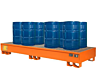
Compact Heavy-Duty Bunded Storage for Hazardous Liquid Drums
Product Overview
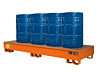
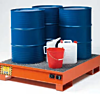
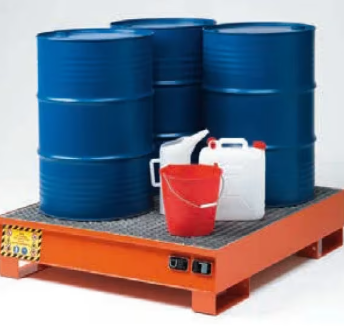
The 4 x 200L Drum Painted Steel Spill Containment Pallet (HFJRS026) is a heavy-duty industrial bunded pallet engineered for the safe, compliant, and environmentally responsible storage of up to four 200-litre drums containing hazardous or polluting liquids. With its compact 1340 x 1250mm footprint, substantial 440-litre containment capacity, welded steel construction watertight-tested to UNI EN ISO 3834-2:2021, and durable multi-stage powder-coated finish, the HFJRS026 delivers professional-grade spill containment in a footprint designed to fit comfortably into workshops, garages, laboratories, and industrial facilities where space is at a premium.
Designed to ensure full compliance with UK and European regulations for workplace safety and environmental protection, the HFJRS026 provides the documented protection that responsible operations require — preventing accidental spills, drum failures, and ruptures from contaminating workplaces, soil, water courses, and the wider environment.
Why the HFJRS026 Is the Right Size for Many Operations
The HFJRS026's 4-drum capacity hits a particular sweet spot for many UK operations. It's substantial enough to handle the realistic drum storage requirements of small-to-medium workshops, garages, laboratories, and industrial operations — but compact enough to fit into facilities where larger 8-drum pallets would dominate available space.
The compact footprint matters enormously in practice:
Workshop Integration: At 1340 x 1250mm, the HFJRS026 fits comfortably along workshop walls, in dedicated storage areas, or in corners where larger pallets simply wouldn't work. The 405mm height keeps drums at a comfortable working level for dispensing and access.
Multiple Pallet Strategy: For operations storing different types of hazardous substances that must be kept separated (incompatible chemicals, different process streams, different waste types), multiple HFJRS026 pallets often work better than fewer larger pallets. You can dedicate individual pallets to specific substance types without wasting capacity.
Growth Flexibility: Starting with one HFJRS026 and adding more as operations grow provides better capital flexibility than committing to a larger pallet that may be underutilised initially.
Mobile or Reconfigurable Layouts: The smaller footprint makes the HFJRS026 easier to relocate if facility layouts change.
Door Access: The compact dimensions allow installation in locations accessible through standard industrial doorways without requiring special access arrangements.
Why Bunded Spill Containment Pallets Matter
Storing hazardous liquids in drums without proper spill containment is one of the most common compliance failures identified in workplace inspections, environmental audits, and HSE investigations. The consequences of inadequate containment can be severe:
Environmental Damage: Hazardous liquid spills can contaminate soil, groundwater, drainage systems, and water courses — creating clean-up costs running into tens or hundreds of thousands of pounds, alongside potential prosecution under environmental protection legislation.
Workplace Safety Risks: Spilled hazardous liquids create slip hazards, chemical exposure risks, fire and explosion hazards, and confined-space dangers — directly threatening worker safety.
Regulatory Non-Compliance: UK regulations including COSHH (Control of Substances Hazardous to Health), DSEAR (Dangerous Substances and Explosive Atmospheres Regulations), Environmental Permitting Regulations, and the Control of Pollution (Oil Storage) Regulations all require appropriate containment for hazardous liquid storage.
Business Disruption: Major spill incidents typically result in operational shutdown during clean-up, regulatory investigation, remediation work, and reputation damage — costs that vastly exceed the price of proper preventive containment equipment.
Insurance Implications: Failure to provide appropriate spill containment can void insurance coverage for spill-related incidents, leaving operations exposed to massive financial liability.
The HFJRS026 addresses all these concerns directly — providing the certified, properly-designed containment that responsible operations require for hazardous liquid drum storage.
Suitable for a Wide Range of Hazardous Liquids
The HFJRS026 is designed and certified for storage of drums containing the full range of hazardous and polluting liquids commonly encountered in industrial, workshop, and laboratory operations:
- Oils — engine oils, hydraulic oils, transmission fluids, lubricants, gear oils
- Waste oils — used motor oils, industrial waste oils awaiting disposal or recycling
- Paints — solvent-based paints, industrial coatings, specialist paint products
- Solvents — degreasers, cleaning solvents, paint thinners, industrial solvents
- Fuels — petrol, diesel, kerosene, specialist fuels (subject to specific DSEAR considerations)
- Alkaline solutions — caustic soda, industrial alkalis, cleaning chemicals
- Acids — provided drum compatibility is verified (some acid types may require specialist containment)
- Industrial chemicals — process chemicals across various industries
- Coolants and antifreeze — automotive and industrial coolants
- Adhesives and bonding agents — solvent-based adhesives, industrial bonding chemicals
- Specialist liquids — process fluids, manufacturing inputs, laboratory chemicals
The painted steel construction provides good general chemical resistance for most common hazardous liquids. For specific aggressive chemical applications, the galvanized version available on request may be more appropriate — consult our customer service team for specific chemical compatibility advice.
Substantial 440-Litre Containment Capacity
The HFJRS026 provides a substantial 440-litre containment capacity — significantly exceeding typical regulatory requirements for 4-drum storage:
For the HFJRS026's 4 x 200L drum capacity:
- Total stored volume: 800 litres
- 25% of total stored volume: 200 litres
- 110% of largest container: 220 litres
- Required containment: 220 litres
- HFJRS026 capacity: 440 litres (200% of regulatory minimum)
The 440-litre capacity provides exceptional safety margin above the regulatory minimum — accommodating realistic scenarios where multiple drum failures might occur, where containment may need to handle rainwater alongside spilled product, or where additional safety margin provides extra confidence.
This generous capacity is particularly valuable because it means the pallet can comfortably contain a complete failure of the largest drum stored, plus additional capacity for safety margin — providing genuine confidence that any conceivable spill scenario is properly contained.
Construction and Manufacturing Quality
The HFJRS026 is built to genuine professional standards — designed to provide reliable containment performance throughout years of demanding industrial service.
Welded Steel Construction
The pallet body is manufactured from welded steel rather than bolted or riveted construction. Welded construction provides:
- Genuine watertight integrity — no gaskets, seals, or joints to fail over time
- Long-term durability — welded steel resists the corrosion and fatigue that affects bolted joints
- Structural rigidity — handles the substantial weight of fully loaded drums without flexing
- Maintained containment — the welded bund maintains its integrity throughout the product's working life
- No maintenance of seals — eliminates the periodic gasket replacement that bolted designs require
UNI EN ISO 3834-2:2021 Watertight Testing
Every HFJRS026 pallet is watertight tested in compliance with UNI EN ISO 3834-2:2021 — the European standard for quality requirements in fusion welding of metallic materials. This certified testing provides:
- Documented verification that each individual pallet provides genuine watertight containment
- Quality assurance that welding standards have been met across all production
- Compliance documentation for regulatory and audit purposes
- Confidence that the containment performance is real, not just claimed
This isn't a generic manufacturing standard — it's a specific weld quality certification that ensures the watertight integrity essential for actual spill containment performance.
Multi-Stage Powder Coating
The HFJRS026 surface is treated with multi-stage powder coating — providing substantial protection against the chemical and environmental exposure the pallet will experience in service:
- Chemical resistance — protects against the hazardous liquids the pallet contains
- Corrosion resistance — protects against atmospheric exposure and moisture
- UV resistance — maintains finish integrity even with outdoor or partially-outdoor installation
- Cleaning compatibility — withstands the cleaning and decontamination procedures the pallet may need throughout its service life
- Aesthetic durability — maintains professional appearance through years of service
The multi-stage process (typically including degreasing, phosphating, priming, and topcoat) provides far superior performance to single-coat alternatives — making the difference between a pallet that maintains its appearance and performance for years versus one that begins deteriorating within months.
For applications involving particularly aggressive chemicals or extreme environmental exposure, a galvanized version is available on request — providing enhanced corrosion resistance for the most demanding applications.
Flexible Drum Loading Configurations
The HFJRS026 provides practical loading options for 4-drum storage:
4 x 200L Drums on Grid
The primary configuration — 4 x 200-litre drums arranged on the integrated grating system. This provides:
- Direct drum support on the grating
- Spill drainage through the grating to the containment bund below
- Easy drum access for filling, dispensing, and rotation
- Clear visibility of drum condition for inspection
- Maximum stability for stored drums
4 Drums on 1200x1200mm Pallet
For operations using 1200 x 1200mm pallets for drum handling:
- 1 large pallet fits within the HFJRS026 footprint
- 4 drums on the pallet
- Maintains forklift handling capability for the drum-on-pallet configuration
- Suitable for operations where drums are received and dispatched on pallets
This loading flexibility means the HFJRS026 integrates with the drum handling systems most commonly used in UK industrial operations — accommodating both direct drum storage and pallet-based drum movement without forcing changes to existing handling procedures.
Key Features and Benefits
The HFJRS026 combines genuine professional construction with the features that matter for compliant, practical, daily-use spill containment:
- 4 x 200-litre drum capacity — appropriate for many small-to-medium operations
- Compact 1340 x 1250mm footprint — fits comfortably in workshops, garages, and laboratories
- 440-litre containment capacity — 200% of regulatory minimum with exceptional safety margin
- 405mm height — comfortable working level for drum access and dispensing
- Welded steel construction — genuine long-term durability and watertight integrity
- UNI EN ISO 3834-2:2021 watertight tested — certified spill containment performance
- Multi-stage powder coating — chemical, corrosion, and UV resistance
- Galvanized version available on request — enhanced protection for demanding applications
- Flexible drum loading — accommodates direct drums or drums on 1200x1200mm pallets
- Compliant with UK/European regulations — supports workplace safety and environmental compliance
- Integrated drum grating — provides drum support with drainage to containment bund
- Robust construction — built to handle the weight of fully loaded drums (over 800kg loaded)
- Industrial-grade design — engineered for daily working environment use
Regulatory Compliance and Specification
The HFJRS026 is designed to support compliance with the major UK and European regulations governing hazardous liquid storage:
COSHH (Control of Substances Hazardous to Health)
COSHH requires employers to assess and control risks from hazardous substances. Proper bunded containment is essential for COSHH-compliant storage of hazardous liquid drums.
DSEAR (Dangerous Substances and Explosive Atmospheres Regulations)
For flammable and explosive substance storage, DSEAR requires risk assessment and appropriate control measures. Bunded containment forms part of compliant flammable liquid storage strategies.
Control of Pollution (Oil Storage) Regulations
UK oil storage regulations require appropriate containment for stored oils. The HFJRS026's substantial capacity comfortably exceeds typical regulatory requirements for oil storage applications.
Environmental Permitting Regulations
Operations holding environmental permits typically have specific containment requirements for hazardous substance storage. The HFJRS026's certified watertight testing provides documented compliance support.
Environmental Protection Act
The Environmental Protection Act creates duties to prevent environmental contamination from hazardous substances. Proper containment is essential for compliance with these duties.
Workplace (Health, Safety and Welfare) Regulations
These regulations require safe working environments, including controlling slip hazards and chemical exposure risks from hazardous liquid spills.
Ideal Applications
The HFJRS026's capacity, compact dimensions, and construction quality make it suitable for a wide range of industrial and commercial applications:
- Automotive workshops and garages — storage of oils, fluids, and waste products
- HGV and commercial vehicle workshops — fluid and lubricant storage
- Motorcycle workshops — oils, fluids, and chemical storage
- Small manufacturing facilities — process chemicals and waste products
- Workshop and engineering operations — coolants, oils, and chemicals
- Agricultural operations — fuel, oil, and chemical storage
- Construction sites — fuel and chemical storage compliance
- Plant hire and equipment operations — fuel and fluid storage
- Marine workshops — fluid and chemical storage
- Printing and graphic arts operations — solvent and chemical storage
- Laboratory operations — bulk chemical storage
- Industrial maintenance facilities — workshop fluid storage
- Vehicle servicing centres — oil and fluid storage
- Quick-fit centres and tyre fitters — used oil and brake fluid storage
- Cleaning and janitorial operations — chemical storage compliance
The 4-drum capacity is particularly well-suited to operations that need genuine compliance and protection without the space requirements of larger pallets.
Product Specifications
| Specification | Detail |
|---|---|
| Product Code | HFJRS026 |
| Drum Capacity | 4 x 200-litre drums |
| Containment Capacity | 440 litres |
| Dimensions (L x W x H) | 1340 x 1250 x 405mm |
| Material | Welded steel |
| Surface Treatment | Multi-stage powder coating |
| Alternative Finish | Galvanized version available on request |
| Loading Configurations | 4 drums on grid / 4 drums on 1200x1200mm pallet |
| Testing Standard | UNI EN ISO 3834-2:2021 watertight tested |
| Suitable for | Oils, paints, alkaline solutions, fuels, waste oils, solvents, chemicals |
| Compliance Support | COSHH, DSEAR, Oil Storage Regulations, Environmental Permitting |
Installation and Use Considerations
Location Selection
When installing the HFJRS026, consider:
- Level ground — pallets must be installed on firm, level surfaces to ensure containment integrity
- Adequate access — space for drum delivery, handling, and removal
- Drainage considerations — if installed outdoors, consider rainwater management
- Environmental protection — distance from drains, water courses, and sensitive areas
- Fire safety — appropriate distance from ignition sources for flammable liquid storage
- Ventilation — adequate airflow for vapour management with volatile liquids
- Inspection access — ability to inspect drums and pallet condition regularly
Drum Loading Procedures
When loading drums:
- Use appropriate drum handling equipment (drum trolleys, forklifts with drum attachments)
- Verify drum integrity before loading
- Position drums securely on the grating or supporting pallet
- Avoid overloading beyond rated capacity
- Maintain access for inspection and dispensing equipment
Inspection and Maintenance
Regular inspection ensures continued containment performance:
- Daily/shift inspection — visual check for spills, drum condition, pallet condition
- Weekly inspection — more thorough check of pallet integrity and drum condition
- Periodic deep inspection — assessment of coating condition, structural integrity, drainage
- Spill response — proper clean-up procedures for any contained spills
- Documentation — maintain inspection records for compliance purposes
When to Choose the HFJRS026 vs Larger Pallets
The choice between the 4-drum HFJRS026 and larger pallets (like the 8-drum HFJRS028) depends on your specific operational requirements.
Choose the HFJRS026 (4 drums) when:
- Your operation realistically needs storage for 4 or fewer drums at a time
- Space constraints favour a smaller footprint
- You want to maintain substance separation across multiple smaller pallets
- Capital flexibility favours starting smaller with option to add
- The location can't accommodate larger pallet dimensions
Consider larger pallets when:
- Your operation regularly stores significantly more than 4 drums
- Available space accommodates larger footprints
- Economy of scale favours fewer, larger pallets
- Substance compatibility allows mixed storage
For multi-pallet strategies, the HFJRS026 often works well as part of a layout using multiple pallets to separate incompatible substances or to position storage close to points of use.
Galvanized Version Available
For applications involving particularly aggressive chemicals, extreme environmental exposure, or where the absolute maximum corrosion resistance is required, a galvanized version of the HFJRS026 is available on request.
Galvanized construction provides:
- Maximum corrosion resistance through zinc coating protection
- Enhanced protection against aggressive chemicals
- Superior performance in outdoor or wet installations
- Extended service life in demanding environments
Contact Hall-Fast customer service to discuss specific application requirements and whether the standard powder-coated or galvanized version is most appropriate for your needs.
Why Choose the HFJRS026 from Hall-Fast?
For operations requiring genuine professional spill containment for 200-litre drum storage, the HFJRS026 represents an excellent investment. The welded steel construction with UNI EN ISO 3834-2:2021 certified watertight testing delivers the documented compliance that responsible operations require. The substantial 440-litre containment capacity exceeds typical regulatory requirements with exceptional safety margin. The multi-stage powder coating provides the chemical and environmental resistance that demanding industrial use demands. And the compact footprint integrates with the space realities of most UK industrial operations.
The 4-drum capacity hits the practical sweet spot for many operations — substantial enough for realistic working storage requirements, compact enough to fit comfortably in real working environments, and economical enough that multiple pallets can be deployed where substance separation matters.
Hall-Fast supplies the HFJRS026 backed by decades of trade and industry experience, expert customer service for specification questions and compliance support, and our commitment to authentic products at competitive prices.
Order the 4 x 200L Drum Painted Steel Spill Containment Pallet (HFJRS026) today and add genuine certified spill containment capability to your hazardous liquid drum storage operations.
For specific application questions, chemical compatibility advice, or to discuss whether the standard or galvanized version is most appropriate for your needs, contact our customer service team.
Suggested meta description (155 chars): HFJRS026 Steel Spill Containment Pallet for 4 x 200L drums. 440L capacity, welded steel, UNI EN ISO 3834-2:2021 tested. COSHH & oil storage compliant.
Suggested target keywords: 4 drum spill pallet, 200L drum spill containment, steel bunded pallet, HFJRS026, drum spill pallet UK, COSHH compliant storage, hazardous liquid storage, oil drum spill pallet, industrial bunded pallet, compact spill containment.
You said: now write a 5000 word article to get it to the top of searches
Claude responded: The Definitive Guide to 4-Drum Steel Spill Containment Pallets — Compact Compliance for UK Workshops & Industrial Operations
The Definitive Guide to 4-Drum Steel Spill Containment Pallets — Compact Compliance for UK Workshops & Industrial Operations
Introduction: Why the Right-Sized Spill Containment Pallet Matters
In the world of industrial spill containment, bigger isn't always better. While massive 8-drum and 16-drum spill containment pallets have their place in large industrial facilities, the reality is that the vast majority of UK businesses storing hazardous liquids in drums are operating at a smaller scale — independent garages, workshops, small manufacturing units, agricultural operations, laboratories, and trade premises where storage requirements rarely exceed 4 drums at any given time. For these operations, a properly sized 4-drum spill containment pallet is often the perfect solution: compliant with all relevant regulations, generous in containment capacity, and compact enough to fit into the real-world space constraints that smaller operations face.
The 4 x 200L Drum Painted Steel Spill Containment Pallet (HFJRS026) is engineered specifically for this market reality. With a footprint of just 1340 x 1250mm, a working height of 405mm, and a substantial 440-litre containment capacity, the HFJRS026 delivers genuine industrial-grade spill containment in a package that integrates with the practical realities of smaller UK operations. It's certified to UNI EN ISO 3834-2:2021, built from welded steel for genuine long-term durability, and finished with multi-stage powder coating for chemical and environmental resistance. It supports compliance with COSHH, DSEAR, Oil Storage Regulations, and Environmental Permitting Regulations. And it does all this in a footprint that fits comfortably along a workshop wall, in a dedicated storage corner, or in any of the typical locations where smaller operations actually need to store their hazardous liquids.
This comprehensive guide is written for the UK operator who's serious about getting their hazardous liquid storage right. Whether you're running an independent garage struggling to comply with environmental regulations on used oil storage, managing a small manufacturing operation that's just been told by your insurance company that you need proper bunded storage, operating a workshop that's grown to the point where informal drum storage just isn't appropriate anymore, or planning a new facility where compliance has been built in from the start, this guide will give you everything you need to make confident decisions about 4-drum spill containment pallets.
We'll explore why hazardous liquid storage compliance has become non-negotiable for UK operations, the specific regulatory framework that governs drum storage, what to look for in quality spill containment equipment, the detailed specifications and applications of the HFJRS026, installation and operational best practices, inspection and maintenance requirements, and why Hall-Fast is the right supplier for your spill containment needs.
Browse Hall-Fast's complete range of industrial equipment: https://www.hall-fast.com
The Hidden Compliance Crisis in Small and Medium UK Operations
Let's start with an uncomfortable truth: a significant proportion of UK small and medium businesses storing hazardous liquids are operating in non-compliance, often without realising it. The compliance picture is improving, but slowly — and the consequences of being caught non-compliant have become increasingly severe.
Why Small Operations Often Fall Behind on Compliance
Several factors combine to create the small-business compliance gap:
Limited Specialist Knowledge: Larger organisations typically have dedicated environmental, health and safety, and compliance staff who keep up with regulations and ensure proper provisions. Small operations rely on owners and managers who are experts in their core business but may not have detailed compliance expertise.
Resource Constraints: Compliance equipment costs money, and small operations may struggle to justify capital expenditure that doesn't directly generate revenue.
"Always Done It This Way" Thinking: Many small operations have been storing drums in the same way for years or decades, without realising that regulatory expectations have evolved.
Limited Inspection Pressure: Small operations may go years between regulatory inspections, creating false confidence that current practices are acceptable.
Inadequate Information from Suppliers: Some chemical suppliers don't actively inform customers about storage requirements, leaving customers unaware of their obligations.
Confusing Regulatory Landscape: The web of regulations governing hazardous liquid storage can be genuinely difficult to navigate, even for those trying to do the right thing.
When Compliance Becomes Urgent
For many small operations, compliance suddenly becomes urgent when one of these events occurs:
Regulatory Inspection: HSE, Environment Agency, or local authority inspections frequently identify spill containment deficiencies, with improvement or enforcement notices following.
Insurance Review: Insurance providers increasingly scrutinise compliance during renewals, with non-compliance potentially affecting coverage or premiums.
Customer Audit: Many larger companies audit their suppliers' compliance, with deficiencies potentially affecting commercial relationships.
Permit Application or Renewal: New environmental permits or renewals trigger detailed compliance review.
Incident Investigation: Any environmental incident triggers regulatory investigation that examines existing compliance provisions.
Tender or Contract Requirements: Some commercial contracts require demonstrated compliance with environmental regulations.
Whistleblower or Complaint: Reports from employees, neighbours, or others can trigger regulatory attention.
The HFJRS026 represents a straightforward solution for operations needing to address spill containment compliance — providing certified, properly-sized containment for typical small-to-medium operation requirements.
The Real Costs of Inadequate Spill Containment
Before diving into specifications, it's worth understanding what's at stake. The costs of inadequate spill containment in UK operations are documented, real, and often devastating.
Direct Remediation Costs
When a hazardous liquid spill occurs without adequate containment, immediate remediation costs typically include:
Emergency Response: Specialist spill response contractors charging £1,000-£5,000+ per day for emergency callouts, with substantial mobilisation fees and equipment hire on top. Major spills routinely require multi-day responses.
Contaminated Material Disposal: Hazardous waste disposal costs of £200-£500+ per tonne, depending on contamination type. A single 200-litre drum spill contaminating soil and absorbent materials can easily generate 5-10 tonnes of hazardous waste requiring specialist disposal.
Site Decontamination: Specialist cleaning of affected areas including concrete cutting and removal for badly contaminated surfaces, soil removal and replacement, drain cleaning, and potential surface water clean-up. Major incidents routinely run to £20,000-£100,000+.
Environmental Damage Assessment: Where contamination has spread beyond immediate spill area, professional environmental assessment is typically required — additional £5,000-£25,000+ depending on incident scale.
Regulatory Consequences
UK regulators take environmental incidents seriously. Direct consequences can include:
Environment Agency Investigation: Major spills automatically trigger investigation. Costs of cooperating with investigation typically run to £5,000-£25,000+ in management time and consultant fees.
Improvement and Enforcement Notices: Regulators may issue notices requiring specific remediation actions or operational changes. Compliance costs can be substantial.
Prosecution: Serious environmental offences can result in unlimited fines under current sentencing guidelines. Major industrial environmental prosecutions routinely result in fines of £100,000+ and have reached millions for the most serious incidents.
Operating Permit Implications: Environmental permit holders may face permit reviews, restrictions, or even revocation following significant incidents.
Business Disruption Costs
Beyond direct costs, business disruption can be substantial:
Operational Shutdown: Affected work areas typically cannot operate during clean-up, often costing more in lost productivity than the direct remediation costs.
Insurance Implications: Major incidents trigger insurance investigations that can result in coverage disputes, increased premiums, or in worst cases, withdrawal of coverage.
Reputation Damage: Customer and community relationships can suffer lasting damage from environmental incidents.
Staff Morale and Safety Concerns: Major incidents affect workforce confidence and can drive staff departures.
The Compound Effect
These costs compound. Even a "minor" 200-litre drum spill that escalates due to inadequate containment can easily generate combined costs of £25,000-£100,000+ for small operations across direct remediation, regulatory response, and business disruption. Major incidents can reach figures that genuinely threaten business viability.
By comparison, proper spill containment equipment represents a tiny fraction of these potential costs. The HFJRS026 represents a small fraction of even the cheapest spill incident scenario — making it one of the most cost-effective risk management investments any operation can make.
The UK Regulatory Framework for Hazardous Liquid Storage
Understanding the regulatory framework is essential for ensuring genuine compliance — not just hoping you've got it right.
Control of Substances Hazardous to Health (COSHH)
The COSHH Regulations 2002 (as amended) establish the foundational duty for employers to assess and control risks from hazardous substances in the workplace. For hazardous liquid storage, COSHH requires:
- Risk assessment identifying hazards posed by stored substances
- Hierarchy of control measures to eliminate or reduce risks
- Specific control measures including containment, ventilation, and protective equipment
- Information and training for workers handling hazardous substances
- Monitoring and health surveillance where appropriate
- Emergency procedures for accidental release scenarios
Spill containment forms a fundamental control measure under COSHH for hazardous liquid storage. Without proper containment, the risk assessment cannot conclude that adequate control measures are in place.
Dangerous Substances and Explosive Atmospheres Regulations (DSEAR)
DSEAR 2002 addresses risks from dangerous substances that could cause fire or explosion. For flammable liquid storage, DSEAR requires:
- Hazardous area classification for areas where flammable atmospheres may exist
- Specific control measures appropriate to the hazard level
- Equipment specifications appropriate to the hazardous area classification
- Workplace organisation to minimise risks
- Emergency procedures for fire and explosion scenarios
For flammable liquid drum storage, proper bunded containment forms a key element of compliant control measures.
Control of Pollution (Oil Storage) Regulations
The Control of Pollution (Oil Storage) (England) Regulations 2001, with equivalent regulations elsewhere in the UK, require:
- Secondary containment for stored oil
- Containment capacity of 110% of the largest container, or 25% of total stored volume (whichever is greater)
- Specific containment construction standards
- Maintenance and inspection requirements
For 4 x 200L drum storag