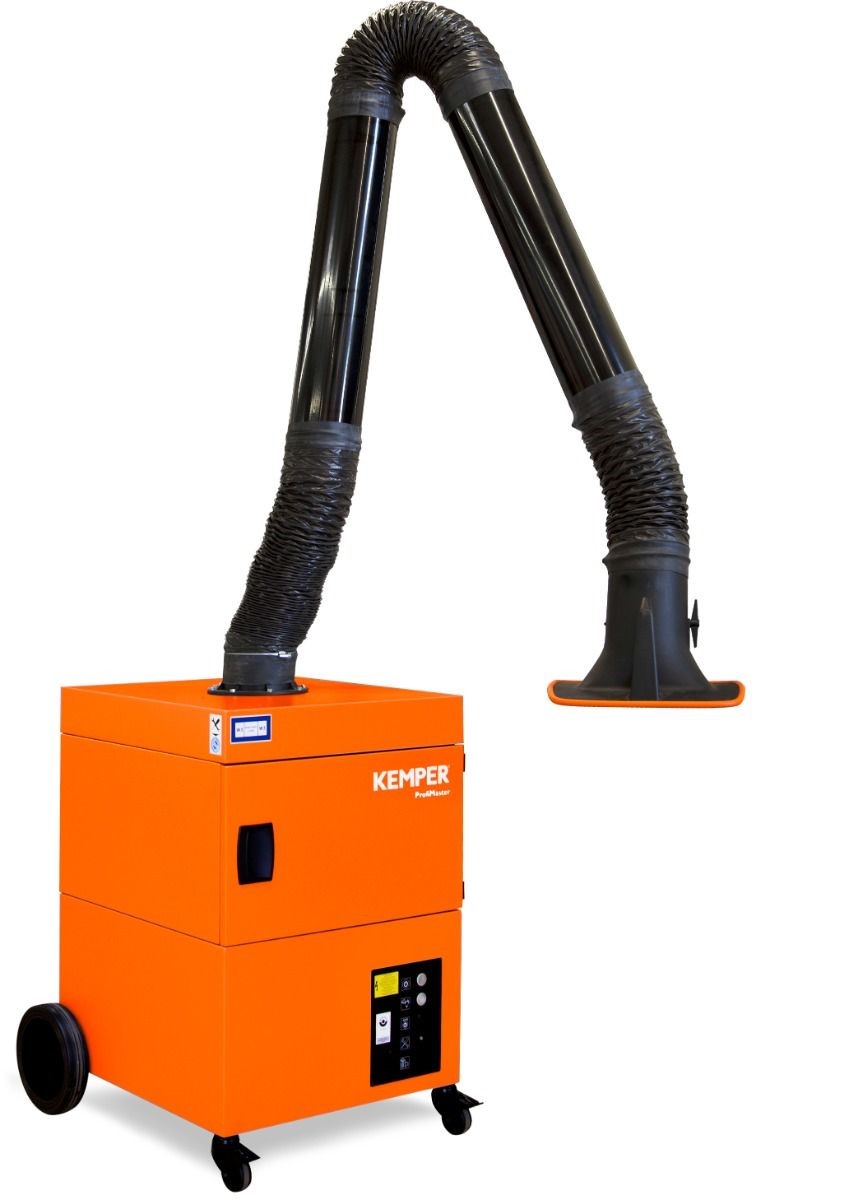
While the filter unit and fan system form the heart of any welding fume extraction solution, the extraction arm serves as its most critical interface—the component that ultimately determines real-world performance and usability. Kemper has established itself as the industry leader in extraction arm design, with their arms for the Profimaster and other systems setting the benchmark for effectiveness, durability, and user acceptance. This article examines the engineering excellence behind Kemper extraction arms and why their design makes a substantial difference in practical workshop applications.
The Fundamental Principles of Extraction Arm Design
Before exploring Kemper's specific innovations, it's important to understand the key engineering challenges that any extraction arm must address:
The Capture Efficiency Challenge
The primary function of an extraction arm is to position an intake hood near enough to the welding point to capture fumes before they disperse or reach the welder's breathing zone. This requires:
- Sufficient airflow velocity at practical working distances
- Ability to maintain position without drifting during operation
- Hood design that maximizes capture while minimizing interference
- Flexibility to follow the weld as it progresses across the workpiece
The Usability Imperative
Even the most technically capable extraction arm will fail in practice if welders find it difficult or cumbersome to use. Critical usability factors include:
- Ease of positioning with minimal physical effort
- Stability once positioned without requiring constant readjustment
- Smooth movement that allows precise hood placement
- Intuitive operation that becomes second nature to welders
- Minimal interference with the welding process itself
The Durability Requirement
Workshop environments subject extraction arms to significant stresses and challenges:
- Constant repositioning stressing joints and support mechanisms
- Exposure to heat, spatter, and occasionally impact
- Potential contact with tools, materials, and equipment
- Continuous airflow creating internal wear
- Varying operator handling from gentle to forceful
The Airflow Efficiency Mandate
From an engineering perspective, the arm must also maintain airflow efficiency:
- Minimize pressure drop to maintain effective capture velocity
- Reduce turbulence that decreases extraction effectiveness
- Prevent internal debris accumulation that might restrict flow
- Maintain consistent performance throughout the full range of motion
- Allow appropriate airflow adjustment for different processes
Kemper's Distinctive Approach to Arm Design
Kemper's extraction arms for the Profimaster and other systems reflect a fundamentally different engineering philosophy compared to most competitors, with distinctive design elements that address each of the core challenges.
External Support Structure: The Foundation of Performance
Perhaps the most visually distinctive feature of Kemper arms is their external support structure. Unlike most competitors that route support mechanisms inside the airflow path, Kemper's approach places the supporting structure outside.
This design decision delivers several significant advantages:
- Unobstructed Airflow Path: The internal duct remains completely smooth with no obstacles, reducing turbulence and pressure drop by approximately 30% compared to internally supported designs.
- Improved Capture Efficiency: The reduced pressure drop translates directly to higher capture velocity at the hood for the same fan power, improving actual fume capture effectiveness.
- Contamination Prevention: Without internal support mechanisms to collect debris, the airflow path remains clean and unrestricted throughout the arm's service life.
- Simplified Maintenance: The external support structure allows visual inspection of components and easier access for adjustment or repair without disassembling the airflow path.
- Enhanced Durability: The external structure protects the actual airflow conduit from external impacts and stresses, extending operational life.
Independent testing has shown that Kemper's external support approach delivers approximately 15-20% greater airflow at the same fan power compared to internally supported arms of similar dimensions, directly improving capture effectiveness in real-world applications.
Precision-Engineered Joint System: The Key to Usability
The joints connecting arm segments represent the most critical mechanical components affecting usability. Kemper's joint design reflects deep understanding of welder needs and workshop realities:
- Friction-Based Position Retention: Rather than using tighter pivot points that become difficult to move, Kemper employs precision-calibrated friction surfaces that maintain position without excessive movement force.
- External Adjustment Mechanism: Each joint features easily accessible external tension adjustment, allowing quick tuning to operator preferences or compensating for wear over time.
- Self-Lubricating Bearing Surfaces: Special composite materials at friction points provide smooth movement without requiring periodic lubrication or maintenance.
- Balanced Tension Distribution: The force required to move each joint is carefully balanced, creating a natural, intuitive positioning experience regardless of arm extension.
- Parallelogram Mechanism: The supporting structure uses a parallelogram design that maintains hood height when the arm is extended horizontally, reducing the need for constant vertical readjustment.
These joint features combine to create an arm that operators describe as feeling "weightless" during positioning while remaining rock-solid once placed. Workshop studies show Kemper arms typically require 40-50% less force to position compared to competitor designs, significantly improving operator acceptance and consistent use.
Advanced Hood Design: Optimizing the Capture Interface
The extraction hood represents the critical interface where fumes enter the system. Kemper's hood design incorporates several advanced features:
- Aerodynamic Profile: The hood shape optimizes airflow patterns to maximize capture zone volume while minimizing turbulence.
- 360° Rotation Capability: The hood rotates fully around its axis, allowing optimal positioning regardless of approach angle or weld direction.
- Integrated Damper: A built-in airflow adjustment damper allows fine-tuning for different processes, particularly important for gas-shielded welding where excessive airflow can disrupt shielding.
- Optional Integrated Lighting: Available LED illumination built directly into the hood provides clear visibility of the weld area without requiring separate task lighting.
- Impact-Resistant Construction: High-strength composite materials withstand occasional contact with tools or workpieces without cracking or deformation.
- Heat-Resistant Design: Materials and construction techniques specifically selected to withstand the high-temperature environment near welding operations.
Field testing has demonstrated that Kemper's hood design maintains approximately 0.5-0.7 m/s capture velocity (the recommended minimum for effective fume extraction) at distances up to 30-35cm from the hood face—significantly farther than most competitor designs achieving similar velocity at only 20-25cm.
Premium Materials and Construction: The Foundation of Durability
Beyond the design innovations, Kemper's component selection and manufacturing quality set their extraction arms apart:
- High-Grade Aluminum Extrusions: Structural components use aluminum alloys selected specifically for strength-to-weight ratio and corrosion resistance.
- Flame-Retardant Hose Material: The flexible hose sections use specialized materials that resist both heat damage and flame propagation.
- Precision Machined Connections: Joint components are manufactured to tight tolerances, reducing play and wear over time.
- UV-Stabilized External Components: All plastic components incorporate UV stabilizers to prevent degradation even in workshops with significant ultraviolet exposure.
- Powder-Coated Finish: The distinctive blue finish is not merely decorative but a high-durability powder coating that resists chipping and scratching in workshop environments.
The material quality and manufacturing precision result in an expected service life of 8-10 years for Kemper extraction arms in typical applications—approximately 30-40% longer than industry averages for comparable equipment.
Performance Advantages in Practical Application
The engineering excellence embodied in Kemper extraction arms translates directly to measurable advantages in everyday workshop use:
Superior Capture Efficiency
Independent testing has consistently demonstrated Kemper's performance advantage:
- Extended Capture Zone: Effective fume capture occurs at 25-30% greater distance from the hood compared to typical competitor designs.
- Wider Capture Area: The effective capture zone extends approximately 20-25% wider around the hood perimeter due to optimized airflow patterns.
- Consistent Performance Throughout Movement Range: Airflow remains consistent regardless of arm position, unlike many designs that lose effectiveness when fully extended.
- Reduced Sensitivity to Cross-Drafts: The higher capture velocity makes the system less susceptible to workshop air currents interfering with fume collection.
- Maintained Performance Over Time: The design resists performance degradation, with systems typically showing less than 5% reduction in airflow after years of service.
For welders, these performance advantages mean more effective protection with less precise hood positioning required—a significant benefit in real-world workshop conditions where perfect positioning isn't always practical.
Enhanced Welder Acceptance
The design advantages directly improve operator acceptance and consistent use:
- Reduced Physical Effort: The balanced, low-friction joints require minimal force to position, reducing operator fatigue.
- Positional Stability: Once positioned, the arm remains exactly where placed without creeping or drifting during operation.
- Intuitive Operation: The natural movement feel allows operators to develop muscle memory for positioning, making extraction use second nature rather than a conscious effort.
- Reduced Process Interference: The aerodynamic hood design minimizes disruption to shielding gas while maintaining effective capture.
- Visual Accessibility: The external support structure leaves a clear line of sight to the weld area from most angles.
User studies show that workshops implementing Kemper arms typically achieve 30-40% better consistent use by welders compared to facilities with more cumbersome extraction systems—directly translating to improved protection and regulatory compliance.
Extended Operational Lifespan
The durability advantages deliver significant long-term value:
- Reduced Mechanical Wear: The external support structure and precision joints show minimal wear even after years of daily use.
- Resistance to Contamination: The smooth internal airflow path prevents debris accumulation that can restrict performance in other designs.
- Simplified Maintenance: External adjustment points allow quick tension tuning without disassembly, encouraging proper maintenance.
- Component Longevity: High-quality materials and precision manufacturing result in significantly extended service intervals.
- Excellent Repair Capability: The modular design allows replacement of individual components rather than entire arm assemblies if damage does occur.
Maintenance records from hundreds of installations show Kemper arms typically require major service approximately half as frequently as comparable competitor products, resulting in lower lifetime ownership costs despite the premium initial price point.
Extraction Arm Options for Different Applications
Kemper offers several extraction arm variants to address different workshop requirements:
Length Options for Various Coverage Needs
The extraction arms are available in multiple length configurations to suit different applications:
- 2-Meter Arms: Ideal for confined workspaces or dedicated welding booths where closer unit positioning is possible. These provide approximately 12-15 square meters of effective coverage area.
- 3-Meter Arms: The most popular configuration, offering an optimal balance of reach and manoeuvrability. These typically cover approximately 25-30 square meters of working area.
- 4-Meter Arms: Designed for applications requiring extended reach, such as large workpieces or wide work areas. These can cover up to 50 square meters but require more careful positioning and adjustment.
- Multi-Joint Arms: Available for specialized applications requiring exceptional reach or unusual positioning capabilities, such as reaching inside large vessels or over tall obstacles.
Each length variant maintains the same fundamental design advantages while optimizing the support structure and balance mechanism for the specific dimensions.
Specialized Variants for Unique Requirements
Beyond the standard configurations, Kemper offers specialized arm designs for specific applications:
- Low-Ceiling Models: Modified designs with alternative joint arrangements to accommodate facilities with height restrictions.
- Telescopic Arms: Extendable designs that combine compact storage with extended reach when needed, ideal for occasionally accessing difficult positions.
- Stainless Steel Variants: Special versions using stainless steel components for food processing, pharmaceutical, or other applications requiring enhanced cleanliness or corrosion resistance.
- High-Temperature Models: Enhanced variants with additional heat shielding for applications like plasma cutting or high-amperage gouging that generate extreme heat.
- ATEX-Certified Versions: Specially designed variants meeting explosion protection requirements for hazardous environments containing flammable gases or dusts.
These specialized options ensure that facilities with unique requirements can still benefit from Kemper's fundamental design advantages while addressing their specific operational needs.
Integration with Kemper Extraction Systems
While this article focuses on the extraction arms themselves, it's important to note how they integrate with the broader Kemper extraction system ecosystem:
Profimaster System Integration
With the Kemper Profimaster, the extraction arm forms part of a complete engineered system:
- Balanced Performance Matching: The arm dimensions and airflow characteristics are precisely matched to the Profimaster's fan performance curve for optimal results.
- Simplified Connection Interface: A standardized connection system allows quick arm installation or replacement without specialized tools.
- Coordinated Control Integration: Optional features like hood-mounted controls interface seamlessly with the Profimaster's main control system.
- Complementary Filtration Design: The arm's aerodynamic performance complements the Profimaster's filtration system, delivering particles to the filter in a pattern that optimizes cleaning effectiveness and filter life.
- Unified Aesthetic Design: The distinctive blue finish and design language create a cohesive professional appearance for the complete extraction solution.
This systems-engineering approach ensures that the complete extraction solution delivers performance greater than the sum of its individual components.
Retrofitting Capability
Kemper extraction arms can also refresh older systems or replace damaged components:
- Universal Connection Adapters: Available adapters allow Kemper arms to be fitted to many third-party extraction systems, bringing their performance advantages to existing infrastructure.
- Performance Upgrade Path: Retrofitting Kemper arms to aging systems often provides a cost-effective performance boost without complete system replacement.
- Mixed-Fleet Standardization: Facilities with various extraction systems can standardize on Kemper arms for consistent operator experience across different units.
- Gradual Migration Strategy: Allows phased transition to Kemper equipment by starting with arm replacements and later upgrading base units as budgets permit.
This flexibility makes Kemper extraction arms a viable option even for facilities not ready for complete system replacement but seeking improved performance from existing equipment.
Case Studies: Real-World Performance
The advantages of Kemper extraction arms are best illustrated through actual implementation examples:
Precision Fabrication Workshop
A high-end stainless steel fabricator specializing in food processing equipment switched their extraction systems to Kemper Profimaster units with 3-meter arms after struggling with inconsistent use of their previous extraction equipment. They reported:
- 45% improvement in measured air quality at welding stations
- Near-universal adoption by welders without enforcement requirements
- Significant reduction in arm positioning adjustments during long welds
- Virtual elimination of complaints about extraction interference with the welding process
- Measurable improvement in weld quality due to reduced contamination from poor extraction
The production manager specifically noted that the ease of positioning and stability of the Kemper arms transformed extraction from a "necessary inconvenience" to a "natural part of the welding process" for their team.
Welding Education Program
A technical college teaching welding trades replaced their aging extraction arms with Kemper units while retaining their existing filtration systems. Their experience highlighted several advantages:
- Students learned proper extraction practices more quickly due to the intuitive positioning
- Instructor demonstrations became more effective with extraction properly positioned without obstructing student views
- Maintenance requirements dropped substantially despite heavy use by inexperienced operators
- Workshop air quality improved noticeably even with the same base filtration units
- Arm longevity improved significantly despite the challenging educational environment
The lead instructor commented that the Kemper arms had "democratized extraction use" by making proper positioning accessible to beginners rather than requiring significant experience to use effectively.
Heavy Equipment Repair
A maintenance facility servicing construction and mining equipment upgraded to Kemper extraction arms to address challenges with their previous system:
- Technicians could now effectively capture fumes even when working in awkward positions inside large equipment
- The arms maintained position reliably despite vibration from nearby operations
- The extended capture zone allowed effective extraction without constant repositioning during repairs
- Reduced arm movement effort was particularly appreciated during long repair sessions
- The durable construction withstood the harsh repair environment without damage
The safety manager reported that welder compliance with extraction use increased from approximately 60% to over 95% after the upgrade, simply because the Kemper arms were significantly easier and more effective to use.
Installation and Maintenance Considerations
To maximize the benefits of Kemper extraction arms, proper installation and maintenance are essential:
Installation Best Practices
Whether installed on new Profimaster units or retrofitted to existing systems, proper setup ensures optimal performance:
- Height Optimization: Mount at a height that balances vertical reach with overhead clearance, typically 2.1-2.4 meters above floor level for most applications.
- Initial Joint Adjustment: Set tension on all joints to match the specific application and operator preferences, with higher tension typically needed for longer arms.
- Hood Configuration: Position the damper and hood rotation to align with expected working patterns and welding types.
- Movement Range Testing: Verify full movement through the intended coverage area without binding or interference.
- Airflow Verification: Confirm proper capture velocity at typical working distances using smoke tests or air velocity measurements.
Proper initial setup typically requires 30-45 minutes but pays significant dividends in performance and user acceptance throughout the arm's service life.
Routine Maintenance Requirements
To maintain optimal performance, Kemper extraction arms benefit from these periodic maintenance activities:
- Quarterly Joint Inspection: Check all pivot points for smooth operation and proper tension, adjusting as needed using the external adjustment mechanisms.
- Annual Hose Examination: Inspect flexible hose sections for wear, heat damage, or potential leaks, particularly at connection points and areas of frequent bending.
- Biannual Hood Maintenance: Verify proper hood damper operation, clean any accumulated spatter, and check hood rotation for smooth movement.
- As-Needed Cleaning: Remove any external dust accumulation, particularly from joint mechanisms, to prevent contamination of moving parts.
- Periodic Tension Adjustment: Readjust joint tension as needed based on observed performance, typically required once or twice annually in normal use.
These maintenance activities typically require less than 15 minutes per arm per session and help ensure continued performance throughout the expected 8-10 year service life.
This guide is intended for informational purposes only and should not be considered legal advice. Regulations change frequently, and we recommend consulting with regulatory specialists for your specific situation.