The end of an aisle is where the worst things happen in warehouses. The geometry of aisle-end positions concentrates risk in ways that the rest of the warehouse does not. Forklift turning movements bring trucks close to upright structures. Visibility around corners is reduced. Pedestrian and vehicle traffic crosses paths. Stock placement and retrieval involves manoeuvres that demand precision in tight spaces. The combination of factors makes aisle-end uprights statistically the most damaged structural elements in nearly every UK warehouse — and the locations where serious incidents are most likely to originate.
End of aisle protection — the focused application of protective equipment at these high-risk zones — is therefore one of the highest-leverage safety investments a warehouse operator can make. Specifying end of aisle protection well, with appropriate equipment selection, comprehensive coverage and integration into the wider safety programme, addresses the locations where risk is concentrated and where the consequences of incidents would be most severe.
This article focuses specifically on end of aisle protection. It examines why the end-of-aisle position presents elevated risk, what equipment options are available, how to specify protection appropriately, and how end of aisle protection integrates with broader warehouse safety arrangements. The Rack Armour range supplied by Hall-Fast Industrial Supplies receives particular attention as the leading premium specification for end-of-aisle upright protection in UK warehousing.
The Rack Armour range is available at the Rack Armour section. Hall-Fast's wider portfolio of warehouse safety equipment is available through the brands page, and discussion can be initiated through the Contact page.
The End-of-Aisle Risk Profile
Several specific factors combine to make the end of an aisle the highest-risk zone in most warehouses.
The first factor is forklift geometry. A forklift truck turning into or out of an aisle traces a curved path that brings the truck body close to the end-of-aisle uprights at specific points in the manoeuvre. The clearance is geometrically tighter than the clearance maintained mid-aisle, where the truck travels in a straight line within the marked aisle width. The tighter clearance produces higher contact frequency at end positions.
The second factor is visibility. The geometry of aisles creates blind spots at corners. A forklift driver approaching an aisle end has reduced visibility of activity in the cross-aisle, on the other side of the racking, or behind the rack run. A driver in the cross-aisle has reduced visibility of activity within the aisle itself. The reduced mutual visibility increases the risk of unexpected contact at the interface.
The third factor is operational activity. End-of-aisle positions tend to see more diverse activity than mid-aisle positions. Forklifts travelling through, forklifts turning into the aisle, forklifts loading or retrieving from end positions, pedestrian traffic crossing the aisle, equipment moving between aisles — all of this activity concentrates at the ends in ways that mid-aisle positions do not see.
The fourth factor is psychological. Operators turning at aisle ends are simultaneously managing several attention demands: the steering of the forklift, the position of the load, the destination of the move, the awareness of other traffic, and the visual scan for hazards. The cognitive load is higher at aisle ends than mid-aisle, and the elevated cognitive load reduces the operator's available capacity for fine motor control of the truck position.
The fifth factor is consequence. Damage to end-of-aisle uprights tends to have more severe structural consequences than damage to mid-aisle uprights. The end uprights typically bear the load of the rack run, and structural compromise at the end can affect the integrity of the entire run. The cascading consequences of end-of-aisle damage tend to be more severe than the localised consequences of mid-aisle damage.
The combination of these factors produces a risk profile that warrants focused attention. End of aisle protection is not just protection at one type of location — it is protection at the locations where the protection investment delivers the highest leverage.
What End of Aisle Protection Looks Like
End of aisle protection takes several forms depending on the specific risk profile and the protection objectives.
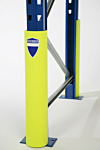
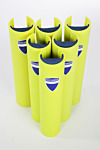
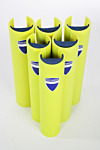
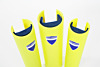
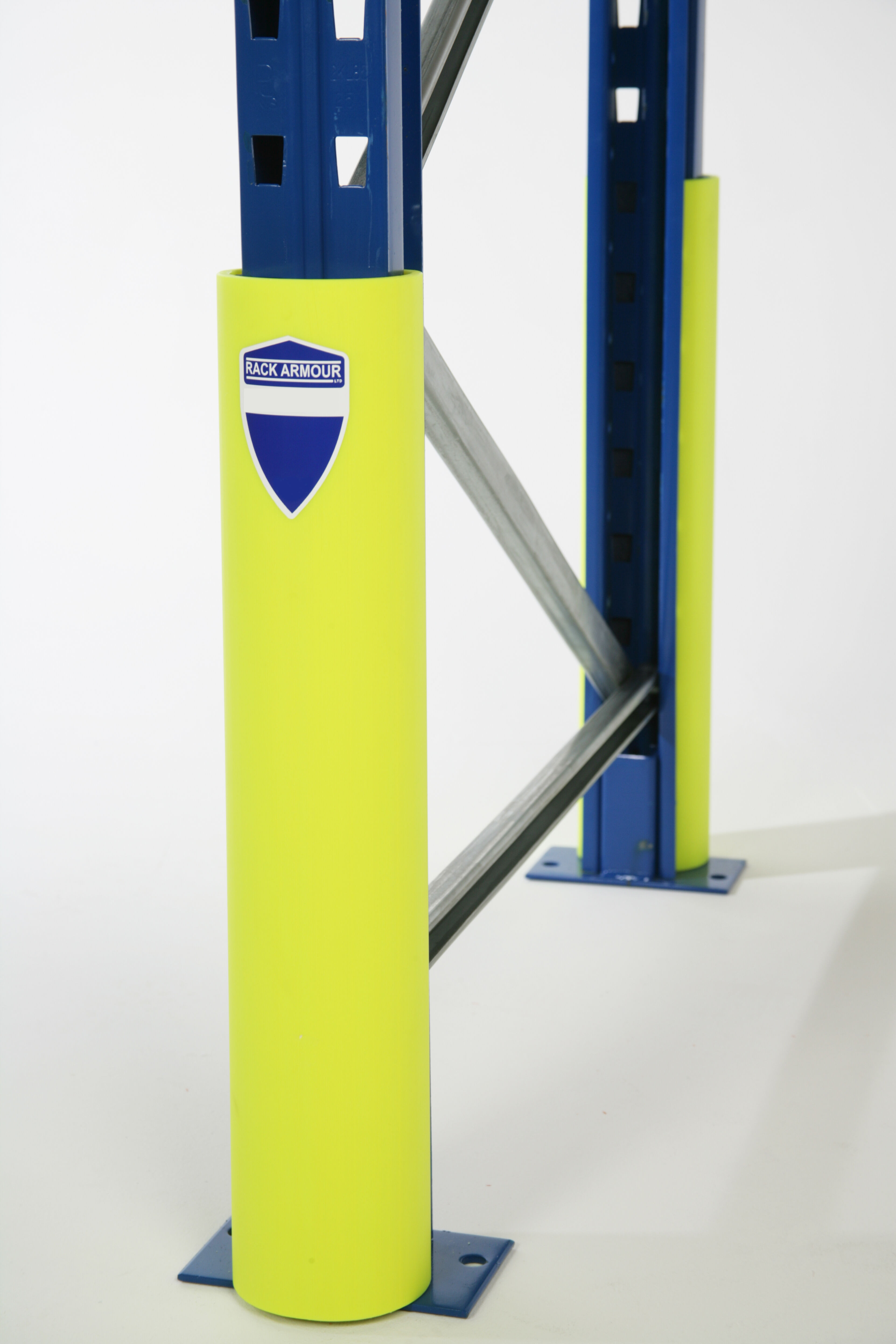
The most fundamental element is upright protection at the end-of-aisle uprights themselves. The Rack Armour range provides the leading premium specification for this purpose. The polymer construction absorbs the impact of forklift contact through controlled deformation, returning to original shape after impact and continuing to provide protection through repeated impact events. The hi-vis yellow finish supports operator orientation at the visually-busy aisle-end position.
The Rack Armour size specification at end-of-aisle positions typically follows the size of the upright being protected. For typical pallet racking, Rack Armour large hi-vis yellow is a common specification. For heavier-duty applications including drive-in or high-bay racking, XL hi-vis yellow or XXL hi-vis yellow provides the appropriate match. For lighter-duty applications, medium hi-vis yellow or small hi-vis yellow covers the requirement.
Beyond the basic upright protection, end of aisle protection may include barriers, bollards or end frames that provide a physical interposition between forklift and rack structure. These elements address contacts that would otherwise reach the upright with more force than the upright protection alone could absorb.
End-of-aisle visual aids — additional signage, floor markings, lighting — support the operator's task of managing the elevated cognitive load at the aisle end. Markings indicating the cross-aisle, hazard zones and approach guidance support correct behaviour at the high-risk position.
The integrated end-of-aisle protection approach combines these elements in proportion to the specific risk profile of each location. Higher-risk aisle ends warrant more comprehensive protection; lower-risk ends may be adequately addressed by upright protection alone.
Specification Choices: Polymer vs Steel vs Foam
Within the upright protection element specifically, the choice of material has implications for end-of-aisle performance.
Steel bolt-down guards have been the traditional approach for end-of-aisle protection. They block impact by physical interposition: the steel guard takes the contact instead of the upright. The protection at the moment of contact is robust. However, the limitations of steel are particularly relevant at end-of-aisle positions: the bolt-fixing causes floor damage that may be problematic in the high-traffic end-of-aisle zone; the steel-on-steel contact between forklift and guard can damage the forklift contact surfaces; the energy transmitted to the floor through the fixings can produce floor cracking under repeated contact; and the guard itself takes damage on contact and may need replacement after significant impacts.
Polyurethane foam guards offer a softer alternative but typically lack the impact-absorption capacity needed for the higher-energy contacts that aisle ends often experience. The foam may compress permanently under repeated impact, losing its protective function over time.
Engineered polymer guards — including the Rack Armour range — combine impact absorption with the practical advantages of polymer construction. The polymer absorbs and dissipates impact energy through controlled deformation, returning to shape after impact. There is no floor damage from fixing points. The contact surface is forgiving to forklift contact. The unit typically continues providing protection through repeated impacts without replacement. For end-of-aisle positions specifically, where the operational stresses are elevated, the engineered polymer specification is particularly well-suited.
The Hall-Fast Price Promise ensures competitive pricing on authentic Rack Armour, supporting the strongest commercial case for the premium specification at the high-leverage end-of-aisle positions. The wider brands portfolio supports complementary equipment specification for the integrated end-of-aisle protection programme.
OUR PRICE PROMISE
OUR PRICE PROMISE!
We will not be beaten on price on any authentic Rack Armour product anywhere in the United Kingdom. If you find a better price on the internet or receive a quotation from any other supplier, please let us know and we will match it. For end-of-aisle protection specifically, this commitment ensures that the premium specification appropriate to these high-leverage positions is available at the most competitive purchase pricing in the UK market.
Coverage Strategy at Aisle Ends
A specific strategic question for end-of-aisle protection is the coverage extent. Several options exist, and the appropriate choice depends on the specific operational context.
The minimum coverage approach addresses the end uprights only — the two uprights at each end of each rack run. This minimum coverage delivers the largest part of the available risk reduction because the end uprights are the primary contact targets. For operations beginning to develop their protection programme, end-uprights-only coverage at aisle ends is a high-leverage starting point.
The expanded coverage approach extends protection to the second uprights from each end — the next bay along on each side. Forklift contact during turning manoeuvres can affect not just the end upright but the next upright along, particularly in narrower aisles or with longer trucks. Expanded coverage at aisle ends addresses this geometric reality.
The comprehensive aisle-end coverage approach extends protection to all uprights within a defined zone of the aisle end — perhaps the first three or four uprights in from each end. This approach addresses the diffuse contact pattern that develops over time as operators encounter the various contact geometries that arise during turning manoeuvres.
The full-aisle approach extends comprehensive Rack Armour coverage to every upright in the aisle, with particular attention to the end positions but coverage throughout. This approach provides the most consistent operator experience and the broadest risk coverage. For most operations, full-aisle coverage is the recommended approach for primary trafficked aisles, with end-of-aisle attention as part of the comprehensive programme.
The choice between these approaches depends on operational context, risk profile, budget, and the cumulative coverage strategy across the warehouse. Conversation through the Contact page can address the specific coverage choice for specific operations.
Integration with Wider Aisle Safety
End of aisle protection is one element of a wider aisle safety approach. The integrated approach considers the aisle as a system, with the end positions as the highest-risk elements within the system but not the only elements.
Aisle width specification affects the contact risk throughout the aisle. Wider aisles produce lower contact frequency at all positions including ends. Narrower aisles concentrate contact risk and demand more comprehensive protection. The aisle width specification at design or reconfiguration is a strategic decision that affects the protection requirement.
Aisle marking — the floor paint or tape that defines the aisle boundaries — supports operator orientation throughout the aisle. Strong markings at aisle ends, including indication of cross-aisle traffic and pedestrian zones, support the operator's task at the high-cognitive-load end position.
Lighting affects visibility throughout the aisle, with lighting at end positions warranting particular attention given the cognitive demands at these locations. Inadequate lighting compromises the operator's task; adequate lighting supports correct behaviour.
Pedestrian traffic management at aisle ends is particularly important because the cross-aisle traffic that flows past aisle ends includes pedestrian movements that interact with vehicle movements. Pedestrian barriers, designated walkways, and visual separation all support the safe interaction.
Forklift technology features — speed limiters, operator-presence systems, anti-tip features — support correct operation at aisle ends as elsewhere in the warehouse.
The end-of-aisle Rack Armour protection sits within this wider system. The protection absorbs the contacts that the wider system has not prevented, providing the final engineering layer of risk control. The wider system reduces the contact frequency that the protection has to address; the protection ensures that the contacts that do occur are absorbed without consequences for the racking.
Sector-Specific End-of-Aisle Considerations
Different operational sectors present different end-of-aisle risk profiles, with implications for the specification approach.
Cold storage operations face elevated risk at aisle ends because of the visibility challenges in low-light, condensation-prone environments and the operator capacity reductions associated with cold-environment work. Comprehensive end-of-aisle Rack Armour XL hi-vis yellow protection addresses these elevated risks, with the hi-vis yellow finish particularly valuable for visibility in challenging lighting conditions.
Pharmaceutical operations face elevated documentation and audit demands at aisle ends as throughout the warehouse. The visible orderly arrangement supported by comprehensive end-of-aisle protection contributes to the regulatory positioning that pharmaceutical operations require.
Chemical operations face elevated consequences from any damage events at aisle ends because of the potential for spillage, environmental contamination or fire ignition. Comprehensive premium specification at aisle ends supports the safety case that chemical operations need to demonstrate.
Third-party logistics operations face elevated commercial sensitivity to aisle-end damage events because such events can affect multiple clients' stock simultaneously. Comprehensive demonstrable protection at aisle ends supports the contractual positioning that 3PL operations rely on.
Retail and e-commerce fulfilment operations face elevated frequency of contact at aisle ends because of the high-throughput operations characteristic of the sector. The cumulative contact exposure across thousands of movements per shift makes the protection investment particularly valuable.
For each of these sectors, conversation with Hall-Fast through the Contact page can address sector-specific end-of-aisle specification considerations.
Implementation: Phased and Comprehensive Approaches
Implementation of end of aisle protection can follow phased or comprehensive approaches depending on operational and budgetary constraints.
The phased approach starts with the end uprights at the highest-risk aisles, extends to other aisle ends, and gradually develops to comprehensive coverage. This approach allows operational learning between phases and supports phased budget planning. The disadvantage is that the cultural messaging of comprehensive safety investment is less complete during the phased build-out.
The comprehensive approach addresses all aisle ends in a single implementation programme, completing the end-of-aisle protection programme before moving to other coverage extensions. This approach delivers stronger cultural messaging and faster realisation of the protection benefits, but requires larger initial investment.
The hybrid approach combines elements of both: comprehensive coverage of the highest-risk aisle ends in a single phase, with subsequent phases extending coverage to other aisle ends and beyond. This approach balances the cultural and operational benefits of comprehensive coverage with the budgetary and operational constraints that may affect implementation.
For operators choosing between these approaches, conversation through the Contact page can address the specific operational context and the most appropriate implementation approach.
Documentation and Demonstrable Protection
End of aisle protection benefits particularly from strong documentation because of the elevated risk profile of the protected positions. The documentation should clearly identify which aisle-end positions have been protected, with what specifications, when, and by whom.
The documentation supports several specific functions at end-of-aisle positions. Insurance review benefits from demonstrable evidence of protection at the highest-risk positions specifically. Audit and customer review benefits from the visible documentation of focused attention at the highest-risk locations. Continuous improvement benefits from systematic records that allow analysis of contact patterns at end positions over time.
The documentation should include the specification of the protection (which Rack Armour size at each location), the supplier records (purchase information from Hall-Fast), the installation details (when and by whom), the inspection records (regular assessment of continued serviceability), and the damage records (any contact events absorbed by the protection).
The integrated documentation forms part of the wider warehouse safety records and supports the demonstrable risk management that insurance, regulatory and commercial interests increasingly expect to see. Hall-Fast can support the documentation function by providing detailed product information, supply records, and specification advice that integrates with the customer's records. The Contact page is the route to discussing documentation requirements alongside the technical specification.
Working with Hall-Fast on End-of-Aisle Specification
Hall-Fast's experience supplying UK warehousing includes extensive familiarity with end-of-aisle protection specification across many operational contexts. The decades of experience summarised at the About page provide depth of perspective that supports specification appropriate to each operation.
The Rack Armour range provides the foundation for end-of-aisle upright protection. The full range — covering small, medium, large, XL and XXL hi-vis yellow sizes, with safety yellow alternatives in small, medium, large and XL sizes — supports specification matching for any upright profile encountered in UK warehousing.
The installation tools and larger installation tool support reliable in-house installation, with the correct tensioning of strapped fixings for long-term performance at the high-stress aisle-end positions.
The wider brands portfolio supports specification of complementary end-of-aisle equipment including barriers, bollards, signage and visual aids. The integrated supply through Hall-Fast supports the coherent end-of-aisle protection programme.
The Contact page is the route to specification advice, quotation, and ongoing engagement on end-of-aisle protection. Many of Hall-Fast's customer relationships have developed deep familiarity with the customer's operational reality, supporting specification decisions that genuinely fit the operational context.
Frequently Asked Questions
How much should I prioritise end-of-aisle versus other locations? End-of-aisle positions warrant priority within the protection programme because of the elevated risk profile. For operations with limited budget for an initial phase, comprehensive protection at all aisle ends is typically the highest-leverage starting point.
What about aisles with very low traffic? Even low-traffic aisles benefit from end-of-aisle protection because the consequences of damage at end positions are severe regardless of contact frequency. The economic case for end-of-aisle protection holds even at relatively low contact frequencies.
Should I specify larger sizes at aisle ends than mid-aisle? Some operations specify upgraded protection at aisle ends — for example, Rack Armour XL hi-vis yellow at aisle ends with large hi-vis yellow mid-aisle on the same upright profile. Where the upright profile permits, the upgraded specification at aisle ends provides additional margin against the elevated impact risk at these positions.
How do I integrate with floor-fixed barriers at aisle ends? Floor-fixed barriers and end-of-aisle Rack Armour upright protection are complementary rather than alternatives. The barriers provide additional physical interposition for higher-energy impacts; the upright protection absorbs the contacts that reach the upright. Both have a role in comprehensive end-of-aisle protection.
What if my aisles are too narrow for any contact margin? Very narrow aisles produce elevated contact frequency throughout the aisle including but not limited to the end positions. Comprehensive Rack Armour protection throughout narrow aisles is the recommended approach, with particular attention to end positions but coverage extending throughout. Conversation through the Contact page can address narrow-aisle specification considerations.
The Geometry of Aisle-End Contact
A more detailed examination of the geometry of aisle-end contact illuminates why this position concentrates risk and how protection specification can address it effectively. Several specific contact patterns recur across UK warehouses.
The turning-in pattern occurs when a forklift turning from the cross-aisle into the aisle clips the inside upright at the entry point. The geometry of the turn brings the truck body or the load close to the upright at a specific point in the manoeuvre. Operators with experience of the specific aisle develop the precision to navigate the turn cleanly, but the margin for error is small and contacts occur regularly.
The turning-out pattern is the reverse: a forklift turning out of the aisle into the cross-aisle clips the inside upright as it begins the turn. This pattern is particularly common when the operator is focused on the destination beyond the aisle end and does not maintain optimal attention to the immediate corner geometry.
The wide-load pattern occurs when a forklift carrying a load wider than the truck body itself produces contact at points that the operator cannot see directly. The load extends beyond the operator's direct field of view, and contacts can occur at the load corners rather than at the truck body itself. End-of-aisle positions are particularly affected because the geometry of turns brings the load corners close to the racking.
The reverse-out pattern occurs when a forklift reversing out of an aisle clips the upright at the end position during the reverse manoeuvre. Reversing operations have inherently reduced visibility, and the end-of-aisle position is exactly where the operator's view is most constrained.
The cross-traffic pattern involves contacts that arise from the interaction between vehicles in the cross-aisle and the end-of-aisle uprights. A vehicle travelling along the cross-aisle can contact end uprights if the vehicle path drifts toward the racking or if the load extends into the racking zone.
Each of these contact patterns warrants protection, and the Rack Armour range addresses them all through its comprehensive impact-absorption capability. The polymer construction absorbs contacts from various directions and at various speeds without requiring direction-specific specification. The full coverage of the lower upright section provides protection regardless of the specific contact geometry.
For operators wishing to understand the specific contact patterns of their operation, analysis of damage records over time typically reveals the dominant patterns. The records support targeted improvement of layout, training, equipment specification or operational practice in addition to the protection programme.
Pedestrian Considerations at Aisle Ends
A specific dimension of aisle-end risk worth examining is the pedestrian dimension. Pedestrians in warehouse environments may be operators on foot, supervisors, maintenance workers, visitors, contractors or other staff. The interaction between pedestrians and vehicle movements at aisle ends creates a category of risk that pure vehicle-protection specification does not address.
Pedestrians at aisle ends face the same visibility challenges as forklift operators. The corner geometry produces blind spots that affect pedestrian situational awareness as well as operator awareness. A pedestrian crossing the cross-aisle at an aisle end may not see an approaching forklift; the forklift operator may not see the crossing pedestrian.
The consequences of pedestrian-vehicle contact are severe regardless of the specific damage to racking. Forklift impact with a pedestrian can produce serious injury or fatality, with consequences for the affected individual, their family, the operator workforce, and the operation more broadly.
Comprehensive end-of-aisle protection should address the pedestrian dimension explicitly. Pedestrian barriers separating walkways from vehicle zones provide physical separation. Floor markings indicating pedestrian crossings or pedestrian-restricted zones support behavioural orientation. Visual aids such as mirrors at corners support mutual visibility. Lighting supports visibility for both pedestrians and operators.
The Rack Armour upright protection at aisle ends contributes indirectly to pedestrian safety by preventing the rack damage that could lead to subsequent collapse with pedestrian harm potential. The cascading consequences of inadequate protection — damaged uprights leading to compromised structural integrity leading to potential collapse — extend to pedestrian risk that aisle-end protection helps to prevent.
The integrated approach to aisle-end pedestrian safety draws on the wider brands portfolio for complementary equipment specification. The conversation through the Contact page can address the integrated specification including the pedestrian dimension.
Insurance and Risk Management at Aisle Ends
The insurance and risk management implications of aisle-end protection deserve specific attention because of the elevated risk profile of these positions. Insurers and risk managers recognise the aisle-end concentration of risk and respond accordingly to the protection arrangements at these locations.
A warehouse with comprehensive end-of-aisle protection presents to insurers as an operation that has identified its highest-risk zones and addressed them appropriately. This impression supports favourable underwriting consideration across multiple cover categories. Conversely, a warehouse with inadequate end-of-aisle protection signals incomplete risk management — the operator has not focused on the highest-risk locations even within the broader protection programme.
The claims experience of an operation typically shows aisle-end damage at higher frequency than mid-aisle damage. The aggregate cost of aisle-end claims across the renewal cycles reflects this concentration. Operations that have invested in comprehensive aisle-end protection typically show better claims experience than operations that have not, with corresponding insurance economics.
Risk management frameworks identify the highest-leverage protection investments through analysis of risk profile by location. Aisle ends consistently emerge as priority locations for protection investment in this analysis. The financial economics support comprehensive aisle-end protection in nearly every operational context.
For risk management and insurance professionals reviewing protection arrangements, the visible comprehensive end-of-aisle Rack Armour protection — particularly in hi-vis yellow finish — is one of the strongest signals of professional risk management. The investment communicates priority effectively to all stakeholders interested in the operation's risk profile.
The Hall-Fast Price Promise supports the financial case for comprehensive aisle-end protection. The premium specification at the highest-leverage locations is available at competitive purchase pricing, supporting the strongest possible economic case for the investment.
Multi-Site Operators and Standardisation
For operators with multiple UK warehouses, end-of-aisle protection presents specific opportunities for standardisation across the portfolio. Different sites may have developed different end-of-aisle specifications over time, with different effective protection levels.
Standardisation across the portfolio at end-of-aisle positions specifically supports several benefits. Operational consistency: operators moving between sites encounter consistent protection arrangements at the highest-risk positions. Procurement efficiency: standardised specification simplifies ordering, supply and replenishment. Documentation simplicity: portfolio-level records of end-of-aisle protection support consistent audit and review. Cultural messaging: visible consistent investment in highest-risk-zone protection across the portfolio reinforces the safety priority.
Hall-Fast's experience supplying multi-site operators includes supporting the standardisation function through consistent product supply across the portfolio. The Rack Armour range available at the Rack Armour section provides the consistent specification that portfolio standardisation requires. The Contact page is the route to discussing portfolio-level commercial arrangements that support multi-site standardisation.
For multi-site operators developing or refining their end-of-aisle protection programmes, the recommendation is to start with portfolio-wide assessment of current arrangements, identify the gap between current state and the desired standardised specification, and develop a phased programme to close the gap across the operating network.
Maintenance and Continuous Improvement at Aisle Ends
End-of-aisle Rack Armour protection benefits particularly from systematic maintenance and continuous improvement attention because of the elevated stresses at these positions. The protection that absorbs more contacts than mid-aisle equivalent positions warrants more frequent inspection and earlier consideration of replacement.
The inspection regime should include explicit attention to aisle-end positions. The condition of the protection at these locations is one of the strongest indicators of the operation's overall safety performance. Aisle-end protection showing accumulated damage suggests elevated contact rates that may warrant operational attention; pristine protection suggests well-managed operation.
Replacement at aisle-end positions may need to occur more frequently than mid-aisle replacement because of the higher cumulative stress. The cost of replacement is modest, particularly under the Hall-Fast Price Promise, and the operational continuity benefits of maintaining premium protection at the highest-risk positions justify the replacement frequency.
Continuous improvement at aisle ends includes analysis of damage patterns, review of operational practice contributing to contact frequency, consideration of layout modifications that might reduce contact risk, and engagement with the supplier on specification developments that might enhance protection performance.
For operations developing systematic continuous improvement of their aisle-end protection, conversation with Hall-Fast through the Contact page supports the engagement with new product developments, specification enhancements, and best practice across the customer base.
Specifying for Future-Proofing at Aisle Ends
A forward-looking dimension of aisle-end specification is future-proofing — choosing specifications today that will continue to serve the operation as it evolves over the coming years and decades. Several specific considerations support future-proofing at aisle ends.
Throughput growth: most UK warehouses experience throughput growth over time, particularly during the e-commerce expansion of recent years. The aisle-end protection specified today should provide margin for the elevated contact frequency that growth may produce. Premium specification through the Rack Armour range provides this margin without immediate need for upgrade.
Equipment evolution: forklift fleets evolve over time, with new models, new operators and changing operational patterns. Aisle-end protection should accommodate the diversity of equipment likely to operate at these positions over the coming years. The Rack Armour polymer construction is forgiving across diverse equipment types.
Operational change: layout reconfigurations, new product types, and changing operational patterns may shift the specific risk profile of aisle ends over time. The strapped fixing system of Rack Armour supports relocation of protection if racking is reconfigured, providing flexibility that bolt-down alternatives cannot match.
Workforce evolution: operator turnover, agency reliance, and workforce composition changes affect the aisle-end risk profile over time. Comprehensive premium protection that absorbs the contacts of less experienced operators continues to deliver value through workforce transitions.
Standards evolution: industry standards and best practice expectations evolve over time. Specification today that meets or exceeds current best practice provides margin against the elevated expectations of future years.
For operators thinking about future-proofing their aisle-end protection, the recommendation is comprehensive premium specification with the Rack Armour range, supported by the ongoing supplier relationship through Hall-Fast that provides advance notice of evolving best practice and product developments. The Contact page is the route to forward-looking specification conversations.
Closing Thoughts
End of aisle protection addresses the highest-leverage risk locations in the warehouse. The combination of forklift geometry, visibility challenges, operational activity intensity, cognitive load and consequence severity makes aisle-end positions warrant focused protection investment. The Rack Armour range from Hall-Fast Industrial Supplies provides the leading premium specification for end-of-aisle upright protection in UK warehousing.
The full Rack Armour range is available at the Rack Armour section. The installation tools and larger installation tool support reliable installation. The wider brands portfolio covers complementary equipment categories for the integrated end-of-aisle protection programme.
To take the next step on your end of aisle protection programme, visit the Contact page for specification advice, quotation, or supply support. Background information about Hall-Fast is available at the About page.
The investment in comprehensive end of aisle protection delivers disproportionate value relative to its modest cost. The locations protected are the locations where serious incidents are most likely to originate and where the consequences of damage are most severe. The protection at these positions absorbs the contacts that other warehouse safety arrangements have not prevented, providing the final engineering layer at the highest-leverage zones. Make this investment with confidence, with the focused attention that end-of-aisle positions warrant, and with the supplier relationship that brings depth of experience to the partnership.
A Closing Reflection on Hot-Spot Thinking
Beyond the specific topic of end of aisle protection, the article illustrates a broader principle worth recognising: hot-spot thinking. Some locations in the warehouse concentrate risk in ways that other locations do not. Identifying these hot spots and applying focused protection investment produces better outcomes than uniform investment that spreads resources across all locations regardless of risk profile.
End of aisle is one prominent hot spot. Other hot spots may exist in specific operations: pinch points where aisles cross, locations near loading docks where vehicle traffic interacts with internal forklift activity, transition points between different storage zones, locations near building services where damage would have cascading consequences. Each operation has its own pattern of hot spots that warrant attention.
The integrated approach to warehouse safety — drawing on the comprehensive Rack Armour range and the wider brands portfolio supplied through Hall-Fast — supports hot-spot thinking through the specification flexibility that allows different protection levels at different locations. The conversation through the Contact page can address the specific hot-spot pattern of your operation and the protection specification that addresses it appropriately.
Hot-spot thinking, applied alongside the broader principle of comprehensive coverage, produces safety performance that focused investment alone cannot achieve. Make the investment with both perspectives in mind, supported by the integrated supplier relationship that brings depth and breadth to the partnership.