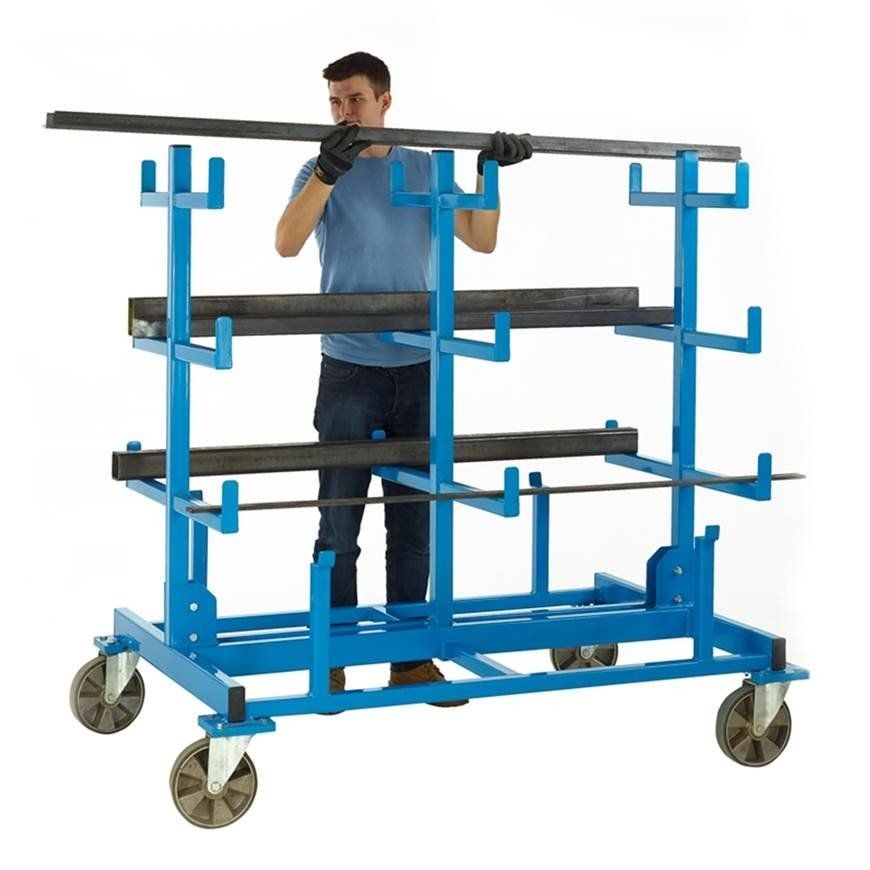
Specifications, Applications, and Why It's the Smartest Storage Investment for Industrial Workshops in 2026
Author: Hall Fast Industrial Supplies Topic: Heavy Duty Mobile Bar Storage Rack — Industrial storage and material handling Reading time: Approximately 28 minutes
Introduction: Why the Right Bar Storage Rack Changes Everything
Walk into any busy fabrication shop, builders' merchant, steel stockholder or window-and-door manufacturer in the United Kingdom, and you'll see the same recurring problem: long, heavy materials taking up far more space, time and effort than they should. Bar stock leaning against walls. Pipe lengths stacked precariously on the floor. Lengths of timber wedged between workbenches. Forklift drivers performing impossible balancing acts to extract a single 6-metre profile from the bottom of a pile.
The cost of disorganised long-material storage is rarely tracked on a spreadsheet, but it's enormous. It shows up as wasted picking time, near-miss manual handling incidents, damaged stock, blocked walkways and frustrated staff. It shows up as customers waiting longer for their orders. It shows up, quietly, as the gap between a workshop that works and one that struggles.
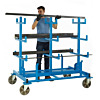
The Heavy Duty Mobile Bar Storage Rack from Hall Fast is engineered to close that gap. With a load rating of up to 2000kg, three tiers of cantilever-style storage arms, four 200mm heavy duty swivel castors (two with brakes), and a clever foldable design that collapses to just 630mm, this rack solves the long-material problem without taking over your floor space. It's built in the United Kingdom, supplied with a 3-year manufacturer's guarantee, and chosen every week by engineering firms, fabricators, merchants and warehouses across the country and around the world.
This guide is the most thorough resource available on the heavy duty mobile bar storage rack. Over the next several thousand words we'll cover everything you need to know before buying — the engineering, the specifications, the applications, the safety considerations, the comparison with alternatives, and the practical workflows that turn a piece of steel furniture into a genuine productivity asset. Whether you're researching for a single rack or specifying for an entire warehouse, by the end of this article you'll know exactly why this product has become the storage standard for forward-looking industrial businesses.
If you're already convinced and you'd like to discuss capacity, lead times or volume pricing, you can contact the Hall Fast team here or call us on 01623 645645.
Part 1: What Is a Heavy Duty Mobile Bar Storage Rack?
Let's start with the basics, because the term "bar storage rack" is used in the industry to describe several quite different products. Getting the terminology right matters when you're specifying for a serious operation.
A bar storage rack is a specialised type of cantilever rack designed to hold long, linear materials — bar stock, pipes, tubes, profiles, lumber and similar items — that don't fit conventional shelving. Conventional shelving works on a four-corner-uprights principle, which makes loading anything longer than the shelf depth impossible without overhang. Cantilever racks solve this by replacing the front uprights with horizontal arms that protrude from a single rear column. Material rests on the arms, with one end (or both, in a double-sided design) projecting out into open space.
A heavy duty bar rack is built to handle industrial weight. This is not a residential garage organiser or a light-duty hobby rack. The frames are welded steel, the arms are reinforced, and the load ratings start where lightweight racks finish. The Hall Fast unit is rated at 1000kg with two support posts and 2000kg with the optional third post — a working capacity that comfortably handles bundles of structural steel, full-length scaffold tubes, stacks of timber beams and dense profiles like uPVC window sections.
A mobile bar rack adds wheels. This single change transforms the way the rack functions in your operation. Static cantilever racks are warehouse furniture — once installed, they live where they were placed. Mobile racks become tools, and you bring them to the work rather than the other way round. For operations where material moves between cutting, machining, assembly and dispatch, this is a step-change in efficiency.
The Hall Fast rack adds two further refinements. First, it's foldable: when not in use, the arms collapse and the unit reduces to a folded height of just 630mm — about knee-high. Multiple folded racks stack on top of each other, freeing up floor space when seasonal demand drops or when you need the floor for a different job. Second, it's double-sided: arms project from both sides of the central spine, so loading and unloading can happen from either direction simultaneously. In a busy fabrication bay where bar stock comes in from goods-in and goes out to the saw, this halves the traffic congestion around the rack.
Put all of that together — heavy duty, mobile, foldable, double-sided cantilever construction with 1000–2000kg capacity — and you have a piece of equipment that genuinely changes how a workshop functions.
Part 2: Full Specifications of the Hall Fast Heavy Duty Mobile Bar Storage Rack
Before we dig into applications and use cases, let's get the technical detail on the table. These are the specifications you'll want to confirm against your own site requirements.
Dimensions
- Overall length: 1,600 mm
- Overall width: 1,100 mm
- Overall height (deployed): 1,560 mm
- Folded height: 630 mm
- Number of tiers per unit: 3
- Spacing between arms: 330 mm
The 1,600mm overall length is significant: it's the length of the rack frame, not the length of material it can hold. Because the cantilever arms support material from underneath, you can store items considerably longer than the rack itself. Six-metre lengths of bar stock, scaffold tube or timber sit comfortably across multiple racks placed in line, or overhang the ends of a single rack within sensible weight distribution.
The 330mm spacing between arms is generous. It's enough to load bundles of bar stock, multiple pipe diameters or stacks of timber on each tier, while still leaving clearance to extract individual items without disturbing the rest. With three tiers, you have effectively three independent storage levels — you might use the bottom for heavy steel, the middle for aluminium profiles, and the top for lightweight uPVC, organising your stock by material type, project or customer.
Mobility
- Castors: 4 × 200mm heavy duty swivel
- Braked castors: 2 (diagonally opposite)
- Wheel material: Industrial-grade for hard floors and slight surface imperfections
The 200mm castor diameter matters more than buyers sometimes realise. Larger wheels roll over door thresholds, expansion joints, drainage channels and minor surface imperfections that would catch on smaller castors. They also distribute the load over a larger contact patch, reducing point pressure on warehouse floors — a significant consideration when you're moving 2 tonnes of steel.
Two braked castors is the industry-standard arrangement for heavy duty mobile equipment. With brakes engaged on diagonally opposite corners, the rack is stable for loading, picking and stationary use. Release the brakes and the rack moves predictably and smoothly under push pressure, even at full load.
Capacity
- Standard configuration: 1,000 kg (with two support posts)
- Upgraded configuration: 2,000 kg (with the optional third support post)
- Note: The middle support post is removable when handling longer materials that span the full length of the rack
The dual-capacity design is one of the smartest features of this rack. Many operations buy storage equipment that's either over-specified (paying for capacity they'll never use) or under-specified (forcing them to upgrade within a year or two). The Hall Fast rack lets you start at 1000kg and add the third post as your demand grows, giving you a clear upgrade path without having to replace the unit.
The removable centre post is equally clever. When you're loading 6-metre lengths that need to span the full bay, you take the centre post out. When you're loading shorter offcuts, sections or bundles that benefit from extra mid-span support, you put it back in. It's the kind of detail that betrays a designer who has actually worked in a fabrication shop.
Construction
- Frame: All-welded heavy duty steel
- Arm reinforcement: Engineered for maximum load with minimum deflection
- Origin: UK manufactured
- Warranty: 3-year manufacturer's guarantee
- Loading on delivery: Forklift required for unloading
UK manufacturing matters for several reasons. It means the steel and the welds are produced to British and European standards. It means parts and replacement components are available without long shipping lead times. And it means the 3-year guarantee is backed by a manufacturer who is reachable and accountable, not lost in an overseas supply chain.
The full product page, including the latest pricing, current stock, and the option to add to basket or open a trade account, is available at hall-fast.com/heavy-duty-mobile-bar-storage-rack1.
Part 3: Why Mobility Matters in Modern Industrial Storage
There's a temptation, when buying storage equipment, to treat mobility as a luxury feature. The reasoning goes: "We don't move our stock often, so why pay extra for wheels?" That reasoning is almost always wrong, and here's why.
In any workshop or warehouse, material spends very little of its life in motion. It might travel from goods-in to a storage location, from storage to a workstation, from a workstation to a finishing area, and from finishing to dispatch. Each of those movements is a manual handling event, and each one is also a productivity event. The faster and safer those movements happen, the more orders you ship per shift.
Static bar racks force material to come to them. Every time you need a length of bar, somebody walks to the rack, lifts it (often awkwardly), carries it to the cutting bay, and walks back again. For long, heavy materials, that journey is the most physically taxing part of the entire production process — and the journey from rack to saw is repeated dozens or even hundreds of times a day.
A heavy duty mobile bar storage rack inverts that workflow. The rack comes to the work. You position it next to the saw, the welder, or the assembly bench, and pick directly from the rack into the next operation. The journey of the material from storage to use shrinks from metres of carried distance to centimetres of slid distance. Multiply that across a year of production and the savings in time, fatigue and back injury risk are substantial.
There's also a flexibility argument. Workshop layouts change. New equipment arrives, processes get re-engineered, products get redesigned, and the optimum location for bar storage shifts. With a static rack, that means either accepting a sub-optimal layout or undertaking a disruptive reinstallation. With mobile racks, you simply roll them to wherever they need to be.
The third advantage is contingency. When a production line breaks down, when a rush order comes in, when you need to clear a section of floor for an inspection, mobile equipment lets you adapt within minutes. The rack that was supplying the saw bay this morning can be supplying the dispatch area this afternoon, with no installer, no lifting equipment and no downtime.
For a fuller picture of mobile material handling solutions, including pallet trucks, sack trucks, platform trucks, electric tugs and scissor lift tables, browse the handling and lifting category at Hall Fast.
Part 4: Materials You Can Store on a Heavy Duty Mobile Bar Rack
The heavy duty mobile bar storage rack is one of the most versatile pieces of storage equipment in industrial use. Almost any long, linear material can live on it, provided the total load doesn't exceed the rated capacity. Here's a thorough look at the material categories it handles every day.
Ferrous Metals
This is where bar racks earn their living. Mild steel round bar, square bar, flat bar, rebar, tube, box section, angle, channel and structural steel sections all sit perfectly across the cantilever arms. The 1000–2000kg capacity comfortably handles bundles of stock at typical mill-cut lengths. For steel stockholders, fabricators and engineering shops, the bar rack is essentially the central storage architecture of the entire operation.
The 330mm arm spacing also accommodates tube of various diameters without bundles tipping or tangling. Whether you're holding 12mm round bar or 100mm box section, the storage geometry works.
Non-Ferrous Metals
Aluminium extrusions, copper tube, brass bar and stainless steel sections all benefit from cantilever-style storage. Non-ferrous metals are particularly vulnerable to surface damage from contact with rough surfaces or other materials, and elevated storage on horizontal arms minimises the scratching, denting and oxidation that plagues stock left on concrete or wooden floors.
uPVC and Plastics
The window-and-door industry was an early adopter of heavy duty mobile bar racks because uPVC profile is awkward to store: long, light, fragile, and produced in many different cross-sections. The bar rack provides separation between profiles, prevents bowing, keeps colours and styles organised, and lets fabricators wheel a complete order's worth of profile straight to the welding bench.
The same applies to plastic pipe, electrical conduit, drainage channel and any other extruded plastic stock.
Timber
Builders' merchants, joinery shops and timber yards use cantilever racks for everything from CLS studwork to structural beams. Timber stores well on bar racks because the horizontal arms support the length without bowing, the elevation keeps the stock clear of damp floors, and the open structure allows air circulation — which matters for moisture content stability.
For mobile timber racks specifically, the ability to wheel a full order's stock from the yard to the cutting list shop is transformative.
Composite and Specialist Materials
Carbon fibre tubes, fibreglass profiles, GRP sections, conveyor track lengths, cable trunking, ducting and similar specialist stock all sit comfortably on cantilever arms. The combination of length, lightness, fragility and value is exactly what cantilever racks are designed to manage.
What Not to Store
A few sensible exclusions: very short items (under about 600mm) tend to fall between the arms and are better suited to shelving or bin storage. Very fragile items in unprotected packaging may need additional dunnage. Round materials with a strong tendency to roll need either end-stops or strapping to prevent migration when the rack is moved. None of these are limitations of the rack itself, simply common-sense considerations for any storage system.
For complementary storage — pallet racking, longspan shelving, lockers, drum storage and IBC storage — the broader industrial and commercial equipment range at Hall Fast covers virtually every storage requirement an industrial site is likely to face.
Part 5: Industries That Rely on Heavy Duty Mobile Bar Racks
The heavy duty mobile bar storage rack isn't a niche product. It's used across an extraordinarily wide range of industries — anywhere long, heavy materials are part of daily production. Let's walk through the major sectors and look at how each one uses the rack.
Engineering and Metal Fabrication
This is the rack's core market. Fabrication shops typically hold raw bar stock in dozens of different sizes and grades, and need to access it constantly throughout the day. A mobile bar rack lets the cutting list operator wheel exactly the day's required stock to the saw, leaving the rest of the inventory tidy and accessible. When the order is finished, the rack rolls back to the stock bay. Many fabricators run two or three racks in rotation: one being loaded, one in use, one being prepared for the next job.
Steel Stockholders and Service Centres
Stockholders move enormous volumes of bar stock through goods-in, storage and dispatch every day. Mobile bar racks form the picking layer of the operation: stock is broken down from full-length pallets onto the racks, the racks roll to the saw or to dispatch, and the empty racks fold flat for return. Combined with overhead crane systems for the heaviest lifting, the mobile rack is the bridge between bulk storage and customer-specific picking.
Builders' Merchants and Timber Yards
For merchants serving the construction trade, customer service depends on rapid, accurate order picking. A heavy duty mobile bar rack lets yard staff assemble a customer's order across multiple SKUs (timber, rebar, conduit, profile) on a single rack, then wheel the rack to the loading bay. The customer's vehicle is loaded in one operation, not five.
uPVC Window and Door Fabricators
Profile management is the central logistical challenge for uPVC fabricators. Each window or door requires several different profile types in cut-to-length sections. Mobile bar racks let fabricators stage a full window or door's worth of profile in front of the welding line, dramatically reducing inter-station travel and improving throughput.
Construction Sites and Site Stores
Tidy site storage is a CDM regulation requirement and a productivity multiplier. On larger sites, mobile bar racks are used to store and transport rebar, scaffold tube, structural timber and electrical conduit between the site store and the work face. The forklift compatibility of the rack means it can be loaded onto a flatbed for transport between site compounds. (Site safety equipment, including bollards, signage and PPE, is covered in the safety at work category.)
Plumbing, HVAC and M&E Suppliers
Pipe, conduit, trunking, ducting and cable tray are the bread and butter of mechanical and electrical wholesale. Each of these materials is awkward in conventional shelving, and each one has multiple SKUs that need to be picked individually. Mobile bar racks turn a chaotic stockroom into an organised, wheelable inventory.
Manufacturing — General Industry
Beyond the obvious metal-and-pipe industries, mobile bar racks turn up in conveyor manufacturers, agricultural equipment makers, automotive aftermarket suppliers, signage and display fabricators, theatrical and exhibition stand builders, and dozens of other specialised manufacturers. Anywhere that long material is part of the input or output stream, a mobile bar rack pays for itself.
Distribution and 3PL Warehouses
Third-party logistics operators handle their clients' inventory, which means they need flexible, scalable storage that can adapt to changing client mixes. The foldable design of the Hall Fast rack is particularly valuable here: when a client contract ends, the racks fold and stack out of the way until the next client's stock arrives.
Education and Training Workshops
Technical colleges, university workshops, training providers and apprenticeship schemes all use mobile bar racks to teach safe material handling, organised storage and lean workshop principles. The educational sector also values the mobility for reconfiguring workshops between courses.
Research, Aerospace and Defence
Specialist materials, traceable batches, controlled environments — these are the storage challenges in research and defence manufacturing. Mobile bar racks can be incorporated into clean-area workflows, segregated from general production, and rolled into specific bays for batch processing.
The breadth of these applications is one reason Hall Fast supplies bar racks not only to UK customers but worldwide. Whatever your industry needs, wherever you operate, the engineering of the heavy duty mobile bar storage rack is the same.
Part 6: Capacity Options Explained — 1000kg vs 2000kg
One of the most common questions buyers ask is: "Do I need the 2000kg version or will 1000kg do?" Let's break that decision down properly.
Understanding the Capacity Rating
The capacity rating refers to the total uniformly distributed load the rack can carry safely across all three tiers. With two support posts, the rated capacity is 1000kg. With three support posts (including the centre post), the rated capacity doubles to 2000kg.
Crucially, this is the total rack capacity, not per-arm capacity. If you're loading 1000kg of steel onto a two-post rack, that load is distributed across the three tiers — typically not equally. A common loading pattern is heaviest at the bottom, lighter toward the top, both for stability and for easier access to commonly-picked items.
When 1000kg Is Enough
For many applications, 1000kg is plenty. A workshop handling aluminium extrusions, uPVC profile, copper pipe, lightweight tube and similar materials will rarely approach the 1000kg ceiling. The same applies to most timber operations: even densely-packed structural softwood doesn't typically push a single rack beyond 1000kg.
If your average material density is moderate, your typical batch sizes are small to medium, and you have the option to spread heavy stock across multiple racks, the 1000kg version is the cost-effective choice.
When You Need 2000kg
Steel stockholders, structural fabricators, rebar suppliers, scaffold companies and operations handling solid-section stock should specify the 2000kg version from the outset. Solid steel bar at industrial mill lengths is dense — a single bundle of 50mm round bar at 6m length can easily weigh several hundred kilograms, and you'll typically want to store multiple bundles per rack.
The 2000kg version is also the right choice if you're not entirely sure of your future needs. Loading flexibility is a feature, not a luxury, in growing businesses.
The Removable Centre Post
The third support post on the 2000kg version is removable, and this is a more important feature than it sounds. With the post in place, the rack is at full 2000kg capacity but each tier is divided into two ~750mm-wide loading bays. Without the post, each tier is a clear 1500mm-wide bay, perfect for handling materials that span the full length without break.
In practice, many users keep the post installed for general use and remove it only when picking or loading a specific long-material job. This gives you the best of both worlds: high capacity for general storage, full-length clearance for specialist tasks.
Multi-Rack Operations
For sites with significant volume, the right answer is rarely a single rack. Most engineering shops and stockholders run several racks simultaneously, dedicated to different material types or different stages of production. The Hall Fast rack is supplied in single-unit form, but the foldable design means scaling up doesn't permanently consume floor space — racks not in active use fold and stack.
If you're specifying for a multi-rack rollout, contact the Hall Fast sales team for volume pricing and trade account terms.
Part 7: The Engineering Behind a Cantilever Bar Rack
For technical specifiers and procurement engineers, the engineering principles behind a cantilever rack are worth a closer look. Understanding why the design works helps you specify, install and load it correctly.
Cantilever Theory in Brief
A cantilever beam is a beam supported at one end and free at the other, with the load applied along its length. Bending moments in a cantilever are highest at the fixed end (the connection to the upright) and decrease toward the free end. This is why cantilever arms are typically thicker at the base and taper toward the tip.
In a bar rack, the cantilever arms project from the central spine. The spine carries the bending moment, transfers it down to the base, and the base — supported on the castors and braced for stability — converts the moment into a footprint reaction.
The whole assembly is in equilibrium when properly loaded. Overload an arm at its tip, or load only one side of a double-sided rack, and you risk overturning the rack or yielding the arms. The 1000–2000kg capacity rating assumes balanced, distributed loading.
Why Welded Steel?
Welded steel construction is the gold standard for industrial cantilever racks for several reasons. Welds are stronger than bolts under shock loading. A welded frame doesn't loosen over time with vibration. And welded construction allows the manufacturer to optimise material placement — putting steel where the stress is, and leaving it out where it isn't.
Bolted-together racks are easier and cheaper to ship flat-pack but have inherent weaknesses in cyclic and impact loading. For a heavy duty industrial application, welded construction is the right specification.
The Castor Choice
200mm castors are at the upper end of the heavy-duty range. Castor selection involves a trade-off: larger wheels roll over obstacles better and distribute load over more floor area, but they're heavier and require more swing clearance for swivel manoeuvres.
The four-castor swivel arrangement is also a deliberate choice. Some heavy duty racks use a two-fixed, two-swivel layout, which is easier to push in a straight line but harder to turn. Four swivel castors trade some straight-line tracking for excellent manoeuvrability — the rack can rotate in place, sidle up to a bench, or thread through tight aisles. For a workshop environment, that manoeuvrability is the right call.
The Braking System
Two braked castors on diagonally opposite corners is the industry-standard arrangement. With both brakes engaged, the rack cannot translate (move sideways) or rotate. With both brakes released, the rack moves freely. Engaging only one brake is generally not done — it can introduce instability under load.
The Folding Mechanism
The folding mechanism on the Hall Fast rack is engineered for repeated use without compromising structural integrity when deployed. When folded, the rack's height drops to 630mm — significantly lower than most workbenches — making stacking simple and storage compact.
When deployed, the locking mechanism returns the rack to its full structural rigidity. There's no compromise between the mobile/foldable convenience and the heavy-duty load rating.
Part 8: Health and Safety — Manual Handling and the Mobile Bar Rack
Manual handling is the single largest cause of workplace injury in the United Kingdom, accounting for roughly a third of all reportable musculoskeletal injuries. The Health and Safety Executive's manual handling regulations require employers to avoid hazardous manual handling where reasonably practicable, and to assess and reduce the risk where it can't be avoided.
A heavy duty mobile bar storage rack is, in part, a manual handling control measure. By bringing storage to the work area, it eliminates the most common source of manual handling injury in workshops — carrying long, heavy materials over distance.
How the Rack Reduces Manual Handling Risk
There are four main ways the mobile bar rack reduces manual handling risk:
- Reduced carry distance. The shorter the distance a load is carried, the lower the cumulative strain on the operator. Bringing the rack to the work area can reduce typical carry distances from 10–20 metres to under 1 metre.
- Better posture. Three tiers at 330mm spacing put most stored material between knee and shoulder height — the safest range for lifting. Compare this with stock leant against a wall, where operators routinely have to stoop or reach overhead.
- One-handed picking. With material elevated on horizontal arms, a single operator can pick a length of bar stock with one hand, slide it free, and walk it to the next operation without first having to lift it from a pile.
- Team handling enabled. When two-person handling is required for very long or heavy items, the open, low-height layout of the rack makes coordinated lifts much safer than picking from a stack on the floor.
Site-Wide Safety Considerations
The mobile rack is part of a wider site safety ecosystem. Floor markings to delineate rack-movement aisles, head protection where overhead loads are present, gloves to prevent cuts and abrasions from raw stock, and steel-toed footwear for foot protection — all of these are standard kit in workshops handling bar stock.
Hall Fast supplies the full range of personal protective equipment and workplace safety items, including gloves, eye protection, hearing protection, fall arrest, signage, anti-slip flooring and spill management products. Specifying the bar rack alongside the right PPE and signage is the proper way to manage workshop risk holistically.
Training and Procedures
Even the best equipment is only as safe as the procedures around it. Best practice for mobile bar rack use includes:
- Always engage both brakes before loading or unloading
- Distribute loads from the bottom tier upward to maintain a low centre of gravity
- Don't exceed the rated capacity, and check load distribution before moving
- Push, don't pull, when moving the rack
- Keep aisles clear of trip hazards
- Inspect castors regularly for damage, hair/debris wrap, and brake function
A well-designed mobile bar rack, used by trained staff, alongside the right PPE, in a tidy and well-marked workshop, is one of the safest and most productive material storage solutions available.
Part 9: Setting Up and Using Your Mobile Bar Rack
Once your heavy duty mobile bar storage rack arrives, the path from delivery to productive use is short — but a few practical steps make the difference between a smooth deployment and a frustrating one.
Receiving the Delivery
The single most important practical note: a forklift, telehandler or HIAB is required for unloading. The rack is shipped flat where possible, but its weight and dimensions exceed safe manual handling thresholds. Confirm forklift availability before the delivery arrives.
On unloading, inspect the rack visually for any transit damage. Hall Fast's quality control catches the vast majority of issues before dispatch, but the supply chain has many touchpoints, and rare damage can occur. Sign for the delivery noting any visible damage, and contact the Hall Fast team immediately if remedial action is needed.
Initial Deployment
The rack is supplied ready to use. Deployment involves:
- Position the folded rack in a clear area
- Release the folding mechanism
- Raise the structure to its deployed height (1,560mm)
- Engage the locking mechanism
- Install the support posts (two for 1000kg, three for 2000kg)
- Engage the brakes on the two braked castors
That's it. No tools, no fixings, no installer required. From folded to ready-to-load typically takes