Forklift impacts are the single most common cause of warehouse infrastructure damage in the UK. Damaged uprights, cracked walls, broken bollards, scuffed floors, dented doors, and disrupted operations all flow from the inevitable contact between fast-moving forklifts and the static structures they navigate. The best forklift impact protection is not a single product — it is a layered system that combines upright protection, wall protection, floor markings, mirrors, and barriers to manage the risk wherever forklifts operate. This guide walks you through the full landscape of forklift impact protection and helps you specify the right combination for your warehouse.
Hall-Fast Industrial Supplies is one of the UK's leading distributors of forklift impact protection products. Browse our flagship Rack Armour range on the Rack Armour brand page, explore our full brand portfolio, learn about Hall-Fast on the About page, or get in touch via the contact page. Our price promise applies to every authentic product we supply: if you find a better price anywhere on the internet, let us know and we will match it.
Why forklift impact protection matters
Every warehouse, distribution centre, and manufacturing facility that operates forklifts will experience impact incidents. The question is not whether impacts will happen — they will — but how severe the consequences are when they do. Without protection, even modest impacts can cause expensive damage to racking, walls, doors, columns, and pedestrians. With the right protection in place, the same impacts leave no significant damage and the warehouse keeps operating. The economics of impact protection are compelling: the cost of a comprehensive protection system is typically a small fraction of the cost of even a single significant damage incident.
The hidden cost of unprotected facilities
The visible cost of forklift impact damage — the bent upright, the cracked wall, the broken bollard — is only part of the total cost. The hidden costs include operational disruption while the damage is repaired, lost storage capacity during the repair window, audit and inspection findings that drive remediation work, insurance premium increases at renewal, increased forklift maintenance from impact-related wear, and in the worst cases injury to staff. Add up the hidden costs and the total economic impact of unprotected facilities is typically several times the direct repair bill.
The business case for proactive protection
The strongest case for impact protection is proactive — installing the protection before significant damage occurs. The economic logic is overwhelming: the investment in protection is paid back many times over by the avoided repair costs across the multi-year service life of the protection products. Most warehouses see payback within months, with the residual service life delivering pure positive return. Beyond the direct economics, proactive protection signals a well-run operation to insurers, auditors, customers, and staff.
The key categories of forklift impact protection
Effective forklift impact protection comprises five main product categories: upright protectors for pallet racking, bollards and column guards for free-standing structures, wall and corner protection for building elements, floor-mounted barriers for traffic separation, and visibility aids such as mirrors, signage, and floor markings. Each category addresses a specific risk, and the best protection programmes combine all five into an integrated system.
Upright protectors for pallet racking
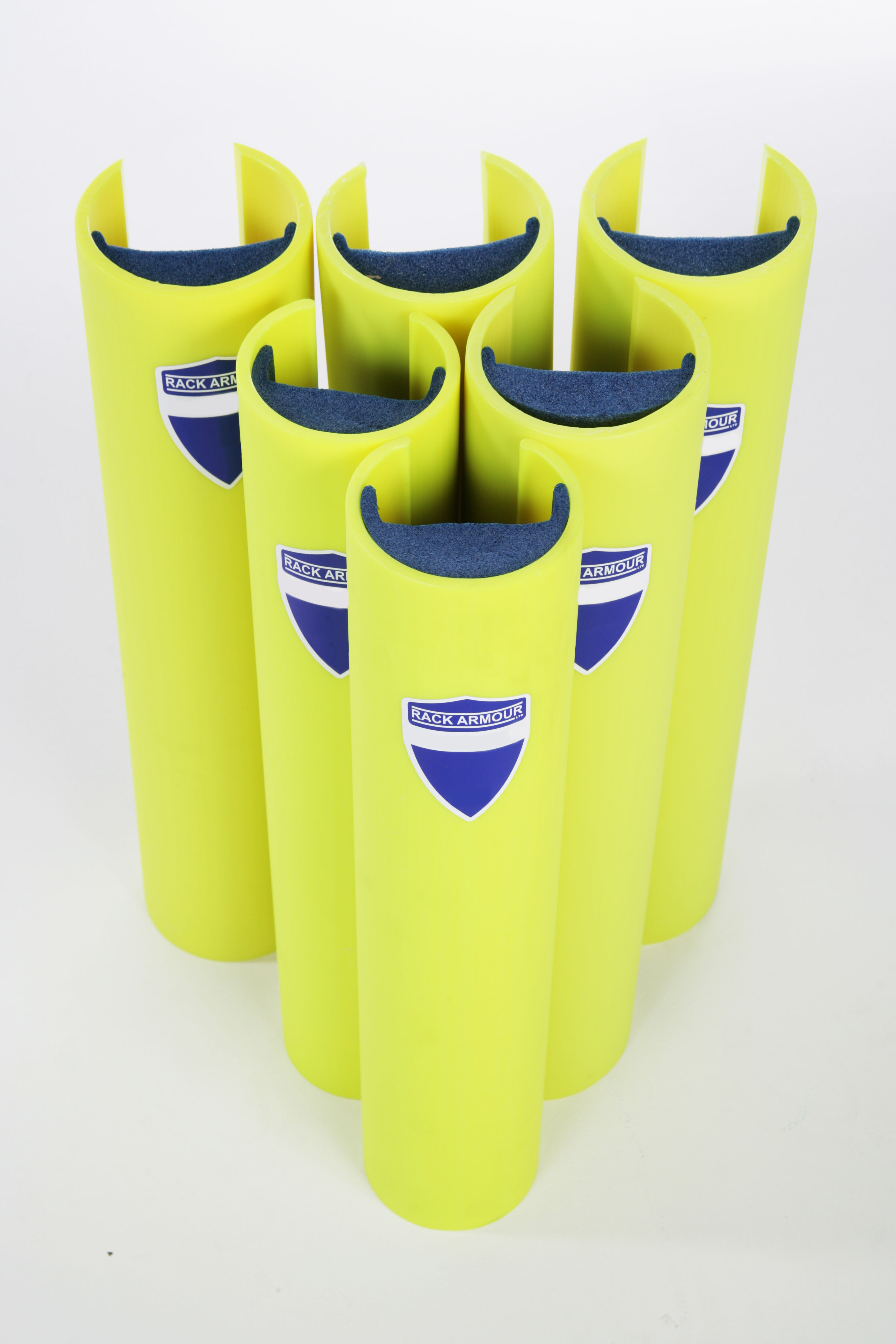
Pallet racking uprights are statistically the most-impacted infrastructure in any warehouse — the cold-formed steel sections sit at floor level alongside every aisle a forklift travels. Polymer upright protectors such as Rack Armour are the industry standard for protecting these uprights, absorbing impact energy and dissipating it through controlled polymer deformation. The protector preserves the steel upright behind it, keeping the racking straight, certified, and operational.
Rack Armour is supplied in five sizes — Small, Medium, Large, XL, and XXL — to fit every standard pallet racking section. Browse the full range on the Hall-Fast Rack Armour page or contact our team for size advice.
Bollards and column guards
Bollards are vertical steel posts, typically anchored into the floor slab, that protect free-standing columns, machinery, doorways, and pedestrian zones from forklift impact. Column guards are similar products specifically engineered to wrap around or sit alongside building columns. Both are heavy-duty solutions for high-energy impact zones — places where a fully-laden forklift could otherwise hit critical building structure or vulnerable equipment. Steel bollards transfer impact energy into the floor and concrete fixings, while polymer-coated and rubber-faced variants offer additional energy absorption.
Wall and corner protection
Walls and corners are particularly vulnerable to forklift impact in goods-in and goods-out zones, around doorways, in narrow corridors, and along loading bay frontages. Wall protection products include rubber and polymer panels, corner guards, and full-height impact strips. These products absorb impact energy and protect the masonry or steel-frame structure of the building, preventing the kind of cumulative damage that can lead to expensive repair bills over time.
Floor-mounted barriers
Floor-mounted barriers separate forklift traffic from pedestrian zones, protect the ends of pallet racking aisles, and create defined traffic flow paths through the warehouse. Common types include A-frame barriers, hoop barriers, and continuous low-rail barriers. Heavy-duty barriers can absorb a fully-laden forklift impact without permanent deformation. Lighter barriers create visual separation and discourage casual incursion without claiming to stop a fast-moving truck.
Visibility aids
Many forklift impacts happen because the driver did not see the obstacle in time. Visibility aids reduce these incidents by improving sightlines and drawing attention to risk zones. Convex mirrors at aisle intersections eliminate blind spots. Floor marking tape defines walkways, traffic lanes, and exclusion zones in bright contrasting colours. Hi-vis signage warns drivers of upcoming hazards. Speed bumps slow vehicles in pedestrian-shared zones. Integrated, the visibility aids reduce the impact rate at source, complementing the protection products that limit the consequences when impacts do happen.
How to choose the best impact protection for your warehouse
The best impact protection is the protection that matches the specific risks of your specific warehouse. Below is a structured approach to identifying the right combination for your operation.
Step 1: Walk the floor and identify the risks
The first step is to walk the warehouse and identify every location where a forklift impact could cause significant damage. Look at the racking — every upright is a candidate for protection. Look at the walls — particularly in goods-in/goods-out zones, around doors, and in narrow access points. Look at the columns and free-standing structures — building columns, racking corners, machine bases. Look at the pedestrian zones — pick aisles, walkways, marshalling areas. Make a note of every risk point and rate it for severity (likelihood of impact × consequence of impact).
Step 2: Review your impact history
Pull the maintenance, repair, and incident records for the past 12 to 24 months. Where have past impacts happened? What did they damage? What did they cost? The history is a strong predictor of where future impacts will happen — and the locations that have been hit before will likely be hit again unless something changes. Use the history to validate and prioritise the risk list from Step 1.
Step 3: Match products to risks
For each identified risk, match the appropriate protection product. Rack uprights → polymer upright protectors. Building columns → bollards or column guards. Walls in impact zones → wall protection panels and corner guards. Pedestrian zones → A-frame barriers and floor markings. Blind intersections → convex mirrors and speed bumps. Use the product capability to match the risk severity — heavier-duty protection for higher-energy risks, lighter-duty protection for lower-energy zones.
Step 4: Plan the rollout
Few operations can install everything in one go, and few should try. Plan the rollout in phases starting with the highest-risk zones identified in Step 1 and validated by Step 2. The first phase typically delivers most of the risk reduction — the high-risk hotspots are usually a small fraction of the total facility but account for most of the historic damage. Subsequent phases extend coverage to the rest of the facility over time as budget allows.
Step 5: Specify and order
With the product list defined, contact Hall-Fast for specification advice and pricing. Our team has specified comprehensive protection programmes for warehouses across the UK and can advise on size, quantity, colour, installation approach, and phasing. Get in touch via the Hall-Fast contact page or browse our brand portfolio to see the range we supply.
Deep dive: Rack Armour upright protectors
Of all the impact protection products in the warehouse, polymer upright protectors deliver the strongest economic return in most operations. Pallet racking uprights are the most numerous and most frequently impacted infrastructure in the warehouse, and the cost of upright damage repair is high. Rack Armour, the UK's leading polymer upright protector, addresses this risk efficiently and economically.
How Rack Armour works
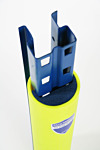
Rack Armour fits over the lower section of a pallet racking upright, wrapping around three faces of the steel section. When a forklift contacts the protector, the polymer body absorbs and dissipates the impact energy through controlled deformation. The polymer returns to its original shape ready for the next impact. The steel upright behind the protector is preserved, the bay stays in service, and the racking remains straight and certified.
The five sizes of Rack Armour
Rack Armour is supplied in five sizes to fit the full range of standard UK and European pallet racking upright sections.
• Small Rack Armour — fits slimmest upright sections, light-duty racking and archive storage
• Medium Rack Armour — fits the most common upright depth, general-purpose pallet racking
• Large Rack Armour — fits heavy-duty general racking, drive-in racking, and high-bay racking
• XL Rack Armour — fits very-heavy-duty racking and tall high-bay sections
• XXL Rack Armour — fits the deepest heaviest-duty industrial racking sections
Two colour finishes
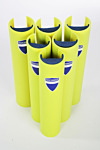
Rack Armour is available in safety yellow — the conventional industrial standard — and hi-vis yellow — a brighter fluorescent finish for low-light or safety-critical operations. Many warehouses mix the two, using hi-vis on priority bays and safety yellow on the rest. Browse safety yellow Medium alongside hi-vis Medium to compare.
Easy installation
Rack Armour is installed using a dedicated tool that snaps the protector into position over the upright. The Small/Medium installation tool works on Small and Medium sizes; the Large/XL installation tool works on Large, XL, and XXL. The retrofit installation can be done by your own warehouse staff on loaded racking without specialist contractors.
Deep dive: bollards and column guards
Bollards and column guards protect free-standing vertical structures from forklift impact. They are the heavyweight option in the protection portfolio — engineered to absorb high-energy impacts that would damage buildings or critical equipment. Bollards typically anchor into the concrete floor with chemical-fix anchors and stand 800 mm to 1200 mm tall. Column guards wrap around building columns to protect the masonry or concrete from impact damage.
Steel bollards
Steel bollards are the traditional option — heavy steel posts powder-coated or galvanised for corrosion resistance, anchored into the slab with multiple high-strength fixings. They will physically stop a fully-laden forklift, transferring the impact energy into the floor and the concrete fixings. The trade-off is that severe impacts can damage the slab or the bollard itself, requiring repair. Steel bollards are best deployed where physical stopping power is essential — protecting building columns, doorway frames, and high-value equipment.
Polymer-faced and rubber-buffered bollards
Polymer-faced and rubber-buffered bollards combine a steel core with an outer polymer or rubber layer that absorbs some of the impact energy. The hybrid construction reduces damage to the bollard itself and to whatever is behind it, at modestly higher cost than plain steel. These products work well in zones where impacts are likely but full stopping power is not strictly required.
Column guards
Column guards are specifically engineered to protect building columns. They typically wrap around the column and stand-off slightly to absorb impact energy without transferring it directly into the masonry or concrete. Column protection is critical because building columns carry essential structural loads — damage to a column from a forklift impact can have building-wide consequences.
Deep dive: wall and corner protection
Walls and corners take a constant low-energy beating in any warehouse with significant forklift activity. Pallet trucks, forklifts, and pallet loads contact walls in goods-in and goods-out zones, around doorways, in narrow access points, and along loading bay frontages. The cumulative damage builds up over time — chipped paint, broken plaster, cracked masonry, dented metal cladding. Wall and corner protection products absorb the contact and protect the wall structure.
Wall protection panels
Wall protection panels are typically polymer or rubber sheets fixed to the wall surface in impact zones. They absorb contact energy through compression, protecting the wall from cumulative damage. Panels come in various heights and thicknesses depending on the impact severity — heavier panels for high-energy zones, lighter panels for general protection.
Corner guards
Corner guards protect external building corners from being chipped or damaged by passing forklifts and trolleys. The 90-degree corner is particularly vulnerable because forklifts cutting the corner contact the corner edge first. Corner guards are typically polymer or rubber profiles fixed along the full height of the corner.
Door frame and door protection
Door frames and doors are common impact victims — particularly in doorway entries to cold stores, internal walls, and goods-in/goods-out areas. Specialist door frame protection profiles wrap the frame to absorb contact energy. Door bumper strips fit to the door itself to take the contact when forklifts swing past.
Deep dive: floor-mounted barriers
Floor-mounted barriers create physical separation between forklift traffic and pedestrian zones, between traffic lanes, and around the ends of pallet racking aisles. They range from heavy-duty traffic barriers engineered to stop a laden forklift to lightweight visual barriers that mark zones without claiming to physically constrain a vehicle.
A-frame barriers
A-frame barriers are angled steel barriers anchored into the floor at the ends of pallet racking aisles, in pedestrian crossing points, and around equipment that needs protection. The angled face is engineered to deflect a forklift away from the protected zone rather than absorbing the impact head-on. A-frame barriers are very common in goods-in/goods-out zones and at the ends of high-density pallet racking aisles.
Hoop barriers
Hoop barriers are inverted-U steel barriers that protect equipment, machinery, and pedestrian zones from forklift impact. They are typically lighter than A-frame barriers and suit medium-duty applications. Hoop barriers are common around free-standing equipment such as wrapping machines, weighing stations, and conveyor terminals.
Continuous rail barriers
Continuous rail barriers run along walkways and traffic lanes to define the route and prevent encroachment. They are the right choice for separating pedestrian walkways from forklift traffic in shared zones such as picking aisles and assembly areas. Heavy-duty continuous rails can stop a forklift; lighter rails primarily provide visual definition and a low-energy physical barrier.
Deep dive: visibility aids and risk reduction
The best impact protection is the impact that never happens. Visibility aids and risk-reduction products reduce the rate at which forklifts contact infrastructure in the first place, complementing the protection products that limit the consequences when contact does occur.
Convex mirrors
Convex mirrors mounted at aisle intersections, blind corners, and goods-in/goods-out access points eliminate blind spots and let forklift drivers see oncoming traffic before they enter the intersection. The wide-angle reflection compresses a large field of view into a small mirror surface, giving the driver awareness of pedestrians and other forklifts that would otherwise be hidden. Mirror selection depends on the viewing distance and the field of view required — Hall-Fast can advise on the right mirror for each location.
Floor marking tape and paint
Floor marking tape and paint define traffic lanes, pedestrian walkways, exclusion zones, and stop points in highly visible colours. The visual cue alerts forklift drivers to risk zones before they reach them, supporting better decisions about speed and trajectory. Floor markings are inexpensive, fast to install, and easy to update as the warehouse layout changes — making them a high-value early-stage investment in any protection programme.
Speed bumps and humps
Speed bumps and speed humps slow forklifts in pedestrian-shared zones, near goods-in/goods-out doors, at aisle exits, and in any location where excessive speed creates risk. The physical bump in the floor enforces a speed reduction that signage alone cannot reliably achieve. Polymer speed bumps are the standard for indoor warehouse use, designed to slow without damaging the forklift or the floor.
Signage and labelling
Signage and labelling complete the visual environment — pictograms warn of specific risks, instructional signs reinforce safe operating practice, and zone labels confirm where forklifts can and cannot operate. Good signage is consistent across the facility, uses standard pictograms recognised by all staff, and is mounted at appropriate heights for forklift driver line of sight.
How protection products work together
The most effective forklift impact protection programmes layer multiple product categories together to address risk from multiple angles. A single product type rarely addresses all the risks in a warehouse — but a thoughtful combination of upright protectors, bollards, wall protection, barriers, and visibility aids creates a comprehensive protection envelope.
Example: a goods-in/goods-out zone
Consider the protection requirement for a typical goods-in/goods-out zone. The risks include: forklifts clipping the door frame on entry, forklifts contacting the wall around the loading bay, pallet trucks bumping pedestrian-zone walls, columns near the loading dock taking impacts, and pedestrians being struck in the shared zone. The protection layer might include door frame protection, wall panels along the impact-prone walls, column guards on the structural columns, A-frame barriers separating the pedestrian zone, convex mirrors at the access points, and floor markings defining traffic and pedestrian lanes. Together these address every identified risk.
Example: a high-density storage aisle
A high-density storage aisle has a different risk profile. The dominant risk is contact between forklifts and pallet racking uprights as the truck navigates the narrow aisle to retrieve and deposit pallets. The protection layer here focuses on Rack Armour on every upright in the aisle, with hi-vis colour for visibility in the often-shadowed aisle interior, plus end-of-aisle A-frame barriers to protect the most exposed bays. Convex mirrors at the aisle intersections support safer entry and exit.
Example: a pedestrian-shared picking aisle
Picking aisles where pedestrians and pallet trucks share space have the highest pedestrian-injury risk. Protection here is dominated by visibility aids and physical separation — continuous rail barriers separating pedestrian walkways from picking lanes, floor markings defining the boundaries clearly, convex mirrors at corners, speed bumps to slow trucks, and Rack Armour on the picking-bay uprights to protect against the contacts that do happen.
Specifying impact protection: a structured approach
To specify impact protection effectively, work through the following structured approach for each zone in your warehouse.
• Identify the zone: name and locate the zone, e.g. 'Aisle 3', 'Goods-in dock', 'Pedestrian crossing at end of aisle 7'.
• List the risks: what infrastructure or people could be hit, by what kind of vehicle, at what speed and energy?
• Rate the severity: how bad would the consequences be — minor cosmetic damage, expensive repair, structural damage, or potential injury?
• Select the products: which protection products address the identified risks at the identified severity?
• Specify quantities and dimensions: how many of each product, what size, what colour, and at what locations within the zone?
• Plan installation: who installs, when, how does the work fit around operations, what tools or contractors are needed?
• Plan inspection: how will the protection be checked over time to confirm it is doing its job, and how are damaged units replaced?
Common mistakes when specifying impact protection
After many years of supplying impact protection products to UK warehouses, Hall-Fast has seen the same handful of mistakes recur. Avoiding these saves time, money, and rework.
Mistake 1: Protecting only the visible problem
Many operations install impact protection only where damage has already occurred — a reactive approach that protects the bay that has been hit but leaves the next-most-likely-hit bay unprotected. Proactive whole-zone protection is more economic over the medium term.
Mistake 2: Over-specifying the lightest zones
Conversely, some specification approaches treat every zone equally and end up over-protecting low-risk zones with heavy-duty products that are not needed there. Zone-by-zone risk assessment and product matching is more cost-effective.
Mistake 3: Forgetting visibility aids
Specifying physical protection without the supporting visibility aids — mirrors, floor markings, signage — misses the opportunity to reduce the impact rate at source. The protection-only approach is more expensive over time because impacts continue to occur, even if they no longer cause significant damage.
Mistake 4: Not thinking about pedestrian protection
Infrastructure protection focuses on protecting the building and the racking. Pedestrian protection — physical barriers, mirrors, floor markings, hi-vis signage — is equally important and is sometimes overlooked. The consequences of a forklift hitting a pedestrian dwarf any infrastructure damage cost.
Mistake 5: Choosing on price alone
Impact protection is a long-life investment. Choosing imported low-grade products to save a small amount on the initial spend often results in higher total cost — products that need replacing more often, perform less well in real impacts, or fade and degrade in the warehouse environment. Authentic, validated, UK-manufactured protection products such as Rack Armour deliver better long-term value, particularly when supplied with a price promise that removes the price-shopping motive.
Maintenance and inspection of impact protection
Impact protection products are largely maintenance-free, but they should be included in the routine warehouse safety inspection regime. Checking the protection regularly confirms it is still doing its job and identifies any units that need replacement.
Visual inspection cycle
Add a visual check of all impact protection to the warehouse safety inspection routine — typically quarterly. Look for units that show signs of severe impact damage, units that have moved out of position, or units that are missing entirely. Most checks will find no action needed; the rare significant finding can be addressed promptly.
Replacement of damaged units
When a protection unit is damaged severely enough to need replacement, address it promptly. The cost of a replacement unit is typically a tiny fraction of the cost of the damage that would occur if the protection were left missing. Keep a small stock of replacement Rack Armour units on site for quick refits, and contact Hall-Fast for replacement bollards, barriers, or wall panels as needed.
Documentation
Document the impact protection installation in your warehouse asset register. Note the products installed, the locations, the dates, and the inspection cycle. Documentation supports insurance and audit positions and makes it easier to extend or refresh protection over time.
Hall-Fast: your partner for forklift impact protection
Hall-Fast Industrial Supplies is one of the UK's leading distributors of forklift impact protection products. We supply a comprehensive range of protection products — Rack Armour upright protectors as our flagship line, alongside bollards, wall protection, barriers, mirrors, floor markings, and signage from leading manufacturers.
Stock and despatch
Hall-Fast holds significant UK stock of Rack Armour and related impact protection products, supporting fast despatch on most orders. Larger orders for new-build warehouse fit-outs are quoted with firm delivery dates at the point of order.
Specifier support
Our team has specified comprehensive impact protection programmes for warehouses across the UK. We can advise on product selection, sizing, quantity, phasing, and installation. Get in touch via the Hall-Fast contact page to discuss your requirement — there is no charge for the specification advice.
The Hall-Fast price promise
Hall-Fast operates a price promise on every authentic Rack Armour product we supply. If you find a better price anywhere on the internet or receive a quotation from another supplier that beats ours, let us know and we will match the price. The price promise applies to all sizes and colours of Rack Armour, the installation tools, and bulk orders. The combination of competitive pricing, UK stock, expert specification support, and the price promise means there is no reason to look elsewhere for impact protection.
Frequently asked questions
What is the most important impact protection product?
For most warehouses, polymer upright protectors such as Rack Armour deliver the strongest economic return because pallet racking uprights are the most numerous and most-impacted infrastructure in the warehouse. Once upright protection is in place, attention moves to wall protection in goods-in/goods-out zones, bollards on critical columns, and visibility aids in shared zones.
How much does comprehensive impact protection cost?
The cost depends on the size and configuration of your warehouse and the protection coverage required. For a typical mid-size UK warehouse, a comprehensive protection programme is a relatively modest investment compared to the avoided damage costs over the multi-year service life of the products. Contact Hall-Fast via the contact page for a quotation tailored to your warehouse.
Can my own staff install impact protection?
Most impact protection products can be installed by competent in-house staff. Rack Armour installs onto loaded racking using a dedicated snap-on tool. Wall protection and floor markings install with standard tools. Bollards and heavy-duty barriers usually require chemical-fix anchoring into the floor, which some warehouses contract out — but the rest can typically be done in-house, saving installation cost.
How long does impact protection last?
Polymer upright protectors typically last a decade or more in normal warehouse service. Steel bollards and barriers have similarly long service lives. Wall protection panels typically last 5 to 10 years. Floor markings need refreshing more often — typically every 2 to 5 years depending on traffic volume. Visibility aids such as mirrors last 10 years or more.
Will impact protection affect my forklift operating tolerances?
Most impact protection products are designed to fit within standard warehouse operating tolerances. Rack Armour adds only a few millimetres of profile to the front of the upright. A-frame barriers and bollards are positioned where they don't impede normal pallet positioning. Floor markings are flush with the floor. The protection should not noticeably constrain forklift operations — and where it does, the constraint is usually a deliberate safety choice.
How quickly can I get impact protection products?
Hall-Fast holds stock of the most-ordered Rack Armour sizes and colours and ships within one to two working days for most orders. Larger orders or specialist products may take longer; we will quote a firm delivery date at the point of order.
About Hall-Fast Industrial Supplies
Hall-Fast Industrial Supplies is a long-established UK distributor of industrial products to warehouses, factories, and distribution centres across the United Kingdom. Find out more about us on the About Hall-Fast page. Forklift impact protection — including Rack Armour, bollards, wall protection, barriers, mirrors, and floor markings — is one of our core product areas, and our specifier team brings deep experience to every project we support.
Browse the full Rack Armour range, explore our wider brand portfolio, or contact us via the contact page to discuss your warehouse impact protection requirement.
Industry sectors and their protection priorities
Different industry sectors place different priorities on impact protection because the operating patterns, regulatory environment, and economic consequences of damage vary widely. Below is a quick guide to how the most common UK warehouse-using sectors approach impact protection.
Third-party logistics (3PL)
3PL warehouses operate with high pallet movement rates, multiple shifts, and varied loads — all of which raise the impact risk. Add the contractual liability for damaged client stock if a bay collapses, and the case for comprehensive Rack Armour upright protection plus extensive wall protection in goods-in/goods-out zones is particularly strong. Many large UK 3PL operators specify Rack Armour as standard across all sites.
Food and beverage distribution
Food and beverage warehouses combine high pallet movement with strict hygiene and audit requirements. Damaged or repaired racking creates audit findings; collapsed racking creates contamination risk and product loss. Cold-store operations particularly benefit from hi-vis Rack Armour because cold-store lighting is often lower than ambient warehouse, and the polymer compound retains its impact-absorbing properties at chilled and frozen temperatures.
Retail distribution centres
Retail DCs serving high-street and online retailers operate under intense seasonal peaks — pre-Christmas, pre-Easter, pre-Black-Friday — where any disruption is multiplied. Most major retail DCs have Rack Armour fitted comprehensively or are working towards full coverage. Wall protection in goods-in zones, bollards on critical columns, and convex mirrors at intersections complete the picture.
Manufacturing
Manufacturing facilities use racking for raw material storage, work-in-progress staging, and finished-goods staging. A racking failure in any of these areas can stop the production line — and unplanned production downtime usually dwarfs any other operational cost. Manufacturing customers typically specify Rack Armour on all production-area racking and on warehouse high-risk bays, with wall protection in dock zones and bollards on critical columns.
E-commerce fulfilment
E-commerce fulfilment operations run very high pick rates with very varied SKUs, generating heavy forklift and pallet-truck movement. Pedestrian-shared zones are common because of the labour-intensive picking. Comprehensive Rack Armour, A-frame end-of-aisle barriers, continuous rail pedestrian separation, convex mirrors at every intersection, and floor markings throughout — the full protection package is typical in modern e-commerce DCs.
Pharmaceutical and healthcare
Pharma and healthcare warehouses operate to GDP and regulatory standards. Damaged racking is an audit finding requiring corrective action. Rack Armour with its wipeable polymer surface fits well with controlled-environment cleaning regimes. Many pharma sites have moved to comprehensive Rack Armour coverage as part of facility-condition compliance.
Conclusion
The best forklift impact protection is the protection that matches the specific risks of your specific warehouse — typically a layered combination of upright protectors such as Rack Armour for pallet racking, bollards and column guards for free-standing structures, wall protection for impact-prone walls and corners, floor-mounted barriers for traffic separation, and visibility aids such as mirrors, floor markings, and speed bumps to reduce the impact rate at source.
The economic case for comprehensive impact protection is overwhelming: the cost of the protection is a small fraction of the cost of the damage it avoids over the multi-year service life of the products. Hall-Fast Industrial Supplies is your UK partner for authentic, validated, well-priced impact protection products, with stock availability, specifier support, and a price promise that means you will not pay more by ordering through us.
Get started today by browsing the Hall-Fast Rack Armour brand page, exploring our brand portfolio, or contacting us via the contact page for tailored specification advice and pricing.