Welding operations present significant health hazards to workers across the UK manufacturing and construction sectors. The dangerous fumes, gases, and particulates generated during welding processes require proper control measures to ensure worker safety and regulatory compliance. This comprehensive guide examines the latest Health and Safety Executive (HSE) guidance on welding fume ventilation, focusing on proper Local Exhaust Ventilation (LEV) implementation and best practices for protecting workers from these hazardous substances.
Understanding the Serious Health Risks of Welding Fumes
Recent research has conclusively established that exposure to welding fumes can cause serious health conditions including:
- Lung cancer (now classified as carcinogenic to humans by the International Agency for Research on Cancer)
- Asthma (with welding fumes recognized as a significant workplace asthma cause)
- Metal fume fever (an acute condition causing flu-like symptoms)
- Pneumonia (with welders showing an increased susceptibility)
- Reduced lung function and various respiratory issues
- Potential nervous system and kidney damage from specific metals
These health impacts affect thousands of UK workers annually, with the HSE estimating that occupational lung disease kills 12,000 workers each year – making proper welding fume control a critical workplace safety concern.
The Control Hierarchy: A Systematic Approach to Fume Management
The HSE mandates following the control hierarchy when addressing welding fume exposure:
- Eliminate the Risk Where Possible
Before implementing ventilation solutions, employers should first consider whether welding is absolutely necessary. Can the process be eliminated through alternative joining methods such as:
- Mechanical fastening (bolts, screws, rivets)
- Adhesive bonding
- Cold joining techniques
- Using pre-fabricated components
- Employing modern alternatives that don't produce hazardous fumes
- Substitute for Safer Alternatives
When welding cannot be avoided, substitution can significantly reduce risks:
- Switch to MIG welding instead of stick welding where appropriate
- Use TIG welding for specific applications where fume generation is lower
- Replace high-manganese consumables with lower-manganese alternatives
- Consider modern low-fume welding technologies
- Utilize automated or robotic welding systems to remove operators from exposure zones
- Engineering Controls: The Primary Defence
When welding must occur, properly designed engineering controls, particularly Local Exhaust Ventilation (LEV), become the primary defence against fume exposure:
Effective LEV System Components
A properly designed LEV system for welding applications typically includes:
- Capture hood: Positioned as close as possible to the welding point (ideally within 200-300mm)
- Ductwork: Properly sized and sealed to maintain adequate air velocity
- Air cleaner/filter unit: Appropriate for the specific contaminants being generated
- Fan system: Sized correctly to provide sufficient airflow at the required pressure
- Discharge: Safely directed away from workers and building air intakes
Fixed vs. Portable LEV Systems
Depending on the welding operation, employers may choose between:
- Fixed installations: Ideal for dedicated welding stations with regular, predictable work
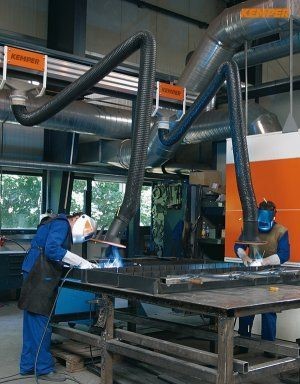
- Movable extraction arms: Suitable for larger workpieces with varying welding locations
- On-gun extraction: Particularly effective for MIG welding by capturing fumes at source
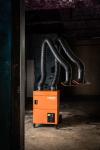
- Mobile extraction units: Appropriate for maintenance work or changing work locations
- Downdraft tables: Useful for smaller workpieces where fumes can be drawn downward
- Administrative Controls: Supporting Engineering Measures
While engineering controls should be the primary defence, administrative measures can enhance protection:
- Implement detailed safe working procedures
- Provide comprehensive worker training on fume hazards
- Establish regular maintenance schedules for all ventilation equipment
- Conduct rotation of workers to limit individual exposure time
- Schedule welding operations during times when fewer workers are present
- Personal Protective Equipment (PPE): The Last Line of Defence
When other controls cannot fully protect workers, appropriate respiratory protective equipment becomes necessary:
- Air-fed helmets or powered respirators for prolonged or high-risk welding
- Properly fitted FFP3 disposable masks for shorter, lower-risk tasks
- Face-fit testing to ensure proper protection levels
- Regular replacement of filters and maintenance of all PPE
- Clear protocols for when and how PPE must be worn
Specific LEV Requirements for Different Welding Scenarios
The HSE guidance emphasizes tailoring control measures to specific welding operations:
General Workshop Welding
For routine welding operations in a typical workshop setting:
- Fixed extraction systems with movable arms generally provide the most effective control
- Capture hoods should be positioned within 200-300mm of the arc
- Regular testing and maintenance must be conducted (at least every 14 months)
- Workspace design should maximize natural and mechanical ventilation
Confined Space Welding
When welding must be performed in confined spaces such as tanks, vessels, or enclosed structures:
- Mechanical ventilation becomes absolutely essential
- Local exhaust ventilation must be supplemented with additional forced ventilation
- Air-fed respiratory protective equipment is typically required
- Gas monitoring equipment should be employed to track oxygen levels and toxic gas buildups
- A dedicated safety observer must be present outside the confined space
Welding on Coated Materials
Special considerations apply when welding materials with coatings or surface treatments:
- Enhanced extraction capacity is required for the additional contaminants
- More frequent filter replacements may be necessary
- Specialized respiratory protection may be required depending on coating composition
- Pre-cleaning of surfaces to remove coatings before welding when possible
Statutory Requirements and Compliance
UK employers must understand their legal obligations regarding welding fume control:
- The Control of Substances Hazardous to Health Regulations 2002 (COSHH) requires adequate control of welding fumes
- LEV systems must undergo thorough examination and testing at least every 14 months
- Records of LEV testing and maintenance must be maintained for at least 5 years
- Risk assessments must be conducted and documented for all welding operations
- Health surveillance may be required for workers regularly exposed to welding fumes
Best Practices for Implementing Effective LEV Systems
To maximize protection and compliance, employers should:
During Selection and Installation
- Consult with qualified LEV engineers when designing systems
- Ensure systems are designed specifically for welding applications
- Consider future needs and potential workshop changes
- Train workers on proper use before installation is complete
- Document design specifications and operational parameters
For Ongoing Operation
- Maintain comprehensive records of all maintenance activities
- Conduct regular visual inspections between formal testing
- Monitor airflow indicators and pressure gauges daily
- Implement a clear fault reporting system for workers
- Schedule preventative maintenance rather than waiting for failures
For Testing and Compliance
- Use only competent persons for LEV testing and examination
- Ensure test reports contain all required information
- Address any identified deficiencies promptly
- Keep all documentation readily accessible for inspection
- Review effectiveness after any process or layout changes
Economic Benefits of Proper Welding Fume Control
Beyond regulatory compliance and worker health, effective fume control offers significant business benefits:
- Reduced absenteeism from work-related illness
- Lower staff turnover and improved workforce morale
- Enhanced productivity through better working conditions
- Decreased likelihood of enforcement action and potential fines
- Lower long-term costs associated with occupational health claims
- Improved company reputation and ability to attract skilled workers
Practical Assessment of Control Effectiveness
Employers should regularly evaluate whether their control measures are working effectively by:
- Conducting workplace air monitoring to measure fume concentrations
- Reviewing health surveillance results for early signs of respiratory issues
- Seeking worker feedback on control measure effectiveness
- Performing smoke testing to visualize airflow patterns and capture efficiency
- Comparing current practices against latest HSE guidance and industry standards
Expert Support for Implementing Proper Welding Fume Controls
Implementing effective welding fume ventilation systems requires specialized knowledge and equipment. For businesses in Mansfield, Nottinghamshire, and throughout the East Midlands, Hall-Fast Industrial Supplies offers comprehensive support for all your welding safety needs.
Their extensive range of welding safety equipment and PPE can be explored at Hall-Fast's Welding and Cut Protection section. Their specialists can help you select appropriate ventilation solutions, proper respiratory protection, and complementary safety equipment tailored to your specific welding operations.
For expert advice on welding fume ventilation systems and LEV requirements, contact Hall-Fast's specialists at (01623) 645 645 or email them at sales@hall-fast.com. Their team can provide guidance on regulatory compliance, equipment selection, and best practices for protecting your workforce from hazardous welding fumes.
Conclusion: A Comprehensive Approach to Welding Fume Safety
Protecting workers from welding fume exposure requires a systematic approach that combines proper engineering controls, administrative measures, and appropriate PPE. By implementing effective Local Exhaust Ventilation systems, following HSE guidance, and partnering with knowledgeable safety equipment suppliers like Hall-Fast, employers can create safer welding environments that protect worker health while ensuring regulatory compliance.
Remember that control measures must be regularly maintained and evaluated to ensure continued effectiveness, and workers must be fully trained on proper use of all safety systems. With the right approach, the health risks associated with welding fumes can be effectively managed, creating safer and more productive work environments across the UK manufacturing and construction sectors.