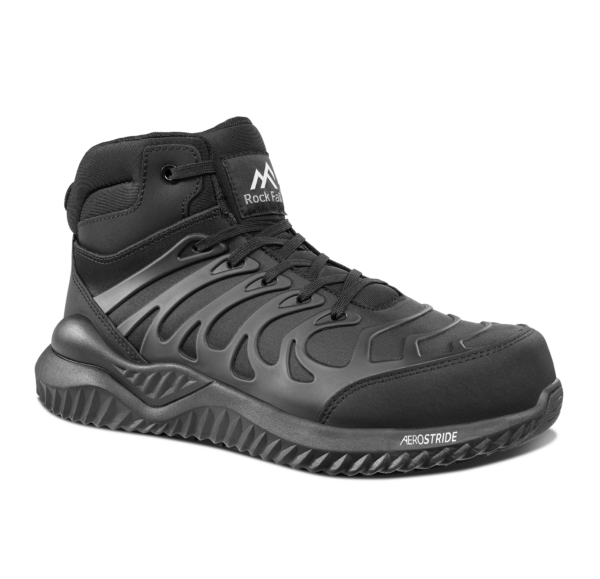
The Best Mid-Cut Safety Trainers in 2025: Why the Rock Fall RF430 Solace Is the Smarter Choice Between a Trainer and a Boot
Focus Keyword: mid-cut safety trainer | Word Count: ~6,000 | Reading Time: ~22 min
Ask most workers in safety-critical roles to describe their footwear situation and you'll often hear a version of the same dilemma. Low-cut safety trainers are comfortable — light, flexible, easy to wear all day — but they leave the ankle exposed on uneven terrain, provide no lateral stability during load-carrying, and offer nothing when the ground gets rough. Full safety boots solve the ankle problem, but at a cost: heavy construction, stiff soles, restricted movement, and a design that belongs firmly in the site compound rather than anywhere near a customer-facing environment.
For years, workers who needed something in between — ankle coverage without boot-weight, support without stiffness, protection without compromise on all-day comfort — had to choose which priority to sacrifice. Not any more.
The Rock Fall RF430 Solace is built precisely to fill this gap. A lightweight mid-cut safety trainer designed with a hi-top construction that wraps around and supports the ankle, the Solace combines the agility and cushioning comfort of Rock Fall's AEROSTRIDE sole system with the elevated coverage and lateral stability that low-cut trainers can't provide. It's equipped with a 200J fiberglass toecap, a PS-rated penetration-resistant midsole, a dynamic KPU cage upper and full EN ISO 20345 certification — in a package that looks and wears more like a premium lifestyle sneaker than a conventional safety boot.
In this guide we'll explore exactly what the mid-cut format offers that neither low-cut trainers nor full boots can match, break down the technology that makes the Solace one of the most accomplished entries in this category in 2025, and make the case for why, for a wide range of workers and working environments, the Solace is not a compromise between two better options — it's the better option outright.
Quick Answer: The Rock Fall RF430 Solace (Product Code: RF430) is a lightweight mid-cut hi-top safety trainer featuring the AEROSTRIDE cushioned sole, Activ-Step® PU footbed, dynamic KPU cage mesh upper, 200J fiberglass toecap, PS-rated penetration-resistant midsole, SR slip resistance and anti-static properties — with 100% recycled polyester sock liner, 60% recycled TPU heel counter and fully sustainable packaging.
1. The Case for Mid-Cut Safety Footwear: Understanding the Gap
The distinction between low-cut, mid-cut and high-cut safety footwear is one that the industry has historically under-explained to end users. Most discussions of safety footwear focus on the rating system — S1, S1P, S3, SR — and the protection credentials of the toecap and midsole. Cut height, by contrast, is treated as a secondary or even aesthetic consideration. This is a mistake. Cut height has a direct and substantial bearing on the biomechanics of working movement, the risk profile of the working environment, and the long-term health outcomes of workers who spend their days on their feet.
What Low-Cut Safety Trainers Do Well — and Where They Fall Short
Low-cut safety trainers have driven the most significant improvement in safety footwear comfort over the past decade. By moving away from the high-ankle design of traditional safety boots and towards a trainer format with a flexible, cushioned sole, low-cut safety trainers have made certified footwear genuinely comfortable to wear for extended periods — reducing fatigue, improving compliance with PPE requirements, and meeting the growing demand from workers for footwear they actually want to wear.
But the low-cut format has a structural limitation that no amount of cushioning technology can fully address: it provides no support to the ankle joint. The ankle is the most commonly injured joint in the lower limb in workplace settings. It is responsible for managing the forces of uneven terrain, controlling balance during load-carrying, and absorbing the lateral stresses of sudden direction changes. Without any supporting structure from the footwear, these forces are managed entirely by the ankle's own ligament and tendon structures — which, under repeated stress or unexpected loads, can stretch, tear or give way entirely.
Ankle sprains and strains are among the most common workplace injuries in industries from construction to logistics to retail. They range in severity from minor nuisances that heal in days to significant ligament tears that require weeks of rehabilitation and can leave lasting instability. In many cases, appropriate footwear with mid-cut or higher coverage would have reduced the severity of the incident or prevented it altogether.
What Safety Boots Offer — and Why Many Workers Won't Wear Them
Full-height safety boots address the ankle support problem effectively. A properly fitted safety boot with a robust upper extending to mid-calf height provides excellent ankle stability on rough terrain, load-carrying stability and protection against ankle-height hazards including snake bite, chemical splash and mechanical impact. For workers in forestry, quarrying, extreme outdoor terrain and heavy construction, a safety boot is the correct specification.
The problem is that for a much larger population of workers — those in logistics, manufacturing, retail, construction site management, utilities, healthcare and countless other roles — the full safety boot is more than the job requires. Its weight and stiffness create fatigue in walking-intensive roles. Its bulk makes it inappropriate for customer-facing environments. Its high cut restricts ankle movement in ways that are uncomfortable rather than helpful for workers on predominantly flat or lightly uneven surfaces. And its traditional aesthetic sits awkwardly in modern workplaces that have invested in professional, contemporary uniform standards.
The result is low compliance. Workers who are issued with full safety boots in environments that don't strictly require them will, over time, stop wearing them. They'll find reasons to leave them in the van, to substitute unsuitable footwear during certain tasks, to manage the discomfort in ways that ultimately create more risk than a properly fitted, willingly worn alternative would. This is one of the most persistent and damaging dynamics in occupational PPE management, and it is directly addressable through appropriate footwear specification.
The Mid-Cut Solution: Support Without Sacrifice
The mid-cut format — broadly defined as footwear that rises to approximately ankle height, providing coverage of the ankle joint without extending fully up the lower leg — resolves the tension between these two formats. It provides the lateral stability and ankle coverage that prevents the most common ankle injuries in workplace settings, without the weight penalty, movement restriction or aesthetic problems of a full boot.
Mid-cut safety trainers like the RF430 Solace represent the most sophisticated evolution of this format: the ankle coverage and support of a boot entry point, delivered in a construction that retains the lightweight, flexible, cushioned character of a premium safety trainer. For workers whose roles involve a mix of indoor and outdoor environments, mixed surface conditions, or any degree of load-carrying or terrain negotiation — the mid-cut format is worth serious consideration as an improvement over both alternatives.
The RF430 Solace is engineered to fill the gap that most safety footwear ranges leave open: ankle support and coverage in a lightweight, flexible, trainer-format construction that neither low-cut trainers nor full safety boots can match.
2. When to Choose a Mid-Cut Safety Trainer: A Practical Risk Assessment Guide
Choosing the right cut height for safety footwear is ultimately a risk assessment decision, and the right answer varies by role, environment and individual. The following framework provides practical guidance for workers and health and safety managers making this decision.
Terrain and Surface Conditions
The single most important factor in determining whether mid-cut coverage adds meaningful protection is the surface conditions encountered during the working day. On consistently flat, uniform surfaces — sealed concrete warehouse floors, level retail flooring, smooth hospital corridors — a low-cut trainer provides equivalent stability to a mid-cut in normal operating conditions. The ankle support benefit of mid-cut coverage becomes most significant when:
• The working environment includes uneven ground surfaces — gravel, compacted earth, broken tarmac, rough outdoor terrain
• There is frequent transition between different surface types or levels — moving between vehicles and ground, stepping on and off platforms, navigating kerbs and ramps
• The ground surface is unpredictable — loose material, debris, wet or icy outdoor surfaces where a momentary loss of footing is more likely
• Gradient is involved — slopes, embankments, ramps and stairways all increase the lateral force on the ankle during each step
Load-Carrying and Manual Handling
Load-carrying significantly increases the injury risk from ankle instability. When carrying a load, the centre of gravity shifts and the body's balance management becomes more demanding. An ankle that might handle a momentary stumble without incident when unloaded can suffer a significant sprain under the same mechanical stress when the wearer is carrying a heavy box, toolbox or materials. Workers in roles with significant manual handling requirements — construction labourers, warehouse pickers, delivery drivers, maintenance engineers — have a materially higher ankle injury risk than those in equivalent roles without load-carrying, and mid-cut coverage is a proportionately more valuable protection for them.
Ankle History and Biomechanics
Workers with a history of ankle sprains or known ankle instability have a significantly elevated risk of repeat injury compared to those without such history. Once the lateral ligaments of the ankle have been stretched or partially torn in a sprain, they heal with some degree of residual laxity — meaning the ankle joint is permanently slightly less stable than before the injury. For these workers, the lateral support provided by a mid-cut upper is not merely a precautionary measure but a genuine clinical recommendation for injury prevention.
Similarly, workers with flat feet (pes planus) or high arches (pes cavus) often have altered ankle biomechanics that make them more susceptible to lateral ankle roll. For these individuals, the additional support of a mid-cut upper can compensate for the reduced intrinsic stability of the foot and ankle complex.
Role Duration and Transition
Workers who split their day between desk-based or light-duty work and more physically demanding site or outdoor tasks face a particular footwear challenge. A low-cut trainer may be entirely appropriate for the office component of the role but insufficient for the outdoor or site component. A full safety boot may be appropriate for the site component but uncomfortable and impractical for desk-based work. The mid-cut safety trainer — comfortable enough for all-day wear in both environments, supportive enough for the outdoor and site components — is the natural solution for this profile.
3. Introducing the Rock Fall RF430 Solace: Technology and Design in Detail
With the case for mid-cut safety footwear established, let's examine the RF430 Solace in detail — the design decisions Rock Fall has made, the technology they've selected, and the practical performance implications for the wearer.
The Hi-Top Construction: How the Solace Achieves Mid-Cut Support
The RF430 Solace achieves its mid-cut ankle support through a hi-top upper construction that rises to approximately ankle height and incorporates the same dynamic KPU cage architecture used in the RF420 Noir. The cage is a three-dimensional KPU (Kieselgur Polyurethane) structural element that wraps around and above the ankle, providing lateral stability that resists the inward or outward rolling forces that cause ankle sprains.
Critically, the KPU cage is not a rigid splint. It is designed as a dynamic, adaptive structure that allows the full range of normal ankle movement — flexion and extension through the gait cycle — while resisting the excessive lateral excursion that causes injury. This distinction is important: a rigid ankle constraint would restrict movement in ways that increase fatigue and can actually transfer mechanical stress to other joints, particularly the knee. The Solace's dynamic cage provides support in the planes where injury occurs while preserving freedom of movement in the planes where efficient, comfortable walking happens.
The breathable mesh base layer beneath the cage maintains the thermal management properties of the upper. Heat and moisture generated during activity are actively dispersed through the mesh, keeping the foot — and crucially the ankle area, which is more enclosed in a mid-cut design than in a low-cut trainer — cool and dry throughout the shift. The water-repellent treatment on the upper adds a degree of moisture resistance without sealing the mesh against air exchange.
The AEROSTRIDE Sole System: Rock Fall's All-Day Performance Platform
The RF430 Solace is built on the same AEROSTRIDE sole system that powers the RF410 Void — Rock Fall's proprietary midsole platform engineered for all-day performance on hard floors and outdoor terrain. In the context of the Solace's mid-cut design, the AEROSTRIDE system takes on additional significance: a mid-cut upper inherently adds weight relative to a low-cut design, and the sole system must compensate for this through its own lightweight, energy-efficient construction.
The AEROSTRIDE midsole is specifically engineered for what Rock Fall describes as extreme impact reduction — not the minimum adequate cushioning that many safety trainer midsoles provide, but a performance-oriented response to the repetitive mechanical demands of all-day wear on hard surfaces. The chunky sole profile provides the structural volume needed for effective cushioning without excessive material density, and the compound retains its performance properties under sustained compression load rather than suffering the gradual degradation that cheaper EVA foams exhibit.
The flexibility of the AEROSTRIDE sole is particularly important in a mid-cut design. A mid-cut upper that provides ankle support but sits on a stiff, inflexible sole transfers the restriction from the ankle to the forefoot, producing an awkward, shuffling gait that accelerates fatigue. The AEROSTRIDE system flexes naturally through the forefoot during push-off, allowing the foot's natural gait mechanics to function normally despite the additional coverage of the hi-top upper. The result is a shoe that walks with the ease of a low-cut trainer while providing the support architecture of a mid-cut design.
Activ-Step® PU Cushioned Footbed
The Activ-Step® PU cushioned footbed in the RF430 Solace provides the second layer of the cushioning system, working in concert with the AEROSTRIDE midsole to create a layered comfort platform that maintains consistent performance across a full working shift. The PU foam used in the Activ-Step® footbed is specified for its resilience under sustained compression — a property that matters especially in a mid-cut design where the additional upper height increases the overall weight of the shoe and places a greater load demand on the cushioning system.
The footbed's direct contact with the foot means it also plays a significant role in moisture management. The surface material of the Activ-Step® footbed wicks perspiration away from the foot surface, complementing the breathable mesh upper in maintaining the dry, cool interior environment that is so important for long-term comfort, blister prevention and foot health in extended-wear scenarios.
Like all Activ-Step® footbeds in the Rock Fall range, the Solace's insole is removable — allowing it to be aired between shifts and replaced with a custom orthotic if required. For workers with specific foot health requirements, this adaptability is a genuine practical advantage that many safety trainers in this category don't offer.
Fiberglass Toecap: 200J Protection in a Non-Metallic, Lightweight Form
The RF430 Solace's fiberglass toecap provides the highest class of impact protection available under EN ISO 20345 — 200 joules — without the weight, temperature conduction or metal-detector issues of a steel toecap. At 200J, the protection rating covers the serious industrial impact scenarios that cause the most significant foot injuries: dropped tools, falling materials, vehicle contact. The fact that this level of protection is delivered in a fiberglass form means the Solace's overall weight remains competitive with low-cut trainers at equivalent protection ratings.
The non-metallic construction — encompassing both the fiberglass toecap and the non-metallic penetration-resistant midsole insert — gives the RF430 Solace a 100% non-metallic certification. This is practically significant in two specific ways. First, workers who pass through metal detection systems as part of their role — airport and secure facility staff, prison officers, government building security — can wear the Solace without triggering detection equipment. Second, in environments with electrical hazard risks, non-metallic footwear eliminates the conductivity pathway that metallic components could create.
The slim profile of the fiberglass toecap also maintains the sleek, trainer-like aesthetic of the Solace's toe box. Steel toecaps often produce a bulbous, heavy visual appearance in the forefoot that reads unmistakably as 'safety boot' rather than 'premium trainer'. The fiberglass toecap in the Solace allows the toe box to retain the clean lines of a lifestyle sneaker, preserving the shoe's fashion-forward visual identity from toe to ankle.
KPU Cage Upper: Dynamic Structure That Moves With You
The KPU cage is the most visually distinctive element of the RF430 Solace, and it performs double duty as both a functional support architecture and a design statement. KPU — Kieselgur Polyurethane — is a synthetic material that combines the structural properties of polyurethane with the flexibility of rubber, allowing it to be formed into complex three-dimensional shapes that provide targeted support in specific areas while remaining supple and movement-friendly everywhere else.
In the Solace, the KPU cage extends from the heel, around the lateral and medial sides of the ankle, and forward through the midfoot — creating a structural envelope that resists the lateral forces responsible for ankle sprains while allowing the natural forward-and-back movement of walking. The cage's three-dimensional form provides abrasion resistance across the entire upper, protecting the breathable mesh base layer from the mechanical wear that comes from contact with rough surfaces, machinery, vehicle footwells and the general abrasive environment of most workplaces.
From a design perspective, the cage creates the high-fashion hi-top aesthetic that sets the Solace apart from conventional mid-cut safety boots. The dynamic, sculpted appearance of the KPU structure — catching light differently from different angles, creating visual depth through its three-dimensional form — communicates quality, innovation and considered design rather than the functional-but-plain appearance of traditional safety footwear. For workers who care about their professional appearance, this distinction is not trivial: it is the difference between safety footwear you're proud to wear and safety footwear you tolerate.
PS-Rated Penetration-Resistant Midsole
The penetration-resistant midsole insert in the RF430 Solace provides PS-rated protection against sharp objects from below — the nails, screws, glass shards, metal swarf and other debris that can penetrate conventional sole materials in construction, manufacturing, waste management and outdoor work environments. The insert is developed by Activ-Step Footwear Components, the same specialist manufacturer responsible for the Solace's premium footbed.
The engineering challenge with penetration-resistant inserts — maintaining flexibility alongside protection — is particularly acute in a mid-cut design, where the additional upper height means the sole must compensate for any stiffness to preserve the shoe's overall wearability. Rock Fall's solution, using an Activ-Step insert designed specifically to maintain the dynamic flexibility of the AEROSTRIDE sole, achieves PS certification without the rigidity penalties that cheaper insert designs impose. The Solace flexes through the forefoot as naturally as a low-cut trainer, despite carrying a fully certified penetration-resistant midsole.
SR-Rated Slip-Resistant Outsole
The high-performing slip-resistant rubber outsole of the RF430 Solace carries SR (Slip Resistant) certification — tested and verified on both wet ceramic tile with soap solution and flat steel with glycerol, the two standard test surfaces used in EN ISO 20345 certification. Achieving SR certification on both surfaces is a meaningful distinction: it demonstrates that the outsole's grip is genuine and versatile rather than optimised for one surface condition at the expense of another.
For a mid-cut trainer designed for mixed indoor and outdoor use, the versatility of the SR-rated outsole is particularly important. Workers in roles that transition between sealed indoor flooring and outdoor surfaces — wet concrete, gravel, compacted soil, wet grass — need an outsole that performs reliably across all these conditions. The Solace's outsole compound is specified for exactly this mixed-use application, providing confident traction in the full range of environments the shoe is likely to encounter.
Anti-Static Properties
The RF430 Solace's anti-static properties make it appropriate for use in environments where electrostatic discharge is a controlled hazard — electronics manufacturing, clean-room environments, petrochemical handling, grain and flour processing and other settings where ESD control is a material safety requirement. In the context of a mid-cut design, anti-static properties broaden the Solace's applicability to the full range of environments that might benefit from its ankle support characteristics, without requiring a separate footwear specification for ESD-sensitive areas.
4. The RF430 Solace and Sustainability: Better Materials, Better Future
The RF430 Solace carries the full Better Materials Framework commitments that Rock Fall has applied across its current generation of safety trainers. In the context of a mid-cut design — where the additional material in the upper might be expected to increase the environmental footprint of the shoe relative to a low-cut alternative — the sustainability credentials of the Solace are particularly worth examining.
100% Recycled Polyester Sock Liner
The sock liner in the RF430 Solace is manufactured entirely from recycled polyester — post-consumer rPET (recycled polyethylene terephthalate) derived from plastic bottles and packaging. Recycled polyester requires significantly less energy to produce than virgin polyester and avoids the extraction of new petroleum-derived raw material. In a mid-cut design with a larger interior surface area than a low-cut trainer, the sock liner represents a slightly larger component than in equivalent low-cut shoes — making the 100% recycled polyester specification a proportionately larger environmental contribution.
The performance characteristics of the rPET sock liner are equivalent to virgin polyester in every application-relevant dimension: moisture management, dimensional stability, durability and skin comfort. Buyers who choose the Solace on sustainability grounds make no performance compromise in doing so.
60% Recycled TPU Heel Counter
The heel counter — the stiffened component that gives the heel section its shape and contributes to the secure heel fit — uses 60% recycled TPU. In a mid-cut design, the heel counter works in conjunction with the KPU cage to provide the lateral ankle stability that is the Solace's defining structural feature. Using recycled TPU at 60% content in this load-bearing structural component demonstrates that Rock Fall's sustainability commitments extend to components where performance cannot be compromised — a more demanding standard than using recycled materials in cosmetic or non-structural elements.
Fully Sustainable Packaging
Every RF430 Solace ships in fully sustainable packaging, completing the environmental story from material selection through manufacturing to delivery. For corporate procurement teams incorporating life-cycle assessments into PPE sourcing decisions, the packaging specification is a relevant data point alongside the recycled material content of the shoe itself.
Rock Fall's Better Materials Framework is notable for what it doesn't do as much as for what it does. It doesn't make vague claims about 'eco-friendly' materials without specificity. It doesn't offset poor material choices in one area with token gestures in another. It makes specific, quantified commitments — 100% recycled polyester in the sock liner, 60% recycled TPU in the heel counter — that are verifiable and consistent across the product range. For buyers who are serious about sustainability rather than merely performative about it, this transparency is a genuine differentiator.
5. Industries and Roles Where the RF430 Solace Excels
The RF430 Solace's mid-cut format gives it a distinct applicability profile compared to low-cut safety trainers. It performs at its strongest in roles and environments where the combination of ankle support, comprehensive safety certification, all-day comfort and the ability to transition between indoor and outdoor settings is most valuable.
Construction: Site Management, Surveying and Engineering
Construction professionals in site management, project management, civil engineering and quantity surveying roles occupy a specific position in the construction workforce: they need to move confidently across active construction sites — uneven ground, loose aggregate, sharp debris, wet concrete — but they also need to be presentable in site offices, client meetings and off-site environments. A full safety boot serves the site component of this role but is impractical for the office; a low-cut trainer serves the office but is insufficient for the site.
The RF430 Solace is the natural specification for this profile. Its mid-cut KPU cage upper provides the ankle support and lateral stability needed for active construction site environments, its fiberglass toecap and penetration-resistant midsole cover the standard impact and sharp object hazards of construction sites, and its trainer aesthetic — a premium hi-top sneaker silhouette rather than a site boot — is appropriate for both site and office environments without a change of footwear. For this specific profile of worker, the Solace doesn't require a compromise: it simply works.
Logistics and Distribution: Load-Carrying Roles
In logistics and distribution environments, the case for mid-cut support is strongest in roles involving significant manual handling — pickers carrying heavy items, drivers loading and unloading vehicles, depot staff moving goods across uneven yard surfaces. For these workers, the combination of hard-floor walking and load-carrying creates the ankle stress profile where mid-cut coverage delivers its most meaningful protection benefit.
The Solace's AEROSTRIDE cushioning system handles the hard-floor walking demands of distribution environments with the same effectiveness as the RF410 Void — the AEROSTRIDE platform is shared between both shoes — while the mid-cut upper adds the ankle support that makes the Solace the more appropriate specification for high-manual-handling roles. For logistics businesses conducting risk assessments that identify ankle injury as a significant hazard, the Solace provides a demonstrably better mitigation than a low-cut trainer at a similar comfort and performance level.
Utilities and Outdoor Infrastructure
Workers in utilities, highways maintenance, telecoms, rail and outdoor infrastructure roles routinely move across the most varied and demanding surfaces encountered in any UK occupational context. Gravel trackways, embankments, verges, uneven pavements, partially excavated road surfaces, wet grass — the range of underfoot conditions in a single working day for a utilities engineer or highways inspector can be enormous. The RF430 Solace's combination of mid-cut ankle support, SR-rated outdoor grip, penetration-resistant midsole and breathable weather-resistant upper makes it one of the most comprehensively specified options in this category.
For lighter outdoor infrastructure roles — inspection, survey, site visits — the Solace's trainer aesthetic and all-day comfort make it significantly more practical and comfortable than a traditional safety boot. For heavier outdoor roles involving sustained exposure to deep mud, standing water or extreme terrain, a waterproof safety boot remains the more appropriate specification.
Manufacturing and Engineering Workshops
Manufacturing environments place a broad range of demands on safety footwear, and the RF430 Solace covers all of them. The 200J fiberglass toecap covers impact hazards from machinery and falling components. The penetration-resistant midsole covers the sharp debris hazards of metalworking and fabrication environments. The anti-static properties cover ESD-sensitive manufacturing processes. The SR outsole covers slip hazards from coolant, oil and process spillages.
The mid-cut coverage adds a further dimension of protection relevant to manufacturing: ankle-height hazards. In machine shop environments, the ankle area can be exposed to hot swarf, chemical splash, low-level mechanical impact and the sharp edges of materials being worked. The KPU cage upper of the Solace provides a degree of protection against all of these hazards that a low-cut trainer simply cannot match.
Warehousing with Yard and Outdoor Components
Many warehousing and distribution operations include significant yard activity — loading bay environments with uneven surfaces, goods yard areas with loose aggregate and vehicle movement, and seasonal outdoor conditions that create wet, slippery and uneven underfoot conditions that are quite different from the controlled indoor warehouse floor. Workers who split their time between indoor warehouse floor and outdoor yard environments face precisely the footwear challenge that the Solace addresses. Its AEROSTRIDE cushioning makes it appropriate for the hard-floor warehouse component; its mid-cut ankle support and SR outsole make it more appropriate than a low-cut trainer for the yard component.
Retail with Stockroom and Delivery Receipt Functions
Large-format retail environments — DIY warehouses, furniture stores, large supermarkets, trade counters — often require staff to move between customer-facing floor areas and back-of-house stockrooms, goods receipt areas and loading docks. The physical demands of the back-of-house environment — uneven loading dock surfaces, manual handling, potentially wet floors — go beyond what most retail safety footwear is designed for, while the customer-facing floor demands footwear that looks smart and professional.
The RF430 Solace meets both requirements. Its hi-top trainer aesthetic is professional and contemporary for the customer-facing environment; its mid-cut support, impact protection and penetration resistance cover the demands of the back-of-house and loading dock environment. For retail health and safety managers seeking a single footwear specification that genuinely covers the full range of environments in large-format retail, the Solace is a strong candidate.
Security and Facilities Management
Security officers and facilities management professionals share a similar working profile: they move continuously across varied environments throughout a shift — indoor corridors, outdoor yards, stairwells, loading bays — encountering a mix of surface types and physical demands that require footwear combining comfort for extended walking with support for varied terrain. The RF430 Solace's 100% non-metallic construction is particularly valuable for security roles where regular metal detector passage is required, and its mid-cut support is appropriate for the patrolling and incident-response demands of active security work.
6. The RF430 Solace vs the Competition: Where It Leads and Where to Look Elsewhere
The mid-cut safety trainer segment is less crowded than the low-cut category but is growing as awareness of the ankle support benefits of mid-cut construction increases. Here is an honest assessment of where the RF430 Solace stands relative to its competitors and within the Rock Fall range.
Vs Other Mid-Cut Safety Trainers
Mid-cut safety trainers from other manufacturers in the market range from basic S1P hi-tops with commodity soles and minimal design investment to premium offerings from outdoor and work boot specialists. The RF430 Solace differentiates itself within this field through three specific advantages: the AEROSTRIDE sole system, which provides premium all-day cushioning performance that most mid-cut competitors at equivalent price points don't match; the KPU cage construction, which provides a dynamic, supportive and visually distinctive upper architecture rather than the plain leather or simple mesh uppers of most mid-cut safety trainers; and the comprehensive Better Materials Framework sustainability credentials, which most mid-cut competitors have not matched in this price bracket.
Vs Full Safety Boots
The RF430 Solace is not a replacement for a full safety boot in environments that genuinely require full boot coverage. Workers in forestry, quarrying, extreme construction and other roles where ankle-high coverage is a mandatory safety requirement should look to a full safety boot. What the Solace offers is a better alternative to a full safety boot for the much larger population of workers who are routinely issued with full boots in environments where mid-cut coverage would provide equivalent relevant protection at significantly better comfort and wearability. For these workers — who represent the majority of safety boot wearers in the UK — the Solace is a meaningful upgrade rather than a downgrade.
Vs the RF410 Void and RF420 Noir
Within the Rock Fall range, the Solace, Void and Noir are complementary rather than competing products, each serving a distinct buyer profile. The RF410 Void is the performance-led all-day comfort specialist: optimised for high-step-count walking on hard floors in a clean, understated low-cut design. The RF420 Noir is the design-led fashion-forward option: the translucent bubble sole and KPU cage in a low-cut format, with added fuel oil resistance for automotive and engineering environments. The RF430 Solace is the mid-cut option: everything the Void offers in terms of AEROSTRIDE cushioning and comprehensive protection, plus the ankle support and KPU cage coverage of the Noir, in a hi-top construction for workers whose environments demand more ankle support than a low-cut trainer provides.
For buyers evaluating the range, the decision tree is straightforward: if ankle support is not a specific requirement, choose between the Void (performance focus) and Noir (design focus) based on the role's aesthetic requirements and whether fuel oil resistance is needed. If ankle support is a requirement, the Solace is the appropriate specification — it combines the best elements of both low-cut siblings in a mid-cut format without significant compromise on either comfort or design.
7. Sizing, Fitting and Caring for Your RF430 Solace
Getting the Right Fit in a Mid-Cut Design
Fitting a mid-cut safety trainer requires slightly more care than fitting a low-cut equivalent, because the upper's extension around the ankle means that both foot length and ankle circumference affect the fit. The following guidance will help ensure you get the right size first time:
• Measure foot length in the afternoon or evening when feet are at their largest; size for the larger foot if there is any difference between left and right
• Allow a thumbnail's width of space between the longest toe and the end of the shoe — particularly important in a mid-cut design where the higher upper can make it tempting to size down for a snug ankle fit
• Check the fit around the ankle specifically: the KPU cage should feel supportive but not constrictive; you should be able to flex the ankle fully through its normal range of motion without the cage creating pressure points
• Wear the same type of socks you would wear at work when trying on or sizing; thicker work socks add volume inside the shoe and affect both foot and ankle fit
• Lace the shoe fully before assessing fit; the lacing system distributes the tension of the upper across both the foot and ankle, and an unlaced shoe will feel significantly different from a properly laced one
• Walk on a hard surface — not carpet — for at least five minutes before confirming the fit; the heel should feel secure without slippage, and there should be no pressure points from the KPU cage at the ankle
Lacing the RF430 Solace for Ankle Support
The lacing system of a mid-cut trainer is more functionally significant than in a low-cut shoe, because the upper laces extend above the ankle and the tension applied directly affects the degree of ankle support the shoe provides. A loosely laced mid-cut shoe provides much less ankle support than the same shoe correctly laced — some wearers inadvertently reduce the benefit of mid-cut coverage by lacing their shoes too loosely out of habit from low-cut footwear. For the Solace, lace firmly enough that the ankle feels supported and the upper moves with the foot rather than independently of it, while ensuring that blood circulation is not restricted.
Breaking In the RF430 Solace
The KPU cage upper of the RF430 Solace is slightly less immediately flexible than a plain mesh upper, and benefits from a brief break-in period — typically three to five days of progressive wear — to allow the cage to adapt to the specific geometry of the wearer's ankle. During this period, wear the shoes for increasing durations rather than jumping immediately to a full shift. The AEROSTRIDE midsole and Activ-Step® footbed are effective from day one; it is the cage, not the sole, that requires adaptation. Any pressure points or areas of cage stiffness experienced in the first few days will typically resolve as the KPU material softens and conforms.
Care and Maintenance
• After each shift, brush loose debris from the outsole tread pattern and the gaps between the KPU cage sections
• Clean the KPU cage with a damp cloth and mild soap solution; KPU is resistant to most mild cleaning agents and maintains its structural properties after regular cleaning
• Clean the mesh upper with a soft brush and damp cloth; avoid harsh chemicals that could damage the water-repellent treatment
• Remove the Activ-Step® footbed after each shift and allow both the footbed and shoe interior to air dry thoroughly — this is the single most effective maintenance step for extending footbed life and preventing odour build-up in the enclosed mid-cut interior
• Do not machine wash — the mechanical and thermal stress of a washing cycle can compromise the adhesive bonds in the sole assembly and the structural integrity of the KPU cage
• Air dry naturally away from direct heat; radiators, tumble dryers and direct sunlight can distort the KPU cage and degrade sole adhesives
• Apply a mesh-safe water-repellent spray periodically to maintain the water-repellent properties of the upper; the mid-cut design means more upper surface area is exposed to weather than in a low-cut trainer, making periodic re-treatment more important
Knowing When to Replace
• Visible deformation or cracking around the toecap — indicating a potential impact has compromised the fiberglass structure
• Separation between the KPU cage and the mesh base layer, or between the cage and the sole unit — signs of adhesive failure that also indicate end of structural life
• Significant outsole tread wear in the heel and forefoot zones, which reduces the shoe's SR slip resistance performance
• Cracking or permanent deformation of the KPU cage sections, particularly around the ankle — indicating the cage has fatigued beyond its effective support range
• Noticeable reduction in midsole cushioning — when the AEROSTRIDE system no longer feels springy and responsive, it has compressed beyond its effective performance range
• Any breach in the upper that compromises the integrity of the interior
For full-time wearers in standard environments, the RF430 Solace can be expected to deliver twelve to eighteen months of reliable service before reaching end of life. The KPU cage is more durable than plain mesh in abrasive environments, which may extend the upper's service life; high-intensity outdoor use can accelerate outsole wear.
8. Frequently Asked Questions About Mid-Cut Safety Trainers and the RF430 Solace
What is a mid-cut safety trainer and how is it different from a low-cut trainer?