The Complete Buyer's Guide to Britain's Most Trusted Heavy-Duty Platform Trucks
When you need to move heavy, bulky, or awkward loads across a yard, warehouse, construction site, or equestrian facility, the equipment you choose matters. It matters because the wrong trolley costs you time, causes injuries, breaks down, and ultimately costs far more than the price difference you thought you were saving. The Stubbs Large Timber Bogie — manufactured in Nottinghamshire by WB Stubbs (Hawksworth) Ltd, the same company that has been building handling equipment at Progress Works since 1836 — is the platform truck that professionals across British industry have trusted for generations to do this job properly.
This guide covers everything you need to know about Stubbs Large Timber Bogies: their specifications, construction, the engineering decisions that make them different from cheaper alternatives, the industries and applications they serve, how to choose the right configuration for your needs, and how to maintain them so they last for decades rather than years. Whether you are buying your first timber bogie or replacing an ageing platform truck that has finally reached the end of its working life, this is the most comprehensive resource available.
What Is a Stubbs Large Timber Bogie?
A timber bogie — also known as a turntable truck, platform truck, site bogie, or flatbed trolley — is a four-wheeled, hand-operated platform on which loads are placed and transported. The term "bogie" comes from its turntable steering mechanism: the front pair of wheels is mounted on a rotating plate (the turntable), connected to a handle that the operator uses to steer. This turntable arrangement allows the truck to be manoeuvred around corners, through doorways, and along narrow aisles with far greater control than a simple four-wheeled cart with fixed axles.
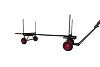
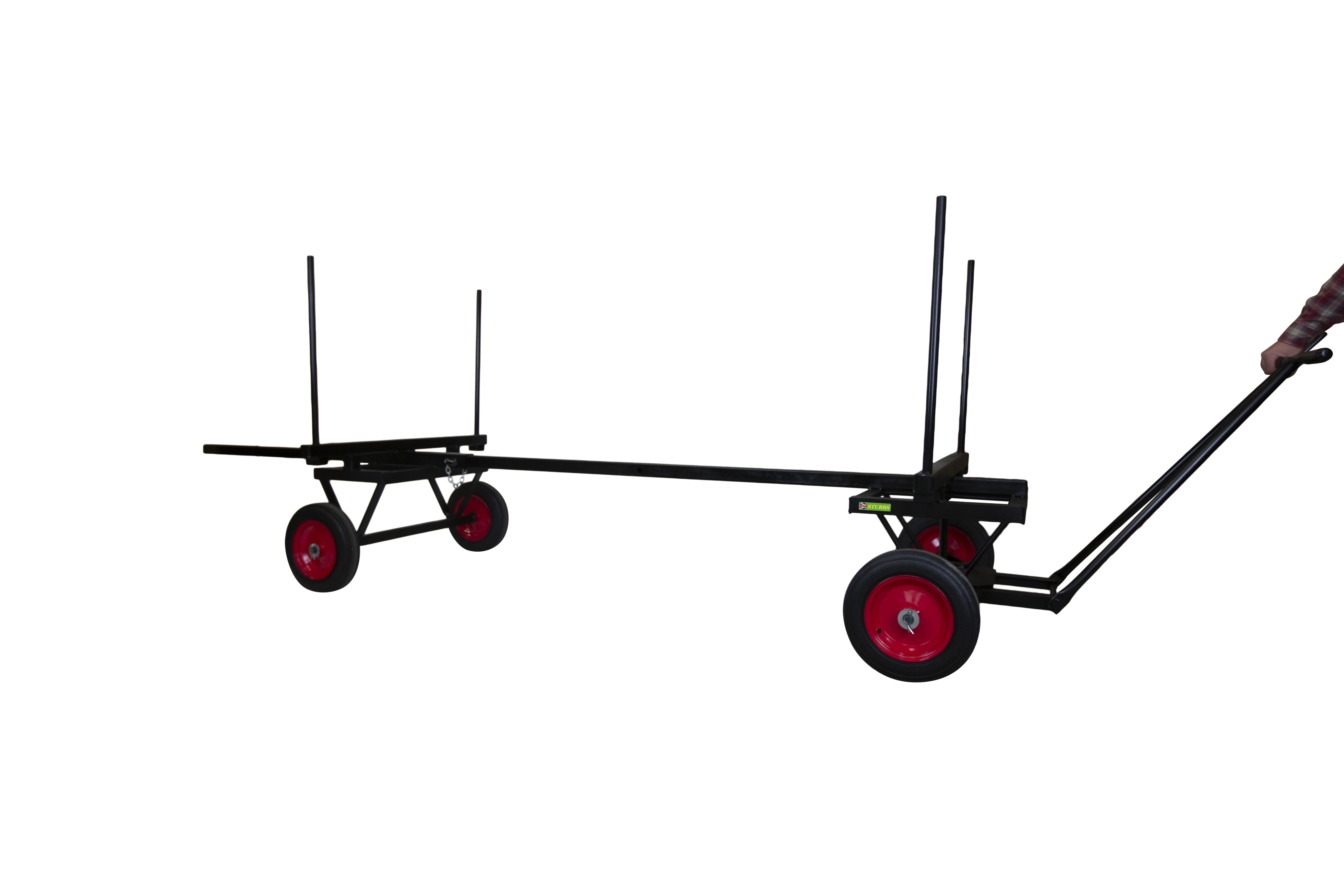
The Stubbs Large Timber Bogie is the heavy-duty model in the Stubbs turntable truck range. It features a generous 1524 x 711mm timber platform mounted within a robust angle steel frame, a 500kg load capacity, 400mm diameter wheels (available as pneumatic or solid cushion rubber), and the distinctive Stubbs dark green baked enamel finish with a light green timber deck. The overall dimensions are 1600 x 711 x 1130mm, the platform height is 510mm from the ground, and the truck weighs 54kg — substantial enough to remain stable under heavy loads, yet manageable enough for comfortable one-person operation when empty.
The U-shaped folding handle is a defining Stubbs feature. It provides an ergonomic steering and pushing grip during use, then folds flat against the front of the truck when not in use, reducing the storage footprint and eliminating the projecting handle that catches on doorframes and other equipment in crowded workspaces.
This model is available as a flatbed (without sides) or with removable timber sides for enhanced load security. When fitted, the timber sides prevent items from sliding off the platform during transport — particularly useful when carrying multiple smaller items, irregularly shaped loads, or when operating on uneven ground where loads are more likely to shift. The sides can be lifted out in seconds, converting the truck back to a flatbed for handling larger items such as machinery, panels, or palletised goods that need to be loaded from the side.
The History and Heritage of WB Stubbs
Understanding why a Stubbs timber bogie is different from a generic imported turntable truck requires understanding the company behind it. WB Stubbs (Hawksworth) Ltd has been manufacturing handling equipment, stable fittings, and industrial products from its Progress Works facility in Nottinghamshire since 1836. That is not a marketing claim printed on a swing tag — it is nearly two centuries of continuous manufacturing at the same site, through industrialisation, two world wars, and every economic cycle since the reign of William IV.
The company is best known in the equestrian world for its stable fittings, hay racks, mangers, tack room equipment, and yard trolleys. The dark green enamelled steel and seasoned timber construction that characterises Stubbs products is instantly recognisable on yards, farms, and estates across the United Kingdom. But the same engineering principles and manufacturing standards apply to the company's industrial and commercial handling equipment, including the turntable truck range.
Stubbs products are manufactured to order in small batches, not mass-produced in overseas factories and shipped in containers. Each frame is fabricated from angle steel, welded, and finished with baked enamel paint — a process that produces a harder, more durable, and more corrosion-resistant finish than the spray-and-air-dry methods used on budget alternatives. The timber decks are cut from selected softwood, treated for dimensional stability and moisture resistance, and fitted within the frame to provide full-span support across the entire platform area.
This is not nostalgia or heritage marketing. It is a practical description of a manufacturing process that produces a measurably better product. The angle steel frame is stronger and more rigid than the lighter-gauge pressed steel used in most imported trucks. The baked enamel finish lasts longer and resists chipping better than standard paint. The selected timber deck grips loads naturally and can be repaired board by board if damaged, rather than requiring the entire platform to be replaced.
Detailed Specifications
Getting the specification right before you buy avoids costly mistakes. Here is the complete technical breakdown of the Stubbs Large Timber Bogie.
Dimensions and Weight
The platform dimensions are 1524mm long by 711mm wide — a generous working area that accommodates the vast majority of loads encountered in warehouse, yard, construction, and agricultural environments. The overall dimensions, including the frame and wheels, are 1600mm long by 711mm wide by 1130mm high. The platform height is 510mm from the ground, which places the loading surface at a comfortable working height that reduces bending and stooping during loading and unloading.
The truck weighs 54kg. This is heavier than many budget alternatives, which typically weigh between 30kg and 40kg, and the difference is entirely attributable to the heavier-gauge angle steel frame and the solid timber deck. The additional weight is an advantage, not a penalty. A heavier truck is more stable under load, less prone to tipping, and less likely to roll away on slight inclines when loaded. The 54kg weight is also well within the range that a single operator can comfortably push and steer when the truck is empty or lightly loaded.
Load Capacity
The rated load capacity is 500kg. This is a safe working load, not a theoretical maximum — it represents the weight the truck is designed to carry repeatedly, day after day, without accelerated wear or risk of structural failure. In practice, the angle steel frame is engineered with a substantial safety margin beyond this rated capacity, but operators should always respect the stated 500kg limit.
A 500kg capacity covers the requirements of the vast majority of general-purpose handling tasks: bags of cement, animal feed, compost, or aggregate (typically 20–25kg each, so 20–25 bags per load); bales of hay or straw; boxes of stock or components; lengths of timber, pipe, or conduit; tools, equipment, and machinery up to half a tonne; paving slabs, blocks, and building materials; and virtually any other load encountered in commercial, agricultural, industrial, or institutional settings.
For operations that regularly handle heavier individual items — for example, engine blocks, steel fabrications, or loaded pallets — Stubbs offers higher-capacity models rated at 750kg and 1,500kg. But for the overwhelming majority of applications, 500kg is the sweet spot that balances capacity, manoeuvrability, and cost.
Frame Construction
The frame is fabricated from angle steel — L-shaped structural steel sections that provide exceptional rigidity and resistance to bending and twisting forces. This is the same type of steel used in structural framing, racking systems, and engineering applications where strength-to-weight ratio matters.
The angle steel sections are welded together to form a continuous frame that surrounds and supports the timber deck from beneath and around all four edges. The welds are continuous rather than spot-welded, distributing load forces across the entire joint rather than concentrating them at individual points. This continuous welding is one of the details that distinguishes Stubbs construction from budget alternatives, where spot-welding or tack-welding is used to reduce manufacturing time and cost, at the expense of long-term joint integrity.
The turntable mechanism — the rotating plate that connects the front axle assembly to the main frame — is the single most stressed component in any turntable truck. On a Stubbs bogie, this connection is engineered with a robust bearing arrangement and heavy-duty mounting that maintains smooth, precise steering action even after years of heavy use. The handle attachment, front and rear axle mountings, and wheel spindles are all designed to withstand the repeated impact and vibration loads that are unavoidable in real-world handling operations.
The Timber Deck
The deck is constructed from selected softwood boards, treated for dimensional stability and resistance to moisture absorption. The timber is carefully chosen for straightness of grain, absence of significant knots, and consistent density — all factors that affect how the deck performs under load over time.
Timber is the ideal deck material for general-purpose platform trucks for several important and practical reasons. It provides a naturally non-slip surface that grips loads without the need for additional matting, fixings, or adhesive pads. It absorbs impacts and vibrations during transit, protecting both the load and the truck structure from the shocks that would be transmitted directly through a steel or mesh platform. It accommodates loads of varying sizes and shapes without the items catching or snagging on mesh apertures or raised edges — a genuine everyday annoyance with mesh-decked trucks that anyone who has used one will recognise immediately.
Critically, a timber deck can be repaired. If an individual board is split, cracked, warped, or rotted, it can be removed and replaced without affecting the rest of the deck or the truck. This is a significant practical and economic advantage over welded mesh platforms, which must be replaced as a complete unit when damaged, and over MDF or plywood platforms, which tend to delaminate and swell when exposed to moisture and cannot be partially repaired.
The deck sits within the angle steel frame and is supported across its full area to prevent flexing and sagging under load. This full-span support is an engineering detail that has a dramatic effect on the truck's long-term performance. Budget manufacturers frequently compromise on deck support, using only perimeter support or a few cross-members, which results in platforms that bow visibly under heavy loads and eventually crack or split at the unsupported spans. The Stubbs deck is designed to remain flat and rigid under the full rated capacity, year after year, load after load.
The Finish
The frame is finished in Stubbs' distinctive dark green baked enamel. Baking the enamel — curing it in an oven at controlled temperature — produces a finish that is significantly harder, more chip-resistant, and more corrosion-resistant than air-dried paint. In outdoor and semi-outdoor environments where turntable trucks are regularly exposed to rain, mud, chemicals, animal waste, and general site contamination, the quality of the finish has a direct and measurable effect on the truck's service life.
The timber deck is finished in light green, providing a visual contrast with the frame that gives the Stubbs range its recognisable appearance. The deck finish also serves a functional purpose, sealing the timber surface against moisture penetration and protecting it from the dirt, oils, and organic materials that would otherwise promote decay.
Wheels
The Stubbs Large Timber Bogie is available with 400mm diameter wheels in two types: pneumatic (air-filled) or solid cushion rubber. The choice of wheel type has a significant impact on the truck's performance in different environments, and understanding the differences will help you select the right option for your application.
Pneumatic wheels are air-filled tyres mounted on steel rims. They provide excellent shock absorption, rolling smoothly over rough, uneven, and loose surfaces without transmitting every bump and vibration through the truck and its load. They offer superior traction on soft or wet ground, gravel, cobblestones, grass, and the kind of mixed surfaces found on construction sites, farms, equestrian yards, and outdoor storage areas. The 400mm diameter is large enough to roll over small obstacles, ruts, and debris without stalling.
The disadvantage of pneumatic wheels is that they can puncture. A flat tyre renders the truck unusable until the tyre is repaired or replaced, which means downtime. In environments where sharp debris, nails, screws, wire, or thorns are common on the ground, puncture frequency can become a genuine operational issue.
Solid cushion rubber wheels eliminate the puncture problem entirely. They are made from solid rubber moulded around a steel rim, and they cannot deflate. They require no inflation checks, no puncture repairs, and no tyre maintenance whatsoever. They are the lower-maintenance option and the better choice for primarily indoor use, smooth concrete or tarmac surfaces, and environments where puncture risk is high.
The trade-off is ride quality. Solid wheels do not absorb shocks the way pneumatic tyres do, and they transmit more vibration through the truck on rough surfaces. They offer less traction on soft, wet, or loose ground. For primarily outdoor use on uneven terrain, pneumatic wheels are the better performer; for primarily indoor use or mixed environments where puncture-free reliability is the priority, cushion wheels are the practical choice.
Who Uses Stubbs Large Timber Bogies?
The versatility of the Stubbs Large Timber Bogie means it serves an exceptionally wide range of industries and applications. Understanding how different sectors use these trucks can help you assess whether it is the right choice for your own operation.
Warehousing and Distribution
In warehouse environments, timber bogies are used for general goods movement: transporting boxes, cartons, sacks, and packages between storage locations, loading bays, packing stations, and despatch areas. The 500kg capacity handles the vast majority of warehouse loads, and the turntable steering allows operators to navigate narrow aisles, around racking, and through doorways with precision. The timber deck provides a non-slip surface that keeps boxes and packages in place without the need for strapping on short internal moves. Warehouses that handle a high volume of varied goods — rather than a narrow range of palletised products that are better served by pallet trucks — find the flatbed timber bogie particularly effective because it accommodates loads of virtually any shape and size.
Construction and Building Sites
Construction sites present some of the most demanding conditions for any handling equipment: rough ground, mud, debris, slopes, narrow access routes, and heavy loads of building materials. The Stubbs Large Timber Bogie with pneumatic wheels is specifically suited to these conditions. Bags of cement, sand, and aggregate; lengths of timber, pipe, and conduit; boxes of fixings and fittings; tools and power equipment; paving slabs, blocks, and bricks — all of these common construction loads sit securely on the timber platform and can be wheeled across site surfaces that would defeat smaller-wheeled trolleys.
Builders' merchants and timber yards use these trucks extensively for customer order assembly, stock movement, and yard loading. The generous 1524mm platform length accommodates full-length building materials without dangerous overhang, and the removable sides option keeps stacked items contained during transport.
Agriculture and Equestrian
This is where the Stubbs name carries its greatest recognition. Stubbs timber bogies have been a fixture on farms, equestrian yards, livery stables, stud farms, and rural estates for decades. They transport bales of hay and straw, sacks of feed and bedding, fencing supplies, water containers, tools, tack, and equipment across yard surfaces that are frequently rough, muddy, cobbled, and exposed to the weather in every season.
The robust angle steel construction, weather-resistant enamel finish, and pneumatic wheel option make these trucks ideally suited to the demanding conditions found in farming and equestrian environments. The sided variants are particularly popular in these sectors, containing loose or irregularly shaped loads during transport across uneven ground. The ability to remove the sides when handling larger items such as machinery, fencing panels, or feed bins adds valuable day-to-day flexibility.
Many equestrian yard owners and farm managers regard the Stubbs timber bogie as one of the most useful single items of equipment they own. It is used from early morning feeds through to end-of-day equipment moves, and its durability means it continues performing year after year in conditions that would destroy lesser equipment within months.
Schools, Colleges, and Local Authorities
Groundskeeping and facilities management teams in schools, colleges, universities, local authorities, parks departments, and leisure centres use timber bogies for grounds maintenance tasks: moving plants, soil, mulch, tools, and equipment around extensive sites. Sports facilities use them to transport line-marking equipment, goal posts, training equipment, cones, and barriers. The trucks are also used for general site maintenance, moving furniture, equipment, and supplies between buildings.
The Stubbs Large Timber Bogie is a popular choice in these settings because it combines the load capacity and durability needed for genuine heavy-duty work with the quality and longevity that justify the investment when purchasing through public procurement processes. These organisations need equipment that will last for many years of daily use, and the Stubbs track record in this regard is well established.
Garden Centres and Nurseries
Garden centres and plant nurseries use timber bogies for moving plants, pots, compost bags, paving, aggregates, garden furniture, and other heavy or bulky items around their premises. The timber deck is particularly well suited to carrying potted plants and bags of growing media, providing a stable, non-slip surface that prevents items from sliding during transport. The pneumatic wheels handle the mixed surfaces found in garden centre environments, including gravel paths, paved areas, and softer ground in outdoor display and growing zones.
Manufacturing and Industrial Workshops
In manufacturing environments, timber bogies transport work-in-progress, components, finished goods, tools, and equipment between workstations, storage areas, and despatch. The flatbed configuration accommodates loads of widely varying shapes and sizes — a significant advantage in manufacturing operations where the items being moved change frequently throughout the day. The timber deck also protects finished surfaces from the scratching and marking that occurs on steel or mesh platforms, making it the preferred choice for handling painted, polished, or coated items.
Stubbs Large Timber Bogies vs. Imported Alternatives: What You Actually Get for the Price
The Stubbs Large Timber Bogie costs more than a budget imported turntable truck. That is a straightforward fact, and it is the first thing many buyers notice. What is less immediately obvious — but far more important to the total cost of ownership — is what you get for that additional investment and what you avoid by not choosing the cheaper option.
Frame Quality
Budget turntable trucks are typically constructed from lighter-gauge pressed or folded steel, not the angle steel used by Stubbs. Pressed steel is cheaper and faster to form, but it is fundamentally less rigid. Under repeated heavy loading, pressed steel frames flex, distort, and eventually crack at stress points — particularly around the turntable mounting, axle connections, and handle attachment. When a frame cracks, the truck is finished. It cannot be economically repaired.
An angle steel frame, welded with continuous beads rather than spot-welds, resists these forces for dramatically longer. The frame is the skeleton of the truck, and its quality determines the truck's ultimate service life more than any other single component.
Deck Quality
Many imported trucks use thin plywood, MDF, or pressed steel mesh for the platform. Plywood and MDF are acceptable on smooth, dry, indoor floors but delaminate and swell rapidly when exposed to moisture — and any truck that is used outdoors, or even in an unheated warehouse or yard, will encounter moisture regularly. Once the deck starts swelling and delaminating, it loses its structural integrity, becomes uneven, and eventually fails.
Mesh platforms are durable but present practical problems: small items fall through the apertures, strapping and packaging catch and snag on the mesh edges, and loads of certain shapes cannot be placed flat because they bridge across the mesh rather than sitting flush. Mesh also transmits every vibration and shock directly to the load, with no cushioning effect.
A solid timber deck, properly selected and treated, avoids all of these problems. It provides a flat, stable, non-slip, weather-resistant surface that lasts for years and can be repaired board by board when eventually needed.
Finish Quality
A spray-applied, air-dried paint finish begins to chip and flake within months of exposure to outdoor conditions, impacts, and abrasion. Once the steel frame is exposed, corrosion begins, and once corrosion takes hold in a structural member, the frame's integrity is progressively compromised.
Stubbs' baked enamel finish is cured at controlled temperature, producing a harder, more adherent coating that resists chipping and weathering for significantly longer. The investment in the finishing process is invisible until you compare a Stubbs bogie after three years of outdoor use with a budget alternative after the same period. The difference is stark.
Bearing and Turntable Quality
The turntable mechanism and wheel bearings are the moving parts of the truck, and their quality determines how smoothly and easily the truck steers, rolls, and handles throughout its life. Budget trucks frequently use the cheapest bearings available, which develop play, roughness, and resistance quickly under load. The turntable mechanism loosens, developing excessive wobble that makes steering imprecise and unpredictable.
Stubbs uses quality bearings throughout, and the turntable mechanism is engineered to maintain its precision and smoothness over many years of use. Replacement bearings are available, and the truck is designed to allow bearing replacement as a maintenance operation rather than requiring the entire truck to be discarded when a bearing wears.
Repairability and Parts Availability
This is perhaps the most significant practical difference. A Stubbs bogie is designed to be repaired, maintained, and kept in service for decades. Individual deck boards can be replaced. Wheels and tyres can be changed. Bearings can be renewed. The handle, turntable, and axle components are all serviceable. Stubbs supports its products with replacement components, allowing owners to maintain their trucks in continuous service rather than disposing of the entire unit when a single component wears out.
Budget imported trucks are typically not supported with spare parts. When a wheel breaks, a tyre goes flat beyond repair, a bearing seizes, or a deck panel fails, the entire truck is scrapped and replaced. Over a five- or ten-year period, the total cost of buying and disposing of multiple cheap trucks frequently exceeds the cost of buying one Stubbs bogie and maintaining it.
The Real Cost Comparison
Consider a conservative scenario. A budget turntable truck costs £150 and lasts, with heavy daily use, approximately two to three years before frame fatigue, deck failure, or worn-out wheels and bearings make it unserviceable. Over a ten-year period, you purchase three or four replacements, spending £450 to £600 in total, plus the cost and inconvenience of disposing of each failed truck and the downtime during replacement.
A Stubbs Large Timber Bogie costs more upfront but, with reasonable maintenance, provides ten or more years of reliable service. Replacement wheels, tyres, and deck boards over that period might add a modest additional cost, but the total expenditure is comparable to or less than the serial-replacement approach — and you have had ten years of consistent, reliable, high-quality performance rather than a repeating cycle of declining performance and replacement.
How to Choose the Right Configuration
The Stubbs Large Timber Bogie is available in several configurations. Choosing the right one for your application is straightforward once you understand the key decision points.
Flatbed or Sided?
The flatbed (no sides) configuration offers maximum versatility. Loads of any shape and size, up to the platform dimensions and weight capacity, can be placed on the platform from any direction. This is the better choice if you regularly handle large, bulky, or irregularly shaped items such as machinery, panels, furniture, or palletised goods that would not fit within fixed sides.
The sided configuration adds removable timber sides that contain loads during transport. This is the better choice if you regularly carry multiple smaller items, loose materials, or loads that could shift or fall from the platform — particularly when operating on uneven ground, slopes, or in windy conditions. Since the sides are removable, you retain the ability to convert to flatbed operation when needed.
If in doubt, the sided version gives you both options. You can leave the sides in place for most tasks and remove them when handling oversized loads.
Pneumatic or Cushion Wheels?
This choice depends primarily on your operating environment.
Choose pneumatic wheels if you operate primarily outdoors, on rough or uneven ground, on gravel, cobbles, grass, mud, or construction site surfaces. Pneumatic tyres absorb shocks, provide traction on loose surfaces, and roll over obstacles more easily than solid wheels. They are the default choice for agricultural, equestrian, construction, and grounds maintenance applications.
Choose cushion (solid rubber) wheels if you operate primarily indoors, on smooth concrete or tarmac, or in environments where puncture risk is a significant concern. Cushion wheels require zero tyre maintenance and cannot go flat, making them the lower-maintenance option. They are the default choice for warehouse, factory, and indoor commercial applications.
If your operation involves a roughly equal mix of indoor and outdoor use, pneumatic wheels are generally the more versatile choice, provided you are prepared to address occasional punctures. If downtime from punctures is unacceptable — for example, in a single-truck operation where no backup is available — cushion wheels eliminate that risk entirely.
Maintenance and Care
A Stubbs Large Timber Bogie is built to last for decades, but like any working equipment, it performs best and lasts longest when it receives basic, regular maintenance. The good news is that the maintenance required is simple, infrequent, and well within the capability of any operator.
Wheel and Tyre Maintenance
For pneumatic-wheeled models, check tyre pressures regularly and inflate to the recommended pressure when needed. Under-inflated tyres increase rolling resistance, make steering heavier, accelerate tyre wear, and reduce the truck's load-carrying stability. Inspect tyres for cuts, embedded objects, and signs of excessive wear. Replace tyres that are worn smooth, cracked, or repeatedly puncturing.
For cushion-wheeled models, inspect the rubber for cracking, chunking (pieces breaking away), flat spots, and excessive wear. Solid tyres wear more slowly than pneumatic tyres but do eventually reach the end of their useful life.
On both types, check that the wheels spin freely without excessive play, roughness, or resistance. Any grinding, clicking, or catching sensation indicates bearing wear that should be addressed. Stubbs replacement bearings are available and can be fitted without specialist tools.
Frame Inspection
Inspect the angle steel frame periodically for signs of cracking, bending, or weld deterioration. Pay particular attention to the turntable mounting point, the handle attachment, and the axle mountings — these are the areas of highest stress during operation. While Stubbs frames are built to withstand years of heavy use, any equipment can be damaged by overloading, impact, or misuse, and early detection allows repair before a minor issue becomes a safety concern.
Deck Maintenance
Keep the timber deck clean and free from substances that could promote decay. Standing water, chemicals, animal waste, and organic materials should be cleaned away after use rather than left to soak into the timber. If the deck finish becomes worn, a coat of appropriate exterior wood preservative or paint will renew the protection.
If individual deck boards become split, cracked, or warped, they can be replaced without affecting the rest of the truck. This is a straightforward repair that extends the truck's life significantly, and it is one of the core advantages of the Stubbs timber deck design over platforms that must be replaced as a complete unit.
Finish Maintenance
The baked enamel finish protects the steel frame from corrosion. If the finish is chipped or scratched — from impacts, abrasion, or simply years of hard use — touch up the exposed areas with a suitable metal primer and enamel paint to prevent rust from developing. In outdoor environments, a seasonal inspection and touch-up routine will keep the frame protected and extend the truck's service life considerably.
Turntable and Handle
The turntable mechanism should operate smoothly, allowing the front wheels to swivel freely through their full range of rotation. If the turntable becomes stiff, rough, or loose, inspect the bearing and mounting for wear or damage. A small amount of lubrication on the turntable bearing, applied periodically, helps maintain smooth operation.
The folding handle should lock securely in both the upright (operational) and folded (stowed) positions. Check the handle pivot and locking mechanism for wear and adjust or repair as needed.
Health and Safety Considerations
Using a timber bogie correctly is not only a matter of efficiency — it is a health and safety requirement. The Manual Handling Operations Regulations 1992 (as amended) require employers to avoid hazardous manual handling operations where reasonably practicable, and to reduce the risk of injury from those operations that cannot be avoided. A properly specified and maintained turntable truck is one of the most effective tools for achieving this in any workplace where goods need to be moved by hand.
Load Limits
Never exceed the rated 500kg load capacity. Overloading places excessive stress on the frame, wheels, bearings, and turntable mechanism, accelerating wear and increasing the risk of sudden structural failure. It also raises the centre of gravity, making the truck less stable and more prone to tipping, particularly on uneven ground or slopes.
Load Placement
Place loads centrally on the platform, distributing weight as evenly as possible. Avoid placing all the weight at one end of the platform, as this creates an imbalance that makes the truck harder to steer and increases the tipping risk. When carrying tall loads, keep the heaviest items at the bottom to lower the centre of gravity.
Surface Conditions
Be aware of the surface conditions you are operating on. Slopes, wet or icy surfaces, loose gravel, and uneven ground all increase the risk of the truck running away, tipping, or becoming difficult to control. On slopes, always position yourself on the uphill side of the truck so that you can control its movement. Never attempt to ride on the truck or allow it to run freely downhill.
Visibility
Ensure you have clear visibility of your route before moving. If the load obscures your view, consider pulling the truck rather than pushing it, or use a spotter to guide you through areas of restricted visibility. This is particularly important on busy sites with vehicle and pedestrian traffic.
Training
All operators should be instructed in the correct use of the turntable truck, including load limits, loading technique, steering, and the safe use of slopes and ramps. While turntable trucks are straightforward to operate, untrained users may not be aware of the tipping risks associated with overloading, uneven loading, or operating on slopes.
Frequently Asked Questions
What is the difference between a timber bogie and a turntable truck?
They are the same thing. "Timber bogie" refers to the timber-decked platform combined with the bogie (turntable) steering mechanism. "Turntable truck" is the more formal industry term. Both terms describe a four-wheeled platform truck with turntable steering, and you will see them used interchangeably across suppliers, manufacturers, and industry documentation.
What size loads can the Stubbs Large Timber Bogie carry?
The platform measures 1524 x 711mm, so any item or combination of items that fits within those dimensions (and does not exceed 500kg total weight) can be carried. In practice, loads that slightly overhang the platform edges can be transported provided they are balanced and the overhang does not create a snagging or tipping hazard.
Can I leave the truck outdoors permanently?
The baked enamel finish and treated timber deck are designed to withstand outdoor conditions, and the truck will perform reliably when stored outside. However, like any steel and timber equipment, its service life will be extended by storing it under cover when not in use — a simple lean-to, open-sided shed, or tarpaulin cover is sufficient. Prolonged exposure to standing water, in particular, will accelerate timber decay even on treated decks.
How long will a Stubbs Large Timber Bogie last?
With reasonable maintenance, a Stubbs bogie will provide decades of reliable service. Many customers report Stubbs trucks remaining in active daily use for 15 to 20 years or more, with only periodic replacement of consumable items such as tyres and the occasional deck board. The angle steel frame, in particular, is essentially a lifetime component under normal use conditions.
Can I get replacement parts?
Yes. Stubbs supports its products with replacement wheels, tyres, bearings, deck boards, and other components. This repairability is a core advantage of the Stubbs range, allowing the truck to be maintained in service rather than disposed of when a single part wears out.
Is the Stubbs Large Timber Bogie made in the UK?
Yes. The Stubbs Large Timber Bogie is manufactured by WB Stubbs (Hawksworth) Ltd at Progress Works in Nottinghamshire, England. It is a genuine British-made product, not an imported item assembled or relabelled in the UK.
What is the delivery time?
Stubbs turntable trucks are made to order. Delivery times vary depending on current production schedules, but you should allow for a lead time when ordering. Contact Hall Fast for current availability and expected delivery dates.
Do I need two people to operate the truck?
No. The Stubbs Large Timber Bogie is designed for single-operator use. One person can comfortably push, steer, and manoeuvre the truck when loaded to its full 500kg capacity, provided the surface conditions are reasonable. The turntable steering and large wheels minimise the effort required.
Can the sides be removed?
On the sided variant, the timber sides are removable, allowing you to convert between a sided and flatbed configuration as needed. The sides lift out without tools, and the changeover takes only seconds.
What is the platform height?
The platform height is 510mm from the ground. This places the loading surface at a comfortable height for most operators, reducing the bending and stooping required when loading and unloading items.
Why Buy from Hall Fast?
Hall Fast is a long-established industrial supplies company offering the full range of Stubbs turntable trucks and timber bogies alongside a comprehensive selection of tools, equipment, workwear, and consumables for trade and industrial customers. Buying from Hall Fast provides several practical advantages.
Hall Fast holds a wide range of handling equipment, allowing you to compare the Stubbs Large Timber Bogie with other turntable trucks, platform trolleys, and handling solutions to ensure you select the right product for your specific requirements. The Hall Fast team can advise on model selection, wheel type, and configuration based on your intended application.
As a UK-based supplier with established logistics, Hall Fast provides reliable delivery to UK addresses and the purchasing experience — from enquiry through ordering to delivery and after-sales support — that trade and professional customers expect.
Conclusion
The Stubbs Large Timber Bogie is not the cheapest turntable truck on the market. It is not designed to be. It is designed to be the best-value turntable truck on the market when measured over the full life of the product, and the distinction between cheapest and best-value is one that professionals who depend on their equipment every day understand instinctively.
The angle steel frame, selected timber deck, baked enamel finish, quality bearings, 400mm wheels, and the accumulated manufacturing expertise of nearly two centuries of continuous production at Progress Works all contribute to a product that performs better, lasts longer, and costs less to own over time than the budget alternatives it is invariably compared with.
Whether you are managing a busy equestrian yard, running a construction site, operating a warehouse, maintaining school grounds, or handling stock in a garden centre, the Stubbs Large Timber Bogie is the platform truck that will still be doing its job, reliably and without fuss, long after cheaper alternatives have been scrapped and replaced.
Buy once. Buy Stubbs. Buy from Hall Fast.