


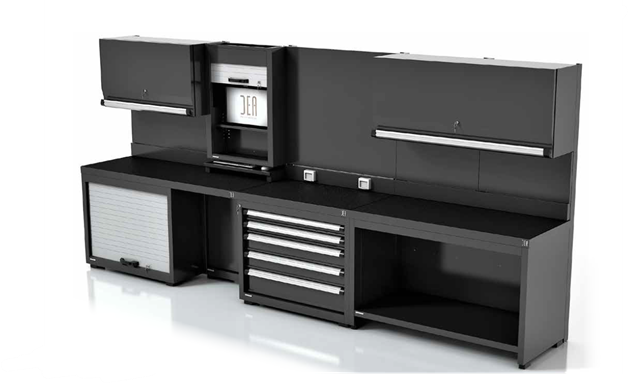
The Complete Guide to DEA WorkLab Modular Workshop Furniture from Hall-Fast Industrial Supplies
Introduction: Why Choosing the Right Industrial Workbench Matters
For manufacturing plants, engineering workshops, automotive service centres, logistics operations, and research laboratories across the United Kingdom, the industrial workbench is far more than a simple flat surface on which to carry out tasks. It is the central hub of productive activity, the platform around which entire workflows are designed, and one of the most important investments a business can make in the efficiency, safety, and professional quality of its operations. A poorly chosen workbench undermines productivity, creates ergonomic hazards, deteriorates rapidly under daily industrial use, and projects an unprofessional image that erodes confidence among both employees and visiting clients.
Yet the UK market for industrial workbenches is vast and varied, ranging from budget flat-pack solutions that buckle under modest loads to bespoke engineering-grade systems that represent a significant capital investment. Navigating this market requires an understanding of materials, construction methods, load-bearing capacities, modular configuration options, surface treatments, and the regulatory framework that governs workplace furniture in British industrial environments. It also requires access to a supplier with genuine expertise, a proven product range, and the technical knowledge to help you configure exactly the right solution for your particular application.
This comprehensive guide examines every aspect of industrial workbenches for UK businesses, with a particular focus on the DEA WorkLab range available from Hall-Fast Industrial Supplies. DEA WorkLab represents the pinnacle of Italian-designed, precision-manufactured modular workshop furniture, offering a system of workbenches, drawer units, cabinets, trolleys, worktops, wall units, ecological containers, and fluid distribution modules that can be configured to meet the demands of virtually any industrial or commercial working environment. Whether you are outfitting a single workstation or furnishing an entire production facility, this guide will equip you with the knowledge to make a confident and informed purchasing decision.
What Makes a Great Industrial Workbench? Essential Characteristics for UK Workplaces
Before examining the DEA WorkLab range in detail, it is valuable to establish the criteria by which any industrial workbench should be evaluated. Understanding these fundamentals helps buyers distinguish genuinely professional equipment from products that may look adequate in photographs but fail to deliver under the sustained demands of real industrial use.
Structural Strength and Load-Bearing Capacity
The defining characteristic of a genuine industrial workbench, as opposed to a commercial desk or domestic workbench, is its ability to support substantial static and dynamic loads without flexing, racking, or deforming. In a manufacturing or assembly environment, workbenches routinely support heavy components, clamped workpieces, mounted vices, power tools, and dense materials. A workbench that flexes under load compromises precision, creates safety hazards, and deteriorates rapidly as fasteners work loose and joints separate. Professional industrial workbenches typically offer load capacities ranging from 300 kg to well over 800 kg evenly distributed, with frames constructed from heavy-gauge welded steel that maintains its rigidity throughout decades of daily use.
Surface Durability and Chemical Resistance
The worktop surface must withstand the specific demands of its intended application. In a mechanical workshop, this means resistance to impact, scratching, oils, solvents, and hydraulic fluids. In an electronics assembly environment, the priority shifts to electrostatic dissipation and clean-room compatibility. In a pharmaceutical or food processing context, chemical resistance, hygiene, and ease of decontamination become paramount. The best industrial workbench systems offer a choice of worktop materials and surface treatments, allowing the buyer to specify the right combination of properties for their particular environment.
Ergonomic Design and Adjustability
Modern industrial workbench design reflects an increasingly sophisticated understanding of occupational ergonomics. Workers who spend extended periods at a workstation that is too high, too low, or poorly configured suffer from musculoskeletal disorders that lead to absenteeism, reduced productivity, and potential employer liability under UK health and safety legislation. Adjustable feet, configurable working heights, and the ability to position tools and materials within comfortable reach are not luxuries but essential features that protect both workers and the businesses that employ them.
Modularity and Configuration Flexibility
No two industrial operations are identical, and the most effective workbench systems are those that can be configured precisely to match the requirements of each individual workstation and workflow. A truly modular system allows the buyer to start with a basic bench frame and add drawers, cabinets, shelving, tool panels, lighting, power distribution, and specialist accessories as needed. Critically, a modular system also allows for future reconfiguration as operational requirements evolve, protecting the initial investment and avoiding the need to replace entire workstations when processes change.
Build Quality and Longevity
Industrial workbenches are not consumable items. A well-chosen, well-manufactured workbench should provide many years, and often decades, of reliable service. This long-term perspective makes initial purchase price a less meaningful metric than total cost of ownership, which factors in durability, maintenance requirements, reconfiguration flexibility, and residual value. A premium workbench that lasts fifteen years and can be reconfigured three times during that period represents dramatically better value than a budget alternative that needs replacing every three to four years and cannot be adapted to changing requirements.
The DEA WorkLab Range: Italian-Designed Modular Workshop Furniture
DEA WorkLab, manufactured by DEA+RO&Co S.p.A. from their production facilities in Reggio Emilia and Fano, Italy, represents one of the most comprehensive and meticulously engineered modular workshop furniture systems available in the UK market. The company has built its reputation on a philosophy that industrial furniture should be as beautiful as it is functional, combining the aesthetic sensibility of Italian design with the uncompromising structural integrity demanded by the world’s most exacting industrial environments. DEA’s client portfolio includes names like Ferrari, Jaguar Land Rover, and BMW, a testament to the quality and prestige that the brand commands.
What distinguishes DEA WorkLab from conventional workbench suppliers is the sheer scope and coherence of the modular system. Every component in the range, from the smallest drawer unit to the largest triple-module workstation, is designed to integrate seamlessly with every other component. This means that a buyer can start with a single workbench module and, over time, expand and reconfigure the installation by adding drawer units, cabinets, trolleys, wall furniture, worktops, ecological waste containers, and fluid and power distribution modules, all in the same design language, with the same quality of construction, and with perfect mechanical and aesthetic compatibility.
Product Categories in the DEA WorkLab Range
The complete DEA WorkLab system, available through Hall-Fast, encompasses the following product categories:
|
Product Category |
Function |
Key Features |
|
Industrial Workbenches |
Core working surfaces for assembly, maintenance, and production tasks |
Single, double, and triple modules; heights 920 mm and 1100 mm; up to 800 kg capacity |
|
Industrial Worktops |
Durable working surfaces with impact and chemical resistance |
2 mm thick steel; 4-fold reinforcement bars; scratch-proof and corrosion-resistant |
|
Industrial Drawer Units |
Organised storage for tools, components, and documents |
3 to 12 drawers; DEAmotion soft-close guides; 30–200 kg per drawer; fully extractable |
|
Industrial Cabinets |
Secure enclosed storage for larger equipment and materials |
20+ models; retractable doors; variable depth; epoxy powder coating |
|
Industrial Trolleys |
Mobile storage that docks to workbenches or moves independently |
Series 90 and 110; 3 to 8 drawers; 4 reinforced wheels with brakes |
|
Industrial Wall Units |
Overhead storage and tool organisation |
Manual or motorised shutters; perforated panels; monitor supports |
|
Ecological Containers |
Integrated waste management at the workstation |
Segregated waste streams; durable construction; easy emptying |
|
Fluid & Energy Distribution |
Cable reel housing and utility connections at the bench |
Accommodates common cable reels; integrated power and air distribution |
|
Complete Workstations |
Pre-configured multi-component setups |
Ready-made compositions for specific workflows; fully customisable |
DEA Industrial Workbenches: Specifications and Configuration Options
The workbench is the foundation of every DEA WorkLab installation, and the range offers a breadth of options that ensures a perfect fit for virtually any industrial application.
Module Sizes and Series
DEA workbenches are available as single, double, and triple modules, with each module size corresponding to a specific working width. All modules are available in the Series 90 (920 mm working height) and Series 110 (1,100 mm working height) configurations, allowing the buyer to specify the ergonomically optimal height for their particular application. The Series 90 is the standard choice for seated or mixed seated-standing work, while the Series 110 is designed for standing-only operations where the elevated surface height reduces the need for workers to bend over their tasks.
Workbench widths range from 720 mm for the most compact single modules up to 2,160 mm for the largest triple configurations. This range accommodates everything from small component assembly workstations in tight production cells to large-format maintenance benches in spacious service workshops. By combining multiple modules side by side, operators can create continuous working surfaces of virtually any length, and the modular joints between adjacent units can incorporate integrated cable routing for power, data, and compressed air distribution.
Construction and Materials
Every DEA workbench frame is constructed from heavy-gauge sheet steel, welded to exacting tolerances and finished with a high-quality epoxy powder coating that delivers exceptional resistance to corrosion, scratches, chemical attack, and mechanical impact. The standard colour is a sophisticated anthracite grey, complemented by stainless steel profiles and chrome-plated extruded aluminium handles that give the range its distinctive premium appearance. However, the colour of every component can be customised to match corporate branding, facility colour-coding schemes, or simply the aesthetic preferences of the buyer.
The lower shelf of each workbench is equipped with an ABS protective cover that resists acids, scratches, and impact, and also dampens noise when tools and components are placed upon it. This attention to the acoustic environment may seem like a small detail, but in busy workshops where dozens of benches are in use simultaneously, the cumulative noise reduction contributes measurably to a more comfortable and less fatiguing working environment.
Load Capacity
DEA workbenches are engineered to support loads of up to 800 kg evenly distributed across the working surface. This exceptional capacity means that even the heaviest components, fixtures, and equipment can be placed on the bench with complete confidence. The rigid, welded steel frame maintains its dimensional accuracy under load, ensuring that precision assembly and measurement tasks can be carried out without concern for surface deflection. This load capacity is maintained throughout the product’s life, not just when new, thanks to the inherent strength and fatigue resistance of the welded steel construction.
Adjustable Feet and Levelling
Every workbench module is fitted with adjustable feet that allow precise levelling on uneven industrial floors. This may appear to be a minor feature, but in practice it is essential for ensuring a stable, non-rocking working surface that supports accurate work and safe operation. The adjustment range accommodates the typical floor irregularities found in industrial buildings, and the foot design distributes the bench’s weight and working loads across a sufficient area to prevent damage to the floor surface.
Cable and Service Integration
A frequently overlooked aspect of workbench design is the provision for routing electrical cables, data connections, and pneumatic hoses. DEA workbenches incorporate pre-cut openings in the upper and rear panels of the frame shoulders that can be easily opened during installation to create clean, concealed pathways for services. This ensures that cables and hoses are routed safely within the furniture structure rather than trailing across the floor or draped over the work surface, reducing trip hazards, protecting the services from damage, and maintaining the clean, organised appearance that characterises a professionally furnished industrial workspace.
Drawer Units, Cabinets, and Storage Solutions
Organised, accessible, and secure storage is fundamental to productive industrial work. Time spent searching for tools, components, or documentation is time wasted, and unsecured storage creates both safety risks and the potential for loss and damage. The DEA WorkLab storage system addresses these requirements with a comprehensive range of drawer units, cabinets, trolleys, and wall-mounted furniture that integrates seamlessly with the workbench modules.
Industrial Drawer Units
DEA’s drawer units are manufactured from thick sheet metal and treated with the same epoxy powder coating used on the workbench frames, providing load-bearing capacity, corrosion resistance, and chemical resistance that far exceeds what lighter-gauge commercial furniture can offer. The range includes models with between three and twelve drawers, each sliding on DEA’s exclusive DEAmotion guides, a soft-closing, full-extension mechanism that allows complete access to drawer contents while preventing the slamming that damages both the furniture and its contents. Individual drawer capacities range from 30 kg for standard drawers up to 200 kg for heavy-duty configurations, depending on the model and specification. Drawers are lockable for security, and the ergonomic extruded aluminium handles include guide slots for labels, making it easy to maintain an organised, visually clear storage system.
Industrial Cabinets
For items that are too large for drawer storage, or that require enclosed protection from dust, contaminants, or unauthorised access, DEA offers a range of more than twenty cabinet models. These include door cabinets with retractable doors that minimise the space required for opening, variable-depth models optimised for different composition types, and specialist configurations for specific storage requirements. All cabinets share the same premium construction standards as the rest of the range, with welded steel structures, epoxy powder coating, and the distinctive DEA design language of stainless steel profiles and aluminium handles.
Mobile Trolleys
DEA’s tool trolleys bridge the gap between fixed workstation storage and the need for mobile tool access at the point of work. Available in Series 90 and Series 110 with between three and eight drawers, these trolleys feature four reinforced castor wheels, two equipped with brakes, and rubberised magnets that secure the trolley to the workbench frame when docked. This dual-mode operation means the trolley functions as an integral part of the workstation when stationary, and as an independent mobile tool chest when detached and wheeled to the task. The castor brakes ensure stability when the trolley is being used in its mobile configuration, preventing unwanted movement that could create hazards in busy workshop environments.
Wall-Mounted Furniture
DEA’s wall units are designed to maximise the use of vertical space above and around the workstation. Options include units with manual or motorised shutters, smooth or perforated rear panels for tool hanging, monitor support brackets for PC integration, and single, double, or triple-width configurations. Wall units are ideal for storing smaller tools, cleaning supplies, reference documents, and electronic equipment, keeping frequently used items within arm’s reach while freeing the working surface for productive tasks.
Industrial Worktops: The Working Surface That Defines Performance
The worktop is the component of the workbench system that makes direct contact with the work being performed, and its characteristics have a direct impact on the quality, efficiency, and safety of every task carried out upon it.
Construction and Durability
DEA industrial worktops are manufactured from 2 mm thick steel sheet with four-fold edges and internal reinforcement bars that create a rigid, impact-resistant surface capable of withstanding the sustained mechanical abuse of daily industrial use. The surface finish provides excellent resistance to scratches, corrosion, and the chemical attack of oils, solvents, acids, and other aggressive substances commonly encountered in workshop environments.
Protection and Noise Reduction
The ABS protective covers fitted to DEA worktops and shelves serve a dual purpose. First, they provide an additional layer of protection against scratching, chemical damage, and impact, extending the working life of the surface and maintaining its appearance. Second, they significantly reduce the noise generated when metal tools and components are placed on or slid across the work surface. This acoustic benefit is particularly valuable in environments where multiple workstations are in operation simultaneously, as the cumulative noise reduction contributes to a more comfortable auditory environment that supports concentration and reduces the risk of noise-induced hearing fatigue.
Customisation Options
DEA worktops can be specified in custom colours to match corporate branding or facility colour-coding systems, and can be configured with additional features such as integrated vice mounting points, cable management channels, and specialised surface treatments for applications requiring specific material properties. This level of customisation ensures that the working surface is optimised not just for the general category of work being performed, but for the precise requirements of each individual workstation.
Industrial Applications Across the United Kingdom
The versatility of the DEA WorkLab system means it is deployed across an exceptionally wide range of industrial and commercial environments throughout the UK. The following sections highlight some of the most common applications and the specific features that make DEA workbenches particularly well suited to each.
Automotive Service Centres and Dealerships
The automotive sector was one of the earliest and most enthusiastic adopters of DEA WorkLab furniture, and the brand has become a recognised standard in dealership service centres and independent workshops alike. DEA’s work with prestige brands including Jaguar Land Rover, BMW, and Ferrari has demonstrated the system’s ability to meet the exacting standards of premium automotive environments where the quality of the workspace reflects directly on the brand being serviced. In these settings, the combination of functional excellence and aesthetic refinement is essential, as service bays are increasingly visible to customers and form part of the overall brand experience.
Manufacturing and Assembly Lines
Production environments demand workbenches that can withstand continuous use, support heavy components and tooling, and be reconfigured rapidly as products and processes change. DEA’s modular system excels in these environments, where individual workstations can be specified with exactly the combination of working surface, storage, tool organisation, and utility connections required for each position on the production line. The ability to reconfigure workstations without replacing the fundamental bench structure provides significant cost savings over the life of a manufacturing facility, particularly in industries where product cycles are short and production layouts change frequently.
Electronics and Precision Assembly
Environments where electrostatic discharge poses a risk to sensitive components, or where cleanliness and contamination control are critical, require workbenches with specific surface properties and construction standards. DEA workbenches can be specified with ESD-safe surface treatments and configured with clean, enclosed cable routing that minimises dust accumulation and contamination risk. The precision of the welded steel construction ensures that working surfaces are flat and true, supporting the accurate positioning and assembly of small, delicate components.
Logistics, Packing, and Despatch
Warehousing and distribution operations use industrial workbenches as packing stations, quality inspection points, and despatch preparation areas. In these environments, the emphasis is on working surface area, load capacity, and the integration of peripheral equipment such as scales, label printers, scanners, and computer terminals. DEA’s pre-cut cable routing, fluid and energy distribution modules, and the ability to specify wide, multi-module working surfaces make the system ideally suited to these high-throughput applications.
Educational and Research Institutions
Universities, research institutes, and training centres require workbenches that combine industrial-grade durability with the flexibility to accommodate a wide variety of disciplines and activities. DEA’s modular system allows institutions to configure standardised workstation layouts that can be adapted for different courses, research projects, and practical exercises, maximising the utilisation of expensive laboratory and workshop space.
Motorcycle and Specialist Vehicle Workshops
The motorcycle service and restoration sector presents unique workspace challenges, with smaller components, specialised tooling, and the need for workbenches that accommodate the specific geometry of motorcycle maintenance tasks. DEA offers dedicated configurations designed for motorcycle workshops, with optimised heights, integrated tyre rack variants, and storage solutions tailored to the tools and components used in two-wheel servicing.
The Italian Design Advantage: Why Aesthetics Matter in Industrial Environments
It might seem counterintuitive to emphasise design aesthetics in the context of industrial workbenches, equipment that will be subjected to daily mechanical abuse in environments where function is unquestionably paramount. However, DEA WorkLab’s commitment to exceptional design is not superficial; it reflects a deeper understanding of how the working environment influences productivity, pride, and professionalism.
Research consistently demonstrates that well-designed, clean, and visually organised workspaces promote better working practices, higher quality output, and stronger employee engagement. Workers who take pride in their environment take greater care with their work, maintain their tools and equipment more diligently, and are more likely to follow established processes and safety procedures. A workshop furnished with premium-quality, aesthetically refined furniture sends a clear message that the organisation values quality in everything it does, from the products it manufactures to the environment in which they are created.
DEA’s Italian design heritage is evident in every detail of the WorkLab range, from the clean lines and proportions of the bench frames to the satin finish of the stainless steel profiles and the precise, tactile action of the chrome-plated aluminium handles. These are details that distinguish a professional working environment from a merely functional one, and they contribute to the intangible but powerful sense of quality and care that influences how employees feel about their work and how customers and visitors perceive the business.
Importantly, DEA achieves this level of aesthetic refinement without compromising functional performance. Every design decision is evaluated against its impact on usability, durability, and ergonomics. The result is furniture that is simultaneously beautiful and brutally practical, a combination that only the best Italian industrial design consistently achieves.
Customisation and Bespoke Configuration
One of DEA WorkLab’s most compelling advantages is the depth of customisation available. While many workbench suppliers offer a fixed catalogue of standard products, DEA’s modular system and manufacturing flexibility allow for a level of bespoke specification that ensures every installation is precisely optimised for its intended application.
Colour Customisation
Every component in the DEA WorkLab range can be finished in a custom colour, specified to RAL or equivalent colour reference standards. This allows businesses to match their workshop furniture to corporate brand colours, departmental colour-coding systems, or simply their preferred aesthetic. The epoxy powder coating process used by DEA delivers consistent, durable colour across all components, ensuring a uniform and professional appearance throughout the installation. Custom colours are available in both gloss and matte finishes.
Modular Composition
The true power of the DEA system lies in the ability to compose complex, multi-component workstations from the modular product range. A single workstation might combine a double workbench base with a three-drawer unit on the left, a door cabinet on the right, a wall-mounted panel with integrated lighting above, a mobile trolley docked to one end, and a fluid distribution module housing cable reels and air hose connections. Each element is selected from the standard range but the composition is entirely bespoke, configured to the exact requirements of the workstation’s specific function.
Accessories and Finishing Details
The DEA range includes an extensive catalogue of accessories that allow workstations to be equipped with exactly the right ancillary features for each application. These include lighting kits for task illumination, skirting boards for clean floor integration, rubber matting for surface protection and noise reduction, plastic drawer organisers and dividers for component storage, additional shelving, vice mounting brackets, monitor arms, keyboard trays, and many more. Each accessory is designed within the DEA system and integrates without adaptation or modification.
Health, Safety, and Regulatory Compliance for UK Industrial Workbenches
The specification and use of industrial workbenches in the United Kingdom is governed by a comprehensive framework of health and safety legislation. Understanding this framework is essential for ensuring that your workbench investment meets all applicable legal requirements and supports a safe, productive working environment.
The Health and Safety at Work etc. Act 1974
Section 2 of the Act places a general duty on employers to provide and maintain plant and systems of work that are, so far as is reasonably practicable, safe and without risks to health. Industrial workbenches fall squarely within the definition of workplace plant, and employers must ensure that the benches they provide are suitable for their intended use, properly maintained, and do not expose workers to unnecessary risks. Choosing reputable, professionally manufactured workbenches from established brands like DEA WorkLab, and maintaining them in accordance with the manufacturer’s recommendations, is a fundamental step in discharging this duty.
Workplace (Health, Safety and Welfare) Regulations 1992
Regulation 11 requires that every workstation is suitable for the person using it and for the work being carried out. This encompasses the physical dimensions of the workstation, its ergonomic characteristics, the provision of adequate lighting and ventilation, and the availability of appropriate seating where the work can reasonably be performed seated. DEA’s range of working heights, adjustable feet, and configurable accessories allows workstations to be tailored to meet these requirements for each individual operator and task.
Provision and Use of Work Equipment Regulations 1998 (PUWER)
PUWER requires that all work equipment is suitable for its intended use, maintained in a safe condition, and accompanied by adequate information, instruction, and training. Industrial workbenches equipped with moving parts such as drawers, doors, and tilting mechanisms are classified as work equipment under these regulations. DEA’s comprehensive product documentation, clear assembly and maintenance instructions, and use of proven safety features such as soft-closing drawer guides all support compliance with PUWER requirements.
Manual Handling Operations Regulations 1992
Ergonomically designed workbenches directly support compliance with the Manual Handling Regulations by positioning work at appropriate heights, reducing the need for bending, reaching, and awkward postures, and providing integrated storage that keeps heavy items close to the point of use. DEA’s modular configuration options allow each workstation to be optimised for the specific manual handling demands of the tasks performed there, minimising the risk of musculoskeletal injury and the associated human and financial costs.
Display Screen Equipment Regulations 1992
Where workbenches incorporate computer terminals, diagnostic equipment, or other display screen equipment, the DSE Regulations impose additional requirements regarding workstation layout, screen positioning, lighting, and operator posture. DEA’s workbench modules with integrated DEAmotion drawer guides are specifically designed to accommodate PC workstations, with provisions for cable routing, monitor positioning, and keyboard placement that support DSE compliance. The availability of wall-mounted units with monitor support brackets provides additional flexibility in positioning screens at the correct height and distance for each operator.
How to Choose the Right Industrial Workbench for Your UK Business
Selecting the right industrial workbench involves balancing a range of factors that are specific to your particular operation. The following decision framework will help you work through the key considerations systematically.
Assess Your Working Height Requirements
The first decision is whether your operation requires the standard 920 mm (Series 90) or the elevated 1,100 mm (Series 110) working height. The standard height suits most seated and mixed-posture applications, while the taller configuration is preferred for standing work. If your workforce includes individuals of significantly different stature, adjustable-height options should be considered to ensure ergonomic suitability for all operators.
Determine Your Width and Module Configuration
Consider the physical dimensions of the work being performed. Small component assembly may require only a compact single module, while large-format inspection, packing, or maintenance tasks may demand a double or triple module, or a composed run of multiple modules joined together. Remember that the modular system allows you to extend your installation in the future, so it is better to plan for the maximum likely configuration from the outset, even if you initially install only part of it.
Specify Your Storage Requirements
Analyse the tools, components, documents, and equipment that each workstation needs to accommodate. Map these items to the appropriate storage solution: drawers for small tools and fasteners, cabinets for larger equipment, wall panels for frequently accessed hand tools, trolleys for items that need to move between workstations. Specifying storage accurately at the outset avoids the clutter, disorganisation, and inefficiency that result from inadequate provision.
Consider Utility Integration
If your workstations require electrical power, data connectivity, compressed air, or other utilities, plan the routing and connection points as part of the initial workbench specification. DEA’s pre-cut cable routing and fluid distribution modules are designed to integrate these services cleanly within the furniture structure, but this integration is most effective when planned from the beginning rather than retrofitted after installation.
Plan for Future Flexibility
Industrial operations evolve, and the workbench system you install today may need to accommodate different products, processes, or layouts in the future. DEA’s modular system is inherently flexible, but maximising that flexibility requires forethought. Consider specifying standard module sizes that can be redeployed, choosing universal mounting and connection standards, and avoiding overly bespoke configurations that limit future reconfiguration options.
Comparing Industrial Workbench Options for UK Buyers
The UK market offers a wide range of industrial workbench products at various price points. The following comparison highlights the key differentiators that distinguish premium systems like DEA WorkLab from more basic alternatives.
|
Feature |
Budget Workbenches |
Mid-Range Workbenches |
DEA WorkLab (Premium) |
|
Construction |
Bolted mild steel; flat-pack |
Welded steel; semi-assembled |
Heavy-gauge welded steel; precision-manufactured |
|
Load Capacity |
150–300 kg |
300–500 kg |
Up to 800 kg evenly distributed |
|
Surface Finish |
Basic paint or laminate |
Powder coat; limited colours |
Epoxy powder coat; any RAL colour; gloss or matte |
|
Drawer Guides |
Roller or ball-bearing |
Ball-bearing; partial extension |
DEAmotion soft-close; full extension |
|
Modularity |
Limited or none |
Basic add-on options |
February 11, 2026
|
View: 106




Rock Fall RF430 Solace Mid-Cut Safety Trainer
March 12, 2026

Rock Fall RF410 Void Safety Trainers
March 12, 2026

WELDING FUME EXTRACTION - HSE Bulletin No. STSU1-2019
February 14, 2019

HALL-FAST EXTEND COMMUNITY PARTNERSHIP
May 12, 2021

Hall-Fast 13th Birthday
August 1, 2019

Wolf Hunt Partnership
June 3, 2019
|
