For nearly two centuries, one name has been synonymous with quality equestrian yard equipment in Britain and beyond: Stubbs England. Their range of horse mounting steps — from the ever-popular Mountie two-step block to the versatile Up & Over three-step design — has become a fixture on yards, livery stables, and riding schools across the country. But what makes Stubbs mounting steps the go-to choice for so many riders, and how do you pick the right one for your needs?
This guide covers everything you need to know about Stubbs horse mounting steps. We look at the full product range, explain why using a mounting block matters more than most riders realise, break down the key features that set Stubbs apart from cheaper alternatives, and help you decide which model is right for your yard. Whether you are a private owner looking for a single block or a yard manager equipping a busy riding school, this is the only guide you need.
Why Every Yard Needs a Good Mounting Block
Before we look at the Stubbs range in detail, it is worth understanding why mounting blocks deserve a place in every equestrian setting — and why the quality of the block you choose genuinely matters.
For generations, mounting from the ground was simply how it was done. Riders were taught to place a foot in the stirrup, grab the saddle or a handful of mane, and swing up. It was seen as a basic skill, and using a mounting block was sometimes viewed as a concession to laziness or physical limitation. That view has changed dramatically in recent years, thanks in large part to veterinary research that has shed light on what happens to a horse's body during a ground mount.
The Science Behind Mounting Block Use
Research conducted at Michigan State University's College of Veterinary Medicine, led by Dr Catherine Geutjens, used an electronic pressure mat containing over 250 sensors to measure the forces placed on a horse's back during mounting. The study compared the forces generated when riders mounted from the ground versus from a raised mounting block.
The findings were clear. The peak force on the horse's back was significantly higher when mounting from the ground than when using a mounting block. In 97 percent of mounting efforts, the greatest pressure was concentrated on the right side of the withers — the bony ridge at the base of the neck where the saddle sits. This asymmetric pressure acts on the long spinous processes of the thoracic vertebrae, effectively creating a lever that twists the horse's spine sideways as the rider hauls themselves up from one side.
The implications are significant. Repeated ground mounting, performed day after day, can contribute to asymmetric muscle development in the shoulders and back, chronic discomfort in the wither area, soreness and stiffness that affects performance, and in some cases, visible signs of distress such as white patches of hair developing over pressure points on the withers. Equine veterinarians, chiropractors, and saddle fitters are now broadly united in recommending the use of mounting blocks as standard practice. As one certified Master Saddle Fitter has put it, the everyday stress to the horse and saddle is such an easy thing to avoid — why not save your saddle and your horse's spine and just use a mounting block?
Benefits for the Rider
The advantages are not limited to the horse. Using a mounting block reduces the strain on a rider's knees, hips, and lower back during the mounting process. This is particularly important for older riders, those recovering from injury, and anyone who rides frequently. For riding schools and livery yards where multiple riders of different ages, sizes, and abilities share the same horses, a quality mounting block is an essential piece of welfare equipment — not an optional extra.
A good mounting block also reduces the risk of the saddle slipping during mounting, which protects both the integrity of the saddle tree and the safety of the rider. Saddle fitters report seeing saddles with twisted trees — a serious and often irreparable fault — that they attribute directly to years of mounting from the ground.
Two Steps or Three?
This is one of the most common questions when choosing a mounting block. The answer depends on the height of both the rider and the horse.
For an average-sized rider mounting an average-sized horse, a two-step block usually provides enough height. The rider can comfortably reach the stirrup and swing a leg over without excessive strain on either themselves or the horse.
However, for shorter riders with taller horses, for bareback riding, or for use in shared yard environments where a range of horse and rider combinations will use the same block, a three-step mounting block is the better choice. The additional height allows the rider to step across into the saddle with minimal stirrup pressure, which further reduces the twisting force on the horse's spine. Some equine professionals go further, suggesting that a three-step block should be considered the standard, arguing that the torque placed on a horse's withers can occur just as easily from a two-step block as it can from the ground if there is a significant height difference between rider and horse.
Stubbs England: A Heritage of Quality
Understanding who makes your equipment matters — especially when that equipment affects the welfare of your horse. Stubbs England, formally known as WB Stubbs (Hawksworth) Limited, is a British manufacturer with a history stretching back to 1836.
The company was founded by Thomas Wade, who established his workshop in the village of Hawksworth, Nottinghamshire. Wade was an engineer by training and began the business as a maker of agricultural implements. In 1835, Thomas married Sarah Stubbs, and the family name became permanently associated with the company. Over the following decades, the business expanded into truck manufacturing, industrial trolleys, and eventually the equestrian equipment for which the Stubbs England name is known worldwide today.
Now in its seventh generation of family ownership, Stubbs continues to manufacture all of its products in the heart of England. The company's skills span welding and fabrication, plastic moulding, sheet metal work, plastic coating, and joinery — a breadth of manufacturing capability that is rare among equestrian equipment brands and that gives them direct control over the quality of everything they produce.
The Stubbs England label can be found in leading stables from Australia to Zimbabwe, and the brand is widely regarded as one of the most trusted names in yard equipment. Their product range extends far beyond mounting blocks — encompassing saddle racks, bridle racks, rug storage, mangers, mucking out equipment, arena markers, show jumps, trolleys, and much more — but it is their mounting steps that are perhaps the most recognisable product on British yards.
What Is Stubbythene?
One term you will encounter repeatedly when looking at Stubbs mounting blocks is "Stubbythene." This is the brand name for the proprietary plastic moulding material used in many Stubbs products, including their entire mounting step range.
Stubbythene is a super-tough, rotationally moulded plastic that gives Stubbs blocks their distinctive combination of strength and light weight. Unlike cheaper injection-moulded plastics that can crack or become brittle in cold weather, Stubbythene is designed to withstand the rigours of outdoor yard use year-round. It resists UV degradation, does not splinter, and maintains its structural integrity across a wide temperature range.
The material also allows Stubbs to mould key safety features directly into the product — including slip-resistant tread surfaces, rounded corners with no sharp edges, and the Stubbs logo itself, which is moulded into the body of each block for consumer confidence and brand authentication.
The Stubbs Mounting Step Range
Stubbs offers several distinct mounting block designs, each suited to different needs and budgets. Here is a detailed look at the key models. You can view the full range of Stubbs mounting steps and industrial steps at Hall Fast.
Stubbs Mounting Block — S52
The S52 is the entry point in the Stubbs mounting step range — a simple, single-step block designed for everyday use on any yard.
Sturdy yet lightweight, the S52 features a slip-resistant tread plate on the top surface and hand holes on either side for easy carrying. There are no sharp corners anywhere on the block, making it safe to leave in areas where horses, riders, and yard staff are moving around. The S52 is made from tough Stubbythene moulding in green with a black tread plate, and it is suitable for rider weights up to 90 kilograms.
With a height of 27 centimetres and a width of 50 centimetres, this is a compact block that works well for riders who need a modest boost — for example, when mounting a smaller horse or pony, or when used as a general-purpose step around the yard. It weighs just 2.4 kilograms, making it easy to pick up and move to wherever it is needed.
The S52 is an excellent choice for pony club environments, as a trailer-friendly travel block, or as a secondary block to keep in a second yard location for convenience.
Key specifications: Height: 27 cm | Width: 50 cm | Weight: 2.4 kg | Material: Stubbythene | Colour: Green with black tread plate | Max rider weight: 90 kg
Stubbs Mountie — S521
The S521 Mountie is arguably the most popular and widely recognised mounting block in the UK equestrian market. It is a two-step design that has been a staple on yards for years, and its success formed the foundation for the later three-step models in the range.
The Mountie features two generously proportioned steps with slip-resistant treads and fully rounded corners. A simple rope handle on each side allows it to be easily carried by one person, while the wide base provides excellent stability on flat and slightly uneven ground. The block is stackable, which makes storage straightforward when multiple blocks are kept on a larger yard, and its versatile design means it finds uses well beyond mounting — as a grooming step, a general-purpose platform, and even around the home and garden.
Made from tough, durable Stubbythene moulding, the S521 is available in five colours: dark red, blue, green, yellow, and pink. This colour range is not merely cosmetic — it allows yards to colour-code equipment, match branding, or simply choose a shade that is easy to spot in an outdoor environment.
With a height of 37 centimetres, a length of 60 centimetres, and a width of 51 centimetres, the Mountie provides a meaningful step up from the single-step S52 and is sufficient for the majority of rider and horse combinations in everyday use.
Key specifications: Height: 37 cm | Length: 60 cm | Width: 51 cm | Material: Stubbythene | Colours: Red, Blue, Green, Yellow, Pink | Features: Slip-resistant treads, rounded corners, rope handles, stackable
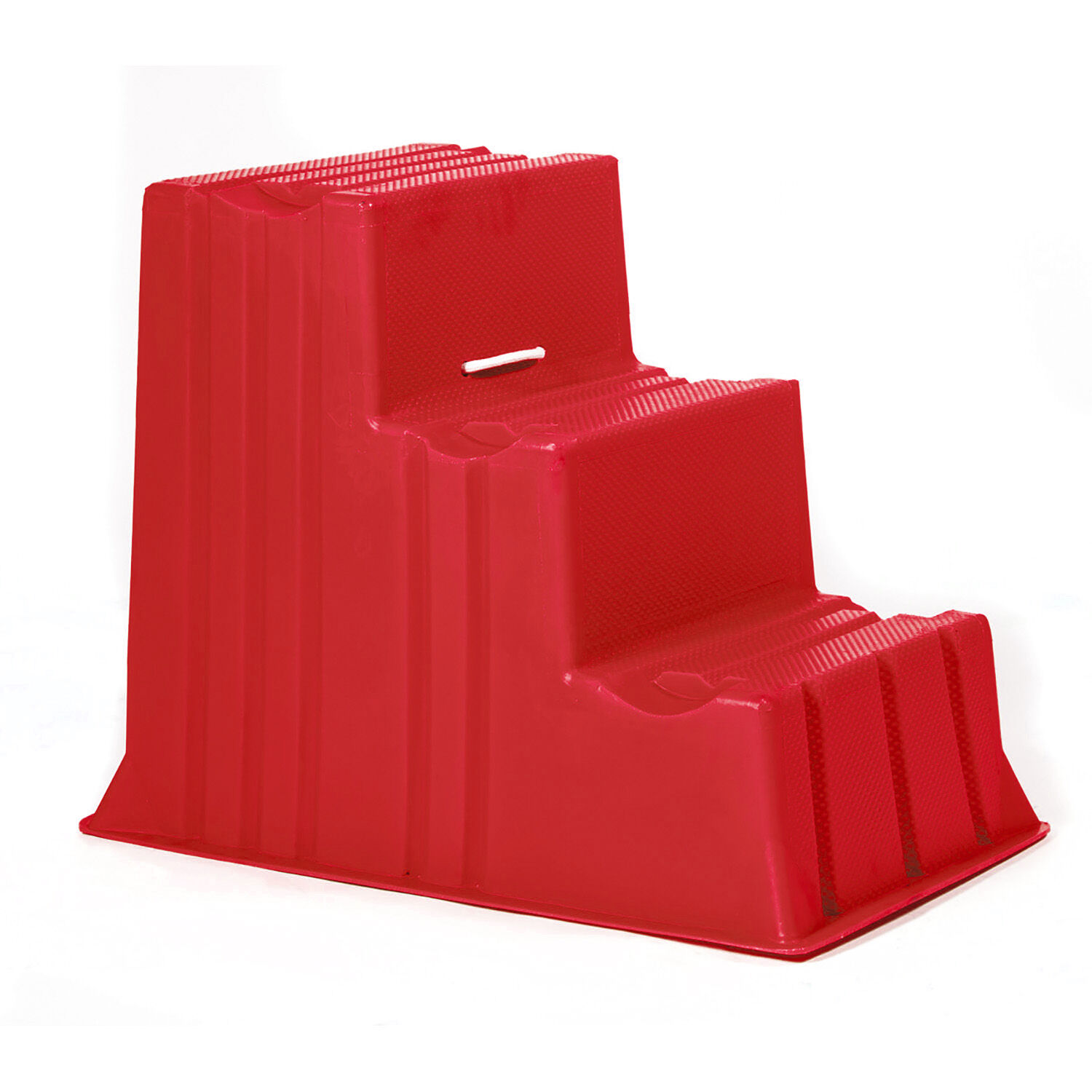
Stubbs Up & Over — S523
The S523 Up & Over is the flagship of the Stubbs mounting step range — a three-step mounting block that doubles as a training pole block, making it one of the most versatile pieces of yard equipment available.
Based on the successful two-step Mountie design, the Up & Over adds a third step to reach a total height of 63.5 centimetres. This makes it the ideal choice for mounting larger horses, for shorter riders, for bareback riding, and for any situation where the extra height reduces the strain on both horse and rider during mounting. It is suitable for rider weights up to 90 kilograms.
The dual-purpose design is what truly sets the S523 apart. Shallow cups are moulded into both sides of all three steps, allowing the blocks to be used as training jump stands. Two or more Up & Over blocks can be arranged to create a triple jump — a brilliant feature for schooling sessions when you are working alone and need to set up exercises quickly. When used as jump stands, the shallow grooves hold poles securely at multiple heights without any additional clips or fittings.
Rope handles on both sides allow easy, lightweight handling despite the block's larger size, and the design allows multiple units to be nested together for compact storage. The slip-resistant surface is moulded directly into each step, and the Stubbs logo is embossed into the body of the block for brand authentication.
The S523 is made from Stubbythene super-tough moulding and is available in four colours: red, blue, pink, and yellow.
Key specifications: Height: 63.5 cm | Length: 74 cm | Width: 52 cm | Weight: 9.5 kg | Material: Stubbythene | Colours: Red, Blue, Pink, Yellow | Features: Slip-resistant surface, rope handles, nestable, dual-use as pole block, max rider weight 90 kg
Comparing the Stubbs Mounting Step Range
Choosing between the three main Stubbs models comes down to how the block will be used, who will use it, and where it will be kept. Here is a practical comparison to help you decide.
Height and Reach
The S52 at 27 centimetres provides a modest boost — enough for an average-height rider mounting an average-sized horse, or for use as a general yard step. The S521 Mountie at 37 centimetres is the all-rounder, providing a comfortable two-step platform that suits the widest range of rider and horse combinations. The S523 Up & Over at 63.5 centimetres is the tall option, designed for larger horses, shorter riders, or situations where minimising stirrup pressure during mounting is a priority.
Portability
The S52 is the lightest at 2.4 kilograms and the most compact — easy to throw in a trailer or carry one-handed across a yard. The S521 is still comfortably portable with its rope handles and light Stubbythene construction. The S523 at 9.5 kilograms is heavier but still manageable for one person thanks to the twin rope handles; it is better suited to staying in one location or being dragged into position rather than carried long distances.
Versatility
The S52 is a single-purpose step. The S521 doubles as a grooming platform and general yard step. The S523 wins on versatility with its dual function as both a mounting block and a pole block for jump training.
Storage
All three designs are stackable or nestable, which is important for yards with limited storage space. The S52 takes up the least room. Multiple S521 blocks stack neatly. The S523 blocks nest into each other, which is efficient but requires a larger footprint per unit.
Best For
The S52 suits pony clubs, travel use, and as a secondary block. The S521 is the ideal everyday mounting block for private yards and general use. The S523 is the top choice for riding schools, livery yards, training facilities, and anyone who wants the added functionality of a jump stand.
What to Look for When Buying Horse Mounting Steps
Whether you are buying your first mounting block or replacing an ageing one, there are several factors worth considering beyond just height and price.
Stability
A mounting block that rocks, tips, or slides when you step on it is a safety hazard. Look for designs with a wide base relative to their height, and consider the ground surface where the block will be used. Stubbs blocks are designed with broad, stable footprints and the weight of the Stubbythene material helps keep them planted. On very uneven ground, a two-step block will always feel more stable than a three-step simply because of the lower centre of gravity.
Tread Surface
Yards are wet, muddy environments for much of the year. A smooth-topped step is an accident waiting to happen. All Stubbs mounting blocks feature slip-resistant tread surfaces moulded directly into the plastic — not stick-on strips that can peel off over time. This is a genuine safety advantage over cheaper blocks that rely on adhesive grip pads.
Durability
Mounting blocks live outdoors and take a beating. They are stood on, kicked by horses, dragged across concrete, left in the sun, and frozen in winter. Cheap blocks crack, warp, and degrade. Stubbythene is specifically engineered for this kind of punishment — it does not crack in cold weather, does not become brittle with UV exposure, and does not splinter if chipped. A well-maintained Stubbs block will last for many years of daily use, making it a far better long-term investment than a budget alternative that needs replacing every season or two.
Rounded Corners and Safe Design
Horses are curious animals, and mounting blocks are often left in areas where horses walk past or stand nearby. Sharp corners or protruding edges on a mounting block can cause injuries — to horses and to people. Every Stubbs mounting block is designed with fully rounded corners and no sharp edges, making them safe to use and safe to leave in communal areas.
Carrying Handles
Moving a mounting block around a yard should not be a chore. The rope handles on the Stubbs S521 and S523 are simple, effective, and durable. The hand holes on the S52 serve the same purpose. These are small details, but they make a big difference in day-to-day use, especially on larger yards where blocks need to be repositioned frequently.
Colour Options
This might seem like a minor consideration, but colour availability has practical benefits. Bright colours are easier to spot across a yard, reducing the risk of someone tripping over a misplaced block. Colour coding can help identify equipment belonging to different areas of a yard. And for riding schools and livery yards with branding to consider, the range of Stubbs colours — red, blue, green, yellow, and pink across the range — provides useful options.
Using Your Stubbs Mounting Block Safely
Owning a quality mounting block is only half the equation. Using it correctly makes the difference between a safe, comfortable mount and one that still puts unnecessary stress on your horse.
Positioning
Place the block on firm, level ground. Even the most stable block will feel insecure on a slope or soft, churned-up surface. Ideally, use a designated mounting area with a solid base — a concrete or rubber-matted area near the arena or stable entrance works well.
Position the block so that when you stand on the top step, your horse's stirrup is within comfortable reach without stretching. You should be able to step into the stirrup with minimal downward pressure, or better still, simply swing your leg over without using the stirrup at all.
Training Your Horse to Stand
A mounting block is only useful if your horse will stand still beside it. If your horse is nervous about the block or tends to walk away, invest time in desensitising them. Place the block in a safe, enclosed area and allow the horse to investigate it at their own pace. Reward them for standing quietly beside it. Build up gradually from standing to leaning over the saddle to a full mount.
A horse that consistently walks off during mounting may be communicating discomfort rather than disobedience. If mounting block training is not improving the situation, consider having the saddle fit checked and the horse's back assessed by a qualified professional.
Mounting Technique
Even with a mounting block, technique matters. Try to avoid putting excessive weight into the left stirrup, as this still creates an asymmetric pull on the saddle. If you can mount by simply stepping across from the block without using the stirrup, this is the gentlest method for your horse's back. If you do use the stirrup, be as quick and light as possible — lingering with your full weight in one stirrup prolongs the twisting force.
Sit down gently once you are in the saddle. Research has shown that riders who land hard in the saddle create pressure forces that can be as high as or even higher than those generated during the mounting itself.
Dismounting
While it is possible to dismount onto a mounting block, most safety experts advise caution. The step surface is a relatively small target, and if the horse moves unexpectedly, the rider could miss the block and stumble. For most riders, dismounting directly to the ground by bringing the right leg over, kicking the left foot out of the stirrup, and dropping down is safer and also avoids the additional spinal torque that comes from stepping down on one side.
Stubbs Mounting Steps for Professional and Commercial Use
Beyond private yards, Stubbs mounting blocks are widely used in professional and commercial equestrian settings. Their durability, safety features, and British manufacturing quality make them a natural choice for environments where equipment sees heavy, daily use and must meet higher standards of reliability.
Riding Schools
In a riding school environment, a mounting block may be used dozens of times a day by riders of widely varying sizes and abilities. The block needs to be tough enough to withstand constant use, stable enough to be safe for nervous beginners, and easy enough to move around as lessons move between arenas and outdoor spaces. The Stubbs S523 Up & Over is particularly popular in this setting — its three-step height accommodates the widest range of riders, and its dual function as a pole block makes it a useful training tool between lessons.
Livery Yards
Shared livery yards need equipment that is robust, clearly visible, and easy for multiple users to handle. The colour options available across the Stubbs range help with identification — some yards assign different-coloured blocks to different areas. The stackable design of the S521 Mountie is ideal for yards that need to store several blocks in a limited space.
RDA and Therapeutic Riding Centres
For Riding for the Disabled Association centres and therapeutic riding programmes, mounting blocks are essential welfare equipment. The height and stability of the Stubbs S523 make it particularly suitable, and the rounded corners and slip-resistant surfaces provide the additional safety margins needed when working with riders who may have limited mobility or balance.
Competition and Show Venues
At competitions and shows, mounting blocks need to be both functional and presentable. The clean lines and bright colour options of the Stubbs range make them a smart addition to a show ground, and the rope handles allow them to be moved quickly between warm-up arenas and competition rings.
Maintenance and Care
One of the advantages of Stubbythene construction is that Stubbs mounting blocks require very little maintenance. However, a few simple steps will keep them in top condition and extend their already long working life.
Clean the blocks periodically with warm, soapy water to remove mud, algae, and general yard grime. Pay particular attention to the slip-resistant tread surfaces, as a build-up of compacted mud can reduce their grip. A stiff brush works well for this.
Check the rope handles regularly for signs of wear or fraying. Rope handles are the one component that may need occasional replacement due to UV exposure and friction. Replacement rope is inexpensive and easy to thread through the existing handle holes.
Store blocks out of direct contact with the ground where possible — placing them on a pallet, rubber mat, or concrete surface prevents the base from sitting in standing water, which can encourage algae growth on the underside.
Inspect the blocks for any signs of cracking or structural damage, particularly after very cold weather or if a block has been struck by a vehicle or heavy equipment. While Stubbythene is extremely resilient, no material is completely indestructible, and a cracked block should be retired from use immediately.
Frequently Asked Questions About Stubbs Horse Mounting Steps
What is the weight limit for Stubbs mounting blocks? The Stubbs S52, S521, and S523 are all rated for rider weights up to 90 kilograms (approximately 14 stone or 198 pounds). This covers the majority of adult riders, but it is important to observe the stated limit — exceeding it can compromise the structural integrity of the block over time.
Which Stubbs mounting block is best for a tall horse? The S523 Up & Over at 63.5 centimetres is the tallest in the Stubbs range and is recommended for larger horses, particularly when combined with a shorter rider. The three-step design allows the rider to mount with minimal stirrup pressure, which is better for the horse's back.
Can I use a Stubbs mounting block as a jump stand? Yes — the S523 Up & Over is specifically designed with shallow cups moulded into both sides of all three steps, allowing it to double as a training pole block. Two or more S523 blocks can be used to create single, double, or triple jump configurations.
What colours are Stubbs mounting blocks available in? The S52 comes in green with a black tread plate. The S521 Mountie is available in red, blue, green, yellow, and pink. The S523 Up & Over comes in red, blue, pink, and yellow. Colour availability may vary by retailer.
Are Stubbs mounting blocks made in the UK? Yes. All Stubbs products are manufactured at the company's factory in Hawksworth, Nottinghamshire, England. The company has been manufacturing in the same location since it was founded in 1836.
How do I clean a Stubbs mounting block? Warm, soapy water and a stiff brush are all you need. The Stubbythene material is easy to clean and does not absorb stains or odours. Regular cleaning of the tread surfaces helps maintain their slip-resistant properties.
Is a two-step or three-step mounting block better? For most private riders with average-sized horses, a two-step block like the S521 Mountie is perfectly adequate. For riding schools, taller horses, shorter riders, or anyone wanting the added versatility of a jump stand, the three-step S523 Up & Over is the better investment. Veterinary research generally supports using the tallest mounting block practical, as higher blocks allow the rider to mount with less stirrup pressure and therefore less strain on the horse's back.
How long do Stubbs mounting blocks last? With reasonable care, a Stubbs Stubbythene mounting block should last for many years of daily use. The material is UV-resistant, does not crack in cold weather, and does not become brittle with age. The rope handles may need occasional replacement, but the block itself is built to be a long-term investment.
Can horses knock Stubbs mounting blocks over? Like any mounting block, a Stubbs block can be moved or knocked by a horse. However, the wide base and relatively low centre of gravity — particularly on the S52 and S521 — provide good stability. The rounded corners and absence of sharp edges mean that even if a block is displaced, it presents minimal injury risk.
Where can I buy Stubbs mounting steps? Stubbs mounting blocks are available from equestrian retailers throughout the UK and internationally. They are stocked by major online equestrian suppliers, local tack shops, and agricultural merchants. For guaranteed authenticity, look for the Stubbs logo moulded directly into the block.
Stubbs Mounting Steps vs Cheaper Alternatives: Is the Premium Worth It?
Walk into any equestrian retailer or browse online and you will find mounting blocks at a wide range of price points. Budget options from unbranded manufacturers can cost significantly less than a Stubbs block, which naturally raises the question: is it worth paying more?
The short answer, based on both material quality and real-world durability, is almost always yes. Here is why.
Material Quality
Cheaper mounting blocks are typically made from standard injection-moulded polypropylene or polyethylene. These materials are adequate for light, occasional use, but they have well-documented weaknesses in demanding environments. Standard polypropylene becomes brittle in cold temperatures — a serious concern for any piece of equipment that lives outdoors on a British yard through winter. Blocks made from this material can crack suddenly when stepped on in freezing conditions, creating sharp edges and an immediate safety hazard.
Stubbythene, by contrast, is a rotationally moulded material specifically developed to resist cold-weather brittleness, UV degradation, and impact damage. Rotational moulding produces a more uniform wall thickness than injection moulding, which means more consistent structural strength across the entire block. The material is also inherently resistant to chemical exposure — an important consideration on yards where blocks may come into contact with disinfectants, hoof oil, fly spray, and other common products.
Integrated vs Aftermarket Safety Features
On a Stubbs block, the slip-resistant tread pattern is moulded directly into the stepping surface as part of the manufacturing process. It cannot peel off, wear through independently of the block surface, or become a tripping hazard. On many budget blocks, grip is provided by adhesive rubber strips or stick-on textured pads. These work initially but degrade quickly under outdoor conditions — UV exposure breaks down the adhesive, and the strips can lift at the edges, creating a catching point that is arguably more dangerous than a smooth surface.
Similarly, the rounded corners on Stubbs blocks are an integral part of the mould design, not a post-production modification. Every block that comes off the production line has the same consistent, safe profile.
Longevity and Total Cost of Ownership
A Stubbs S521 Mountie costs more upfront than a generic two-step block, but it is designed to last for years — often a decade or more — of daily use. A cheaper block may need replacing after one or two seasons, at which point the cumulative spend matches or exceeds the cost of the Stubbs product, with the added inconvenience of repeat purchasing and disposal.
For commercial environments like riding schools and livery yards, where equipment is used hard every day and needs to represent the business professionally, the false economy of budget blocks becomes even more apparent. A cracked or visibly deteriorating mounting block does not inspire confidence in paying clients, and the liability implications of a client being injured on defective equipment are not worth the saving.
Brand Assurance
When you buy a Stubbs block with the logo moulded into the body, you know exactly what you are getting — a product made in Britain by a company that has been manufacturing equestrian equipment for nearly 190 years and has a reputation to protect. With unbranded or white-label imports, there is no equivalent assurance about material composition, manufacturing standards, or after-sales support.
Mounting Blocks in the Context of Overall Horse Welfare
It is worth stepping back and placing the mounting block conversation in the broader context of equine welfare. In recent years, the equestrian community has become increasingly aware that many traditional practices — from bitting and shoeing to training methods and tack fit — deserve reexamination in light of improved understanding of equine biomechanics and behaviour.
Mounting is one of the most frequent interactions between a rider and their horse, yet until relatively recently it received remarkably little scientific scrutiny. The research from Michigan State University and subsequent studies have helped change that, demonstrating that the forces involved in mounting are not trivial and that their effects are cumulative.
For lesson horses and riding school horses that may be mounted multiple times a day by different riders, the impact is particularly significant. A busy riding school horse might be mounted from the ground hundreds of times per year. Over a career spanning a decade or more, that represents thousands of asymmetric loadings on the spine and withers — a chronic stress that no amount of good riding afterwards can undo.
Investing in a quality mounting block and making its use a non-negotiable part of yard culture is one of the simplest, most cost-effective welfare improvements any yard can make. It costs nothing to use once purchased, requires no ongoing maintenance to speak of, and benefits every horse and rider who uses it every single time.
For yards that are serious about equine welfare — and that should be every yard — making the mounting block a standard part of the routine rather than an afterthought is a statement of values. And equipping that yard with blocks that are genuinely fit for purpose, safe, durable, and designed with both horse and rider in mind, is the logical next step.
Where to Position Mounting Blocks on Your Yard
The placement of mounting blocks on a yard deserves more thought than it typically receives. A block tucked in a corner or left on soft ground is less likely to be used consistently than one that is conveniently positioned and ready to go.
Ideally, place your primary mounting block on a firm, level surface near the entrance to your main riding arena. This could be a concrete pad, a section of rubber matting, or a well-compacted hard-standing area. The surface should drain well — standing water around a mounting block encourages algae growth on both the block and the ground, creating a slip hazard.
If your yard has multiple riding areas or a separate outdoor school, consider having a block at each location. The S521 Mountie's light weight and stackable design make it practical to keep several around a larger yard without excessive cost or storage issues.
For trailer loading and unloading, a smaller block like the S52 can be invaluable. Its compact size makes it easy to stow in the lorry or trailer and pull out whenever needed, and it provides a useful step for riders who need to mount at showgrounds or on trail rides where no permanent block is available.
In shared yard environments, clear communication about where blocks live and where they should be returned after use prevents the all-too-common scenario of a block going missing just when it is needed. Some yards paint their blocks with the yard name or use specific colours for specific locations to encourage consistent returns.
Making the Right Choice
Choosing a mounting block might seem like a straightforward decision, but as we have seen, it is one that affects the long-term health and comfort of your horse, the safety of the rider, and the longevity of your saddle. A quality block from a trusted manufacturer is a small investment that pays dividends every time you ride.
Stubbs England has been making equestrian equipment since 1836, and their mounting step range reflects nearly two centuries of manufacturing expertise. The Stubbythene material is purpose-built for the demands of yard life, the safety features are moulded in rather than bolted on, and the designs have been refined over years of real-world use by riders and yard managers across the world.
Whether you choose the compact S52 for its portability, the classic S521 Mountie for its all-round capability, or the versatile S523 Up & Over for its height and dual-purpose design, you are buying a piece of equipment that is built to last and backed by a brand that has staked its reputation on quality for nearly 190 years.
Your horse's back will thank you. Your knees will thank you. And your saddle fitter will definitely thank you.
Summary: Quick Reference Guide
To wrap up, here is a quick reference to help you choose the right Stubbs mounting step for your situation.
Choose the Stubbs S52 Mounting Block if: you need a compact, lightweight, single-step block for travel, pony club use, or as a secondary block in a second yard location. At just 2.4 kilograms and 27 centimetres high, it is the most portable option in the range.
Choose the Stubbs S521 Mountie if: you want a reliable, all-purpose two-step mounting block for everyday use on a private yard or small livery. Available in five colours, stackable, and light enough to carry easily with its rope handles, the Mountie is the best-selling Stubbs block for good reason.
Choose the Stubbs S523 Up & Over if: you run a riding school, manage a busy livery yard, ride a tall horse, or want the added functionality of a training pole block. At 63.5 centimetres high with three generous steps, the Up & Over provides the maximum height advantage for reducing spinal strain during mounting and doubles as a versatile schooling tool.
Whichever model you choose, you are investing in a product that is designed and manufactured in England by a family business with nearly 190 years of expertise, built from a proprietary material engineered specifically for the demands of equestrian life, and supported by a reputation that extends to leading yards on every continent. When it comes to the daily ritual of mounting your horse, that is exactly the kind of quality that makes a difference — for you, for your horse, and for every ride that follows.
Shop Stubbs Mounting Steps
Ready to invest in a Stubbs mounting block for your yard? Browse the full range of Stubbs industrial steps and mounting blocks — including the S52, S521 Mountie, and S523 Up & Over — at Hall Fast's dedicated Stubbs Industrial Steps page. Hall Fast offer competitive pricing, reliable delivery, and expert customer service to help you choose the right block for your needs.