Below is the SEO article for the Sall Galvanized Steel Spill Pallet for 2 Drums (Nestable Design) – over 5,000 words, with Hall-Fast internal links woven throughout.
The Definitive Buyer's Guide to the Sall Galvanized Steel Spill Pallet for 2 Drums (Nestable Design): The Smartest Twin-Drum Bund on the UK Market
Buy online: Sall Galvanized Steel Spill Pallet for 2 Drums (Nestable Design) – Hall-Fast
There's a point in the life of every working site – every workshop, every yard, every depot, every plant maintenance store – where one drum is no longer enough. You're holding a drum of new oil and a drum of waste oil. A primary lubricant and a secondary product. Diesel and AdBlue. Or simply two drums of the same product because consumption has scaled past the point where a single 200-litre supply lasts a working week.
The moment you have two drums on the floor, you have a problem.
A single-drum spill pallet won't do – you'd need two of them, taking up twice the floor footprint with twice the inspection burden. A large multi-drum bunded store is overkill. A wooden pallet with the two drums on top offers zero secondary containment. And whatever you choose, the Oil Storage Regulations are now applying to a larger combined volume – with the 110% rule potentially in play for the largest single drum, and the 25% rule applying to the aggregate.
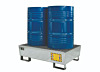
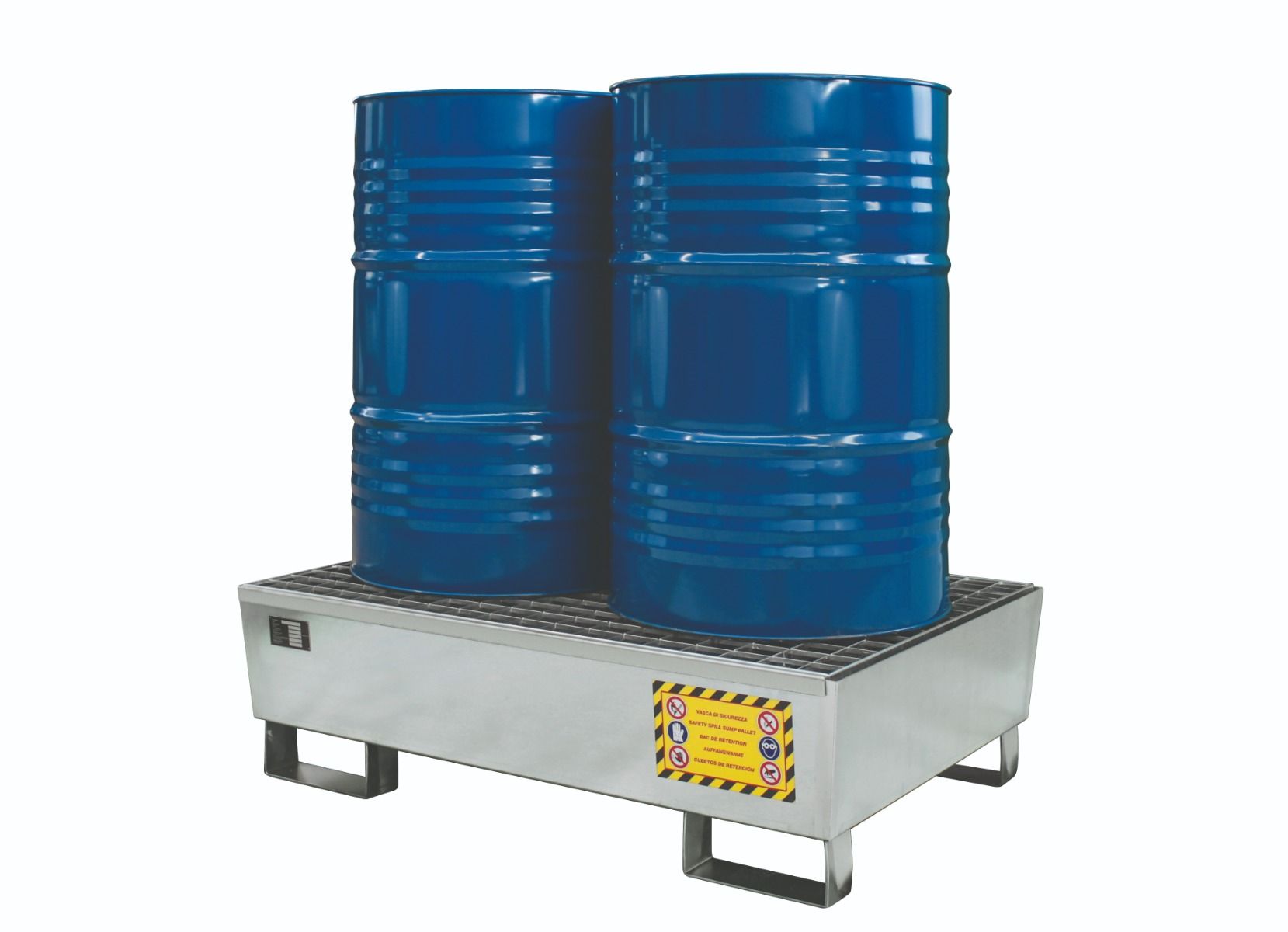
This is exactly the gap the Sall Galvanized Steel Spill Pallet for 2 Drums (Nestable Design) is engineered to fill. It is the smartest twin-drum bund on the UK market – purpose-designed for the compliant outdoor or indoor storage of two 200-litre drums side by side, manufactured from hot-dip galvanized structural steel for exceptional corrosion resistance, and uniquely shaped so empty units nest inside each other to save floor and transport space when not in use.
In this comprehensive buyer's guide we'll cover everything you need to know – build quality, certifications, applications, UK regulatory context, complementary products and why Hall-Fast is the smartest place in the UK to buy.
What is a Sall Galvanized Steel Spill Pallet?
A steel spill pallet – sometimes called a steel bund, a drum sump, a bunded pallet or a secondary containment pallet – is a fabricated steel platform with an integrated, watertight sump beneath the drum surface, designed to capture any liquid that leaks, drips or spills from the drum(s) stored on top. It performs three essential functions at once:
- Elevates the drums off the floor on a galvanized steel grating, preventing contact with any captured liquid below.
- Contains any drips, leaks or full-drum failures within an integrated, watertight steel sump.
- Demonstrates compliance with UK and European secondary containment regulations for the storage of oils, fuels and hazardous liquids.
The Sall Galvanized Steel Spill Pallet for 2 Drums is the twin-drum unit in the nestable range – purpose-engineered for the compliant storage of two 200-litre drums positioned side by side, indoor or outdoor, with the unique conical-form factor that allows multiple empty pallets to be stacked inside one another for compact storage and shipping.
You can view full current specifications and order online at: https://www.hall-fast.com/brands/sall/galvanized-steel-spill-pallet-for-2-drums-nestable-design.
A brief introduction to Sall
Sall is the Justrite Safety Group's Italian-engineered brand specialising in steel spill containment, bunded drum trolleys, forklift skips, IBC bunds, outdoor drum cabinets and bespoke industrial fabrications. The company has built its global reputation on three pillars:
- Precision steel fabrication in certified, traceable structural steel
- Certified welding to UNI EN ISO 3834-2:2021 – the highest tier of European welding quality
- Conformity with international standards – CE marking under Machinery Directive 2006/42/EC, StawaR compliance for sumps under 1,000 litres, and watertight quality testing on every finished unit
Every Sall spill pallet is proof-tested with penetrating liquid at the factory before despatch, so by the time it arrives on site you have a piece of secondary containment whose integrity has already been independently verified.
Browse the wider Sall range at Hall-Fast on the dedicated brand category page: Sall – Hall-Fast Industrial & Commercial Equipment.
Why Two Drums is the Most Common Storage Specification
If you look across UK site visits in any industrial, agricultural, automotive or maintenance context, two-drum storage is the most frequently encountered configuration. Here's why.
1. Most operations need a primary plus a secondary
Almost every drum-using site holds at least two related products:
- New oil plus waste oil
- Fresh lubricant plus used lubricant for recycling
- Diesel plus AdBlue
- Primary chemical plus a complementary cleaning product
- Two different grades of the same product (e.g. hydraulic oils of different viscosities)
Holding both on a single twin-drum bund is more efficient than two separate single-drum bunds.
2. The compliance maths works in your favour
Under the Oil Storage Regulations, the secondary containment requirement for two drums is 25% of the aggregate volume (100 litres) or 110% of the largest drum (220 litres), whichever is greater. The Sall twin-drum spill pallet is sized to comfortably meet the 25% rule and provides margin for many two-drum compliance scenarios. For the strict 110% containment requirement, see the wider Sall range of larger spill pallets or pair the bund with appropriate storage cabinets.
3. It matches typical pallet handling
Two 200-litre drums fit neatly on a single standard pallet footprint, can be loaded and unloaded by forklift in a single operation, and can be moved between sites or storage positions as a single unit. This makes the twin-drum bund an operational sweet spot for handling, logistics and inventory.
4. It's the natural growth step from a single-drum installation
Sites that start with a single-drum spill pallet often reach the point where a second drum becomes routine. Rather than buying a second single-drum unit, the twin-drum bund delivers the same compliance with a smaller floor footprint and simpler inspection routine.
For most sites holding two drums of related products, the twin-drum bund is exactly the right specification – not too small, not too big, with the documented compliance pedigree to satisfy any auditor.
Why Galvanized Steel? The Three-Way Trade-Off
Spill pallets are available in three principal materials. Choosing the right one matters – both for total cost of ownership and for regulatory fit. Here's how galvanized steel compares.
Galvanized steel (this product)
Hot-dip galvanizing coats the entire welded steel structure – inside and out, including weld zones and inaccessible internal surfaces – with a metallurgically bonded layer of zinc. The result is:
- Exceptional outdoor corrosion resistance – decades of service in fully exposed environments
- Self-healing protection – minor scratches and impacts don't expose bare steel
- Maintenance-free – no painting, touching up or recoating required
- Unmatched durability for the harshest yards, depots, marine and agricultural environments
- Compatible with most fuels, oils, lubricants and many industrial chemicals
- Recyclable at end of life
The trade-off is the matt grey finish – less visible than a painted orange or yellow finish on a busy site – and a slightly higher unit cost than the painted equivalent. For sites where the spill pallet will live outdoors, get wet regularly, or be exposed to road salt, agricultural chemicals or marine atmospheres, the galvanized variant pays for itself many times over in extended service life.
Painted (powder-coated) steel
Sall also manufactures painted (polyester powder-coated) spill pallets with a multi-stage, 80–100 micron coating. These are the right choice for indoor and under-cover use where high visibility (typically orange) matters and outdoor exposure is limited.
Plastic (polyethylene)
Plastic drip trays and bunded pallets are available from other suppliers but have important limitations: UV degradation over time, lower load capacity, susceptibility to impact damage from forklift tines, and lower fire resistance. For two 200-litre drums stored long-term outdoors, galvanized steel is the right answer.
Bottom line
If your two-drum storage point is outdoors, exposed, washed down regularly, marine-adjacent, agricultural, or simply expected to last a generation, the Sall galvanized variant is the right specification.
Why Bunded Storage Matters: The UK Regulatory Backdrop
To understand why a Sall galvanized spill pallet is more than a "nice to have," you have to look at the regulatory landscape governing oil, fuel and chemical storage in the UK.
Secondary containment – the legal framework
Several overlapping pieces of legislation and guidance apply to anyone keeping 200-litre drums of oil, fuel or hazardous liquid on their premises:
- The Control of Pollution (Oil Storage) (England) Regulations 2001 – the bedrock rule that any container of oil within scope must be stored within a secondary containment system holding at least 110% of the largest container, or 25% of the aggregate volume, whichever is greater. Similar regulations apply across Scotland (Water Environment (Oil Storage)(Scotland) Regulations 2006) and equivalent frameworks in Wales and Northern Ireland.
- COSHH 2002 (Control of Substances Hazardous to Health) – which requires you to assess and control the risks from hazardous substances, including by preventing or controlling exposure.
- DSEAR 2002 (Dangerous Substances and Explosive Atmospheres Regulations) – which covers flammable liquids and requires suitable arrangements for safe storage and handling.
- The Environmental Permitting Regulations and the wider duty of care under the Environmental Protection Act 1990 – which can hold you liable for environmental damage from a spill.
- ISO 14001 environmental management systems – which require organisations to have processes, equipment and training in place to prevent, detect and respond to spills.
The "polluter pays" principle underpins all of this: if your drum leaks and contamination reaches a drain, a watercourse or contaminates soil, you are responsible. Clean-up costs run from a few hundred pounds for a minor spill to tens or hundreds of thousands for a serious incident.
What this means specifically for two 200-litre drums
For two 200-litre drums stored together:
- 25% of aggregate volume = 100 litres
- 110% of largest single drum = 220 litres
- Whichever is greater = 220 litres
The Sall twin-drum spill pallet is sized to comfortably exceed the 25% rule. Where the strict 110% interpretation applies on your specific site (this is a matter for your site's environmental management plan and regulator engagement), a larger bunded unit may be required. The Hall-Fast team can advise – contact us via the Contact page.
For sites needing larger combined sump capacity, see the wider Drum Storage Sumps and Drum Storage categories at Hall-Fast.
Insurance, environmental liability and reputation
Beyond statutory compliance, insurers increasingly expect to see formal secondary containment on any site holding bulk liquids. A documented programme of bunded storage reduces premiums, accelerates claims handling, and demonstrates due diligence to regulators, auditors and customers. For larger contracts – particularly food, pharmaceuticals, automotive OEM supply, defence and energy – auditable spill controls are a procurement prerequisite.
The Sall galvanized spill pallet is not just a convenient platform – it is a fully-fledged piece of secondary containment infrastructure, with the welding certification, watertightness verification and StawaR compliance pedigree to satisfy any inspector or auditor.
Key Features and Engineering of the Sall Galvanized Twin-Drum Spill Pallet
Now let's look in detail at what makes this particular unit the smartest twin-drum bund on the UK market.
Heavy-duty welded steel construction
The body, sump and grating support are fabricated from certified, traceable structural carbon steel with continuously welded seams. Unlike pressed, riveted or bolt-together alternatives, the welded construction has no joints to fail, no fasteners to corrode, and no gaskets to perish. Every weld is inspected and proof-tested with penetrating liquid before the unit is dispatched – your guarantee that the sump will hold liquid if either drum leaks.
Hot-dip galvanized finish for exceptional corrosion resistance
After fabrication, the entire unit is hot-dip galvanized – immersed in molten zinc that forms a metallurgically bonded coating across every surface, inside and out, including weld zones and otherwise inaccessible internal cavities. The resulting coating is:
- Self-healing – minor scratches and impacts don't expose bare steel
- Maintenance-free – no painting or touching up required for the life of the product
- Exceptionally long-lasting – often 25+ years in normal industrial use
- Resistant to UV, rainfall, frost, road salt and agricultural chemicals
- Compatible with most fuels, oils, lubricants and industrial fluids
For applications involving acids or aggressive corrosive liquids, optional internal polyethylene (PE) or polypropylene (PP) sump linings can be specified to combine the structural strength of galvanized steel with the chemical resistance of plastic.
Watertight certification to UNI EN ISO 3834-2:2021
The Sall manufacturing facility is certified to UNI EN ISO 3834-2:2021 – the European standard for "Comprehensive quality requirements for fusion welding of metallic materials." This is the highest available tier, covering welder qualification, weld procedure specifications, materials traceability, equipment calibration and inspection protocols including non-destructive testing under UNI EN ISO 9712:2022.
For a secondary containment vessel intended to hold a hazardous liquid in the event of failure, this is the gold standard. When an auditor asks "How do you know this pallet won't leak?" – the answer is the ISO 3834-2 certificate and the individual proof-test that accompanies each unit.
StawaR compliance
The Sall twin-drum spill pallet conforms to the German StawaR directive (the technical reference standard for steel containment products with a sump capacity under 1,000 litres). Although German in origin, StawaR is the de facto European benchmark for sub-1,000-litre steel bunds and is recognised right across the EU and UK. Conformity tells you the product is fit for purpose without further specification work on your part.
Integrated sump with generous containment volume
The integral sump beneath the two drums captures leaks, drips and dispensing run-off from either or both drums. Sized comfortably above the 25% aggregate containment threshold for two 200-litre drums, the sump turns the pallet into a complete secondary containment unit for a typical twin-drum installation.
Removable galvanized grating
A galvanized steel grating sits on the sump shelf to take the weight of both drums. The grating:
- Elevates the drums clear of any captured liquid – drums stay clean and labels remain readable
- Distributes load evenly across the sump structure
- Allows visual inspection of the sump beneath without removing the drums
- Is removable in sections for cleaning and inspection
- Is hot-dip galvanized to match the body for matching corrosion resistance
Side-by-side twin-drum format
The deck is sized to hold two standard 200-litre drums positioned side by side rather than front-to-back. This gives:
- Easy independent access to each drum for taps, pumps and dispensing
- Clear sight of both drum labels for stock control
- A compact pallet footprint that doesn't waste floor space
- Even loading on the sump and grating
Nestable conical design
This is the feature that genuinely sets the Sall range apart. The body of the spill pallet is subtly conical – wider at the top than at the bottom – so multiple empty pallets can be nested inside one another for compact storage when not in use. The result is:
- Significantly less floor space required to store a stock of empty spill pallets
- Lower transport and logistics costs – multiple units fit on a single pallet or in a single container
- Practical for distributors and end-users managing fluctuating stock levels
- No compromise on capacity, strength or compliance when in service
If your operation rotates spill pallets between active duty and storage – or if you keep a stock of replacements for incident response – the nestable design is a meaningful operational advantage. It's particularly valuable for multi-site organisations standardising on a single bund specification across multiple depots.
Forklift-handleable
The pallet is designed to be moved with a forklift or pallet truck with appropriate tine length, allowing both drums and their bund to be relocated as a single unit if required. Always check forklift capacity against the combined drum + sump + pallet weight – for a fully loaded twin-drum bund, that's typically over 500 kg.
Anti-cut, operator-friendly design
All exposed edges are deburred and finished, with no sharp corners or protrusions to snag clothing or injure hands during loading and inspection.
For full specifications and to buy online, visit https://www.hall-fast.com/brands/sall/galvanized-steel-spill-pallet-for-2-drums-nestable-design.
Why Nestable Design Matters in the Real World
The nestable design feature isn't a marketing gimmick – it solves four genuine operational problems that anyone responsible for spill containment will recognise.
1. Storage of spare units
Many sites keep a small stock of spare spill pallets as part of their incident response plan, ready to be deployed when a drum starts to leak, when new drums arrive on site, or when an existing pallet is taken out of service for inspection or repair. A traditional spill pallet takes up the same floor space whether full or empty – so a stock of five replacements ties up significant warehouse area. Nested Sall pallets occupy a fraction of that footprint.
2. Fluctuating drum populations
Sites with seasonal variation in drum stocks (agricultural operations through the growing season, construction sites through major projects, defence operations during deployment cycles) can deploy and recover spill pallets as drum counts rise and fall, rather than running with a permanently oversized fleet that sits idle for months.
3. Distribution and procurement efficiency
For distributors and end-user procurement teams, nestable design means more pallets per van load, per truck and per warehouse rack. That translates to lower carbon footprint, lower freight cost and lower warehousing overhead. For multi-site operators ordering pallets in bulk, the savings are substantial – and they compound year after year.
4. End-of-life recovery
When a spill pallet eventually comes to end of service, nested storage simplifies the logistics of getting it back to the scrap yard or recycling point. Galvanized steel is fully recyclable, so a nested stack of end-of-life pallets recovers cleanly into the materials economy.
For most end-users the nestable design is a "nice to have." For procurement teams, multi-site operators and distributors, it's a genuine commercial advantage that pays back month after month.
Real-World Applications: Where the Sall Galvanized Twin-Drum Pallet Earns Its Keep
The galvanized twin-drum spill pallet is industry-agnostic. If you store two 200-litre drums anywhere on your site – particularly outdoors or in a damp/exposed environment – this unit will pay for itself many times over in compliance assurance and contamination prevention. Some of the sectors that rely on it include:
Automotive workshops and transport depots
Engine oils plus waste engine oil. Gearbox oil plus AdBlue. Antifreeze plus screen wash. Almost every automotive workshop has two-drum requirements built into its daily workflow, and the galvanized twin-drum bund handles this configuration perfectly. Pair with Trolley Jacks, Gravity & Suction Oil Drainers and the wider Lifting Automotive range.
Engineering and manufacturing
Hydraulic oil plus cutting fluid. Lubricant plus coolant. Primary process chemical plus a complementary additive. Engineering operations routinely need two related products on hand – the galvanized twin-drum pallet provides a single, compact, compliant storage solution.
Agricultural operations
Diesel plus red diesel. Lubricant plus agrochemical. Primary herbicide plus a complementary product. UK farms typically run multiple drum stocks across the growing year, and the galvanized finish withstands the realities of outdoor farm storage – wind, rain, frost, mud and the occasional knock from a passing tractor. See also our Agricultural Liquid Storage range.
Construction sites and depots
Plant fuels plus lubricants. Hydraulic oils plus chain oils. Two related products held in compound storage areas, exposed to weather, vehicle movements and the rough-and-tumble of an active building project. See the wider Storage & Shelving category for complementary site-storage solutions.
Marine and port operations
Marine fuels, lubricants, hydraulic oils and treatment chemicals in salt-laden atmospheres demand the corrosion resistance of hot-dip galvanizing. Twin-drum storage at quayside, on barges or in port maintenance facilities is a typical Sall application.
Chemical processing and laboratories
Two process chemicals, reagent plus catalyst, or product plus waste stream often need to be stored adjacent to each other for operational efficiency. The optional PE/PP-lined version of the Sall pallet handles acids and corrosive liquids. For static, ventilated indoor storage of flammables, see the Asecos Storage Cabinets range.
Energy, utilities and infrastructure
Substations, pumping stations, generator installations and remote infrastructure sites often hold a primary diesel drum plus a lubricant drum, or two grades of lubricant for different equipment. The maintenance-free galvanized finish is ideal for unattended outdoor locations.
Defence and government
Reliable, certified, paperwork-ready secondary containment is a procurement requirement for many MOD, blue-light and government contracts. The Sall pedigree – UNI EN ISO 3834-2:2021, StawaR, watertight tested – delivers exactly the documentation auditors expect to see.
Waste management and recycling
Two waste streams (used oils and contaminated solvents, for example) held in bunded storage during transfer and collection cycles. The galvanized finish withstands routine washdown and outdoor exposure.
Food, beverage and pharmaceutical (non-product-contact)
For non-product-contact use (cleaning chemicals, sanitisers, plant lubricants), the galvanized twin-drum pallet provides reliable containment in outdoor and back-of-house storage. For direct hygiene-critical applications, stainless steel versions are available on request.
Plant maintenance and facilities
Almost every facilities team running boilers, generators, compressors or HVAC plant holds at least two drums of related lubricant, coolant or treatment chemical. The twin-drum bund consolidates this storage into a single, compliant footprint.
Sall Heritage and Certifications: A Closer Look
You'll see four key certifications and standards referenced repeatedly in Sall literature. Here's what they mean and why they matter.
UNI EN ISO 3834-2:2021 – The Gold Standard for Welded Construction
The ISO 3834 family is the international standard for "Quality requirements for fusion welding of metallic materials." Part 2 is the highest tier – "Comprehensive quality requirements" – and covers:
- Personnel – welders qualified, tested and traceable
- Procedure – every weld made to an approved Welding Procedure Specification
- Materials – steel and consumables traceable batch-by-batch
- Equipment – welding plant calibrated and maintained
- Inspection – every assembly inspected, with NDT under UNI EN ISO 9712:2022 where required
- Documentation – complete traceability from raw material to finished product
For a containment vessel that must hold liquid if a primary container fails, this is the only level of welding certification worth specifying.
Watertightness testing with penetrating liquids
Every Sall bunded unit is proof-tested with penetrating liquid at the factory before despatch. Penetrating liquid testing is the most stringent leak test available for closed welded vessels – more sensitive than pressure testing alone – and it gives you confidence that the sump will perform exactly as required in service.
StawaR Compliance for Sub-1,000-Litre Sumps
The Sall twin-drum spill pallet conforms to StawaR – the de facto European benchmark for steel containment basins with a sump capacity under 1,000 litres. StawaR sets out detailed requirements for material thickness, weld integrity, drainage arrangements, visual identification and watertight performance.
Certified, traceable steel
The structural steel used in every Sall spill pallet is certified and traceable. The manufacturer can document, batch by batch, the origin and mechanical properties of every plate that went into every weld.
Galvanized vs Painted vs Stainless: Which Sall Finish is Right for You?
Sall offers the twin-drum spill pallet in three principal material variants. Selecting the right one depends on your operating environment and the liquids you handle.
Galvanized steel (this product) – for the toughest outdoor environments
Hot-dip galvanizing delivers outstanding corrosion resistance in genuinely exposed outdoor conditions, marine atmospheres, agricultural settings or where the unit is regularly washed down. The matt grey finish is less visible than painted alternatives. Over-painting on request is available if a specific colour is required (often referred to as "galvanized and overpainted").
Painted (powder-coated) steel – the indoor workhorse
For indoor and under-cover use, the painted variant with a multi-stage 80–100 micron polyester powder coating is the right choice. It delivers high visibility (typically orange), strong corrosion resistance for indoor environments, and a slightly lower unit cost than galvanized.
Stainless steel – for hygiene-critical and chemically aggressive applications
For food, beverage, dairy, pharmaceutical, cosmetic and laboratory use – or where particularly aggressive chemicals are handled – Sall manufactures stainless steel spill pallets to order. These deliver the highest standard of hygiene, easiest cleaning, and broadest chemical compatibility.
Internal PE/PP lining
All three base materials can be supplied with an internal polyethylene or polypropylene sump lining on request, extending chemical compatibility to acids and aggressive corrosives without compromising structural strength.
For advice on selecting the right finish for your application, contact the Hall-Fast technical team on 01623 645645 or via the Contact page.
How to Choose the Right Spill Pallet for Your Site
Several practical questions to answer before ordering:
1. How many drums do you store at once?
If the answer is "two drums of related products," the twin-drum spill pallet on this page is exactly the right choice. For single drums, see the Galvanized Steel Spill Pallet for 1 Drum. For four-drum or larger installations, Sall manufactures the full range of multi-drum spill pallets – see the Drum Storage Sumps range at Hall-Fast.
2. What is being stored?
- Oils, fuels, lubricants – standard galvanized finish is ideal
- Aggressive solvents, marine fuels, regular washdown – galvanized with PE/PP lining if acid resistance is needed
- Acids, strong corrosives – galvanized with PE/PP lining, or stainless steel to order
- Food/pharma/cosmetics – stainless steel on request
3. Indoor or outdoor use?
The galvanized variant is the right choice for outdoor, exposed, washdown, marine and agricultural environments. For indoor and under-cover use where high visibility matters, the painted equivalent is typically a better fit.
4. Do you need 25% or 110% containment?
For the standard interpretation of the 25% aggregate rule with two 200-litre drums (100 litres minimum sump volume), the Sall twin-drum unit is sized comfortably above the threshold. If your site environmental management plan requires the stricter 110% interpretation (220 litres sump volume to cover the largest single drum), a larger bunded unit or supplementary containment is required. The Hall-Fast team can advise on the right specification.
5. Do you need transport mobility?
A static spill pallet stores drums in one position. For mobile applications (decanting at multiple points, moving drums between fill stations), consider the bunded drum trolley range instead.
6. Are stocking and storage logistics important?
If you keep spares, rotate units between sites, or manage spill pallet stocks across multiple locations, the nestable design delivers a real and ongoing logistical benefit.
7. Do you need optional accessories?
Sall can supply a wide range of optional extras on request, including PE/PP linings, sump alarms for liquid detection, over-painting in specified colours, bespoke modifications, and matched accessories.
For bespoke specifications, contact Hall-Fast: Contact page or call 01623 645645.
Best Practice for Safe Use
Buying the right kit is only half the battle – using it correctly is what keeps your site compliant and your team safe.
Site preparation
Before installing the spill pallet:
- Choose a firm, level surface that can support the loaded weight (two drums + sump contents + pallet, typically over 500 kg)
- Avoid positions immediately adjacent to drains or watercourses
- Provide sufficient clear space around the pallet for inspection and access to both drums
- Mark and sign the area appropriately – see Industrial Signs in the Hall-Fast range
- Where two different products are stored, clearly identify each drum position to prevent operator confusion
Loading the drums
- Use appropriate lifting equipment to position each drum onto the pallet – never roll or tip a full drum onto the grating by hand if a safer alternative exists
- Drum lifters, forklift drum attachments and Drum Handling Equipment are widely available
- Ensure each drum sits squarely and stably on the grating
- Position drums so labels face outwards for easy identification
Routine inspection
- Visually inspect the sump weekly for any captured liquid
- If liquid is present, identify which drum is the source, decontaminate, and re-instate
- Check the integrity of the galvanized coating annually
- Confirm the grating is correctly seated
- Ensure both drum labels remain legible
Dispensing and decanting
If either drum is used for in-situ dispensing:
- Use a properly rated drum tap, pump or transfer system
- Place a smaller drip tray under the dispensing point as additional protection
- Wipe any spillage promptly – the sump will catch significant releases but prompt clean-up minimises contamination
- Maintain stock of appropriate Spill Management absorbents and kits
- Where two chemically incompatible products are stored, take particular care to prevent cross-contamination
After a spill event
- Decontaminate the sump appropriately for the captured liquid
- Identify and address the root cause (drum damage, seal failure, dispensing accident)
- Dispose of contaminated absorbents and liquids through an authorised waste contractor
- Re-inspect the pallet for damage and confirm watertightness before returning to service
- Update site spill records as required under your environmental management system
Inspection, maintenance and lifespan
The Sall galvanized spill pallet should be subject to a documented periodic inspection – typically annually – covering structural integrity, weld condition, sump watertightness, grating condition and galvanized coating integrity. With proper care, a galvanized Sall pallet will deliver a working life measured in decades even in heavy-duty industrial service.
Operator training
Anyone using the pallet to store hazardous substances should be trained in:
- The relevant COSHH assessments and safe-handling procedures for each substance
- Spill response procedures specific to the substances stored
- Recognising chemical incompatibilities between adjacent drums
- Use of associated PPE – see the Personal Protective Equipment (PPE) range, particularly Hand Protection, Eye Protection and Respiratory Protection as appropriate
Complementary Products: Building a Complete Drum Storage and Handling System
The galvanized twin-drum spill pallet is most effective as part of a holistic drum-storage and spill-containment system. Hall-Fast supplies every element of that system from a single source. Worth combining with your Sall spill pallet:
- Galvanized Steel Spill Pallet for 1 Drum – the single-drum unit in the same range, for sites with mixed configurations.
- Drum Storage – static racks and shelving for organising drums between uses.
- Drum Storage Sumps – multi-drum bunded pallets for larger installations.