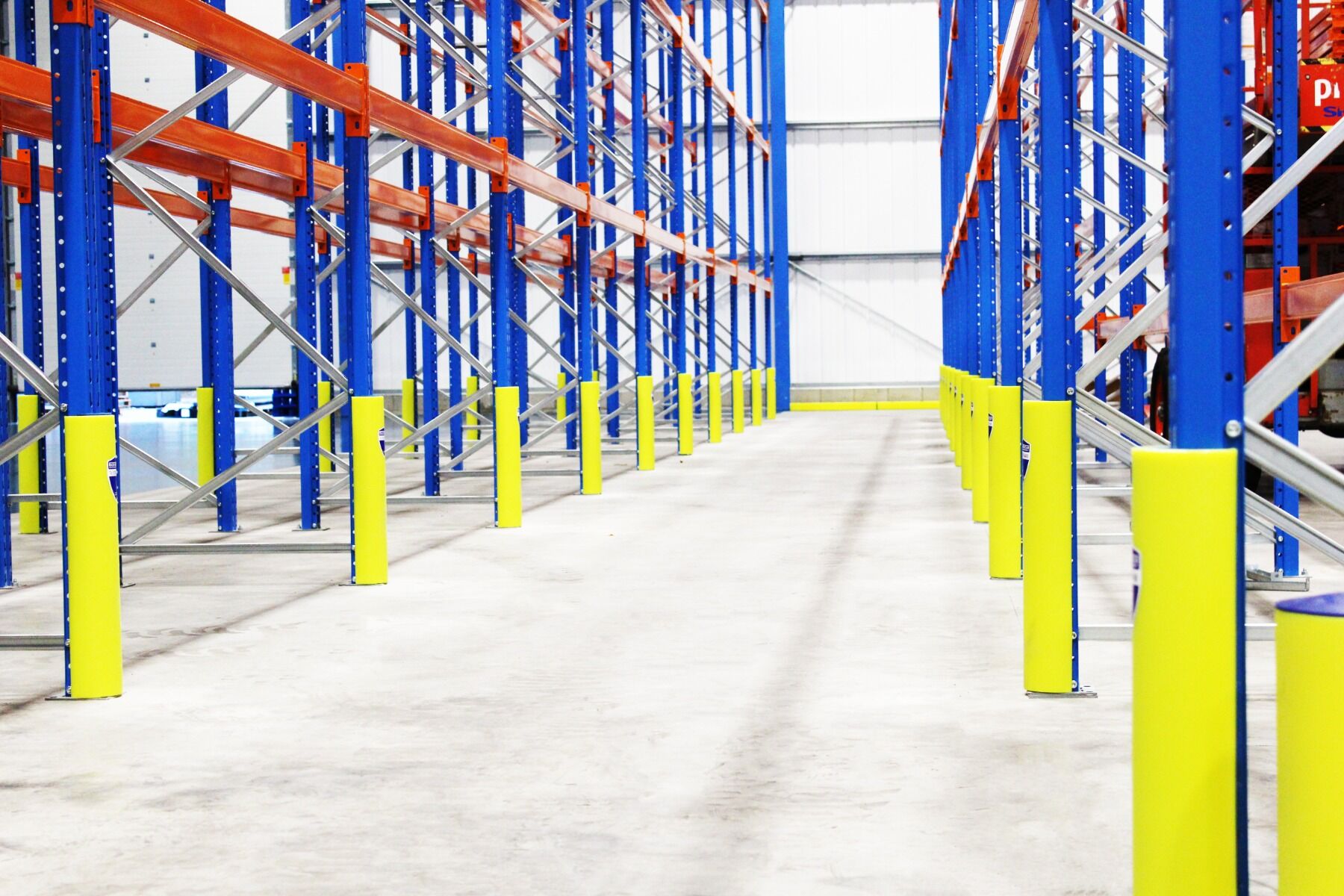
Introduction: Birmingham's Position at the Heart of UK Manufacturing and Distribution
Birmingham sits at the geographic centre of the UK industrial economy, and its industrial base reflects that position more comprehensively than almost any other city. The West Midlands automotive supply chain — anchored by Jaguar Land Rover at Solihull and Castle Bromwich, BMW's engine plant at Hams Hall, and a tier-one and tier-two supplier network running across the region — is the densest automotive manufacturing cluster in the UK. Layered on top of that sits the wider Birmingham manufacturing base in metals, plastics, electronics, and engineering services. And surrounding both is one of the country's most significant distribution and logistics hubs, built around the M6/M42/M5 motorway interchange that gives Birmingham road connections to every major UK conurbation within a working day.
For warehouse and manufacturing operators across this complex industrial economy, pallet racking protection has become a routine specification rather than a discretionary spend. The IATF 16949 audit regime that runs through automotive supply chain operations consistently looks for documented rack protection on warehouse audits. The high-throughput nature of distribution operations along the M6 corridor makes operational disruption from racking damage particularly costly. The multi-tenant logistics park developments at Birmingham Business Park, Hams Hall, Birch Coppice, and Prologis Park along the M42 drive substantial new-build racking installations where protection is increasingly specified at fit-out stage. And the audit-led specification culture across automotive and aerospace supply chains drives strong demand for FEM 10.2.16-tested protection rather than unbranded alternatives.
This guide is the comprehensive reference for Rack Armour® — the UK's most-specified clip-on pallet racking protector — written specifically for Birmingham and West Midlands operators. It covers the full Rack Armour® range, the engineering principles behind why it works, the FEM and HSE compliance framework that supports its use (with particular attention to the IATF 16949 and AS9100 audit regimes that dominate the local automotive and aerospace sectors), the application patterns most relevant to the West Midlands industrial base, and the practical realities of installing and maintaining the product across single-site and multi-site projects.
By the end of the guide, you should be able to identify the right size and colour for your racking, plan a rollout, and know what supporting documentation to keep. If you'd rather skip ahead and talk to a Hall-Fast specifier directly, contact us — we'll walk you through the right specification for your operation.
Hall-Fast operates a price match promise on every authentic Rack Armour® product. If you find a better price anywhere on the internet, or have received a written quotation, send it through and we'll match it.
The West Midlands Industrial Base and How It Shapes Rack Protection Requirements
Birmingham's industrial base is unusually diverse, and that diversity drives different specification patterns across different sectors.
The automotive supply chain. This is the defining sector of West Midlands manufacturing, and its specification requirements ripple through everything else. Jaguar Land Rover's plants at Solihull, Castle Bromwich, and Wolverhampton, BMW's engine plant at Hams Hall, and the network of Aston Martin, Bentley, and other vehicle manufacturers across the wider region anchor a tier-one and tier-two supplier network running into the thousands of operations. These suppliers operate to IATF 16949 — the global automotive quality standard — which drives consistently high standards for documented warehouse safety and rack protection. Non-conformance findings on IATF 16949 audits can affect supplier scorecards and contract renewals, which makes documented FEM 10.2.16-tested rack protection a near-universal specification.
For the typical Birmingham automotive supplier, the racking specification runs to standard pallet racking carrying parts, components, and sub-assemblies. The dominant Rack Armour® size is Medium (Euro B) for standard parts storage and Large (Euro C) for heavier sections. Safety Yellow is the universal default for visual integration with the rest of the audited facility's yellow infrastructure.
Aerospace and defence. Birmingham and the wider West Midlands has a substantial aerospace and defence presence, including Rolls-Royce facilities, the Aston Science Park cluster, and the wider supply chain. AS9100 audit regimes apply alongside IATF 16949 for some operations, and the documented compliance trail matters in both directions.
General manufacturing and engineering. The wider Birmingham manufacturing base — metals, plastics, electronics, machined components, surface treatment, foundries — represents a substantial sector in its own right. Specifications vary by what's stored, but Medium and Large dominate, with Safety Yellow as the default colour.
Multi-tenant distribution and logistics. The M6/M42/M5 motorway hub has driven the development of major multi-tenant logistics parks at Birmingham Business Park (Solihull), Hams Hall, Birch Coppice (Tamworth), and Prologis Park along the M42. These typically host major retail distribution, e-commerce fulfilment, contract logistics, and parts distribution operations. Standard distribution warehousing dominates, with Medium and Large the dominant sizes and Safety Yellow the typical colour standard.
Rail-served and intermodal logistics. The Birmingham Intermodal Freight Terminal at Birch Coppice and the wider rail freight presence in the region drive a specific subsector running container-served distribution. Higher-density storage systems are common, driving demand for XL and occasionally XXL specifications.
Older industrial areas. Witton, Erdington, Aston, Tyseley, and the wider belt of older industrial areas across Birmingham still host substantial manufacturing, distribution, and engineering activity. Racking specifications vary widely across this sector — anything from light-duty up to heavy industrial — and mixed-size rollouts are common.
Why Pallet Racking Damage Costs So Much More Than the Repair — Especially in Audit-Driven Birmingham Operations
The headline cost of racking damage is the repair invoice. A bent upright might cost a few hundred pounds to replace, plus the rack inspector's fee. The hidden numbers are where the actual cost lives — and for audit-driven Birmingham operations, the hidden numbers are particularly significant.
When an upright fails an inspection, the immediate consequence is bay isolation. The damaged section is taken out of service, the stock relocated, and the affected aisle closed off until repair is complete. For the typical Birmingham automotive supplier, bay isolation has a cascading effect on the just-in-time delivery cycles that automotive supply requires. JLR, BMW, and the wider OEM customer base operate tight delivery windows, and a supplier whose warehouse operations are disrupted by racking damage faces immediate consequences for delivery performance scorecards.
The compliance and insurance dimension matters too — and matters more for audit-driven sectors. IATF 16949 audits routinely scrutinise warehouse operations as part of the quality system review. AS9100 audits for aerospace operations apply similar scrutiny. Damaged uprights without protection in place reliably trigger non-conformance findings, and remediation cost (additional audits, corrective action documentation, customer notifications, supplier scorecard impact) typically runs to several thousand pounds per finding even before the underlying issue is fixed. Repeated findings can affect supplier approvals and contract renewals.
The Health and Safety Executive treats damaged racking seriously. Under HSE guidance and the FEM 10.2.03 standard for racking inspection, damaged racking that hasn't been identified, isolated, or repaired exposes the operator to potential enforcement action. Insurance assessors take the same view — visible racking damage affects renewal premiums.
There's also a longer-term cost picture. Repeated damage to the same upright accelerates wear on the racking system as a whole. For purpose-built modern Birmingham DCs at the larger logistics parks, where racking represents substantial capital investment, brought-forward replacement expenditure can be financially significant.
The economics of protecting the lower section of the upright — the strike zone, the lower 600mm of the leg — work out clearly. This is why most serious Birmingham operations now treat rack protection as standard equipment, and why Rack Armour® has become the default specification.
What Rack Armour® Actually Is
Rack Armour® is a clip-on pallet racking upright protector, fitted to the lower 600mm of the racking leg. Every product in the range consists of three engineered elements working together.
The outer shell is moulded from high-density polyethylene (HDPE), a tough impact-resistant thermoplastic. The shell wraps around the front and sides of the upright, leaving the back open so it can clip into place. The shape is patented — designed to deflect impacts laterally, redirecting force away from the upright. HDPE doesn't rust, doesn't corrode, doesn't flake or chip, and recovers its original shape after typical impact loading.
The inner foam core is a high-density energy-absorbing foam bonded to the inner surface of the HDPE shell. Where the shell deflects the impact, the foam absorbs it — converting kinetic energy from the forklift strike into heat and into the work done compressing the foam. The foam recovers between impacts, which is why a single Rack Armour® unit typically absorbs multiple strikes across its 15+ year service life without needing replacement.
The clip mechanism is integral to the moulded shell and sized precisely to grip the front-facing width of standard pallet racking uprights. The clip is tight enough that the protector stays in place after impact but designed to be installed and removed by hand without tools, anchors, or fixings.
The combined effect is a protector that fits in seconds, stays put under repeat impact, integrates visually with warehouse safety infrastructure through its high-visibility yellow finish, and lifts off in seconds for the rack inspections required under FEM and HSE guidance. The product is independently tested to FEM 10.2.16 and performs across the full operational temperature range of UK warehouses, from ambient through to -40°C cold storage. The full range, both colour finishes, and the matching installation tools are stocked at Hall-Fast and available on the Rack Armour® brand page.
The Engineering — How Rack Armour® Works
When a forklift strikes a racking upright at warehouse speed (typically 5-10 mph), the kinetic energy involved is substantial. A 5,000kg forklift moving at 8 mph carries roughly 25 kJ of kinetic energy at the moment of impact — more than enough to plastically deform a steel upright if directed straight into it. Smaller MHE — reach trucks, powered pallet trucks, electric stackers common in automotive supplier operations — carries proportionally less energy, but still enough to bend an unprotected leg in a single strike.
Steel column guards approach the problem by trying to block the force. The guard is rigid, anchored to the floor, and built from heavier-gauge steel. In theory, the impact loads the guard rather than the upright. In practice, this only works as long as the guard doesn't move. Floor anchors loosen under repeat loading, the concrete spalls around the bolt holes, and on a serious impact the guard deflects into the upright anyway, often causing more damage than the impact would have caused without the guard.
Rack Armour® approaches the problem by absorbing the energy rather than blocking it. The HDPE shell deflects on impact — designed to flex visibly under load — converting some kinetic energy into elastic deformation. The foam core then absorbs the remaining energy through controlled compression. By the time the impact pulse reaches the upright, most of the original kinetic energy has been dissipated.
This is the same engineering principle used in vehicle crumple zones and bicycle helmets — well-established physics, and the 80% damage reduction figure verified in independent testing is consistent with what's predictable from a properly engineered HDPE-and-foam absorption system. The protector is fundamentally sacrificial — designed to take the damage so the racking doesn't.
The clip-on installation matters for the engineering. Because the protector isn't anchored to the floor, the impact energy can't be transferred from the protector into the floor or the floor anchor zone. This is particularly relevant for the modern logistics park buildings at Birmingham Business Park, Hams Hall, Birch Coppice, and Prologis Park along the M42, where engineered floor specifications matter for narrow-aisle, very-narrow-aisle, and any automated systems.
The Complete Rack Armour® Range — Five Sizes, Two Colours, Two Tools
The Rack Armour® range stocked at Hall-Fast covers all standard UK pallet racking profiles in five upright sizes and two colour finishes, with two installation tools designed for project-scale rollouts.
The Small (Euro A) is sized for front-facing upright widths up to 87mm — light-duty pallet racking, mezzanine support legs, archive storage, and smaller-profile uprights. Across Birmingham automotive supplier operations, the Small specification appears commonly on lighter-duty parts storage in the secondary sections of mixed-size warehouses, and on mezzanine support in multi-tier picking operations. Available in Hi-Vis Yellow and Safety Yellow.
The Medium (Euro B) fits uprights up to 100mm wide — the workhorse size of the UK warehouse industry. By some margin our highest-volume Rack Armour® line into the Birmingham customer base, particularly into automotive supplier warehouses, multi-tenant distribution centre operations, and general manufacturing. Available in Hi-Vis Yellow and Safety Yellow.
The Large (Euro C) fits uprights from above 100mm and up to 110mm wide — heavier-duty racking common across larger Birmingham distribution centres, heavier-end automotive supply, contract logistics operations, and engineering supply chain. Available in Hi-Vis Yellow and Safety Yellow.
The XL (Euro D) covers uprights above 110mm and up to 120mm wide — heavy-duty racking including drive-in and drive-through systems, high-bay pallet racking. Common across Birmingham's larger DC operations along the M6 and M42 corridors, particularly for FMCG bulk distribution and consumer goods. Available in Hi-Vis Yellow and Safety Yellow.
The XXL (Euro E) is the largest size in the range, fitting uprights above 120mm and up to 135mm wide — pallet shuttle and semi-automated racking, very high-bay storage, deep-lane systems. Most common at the largest Birmingham logistics park operations and at some Birch Coppice intermodal-served sites where high-density storage maximises container destuffing throughput. If your uprights are wider than 135mm, contact Hall-Fast directly. Available in Hi-Vis Yellow and Safety Yellow.
All five sizes are 600mm tall — matching the strike zone where forklift damage concentrates. All five share the same patented HDPE shell, foam core, clip-on installation, FEM 10.2.16 testing, -40°C operating range, and 15+ year service life.
For site-wide rollouts, Hall-Fast also stocks the two installation tools. The Small/Medium tool is designed for repetitive bulk installation. The Large/XL/XXL tool provides leverage for the stiffer clip tensions on the larger sizes.
How to Choose the Right Size for Birmingham Operations
The right size is determined by the front-facing width of your racking upright, measured in millimetres across the front face of the leg.
| Upright Front-Facing Width | Rack Armour® Size | Birmingham Application Pattern |
|---|---|---|
| Up to 87mm | Small (Euro A) | Light-duty parts storage, mezzanine support, archive, smaller-profile uprights |
| Above 87mm and up to 100mm | Medium (Euro B) | Standard pallet racking — dominant volume across automotive supply, distribution, and general manufacturing |
| Above 100mm and up to 110mm | Large (Euro C) | Heavier-duty distribution, larger automotive supply chain operations, engineering stores |
| Above 110mm and up to 120mm | XL (Euro D) | Drive-in and high-bay racking, FMCG bulk distribution, larger DC operations |
| Above 120mm and up to 135mm | XXL (Euro E) | Pallet shuttle, semi-automated, deep-lane, the heaviest large-format DC racking |
Most Birmingham-area operations run a single upright profile across the bulk of the building, but mixed installations are common — particularly in older industrial areas where buildings have been re-fitted multiple times.
If you're unsure about sizing, take photos of the upright with a tape measure across the front face and send them through. For larger Birmingham customers, we can usually arrange a site visit to confirm sizing across mixed installations.
Hi-Vis Yellow vs Safety Yellow — How to Choose
Both Rack Armour® finishes deliver identical impact protection. The choice is about visual integration into your warehouse.
Safety Yellow is the classic industrial warning yellow that integrates with existing bollards, kerb protection, and floor markings. For audited Birmingham operations — and given the scale of the IATF 16949 automotive supplier base, audit-driven specification dominates the local market — Safety Yellow is usually the only specification that satisfies the building standard. It's also the typical choice for multi-tenant logistics park operations and contract logistics where visual consistency with customer-mandated facility standards matters.
The Safety Yellow range covers all five sizes — Small, Medium, Large, XL, and XXL.
Hi-Vis Yellow is the brighter, more fluorescent finish — best suited to cold and frozen storage where ambient lighting is lower, drive-in racking interiors where forklifts operate inside the rack run, and zones where contrast matters more than coordination. For Birmingham operations with cold sections — food distribution and some FMCG operations across the M42 corridor — Hi-Vis Yellow on cold racking and Safety Yellow on ambient sections is the typical pattern.
The Hi-Vis Yellow range covers all five sizes — Small, Medium, Large, XL, and XXL.
Hall-Fast quotes both finishes within a single project order — send your specification through and we'll quote both within one project.
Rack Armour® vs Steel Column Guards — Particularly Clear-Cut for Audited Birmingham Operations
For Birmingham's audited automotive and aerospace supplier base, the comparison between absorption and rigid protection is particularly clear-cut, because the documentation requirements compound the engineering case.
Where steel column guards make sense. Heavy steel column guards are appropriate for protecting the bases of structural columns — the load-bearing columns of the building itself, not racking uprights. They have a place at end-of-aisle positions where impact frequency is very high. Hall-Fast also stocks complementary impact and wall protection products for these adjacent applications.
Where Rack Armour® is the better choice. For protecting pallet racking uprights specifically, Rack Armour® is the better specification.
The primary issue with steel column guards on racking uprights is energy transfer. A steel guard fixed to the floor doesn't absorb the impact, it transfers it. The energy goes into the guard, then into the floor anchor, and ultimately into the upright if the guard deflects. On a serious impact, the guard itself deforms into the upright, often causing more damage than the impact would have caused without protection.
The secondary issue is documentation. Steel column guards typically come with limited or no impact testing documentation. Rack Armour® comes with full FEM 10.2.16 test data — which matters significantly for IATF 16949 and AS9100 audit files where the documented compliance trail is part of what auditors review.
The third issue is inspection. Rack inspections under FEM 10.2.03 require the inspector to see the upright clearly. Floor-anchored steel guards obstruct that view and often have to be removed or worked around. Rack Armour® lifts off in seconds.
The fourth issue is floor specification. Modern Birmingham logistics park buildings — particularly at Birmingham Business Park, Hams Hall, Birch Coppice, and Prologis Park — are typically built with engineered floors. Floor-anchored steel guards require drilling, which compromises the floor specification and can void warranties. Rack Armour® clips on by hand without touching the floor.
The fifth issue is total cost over the racking lifecycle. Steel guards have a lower unit price than Rack Armour® in many cases, but the lifecycle cost picture is different once you include floor repair, contractor installation, replacement after serious impacts, and the cost of repaired uprights that the steel guard didn't actually protect. Across a 15+ year racking lifecycle, Rack Armour® usually works out cheaper.
FEM Standards and Compliance — Critical for IATF 16949 and AS9100 Operations
Compliance is one of the underrated reasons to specify branded, tested rack protection — and for Birmingham's audit-heavy automotive and aerospace supplier base, it's frequently the deciding factor.
Rack Armour® is independently tested to FEM 10.2.16, the European Federation of Materials Handling standard for racking impact protection. Specifying FEM 10.2.16-tested protection contributes to demonstrable due diligence under the Health and Safety at Work Act, supports compliance with the broader FEM 10.2.03 standard for racking inspection, and provides the documentation trail that customer auditors expect.
FEM 10.2.02 covers user requirements for static pallet racking systems — what the racking should be capable of and how it should be loaded. FEM 10.2.03 is the standard for the inspection of static pallet racking, with green/amber/red damage classification triggering action thresholds. Most Birmingham operators run annual SEMA-approved inspections to FEM 10.2.03. FEM 10.2.16 covers impact protection devices.
For Birmingham's automotive supplier sector specifically, the IATF 16949 audit regime drives consistent demand for documented warehouse safety measures. Tier-one and tier-two suppliers to JLR, BMW Hams Hall, and the wider OEM customer base operate to IATF 16949 audit cycles that scrutinise warehouse operations as part of the quality system review. AS9100 applies similarly for aerospace operations. Specifying authentic Rack Armour® and keeping the FEM 10.2.16 supporting documentation makes the rack protection element of these audits straightforward — and avoids the kind of non-conformance findings that trigger remediation cost and supplier scorecard impact.
Hall-Fast can supply the relevant Rack Armour® specifications, FEM 10.2.16 test data, and product documentation to support your audit and compliance files, including IATF 16949, AS9100, ISO 9001, ISO 45001, and customer-specific audit regimes — request the documentation through our contact page.
Lifecycle Cost — Why Rack Armour® Pays Back Particularly Quickly in Audited Birmingham Operations
Rack protection is one of those investments where the up-front unit cost is the wrong number to focus on. The right number is the cost over the lifecycle of the racking system — typically 25 years for well-specified pallet racking — and the avoided costs across that period.
The cost components of unprotected racking damage typically include direct repair costs, productivity loss during bay isolation, insurance premium impact, audit and customer SLA impact, HSE and incident exposure, and cumulative racking system degradation that brings forward capital expenditure.
For Birmingham operations specifically, three cost components tend to be larger than national averages.
First, just-in-time delivery impact for automotive suppliers. JLR, BMW, and other OEM customers operate tight delivery windows, and a supplier whose warehouse operations are disrupted by racking damage faces immediate consequences for delivery performance scorecards. The cost of even a single missed delivery window can run to several thousand pounds in penalties and customer relationship cost.
Second, audit cost. Non-conformance findings on IATF 16949 or AS9100 audits typically run to several thousand pounds per finding even before remediation, and repeated findings can affect supplier approvals. For tier-one suppliers in particular, an audit finding that affects supplier status can have very large commercial consequences.
Third, multi-tenant park rent and lease implications. For operators leasing space at the major Birmingham logistics parks, racking damage that compromises floor specification can affect lease compliance, with potential restoration cost implications at lease end.
Against this, the cost of Rack Armour® protection is straightforward — a unit cost per protector, a one-off install with no contractors or floor work, a 15+ year service life, and an 80% reduction in damage events.
For most Birmingham operations the payback period is measured in months, not years. For multi-site operators, Hall-Fast quotes project pricing on multi-site rollouts that brings the per-unit cost down further.
Sectors and Applications We See Most Often Across Birmingham and the West Midlands
Across the local customer base, certain sectors and application patterns recur.
Automotive tier-one and tier-two suppliers. The defining sector locally. JLR, BMW Hams Hall, and the wider OEM customer base anchor a substantial supplier network. IATF 16949 audit regimes drive strong demand for documented rack protection. Medium Safety Yellow and Large Safety Yellow are the dominant specifications.
Aerospace and defence supply chain. AS9100 audit regimes apply alongside or in place of IATF 16949 for some operations. Documentation requirements are typically stringent. Medium and Large in Safety Yellow dominate.
Multi-tenant distribution and contract logistics. Birmingham Business Park, Hams Hall, Birch Coppice, Prologis Park along the M42, and the wider M6 corridor host major distribution operations. Medium and Large the dominant sizes, Safety Yellow the typical colour standard.
E-commerce and retail fulfilment. Major retail and online fulfilment operations across the Birmingham logistics parks. Standard distribution warehousing dominates — Medium racking, Safety Yellow.
Parts distribution. Both automotive aftermarket and industrial parts distribution have substantial presence. Audit regimes (IATF 16949 for automotive aftermarket, ISO 9001 for general parts) drive demand for documented rack protection.
General manufacturing and engineering. Metals, plastics, electronics, machined components, surface treatment, foundries, and the wider manufacturing base. Specifications vary by what's stored — Medium and Large most common, typically Safety Yellow.
FMCG and consumer goods bulk distribution. Heavy pallet weights and high turnover drive XL and XXL specifications, particularly on drive-in and high-bay racking. Cold storage operations combine Hi-Vis for the freezer and Safety Yellow for ambient sections.
Rail-served and intermodal distribution. Birch Coppice intermodal terminal and the wider rail freight presence drive a specific subsector running container-served distribution. High-density storage common, XL and XXL more frequent.
Older industrial areas. Witton, Erdington, Aston, Tyseley, and the wider belt of older industrial activity. Mixed racking applications with full range of sizes appearing depending on operation type.
If your operation isn't on this list, the pattern is likely still recognisable. For a specifier's opinion, contact the Hall-Fast team.
Installation — Working Around Birmingham's 24/7 Manufacturing and Distribution Operations
One of Rack Armour®'s defining features is that the entire installation lifecycle — fitting, inspection, removal, replacement — is designed to be done in-house by warehouse staff, without contractors, drilling, or specialist tools. This matters particularly for Birmingham's continuous-operation manufacturing and distribution sectors, where shutting down to install rack protection isn't realistic.
Fitting. Each Rack Armour® protector clips onto the upright by hand. For Small and Medium sizes — by far the most common across Birmingham operations — the clip tension is light enough that any team member can fit one in seconds. For Large, XL, and XXL sizes, the clip tension is higher and the matching fitting tool is recommended.
The Small/Medium installation tool is designed for repetitive bulk installation. The Large/XL/XXL installation tool is designed for the higher clip tensions on the larger sizes.
Phasing your rollout. For 24/7 operations — common across Birmingham automotive supply, aerospace, and major distribution — phasing the rollout aisle by aisle during quieter periods minimises operational disruption. For DCs and manufacturing operations with planned shutdown windows, those windows are usually the right time for a full rollout.
Inspection. Rack Armour® supports rather than obstructs the rack inspection process — the protector lifts off the upright by hand.
Replacement. When a protector reaches the end of its service life, replacement is as simple as the original installation. For operations running Rack Armour® at scale, talk to us about a stocking arrangement.
Multi-Site Network Rollouts — Common Across Birmingham's Tier-One Supplier and 3PL Sectors
For multi-site operators with anchor presence in Birmingham — common across tier-one automotive suppliers, contract logistics providers, retail distribution, and e-commerce fulfilment — the same logic applies but at greater scale.
The advantage of Rack Armour® at network scale is that one specification — typically Medium and Large in Safety Yellow, with smaller and larger sizes filling specific bays — covers the bulk of any UK warehouse. Standardising at network level keeps procurement straightforward, simplifies stock management, and gives you a consistent visual finish across the estate.
For multi-site projects, contact Hall-Fast directly — we handle phased delivery to multiple addresses, network-level invoicing, custom branded labelling at scale, and combined orders covering protectors, installation tools, and complementary safety products.
Why Buy Rack Armour® from Hall-Fast for Birmingham and West Midlands Operations
Hall-Fast Industrial Supplies is a long-established UK industrial supplier and an authorised Rack Armour® stockist. We carry the full range across all sizes, both colours, and both installation tools, and we support buyers from single-bay orders through to multi-site network rollouts.
Our price match promise applies on every authentic Rack Armour® product. If you find a better price elsewhere on the internet, or have received a written quotation, send it through and we'll match it.
Bulk and project pricing for site-wide and multi-site rollouts. Volume orders, phased deliveries, and combined orders qualify for project pricing beyond the standard catalogue rate. Get in touch with your specification for a tailored quote.
The full authentic Rack Armour® range stocked, including both colour finishes and both installation tools. No gaps in availability, no waiting for special orders.
Custom branded labels on project orders — particularly relevant for IATF 16949 and AS9100 supply chain operations where labelling can support traceability documentation.
Compliance documentation and specification support including FEM 10.2.16 test data, product specifications, and material data sheets to support IATF 16949, AS9100, ISO 9001, ISO 45001, and customer audit files. For automotive and aerospace supplier audits specifically, this documentation matters.
A real industrial supplier on the other end of the phone. Read more on the About Hall-Fast page or get in touch directly.
Beyond Rack Armour®. We also stock complementary impact and wall protection, storage and shelving systems, longspan shelving, storage pallet systems, road and warehouse safety products, rack identification labels, bay load signs, loading dock buffers, and many other warehouse safety and equipment categories. For the full picture see our brands directory.
Frequently Asked Questions
What size pallet racking does the Rack Armour® range fit? Five sizes covering all standard UK pallet racking from up to 87mm wide (Small) through to up to 135mm wide (XXL). All are 600mm tall.
Which sizes are most common for Birmingham automotive supplier and distribution operations? Medium (Euro B) is the dominant volume across the Birmingham customer base — typically Medium Safety Yellow for IATF 16949 audited automotive supply, contract logistics, and general distribution. Large Safety Yellow appears on heavier-duty sections, with XL and XXL on drive-in and high-bay storage.
Should I order Hi-Vis Yellow or Safety Yellow? Both colours give identical impact protection. For IATF 16949 and AS9100 audited Birmingham operations, Safety Yellow is typically the building standard. Hi-Vis Yellow is best for cold storage and dim aisles.
Is Rack Armour® FEM tested? Will it pass an IATF 16949 audit? Yes. Rack Armour® is independently tested to FEM 10.2.16, the European standard for racking impact protection. Hall-Fast can supply test data and specifications for IATF 16949, AS9100, ISO 9001, and ISO 45001 audit files.
Will it work in cold storage? Yes. Rack Armour® is rated to operate at temperatures down to -40°C, suitable for ambient, chilled, and frozen storage.
Do I need contractors to install it? No. Rack Armour® clips on by hand with no anchors, drilling, or floor fixings. For larger rollouts, the matching installation tools — Small/Medium and Large/XL/XXL — speed the process up significantly.
Do you handle multi-site rollouts? Yes. Multi-site network rollouts are one of our most common project types. Contact us with your specification and site list.
Do you really price match? Yes — our price promise covers every authentic Rack Armour® product. Send us a lower price or written quote and we'll match it.
Do you supply other industrial products beyond Rack Armour®? Yes — see our brands directory or contact us for advice on complementary products.
Conclusion: Specify Rack Armour® Properly Across Birmingham's Diverse Industrial Base
For warehouse, manufacturing, and distribution operators across Birmingham and the W