How Pallet Pal Level Loaders Eliminate Ergonomic Hazards, Boost Efficiency, and Why Hall-Fast's Price Promise Makes Them Your Trusted Partner
In today's fast-paced warehousing, manufacturing, and distribution environments, worker safety and operational efficiency are not just priorities—they're essential to business success. One of the most overlooked yet critical sources of workplace injuries stems from a seemingly routine task: loading and unloading pallets. Workers bend, stretch, reach, and strain thousands of times daily, accumulating micro-traumas that lead to debilitating musculoskeletal disorders, lost work time, increased insurance costs, and reduced productivity.
Enter the Pallet Pal Level Loader—an ingeniously engineered ergonomic solution that has revolutionized manual pallet handling across industries worldwide. This comprehensive guide explores everything you need to know about Pallet Pal Level Loaders, from understanding their innovative design and operational benefits to selecting the right model for your specific needs. Most importantly, we'll reveal why Hall-Fast Industrial Supplies stands as your trusted industry expert for Pallet Pal equipment, backed by their competitive Price Promise that ensures you receive the best value without compromising on quality or service.
Whether you're a warehouse manager seeking to reduce injury rates, a facilities director evaluating ergonomic equipment investments, a safety officer researching OSHA compliance solutions, or a business owner looking to boost productivity while protecting your workforce, this guide provides the comprehensive information you need to make informed decisions about Pallet Pal Level Loaders.
What Is a Pallet Pal Level Loader? Understanding the Revolutionary Design
The Ergonomic Challenge of Manual Pallet Handling
Before exploring the solution, let's understand the problem. Traditional manual pallet loading and unloading creates one of the most significant ergonomic challenges in modern warehousing and manufacturing environments.
When workers manually load boxes, cartons, or products onto pallets starting at floor level, they must bend deeply to place the first layer. As the pallet builds, they work at increasingly comfortable heights for the middle layers. However, the problem returns when completing the top layers—workers must reach upward, stretching to dangerous heights while handling heavy loads. This cycle reverses when unloading pallets: comfortable heights initially, then progressively worse ergonomics as the pallet height decreases.
This constant bending, reaching, and stretching—repeated hundreds or thousands of times per shift—places enormous strain on workers' backs, shoulders, necks, and knees. The cumulative effect manifests as musculoskeletal disorders (MSDs), the leading cause of workplace injuries and disability in warehousing and logistics operations.
The Occupational Safety and Health Administration (OSHA) recognizes manual material handling as a primary risk factor for work-related MSDs. The economic impact is staggering: back injuries alone account for over $50 billion in annual workers' compensation costs in the United States. Beyond direct costs, businesses suffer from reduced productivity, increased absenteeism, lower morale, higher turnover, and potential OSHA penalties for workplace safety violations.
The Pallet Pal Solution: Ingenious Simplicity
The Pallet Pal Level Loader solves this ergonomic crisis through an elegantly simple yet brilliantly effective design: it automatically adjusts the height of the pallet load as items are added or removed, maintaining the top of the load at a consistent, comfortable working height throughout the entire loading or unloading process.
Imagine placing the first box on a pallet positioned at comfortable waist height instead of bending to floor level. As you add more boxes, the pallet automatically and gradually lowers, keeping the top of the growing stack at that same comfortable height. When the pallet is fully loaded, it sits near floor level, ready for forklift removal. The process reverses for unloading: place a full pallet on the Level Loader, and it automatically positions the top layer at comfortable height. As you remove items, the pallet rises gradually, maintaining optimal working height until the pallet is empty.
This automatic height adjustment eliminates virtually all bending, reaching, and stretching associated with manual pallet handling. Workers maintain natural, neutral body positions throughout their shifts, dramatically reducing strain and fatigue while simultaneously improving speed and efficiency.
Core Design Components
The Pallet Pal Level Loader achieves this remarkable functionality through several key engineered components:
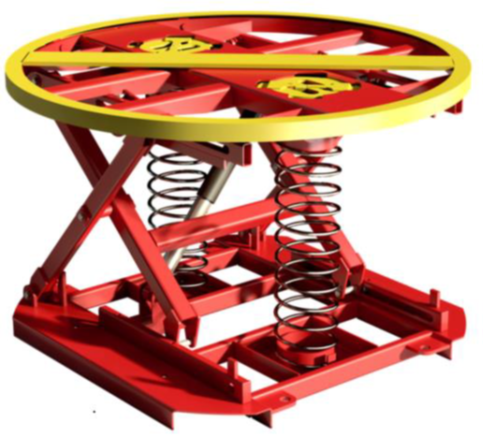
Spring-Actuated Lift Mechanism: Heavy-duty calibrated springs provide the primary lifting force. As weight is removed from the platform, the springs extend, raising the load. As weight is added, the springs compress, lowering the platform. The springs are precisely calibrated to specific load weight ranges, ensuring optimal performance across the intended weight spectrum.
Shock Absorber/Dampener System: While springs provide the lifting force, shock absorbers control the motion. These dampeners ensure smooth, gradual raising and lowering without bounce, overshoot, or sudden movements. This creates a stable, predictable platform that enhances both safety and ease of use.
Proven Linkage Design: The mechanical linkage connecting the platform to the spring mechanism ensures the platform remains level even when loads are unevenly distributed. This is crucial for real-world applications where pallet loads rarely distribute weight perfectly evenly.
Turntable Platform: A low-friction, bearing-supported turntable top allows workers to rotate the entire pallet load with minimal effort. This enables "near-side" working—workers can stand in one position and rotate the pallet to access all sides, eliminating the need to walk around the pallet repeatedly.
Robust Steel Frame: Heavy-duty tubular or structural steel frames provide the structural integrity to safely support loads up to 4,500 lbs (approximately 2,040 kg) depending on model. The frame design ensures stability and durability even under continuous heavy-duty use.
Fork Pockets: Built-in fork pockets allow easy relocation with standard forklifts, providing operational flexibility to reconfigure work areas as needs change.
Free-Standing Design: The Level Loader requires no permanent installation, bolting, or connection to utilities. It stands freely, ready to use immediately upon delivery.
The Pallet Pal Product Family: Models for Every Application
Pallet Pal offers several distinct models, each engineered for specific operational requirements. Understanding the differences helps ensure you select equipment optimally suited to your needs.
Pallet Pal 360 Spring Level Loader: The Industry Standard
The Pallet Pal 360 Spring Level Loader represents the most popular and versatile model, serving as the industry standard for automatic pallet positioning.
Key Features:
- Fully Automatic Operation: No manual adjustments, buttons, or controls required. Simply load or unload, and the unit automatically maintains optimal height.
- Spring Actuation: Heavy-duty calibrated springs provide reliable, maintenance-free lifting force requiring no electricity or compressed air.
- 360° Turntable Access: The bearing-supported turntable platform rotates smoothly, allowing complete access from any side while standing in one position.
- Load Capacity: Available in configurations handling loads from 400 lbs to 4,500 lbs, accommodating diverse operational needs.
- Dampened Motion: Integrated shock absorbers ensure smooth, controlled raising and lowering without bounce or sudden movements.
- Level Maintenance: Proven linkage design keeps the platform level even with uneven load distribution.
- Portability: Built-in fork pockets enable easy relocation throughout facilities as workflow requirements change.
- Zero Operating Costs: No electricity, compressed air, or consumables required—simply position and use.
Ideal Applications:
- Warehousing and distribution centers with consistent pallet handling operations
- Manufacturing facilities with manual loading/unloading of materials
- Order picking and packing operations
- Shipping and receiving departments
- Retail distribution centers
- Food and beverage processing facilities
- Pharmaceutical and medical supply operations
The Pallet Pal 360 Spring serves most general-purpose applications excellently, providing reliable, maintenance-free operation at the lowest total cost of ownership.
Pallet Pal AIR Pneumatic Level Loader: Enhanced Versatility
The Pallet Pal AIR model adds pneumatic assistance to the spring mechanism, creating a hybrid system that offers advantages for specific applications.
Key Features:
- Airbag-Spring Combination: An industrial airbag supplements the spring system, providing virtually linear response across the load range.
- Pressure Adjustability: Operators can adjust air pressure to fine-tune performance for varying load weights and pallet heights.
- Wider Load Range: The pneumatic assistance enables handling of more diverse load weights without spring changes.
- Safety Backup: The spring mechanism provides safety by supporting the unloaded turntable even if accidental air loss occurs.
- Simple Connections: Only two air connections required—straightforward installation with standard shop air (typically 75-80 PSI).
- Maintained Portability: Fork pockets and free-standing design preserved despite pneumatic components.
Ideal Applications:
- Operations with widely varying pallet weights
- Facilities handling frequent product changes requiring different load ranges
- Environments where spring calibration changes would be impractical
- Applications requiring precise height control across diverse loads
The pneumatic model costs more initially than the spring-only version but provides operational flexibility that justifies the investment when load variations are significant.
Pallet Pal Powered Level Loaders: Maximum Control
For applications requiring complete operator control over platform height, powered models provide ultimate versatility.
Key Features:
- Full Height Adjustment: Operators control precise platform height from floor level to maximum extension (typically 32-33 inches plus pallet height).
- Foot Pedal Control: Hands-free height adjustment via floor-mounted foot pedal or switch.
- Infinite Positioning: Platform adjusts to any height within range, not just spring-determined positions.
- Hydraulic or Pneumatic Power: Available with internal hydraulic systems (electric powered) or pneumatic systems (shop air powered).
- Manual Turntable: Bearing-supported turntable maintains 360° access despite powered lift mechanism.
- Multiple Capacity Options: Available in 2,000 lb and 4,000 lb capacities.
Ideal Applications:
- Operations handling extremely varied pallet sizes, weights, and heights
- Applications requiring precise positioning for specialized tasks
- Facilities with custom packaging configurations
- Environments where operator discretion over height provides process advantages
Powered models represent higher initial investment and ongoing operating costs (electricity or compressed air consumption) but deliver operational flexibility automatic spring units cannot match.
Pallet Pal Roll-On/Roll-E Level Loaders: Low-Profile Innovation
Roll-On and Roll-E models feature unique low-profile designs that lower completely to floor level, enabling pallet loading and unloading with hand pallet trucks.
Key Features:
- Floor-Level Loading: Platform lowers to floor height, allowing pallets to be rolled on/off with standard hand pallet trucks.
- Internal Hydraulic Power: Electric-powered hydraulic system provides smooth height adjustment.
- Pushbutton or Foot Switch Control: Operators adjust height easily via control buttons or foot switches.
- Four-Side Access: Narrow side and back panels allow easy reach-over for accessing all four sides of loads.
- Optional Full Turntable: Available with or without rotating turntable depending on application needs.
- Eliminates Forklift Dependency: Hand pallet truck compatibility provides operational flexibility in facilities without continuous forklift access.
Ideal Applications:
- Facilities with limited forklift availability or restricted forklift access areas
- Operations using hand pallet trucks as primary material handling equipment
- Retail stockrooms and back-of-house operations
- Small to medium warehouses
- Shipping and receiving areas with hand-truck-based workflows
Roll-On models bridge the gap between fully automatic spring units and hand truck operations, providing ergonomic benefits while maintaining compatibility with existing hand-truck-based workflows.
The Compelling Benefits: Why Invest in Pallet Pal Level Loaders
Dramatic Reduction in Workplace Injuries
The primary and most compelling benefit of Pallet Pal Level Loaders is their dramatic impact on workplace safety and injury prevention.
Musculoskeletal Disorder Prevention: By eliminating repetitive bending, reaching, and stretching, Level Loaders address the root causes of MSDs—the most common and costly workplace injuries in material handling environments. Studies consistently show that implementing ergonomic pallet positioners reduces injury rates by 50-70% in manual pallet handling operations.
Back Injury Elimination: Back injuries represent the single most expensive workplace injury category. The Occupational Safety and Health Administration estimates that back injuries cost U.S. businesses over $50 billion annually in direct costs alone. Level Loaders virtually eliminate the bending and lifting motions that cause the vast majority of these injuries.
Shoulder and Neck Strain Reduction: Reaching overhead to place items on tall pallet stacks strains shoulders and neck, causing injuries and chronic pain. Level Loaders maintain loads at waist to chest height, eliminating overhead reaching entirely.
Cumulative Trauma Prevention: Even when individual lifting motions don't cause immediate injury, thousands of repetitions create cumulative trauma that manifests as chronic pain and disability. Level Loaders break this cycle by eliminating harmful repetitive motions.
Slip, Trip, and Fall Prevention: Workers navigating around pallets, stepping over products at floor level, or losing balance while bending to place items all risk falls. Level Loaders reduce these hazards by maintaining organized work areas and eliminating awkward body positions that compromise balance.
Reduced Worker Fatigue: Beyond preventing acute injuries, Level Loaders dramatically reduce worker fatigue. Less strain means workers maintain energy and focus throughout entire shifts, reducing errors and accidents that occur when workers are exhausted.
The safety benefits alone often justify Level Loader investments through reduced workers' compensation costs, lower insurance premiums, eliminated OSHA fines, and improved workplace morale.
Significant Productivity Improvements
Beyond safety, Level Loaders deliver measurable productivity improvements that provide rapid return on investment.
Faster Loading and Unloading: Workers operating at comfortable heights work faster than those constantly bending and stretching. Studies document productivity improvements of 20-40% when comparing manual floor-level pallet handling to ergonomic Level Loader operations.
Reduced Worker Fatigue: Less physical strain means workers maintain consistent pace throughout shifts rather than slowing progressively as fatigue accumulates. The productivity difference between fresh workers at shift start and exhausted workers at shift end narrows significantly.
Fewer Work Breaks: Workers requiring frequent breaks to recover from physical strain work fewer productive hours per shift. Level Loaders reduce this recovery need, increasing actual working time.
Better Product Placement: Working at comfortable heights enables workers to place products more carefully and precisely, reducing damage from dropped items, improving pallet stability, and creating better stacks.
Near-Side Access Efficiency: The turntable feature enables workers to stand in one position and rotate pallets to access all sides, eliminating constant walking around pallets. This seemingly minor efficiency compounds over thousands of pallet operations.
Reduced Training Time: New workers learn proper loading techniques faster when not simultaneously struggling with awkward ergonomics. The comfortable working height allows focus on proper stacking patterns rather than physical discomfort.
Ability to Handle Heavier Items: Workers can safely handle heavier individual items when working at proper height compared to floor-level or overhead placement. This can reduce the need for team lifts or mechanical assists for moderate-weight items.
Lower Total Operating Costs
While Level Loaders require upfront investment, their total cost of ownership proves highly favorable when accounting for all factors.
Reduced Workers' Compensation Costs: Lower injury rates directly reduce workers' compensation insurance premiums and claim payouts. For many operations, these savings alone recover equipment costs within 1-3 years.
Decreased Absenteeism: Injured workers miss work; less-injured workers work more consistently. Reduced absenteeism eliminates costs of overtime, temporary workers, or understaffing.
Lower Turnover: Physically demanding work drives employee turnover as workers seek less punishing employment. Lower turnover reduces recruitment, hiring, and training costs while maintaining experienced workforce continuity.
Minimal Maintenance: Particularly with spring-actuated models, maintenance requirements are minimal. No electricity, no consumables, no complex systems requiring ongoing service. Periodic lubrication and inspection represent the primary maintenance needs.
Long Service Life: Quality Level Loaders like Pallet Pal models commonly serve 10-15+ years with proper maintenance. The upfront investment amortizes across many years of productive use.
Energy Costs: Spring models consume zero energy. Even powered models use minimal electricity or compressed air compared to alternatives like powered pallet jacks or dedicated lift tables.
Improved Product Quality: Reduced product damage from dropped items, better stacking, and more careful handling reduce waste and replacement costs.
OSHA Compliance: Demonstrating commitment to ergonomics and injury prevention helps maintain OSHA compliance, avoiding potential fines and citation costs.
Enhanced Workplace Morale and Culture
Benefits extend beyond purely financial considerations to workplace culture and employee satisfaction.
Worker Appreciation: Providing ergonomic equipment demonstrates genuine concern for worker wellbeing. Employees recognize when employers invest in their safety and comfort, fostering loyalty and engagement.
Reduced Pain and Discomfort: Workers arriving home without debilitating back pain, sore shoulders, and exhausted bodies enjoy better quality of life outside work. This cannot be overstated as a human benefit beyond business considerations.
Professional Work Environment: Modern ergonomic equipment creates professional work environments that attract and retain quality workers. Facilities prioritizing safety and efficiency stand out in competitive labor markets.
Positive Safety Culture: Visible commitment to ergonomics reinforces broader safety culture. When workers see management investing in injury prevention, they engage more seriously with all safety initiatives.
Pride in Workplace: Workers take pride in well-equipped, modern facilities. This intangible benefit manifests as better work quality, stronger team cohesion, and positive word-of-mouth recruiting.
Application Across Industries: Where Pallet Pal Level Loaders Excel
Warehousing and Distribution Centers
Distribution and warehousing operations represent the primary market for Pallet Pal Level Loaders, and for good reason—these environments handle massive pallet volumes with predominantly manual loading and unloading.
Order Picking Operations: Workers building customer orders manually pack products onto pallets for shipment. Level Loaders maintain comfortable working height as orders grow, enabling efficient, injury-free order fulfillment.
Receiving Operations: Incoming shipments require unloading, inspection, and breakdown. Level Loaders facilitate efficient receiving by maintaining optimal height as pallets are unloaded and products processed.
Cross-Docking: Fast-paced cross-dock operations transfer products from inbound to outbound pallets rapidly. Level Loaders accelerate this process while protecting workers during intensive manual handling.
Value-Added Services: Many warehouses provide kitting, repacking, labeling, or customization services. These manual operations benefit immensely from ergonomic pallet positioning.
Returns Processing: Processing returned products requires unloading, inspection, and repackaging. The variable nature of returns makes the Level Loader's adaptability particularly valuable.
Manufacturing Facilities
Manufacturing operations use Level Loaders at various production stages where manual pallet handling occurs.
Raw Material Receiving: Incoming raw materials arrive on pallets requiring unloading for production use. Level Loaders enable efficient material transfer from pallets to production.
Work-in-Progress Handling: Semi-finished products moving between production stages often travel on pallets. Level Loaders facilitate manual loading and unloading at production stations.
Finished Goods Packing: Completed products require packaging onto pallets for shipment or storage. Level Loaders enable efficient, ergonomic packing operations.
Assembly Operations: Assembly lines frequently draw components from pallets. Level Loaders maintain optimal height as components are consumed, eliminating bending and reaching.
Quality Control: QC stations examining products benefit from ergonomic positioning, allowing thorough inspection without physical strain.
Food and Beverage Processing
Food and beverage operations handle enormous volumes of manual pallet loading and unloading in temperature-controlled environments where worker comfort is already challenged.
Packaging Operations: Manual case packing onto pallets occurs continuously in food production. Level Loaders maintain comfortable height throughout these intensive operations.
Ingredient Handling: Incoming ingredients require efficient unloading and processing. Ergonomic handling reduces fatigue in demanding production environments.
Finished Product Palletizing: Cases of finished product require organized pallet building. Level Loaders enable consistent, stable pallets built efficiently.
Cold Storage Operations: Working in refrigerated environments already stresses workers. Level Loaders eliminate additional strain, maintaining worker effectiveness in challenging conditions.
Sanitation Compliance: Food facilities maintain rigorous cleaning standards. Level Loaders' simple construction facilitates cleaning while reducing contamination risks from workers bending to floor level.
Pharmaceutical and Medical Supply
Pharmaceutical and medical supply operations demand careful handling of valuable, often fragile products while maintaining regulatory compliance.
Prescription Fulfillment: Pharmacy distribution centers manually build pallets of prescription orders. Level Loaders enable accurate, careful placement while maintaining efficiency.
Medical Device Handling: Delicate medical devices require gentle handling. Level Loaders' smooth, controlled motion protects products while enabling efficient operations.
Cold Chain Compliance: Temperature-sensitive products require rapid handling. Level Loaders accelerate operations without compromising care or worker safety.
Regulatory Compliance: Demonstrating ergonomic workplace design supports regulatory compliance requirements in heavily regulated pharmaceutical environments.
Retail Operations
Retail stockrooms and receiving areas benefit significantly from Level Loaders despite typically smaller scale than warehouse operations.
Back-of-House Receiving: Retail receiving departments unload frequent deliveries. Level Loaders improve efficiency while protecting workers in space-constrained environments.
Stock Replenishment: Building display pallets or organizing stock requires manual handling. Level Loaders facilitate these operations in limited spaces.
Returns and Damaged Goods: Processing returns and damaged merchandise benefits from ergonomic positioning in areas not designed for intensive material handling.
Seasonal Volume: Retail operations experience dramatic seasonal variations. Level Loaders help manage peak periods without overwhelming staff.
E-Commerce Fulfillment
Explosive e-commerce growth creates demanding fulfillment environments where speed and accuracy are paramount.
Order Packing: E-commerce fulfillment requires building mixed-product pallets rapidly. Level Loaders enable fast, accurate packing while protecting workers during intensive operations.
Returns Processing: High return volumes in e-commerce require efficient processing. Level Loaders facilitate the intensive manual handling returns require.
Peak Season Management: E-commerce peaks during holidays create extraordinary demands. Level Loaders help manage these periods without unsustainable worker strain.
Selecting the Right Pallet Pal Level Loader: Expert Guidance from Hall-Fast
Choosing the optimal Level Loader model requires understanding your specific operational requirements. Hall-Fast Industrial Supplies' industry expertise proves invaluable during this critical selection process.
Key Selection Criteria
Load Weight Range: Determine your typical and maximum pallet weights. Spring-actuated models require springs calibrated to your load range. The Pallet Pal 360 offers five different spring combinations handling loads from 400 lbs to 4,500 lbs. Hall-Fast's experts help identify which spring configuration optimizes performance for your specific loads.
Load Consistency: Do your pallet weights vary significantly or remain relatively consistent? Consistent loads work perfectly with spring models. Highly variable loads might justify pneumatic or powered models providing flexibility across wider weight ranges.
Pallet Size: While most Level Loaders accommodate standard pallet sizes (40" x 48", 42" x 42", 48" x 48"), verify compatibility with your specific pallets, particularly if using non-standard sizes or European pallets.
Building Height: How high do you build pallets? Spring combinations are calibrated based on anticipated full load height. Taller pallet builds require different spring configurations than shorter loads.
Frequency of Use: Intensive continuous use suggests spring models for their simplicity and zero operating costs. Less frequent use might accommodate powered models' operating costs for their flexibility benefits.
Available Utilities: Pneumatic and powered models require shop air (75-80 PSI) or electrical connections (typically 115V). Ensure necessary utilities are available at intended use locations or select spring models requiring no utilities.
Relocation Needs: Will Level Loaders remain stationary or move frequently between locations? All models feature fork pockets for relocation, but operational workflows might influence model selection.
Budget Considerations: Spring models represent lowest initial investment and operating costs. Pneumatic models cost more initially. Powered models carry highest costs but provide maximum flexibility. Hall-Fast's expertise helps balance budget against operational requirements.
Hall-Fast's Value-Added Selection Support
Unlike commodity suppliers simply taking orders, Hall-Fast Industrial Supplies provides genuine consultative support ensuring you select equipment truly suited to your needs.
Application Assessment: Hall-Fast's experienced team asks probing questions understanding your specific operations, not just checking boxes on specification sheets.
Operational Analysis: They consider your complete workflow, not just isolated equipment specifications, ensuring Level Loader selection integrates optimally with existing operations.
Customization Guidance: While Pallet Pal offers standard models, modifications and customizations are sometimes possible. Hall-Fast coordinates with manufacturers exploring options when standard configurations don't quite fit.
Comparative Analysis: Hall-Fast presents objective comparisons between models, highlighting trade-offs to inform your decision rather than pushing highest-margin products.
ROI Calculation Support: Hall-Fast helps quantify expected return on investment by estimating injury reduction, productivity improvement, and operating cost savings specific to your operations.
Long-Term Planning: Rather than just fulfilling current orders, Hall-Fast considers your long-term needs, helping plan equipment deployments that serve both immediate requirements and future growth.
This consultative approach ensures customers purchase equipment genuinely suited to their needs rather than simply buying based on price or features lists.
Hall-Fast Industrial Supplies: Your Trusted Partner for Pallet Pal Level Loaders
Industry Expertise You Can Trust
Hall-Fast Industrial Supplies isn't just another industrial equipment supplier—they're recognized industry experts with nearly 20 years of experience serving customers across the UK and over 100 countries worldwide.
Deep Product Knowledge: Hall-Fast's team possesses comprehensive understanding of Pallet Pal products, operational applications, maintenance requirements, and troubleshooting. This knowledge ensures customers receive accurate information and appropriate recommendations.
Industry Experience: Serving diverse sectors—warehousing, manufacturing, agriculture, construction, retail, and more—provides Hall-Fast with practical understanding of how equipment performs across varied operational contexts.
Technical Competence: Beyond sales knowledge, Hall-Fast's team understands the technical aspects of equipment operation, installation requirements, safety considerations, and integration with existing systems.
Solution-Oriented Approach: Rather than just selling products, Hall-Fast focuses on solving operational challenges. This perspective ensures recommended equipment addresses actual needs rather than simply moving boxes.
Continuous Education: The team maintains current knowledge through ongoing manufacturer training, industry conferences, and customer feedback, ensuring they stay abreast of latest developments and best practices.
Hall-Fast's Competitive Price Promise
In a market where pricing often lacks transparency and customers worry about overpaying, Hall-Fast's Price Promise provides reassurance and value.
Competitive Pricing Commitment: Hall-Fast commits to competitive pricing on Pallet Pal Level Loaders, ensuring customers receive excellent value without sacrificing quality or service.
Price Matching Consideration: When customers provide comparable quotes from other reputable suppliers, Hall-Fast works to match or beat those prices while maintaining their superior service standards.
Transparent Quotations: Hall-Fast provides clear, detailed quotations showing exactly what customers are purchasing, eliminating hidden costs or surprise charges.
Volume Pricing: For customers purchasing multiple units or planning multi-phase deployments, Hall-Fast offers volume pricing that rewards larger commitments.
Total Value Proposition: Hall-Fast's pricing considers total value—not just equipment cost but also their expert guidance, support, warranty service, and long-term partnership benefits.
No Pressure Tactics: Unlike aggressive sales operations, Hall-Fast respects that equipment investments require careful consideration. Their price promise remains available as customers conduct due diligence.
The Price Promise means customers can confidently proceed knowing they're receiving competitive pricing backed by superior expertise and service—the best of both worlds.
Comprehensive Support Throughout the Equipment Lifecycle
Hall-Fast's value extends far beyond the initial sale through comprehensive lifecycle support.
Pre-Purchase Consultation: As discussed, Hall-Fast provides genuine consultative support helping customers select appropriate equipment before purchase.
Order Processing: Simple, efficient order processes ensure smooth transactions with clear communication throughout.
Delivery Coordination: Hall-Fast coordinates delivery logistics, ensuring equipment arrives when and where needed without unnecessary complications.
Installation Guidance: While Level Loaders generally require minimal installation, Hall-Fast provides guidance ensuring proper positioning and safe operation.
Operator Training Resources: Hall-Fast helps customers access training materials and best practices for safe, effective equipment operation.
Maintenance Guidance: Proactive maintenance information helps customers maximize equipment longevity and reliability.
Warranty Support: Hall-Fast facilitates warranty service if issues arise, coordinating with manufacturers and ensuring prompt resolution.
Parts Availability: Access to Hall-Fast's extensive 200,000+ product line inventory ensures replacement parts and accessories remain available throughout equipment service life.
Technical Support: Questions arising during equipment use receive knowledgeable responses from Hall-Fast's experienced team.
Long-Term Partnership: Hall-Fast views customer relationships as long-term partnerships, remaining engaged to support evolving needs years after initial purchases.
This comprehensive support distinguishes Hall-Fast from transactional commodity suppliers focused solely on initial sales.
Why Choose Hall-Fast for Your Pallet Pal Investment
Established Reputation: Nearly 20 years in business serving customers worldwide demonstrates Hall-Fast's reliability and staying power.
Award-Winning Service: Multiple industry awards recognize Hall-Fast's commitment to customer satisfaction and service excellence.
Extensive Product Range: Beyond Pallet Pal Level Loaders, Hall-Fast's 200,000+ product lines mean customers can source complementary equipment, accessories, and supplies through one trusted partner.
Global Reach: While UK-based, Hall-Fast successfully serves customers in 100+ countries, providing international customers access to quality British suppliers and products.
Financial Stability: Established operations and strong business fundamentals ensure Hall-Fast will remain available to support customers throughout equipment service lives.
Customer-Centric Culture: From ownership through front-line staff, Hall-Fast maintains genuine commitment to customer success rather than just transaction completion.
Industry Respect: Hall-Fast's reputation within industrial supply sectors ensures they maintain strong manufacturer relationships, providing customers with favorable pricing and support.
When investing in Pallet Pal Level Loaders, choosing Hall-Fast Industrial Supplies as your supplier ensures you receive not just quality equipment but also the expertise, service, and partnership that maximize your investment value.
Installation, Operation, and Maintenance Best Practices
Proper Installation for Optimal Performance
While Pallet Pal Level Loaders are free-standing and require no permanent installation, proper positioning ensures safe, effective operation.
Floor Surface Requirements: Position Level Loaders on solid, level surfaces capable of supporting concentrated loads. Concrete floors typically work excellently. Avoid significantly sloped or uneven areas unless using optional leveling feet.
Operational Clearance: Ensure adequate clearance around the Level Loader for safe operation. Workers need space to approach from all sides, forklifts require access for pallet placement and removal, and turntable rotation must not strike obstacles or equipment.
Utility Access: Pneumatic and powered models require access to shop air lines or electrical outlets. Ensure connections are available at intended installation locations and route supply lines safely to prevent trip hazards.
Workflow Integration: Position Level Loaders logically within workflows. Consider proximity to production lines, storage areas, shipping docks, or other operations feeding or receiving pallets. Minimize unnecessary transport distances while ensuring adequate working space.
Fork Truck Access: Forklifts must access Level Loaders safely for pallet placement and removal. Ensure fork pockets remain accessible and approach paths remain clear.
Optional Leveling Feet: If operating on slightly uneven floors, optional leveling feet (available on some models) stabilize the unit. These adjust to compensate for minor floor variations.
Safety Markings: Consider marking floor areas around Level Loaders with safety striping, alerting workers and mobile equipment operators to active work zones.
Safe Operation Procedures
Proper operation ensures worker safety and equipment longevity.
Operator Training: Before use, operators should receive training covering safe operation, proper loading techniques, emergency procedures, and basic troubleshooting. Hall-Fast can provide training resources and operational guidance.
Load Capacity Adherence: Never exceed rated load capacity. Overloading risks equipment damage, dangerous failures, and worker injury.
Balanced Loading: Distribute weight evenly across pallets. Significantly off-center loads affect level maintenance and potentially create unstable, dangerous conditions.
Proper Pallet Placement: Ensure pallets center properly on Level Loader platforms. Overhanging pallets create hazards and reduce stability.
Safe Loading Practices: Stack items carefully with heavier items on bottom, lighter items on top. Maintain stable stack geometry avoiding dangerous overhangs or unbalanced configurations.
Turntable Operation: Rotate turntables slowly and deliberately. Sudden, forceful rotation can destabilize loads or catch on obstacles.
Clear Platform Before Moving: Always ensure platforms are empty or loads are stable before rotating turntables or relocating Level Loaders.
Forklift Safety: Operators moving Level Loaders with forklifts must follow safe material handling practices, ensuring forks fully engage fork pockets and moving carefully to prevent tip-overs.
Emergency Procedures: Establish procedures for equipment malfunctions, load stability issues, or operator injuries. Ensure operators know how to safely disengage and secure equipment in emergencies.
Personal Protective Equipment: Operators should wear appropriate PPE including safety footwear, and gloves when handling products.
Maintenance Requirements and Best Practices
Proper maintenance maximizes Level Loader longevity and reliability.
Spring Models (Minimal Maintenance):