The Complete Guide to Lean Inventory Management for Modern Workplaces
Kanban shelving is one of the most powerful, yet most underused, tools available to manufacturers, warehouses, and any organisation that needs to manage physical inventory reliably and efficiently. This guide explains exactly what kanban shelving is, how the kanban system works in a physical storage context, the measurable benefits it delivers, how to design and implement a system, and what to look for when buying. If you are ready to explore products, visit Hall Fast's Kanban Shelving range directly.
Table of Contents
- What Is Kanban Shelving?
- A Brief History: From Toyota to the Factory Floor
- How a Kanban Shelving System Works
- Types of Kanban Shelving
- The Business Benefits of Kanban Shelving
- Industries That Benefit Most
- Designing Your Kanban Shelving System
- Implementing Kanban Shelving: Step by Step
- What to Look for When Buying Kanban Shelving
- Common Mistakes and How to Avoid Them
- Kanban Shelving vs Other Storage Systems
- Integrating Digital Kanban with Physical Shelving
- Maintaining Your Kanban Shelving System
- Frequently Asked Questions
- Conclusion
1. What Is Kanban Shelving?
Kanban shelving is a purpose-built storage system designed to make inventory replenishment visual, automatic, and error-proof. The word kanban (看板) is Japanese for "signboard" or "visual card," and the shelving that carries that name is built around a single, elegant idea: when stock falls to a certain level, the storage system itself triggers a reorder, without a manager having to check a spreadsheet or walk a stockroom to notice that supplies are running low.
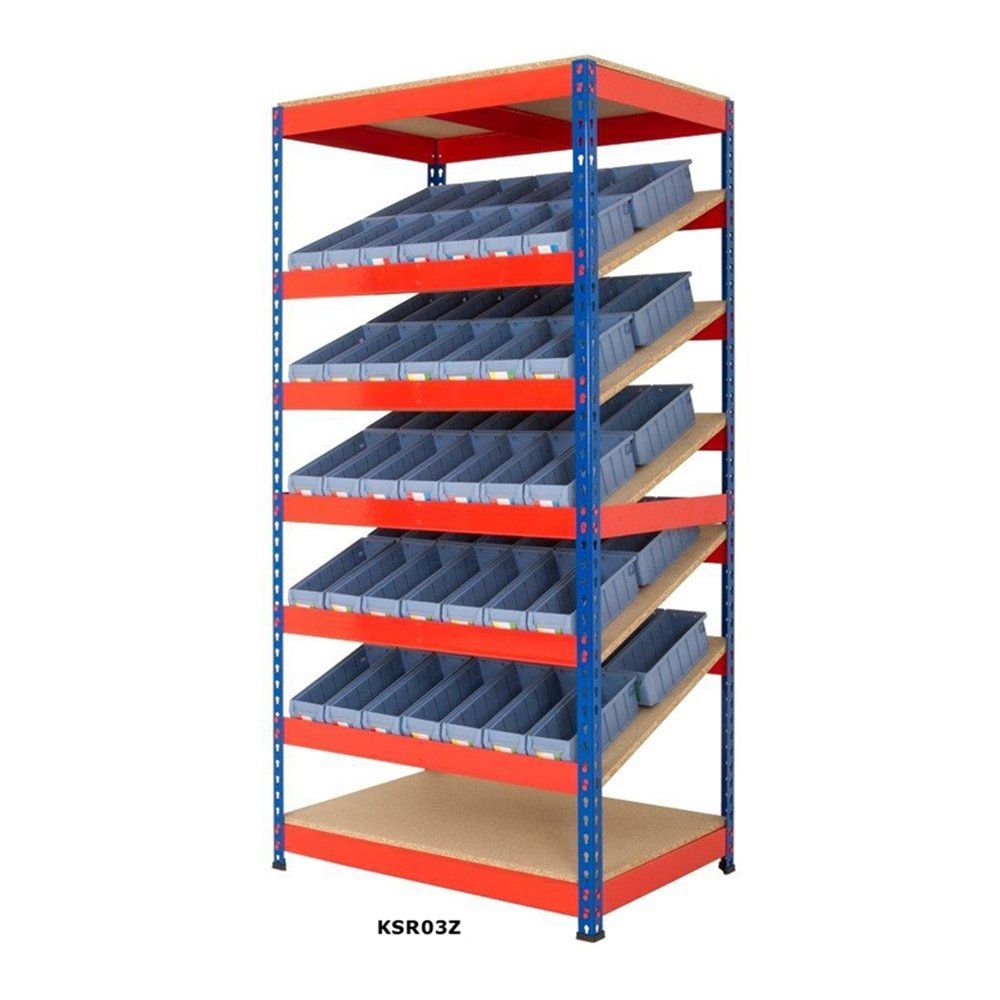
In its most common form, kanban shelving uses two-bin or multi-lane gravity-fed rack systems. Items sit in sloped lanes so that when the front-most item is taken, the next slides forward automatically under gravity. Distinct zones — often colour-coded or physically separated — indicate "in use" stock and "reserve" stock. The moment the reserve bin becomes active, a replenishment signal (a card, a barcode scan, or a digital trigger) is generated, and the resupply process begins. By the time that reserve bin is empty, new stock has arrived and restocked the back of the lane. The system is self-regulating.
This approach sits at the heart of lean manufacturing philosophy. It replaces complex, expensive materials requirements planning (MRP) systems with a decentralised, floor-level mechanism that production workers, stores staff, and procurement teams can all understand immediately, just by looking at it. That visual clarity is not an accidental feature — it is the entire point.
Kanban shelving is distinct from ordinary bin storage or standard shelving in that it is engineered for a specific purpose: controlling inventory flow, not merely holding items. The physical design of the shelf — its angles, its lane dividers, its bin sizing, its signalling mechanisms — are all optimised for this purpose. Buying a kanban system is not simply buying a rack; it is buying a methodology made physical.
2. A Brief History: From Toyota to the Factory Floor
The kanban concept was developed at Toyota in the late 1940s and 1950s, primarily by industrial engineer Taiichi Ohno, as part of what would eventually become the Toyota Production System (TPS). Ohno was searching for a way to synchronise production across a complex, multi-stage manufacturing process without creating excessive inventory at any single point. He drew inspiration from an unlikely source: American supermarkets.
In a supermarket, shelves are restocked based on what customers actually take — not based on complex forecasts of what customers might want. Items are replaced only when they have been consumed. Ohno saw that this pull-based replenishment model was far superior to the push-based approach common in manufacturing, where large quantities of parts were produced in advance and warehoused on the assumption they would eventually be needed. That push approach created overproduction waste, storage cost, defect risk, and cash tied up in idle inventory.
Toyota's kanban system used physical cards (kanban cards) to authorise production or movement of specific quantities of parts. When a downstream process consumed a container of parts, they sent the kanban card upstream as permission to produce or supply more. This simple card-based signal system dramatically reduced work-in-progress (WIP) inventory and made the entire production flow visible and controllable.
Over the following decades, kanban principles spread from Toyota to manufacturers worldwide, and then into service industries, software development (where digital kanban boards became ubiquitous), healthcare, retail, and beyond. The physical infrastructure — the shelving, bins, gravity tracks, and signal systems — evolved alongside the philosophy, becoming increasingly sophisticated and adaptable.
Today, kanban shelving systems are found in automotive assembly plants, pharmaceutical warehouses, NHS hospital stores, aerospace component rooms, food production facilities, and small engineering workshops alike. The scale changes; the principle does not.
3. How a Kanban Shelving System Works
Understanding how kanban shelving works mechanically is essential before investing in or designing a system. The core mechanism is straightforward, though different configurations achieve it in different ways.
The Two-Bin Model
The most fundamental kanban shelving configuration is the two-bin system. Each storage location holds exactly two bins (or containers) of a given part or consumable. The bins are usually positioned on a sloped gravity track so that the front bin is accessible to operators and the rear bin sits behind it in reserve.
Operators draw from the front bin. When the front bin is empty, they move it to one side (often placing it in a collection area or inverting it on the shelf to signal emptiness), and the rear bin slides or is moved to the front, becoming the active supply. The empty front bin is the replenishment signal. It goes to the stores team or procurement, triggering a resupply. By the time the second bin is depleted, the new stock has arrived and refills the rear position.
This cycle is continuous and self-sustaining. There is no need for stock-takes to trigger orders, no reliance on someone noticing a low-stock situation, and no complex forecasting required at the point of use. The system maintains stock levels automatically as long as it is designed correctly and maintained properly.
The Three-Bin Model
Where lead times are longer, or where consumption is rapid, a three-bin model provides a larger buffer. The principle is identical: one bin in use at the point of consumption, one in the stores area being picked and prepared, and one on order from the supplier. Each empty bin triggers the next stage of replenishment. The number of bins in the chain is determined by lead time and usage rate — two of the most important variables in kanban system design.
Gravity-Fed Lanes
Many commercial kanban shelving systems use gravity-fed lanes with roller tracks or smooth inclined surfaces to ensure that stock always presents itself at the front of the shelf. This delivers FIFO (first-in, first-out) stock rotation automatically — critical in environments with perishables, date-coded items, or components with shelf lives. When a unit is taken from the front, all remaining units advance forward. New stock is loaded at the rear, flowing to the front over time. There is never a situation where old stock hides behind new stock.
Visual Signals and Replenishment Triggers
The signal that triggers replenishment can take several forms depending on the organisation's systems and preferences. Traditional kanban cards are physical cards containing part numbers, quantities, supplier details, and bin information. When an empty bin is returned to stores, the card travels with it, authorising the resupply. More modern systems use barcodes or QR codes on bins that are scanned when emptied, generating a digital purchase order or stores pick automatically. Some advanced systems use weight sensors or RFID tags to detect stock depletion and trigger orders without any manual scanning. The physical shelving system is compatible with all of these approaches.
4. Types of Kanban Shelving
Kanban shelving is not a single product but a category encompassing several distinct physical formats, each suited to different applications, item sizes, and operating environments.
Gravity-Fed Carton Flow Racking
The most widely used format for medium to large items. Shelves are fitted with roller tracks or wheel lanes set at a slight downward incline (typically 3–5°) from back to front. Cartons, totes, or individual items placed at the rear roll smoothly to the front for pick. Ideal for production line supermarkets, assembly areas, and warehouse pick faces.
Bin-on-Shelf Kanban Systems
Smaller components — fasteners, electronic components, medical consumables, cleaning supplies — are stored in standardised plastic bins arranged in kanban lanes on shelving. The bins are colour-coded, numbered, and sized to specific part quantities. This is the most common format in precision manufacturing, electronics assembly, and healthcare settings.
Wall-Mounted Kanban Panels
Where floor space is at a premium, wall-mounted systems with shallow tilted bins or pockets allow kanban management of small parts, stationery, personal protective equipment, and similar items directly at the workstation. These systems are popular in 5S-organised lean workshops.
Modular Kanban Carts
Mobile kanban carts allow the supermarket concept to move to where it is needed. A cart holding a defined quantity of components is wheeled to the production cell; when empty, it triggers replenishment and is replaced by a full cart. This format is common in automotive assembly where different products share a line and component needs change frequently.
Locker-Style Kanban Dispensing Units
For high-value or controlled items — tools, personal protective equipment, or regulated consumables — enclosed kanban dispensing units provide controlled access alongside the visual replenishment signal. The unit logs who took what, maintaining traceability while still operating on the kanban pull principle.
| Type | Best For | Typical Setting |
|---|---|---|
| Gravity-Fed Carton Flow | Medium to large items, cartons, totes | Warehouse pick face, production supermarket |
| Bin-on-Shelf | Small components, fasteners, medical supplies | Manufacturing, electronics, healthcare |
| Wall-Mounted Panels | Very small items, limited floor space | Lean workshops, offices, point-of-care stores |
| Modular Carts | Mixed-model production, changing line needs | Automotive assembly, flexible manufacturing |
| Dispensing Units | High-value or controlled items | Tool stores, PPE management, regulated environments |
5. The Business Benefits of Kanban Shelving
The case for kanban shelving is not philosophical — it is measurable. Organisations that implement properly designed kanban shelving systems consistently report significant, quantifiable improvements across several key performance indicators.
Reduced Inventory Carrying Costs
Perhaps the most immediate and largest financial benefit. When inventory is managed by kanban, you hold only what you need for one replenishment cycle plus a small safety buffer. You are not carrying weeks or months of safety stock "just in case." The cash that was locked up in excess inventory is freed. Storage space requirements shrink. Insurance costs on held stock fall. In many manufacturing and distribution businesses, inventory reductions of 30–60% are achievable through disciplined kanban implementation, and a significant portion of that reduction is enabled by proper kanban shelving infrastructure.
Eliminated Stockouts
Paradoxically, holding less stock while simultaneously suffering fewer stockouts is one of the counterintuitive outcomes of kanban systems. This happens because kanban creates a reliable, automated replenishment signal that fires before stock runs out rather than after. Traditional ad hoc ordering systems are reactive — someone notices the shelf is empty and raises an emergency order. Kanban is proactive — the shelf signals for a reorder while there is still a full bin in use. Stockouts fall dramatically, and with them, the costly production stoppages, emergency procurement, and expediting that stockouts cause.
Improved Quality Through FIFO
Gravity-fed kanban systems enforce FIFO automatically. Older stock is always consumed before newer stock. This matters enormously for items with shelf lives — adhesives, lubricants, food ingredients, pharmaceutical products, time-sensitive components — but also for any item where deterioration over time is possible. FIFO prevents the accumulation of obsolete or expired stock at the back of shelves, a chronic problem with conventional static shelving.
Reduced Labour in Inventory Management
The effort spent on stock counts, expediting, hunting for missing parts, emergency purchasing, and managing the paperwork of reactive procurement is enormous in most organisations. Kanban shelving replaces much of this reactive activity with a reliable, low-effort routine. Stores staff replenish from defined signals; procurement responds to predictable, regular triggers rather than emergencies. The total labour time devoted to inventory management typically falls, while reliability improves.
Better Use of Floor Space
Because kanban defines maximum stock levels as well as minimum, shelving can be sized precisely to the quantity that is actually needed. There is no need for the generous over-sizing that characterises conventional shelving designed to hold a vague "plenty." Combined with the elimination of excess stock, kanban shelving typically allows a given inventory to be managed in significantly less floor area than a conventional shelving approach.
Enhanced Visibility and Control
A kanban shelving system is a real-time, physical dashboard of inventory status. Any manager, production supervisor, or visitor can walk the floor and immediately see which items are in good supply (both bins full), which are being consumed (front bin depleted), and which have triggered replenishment (front bin empty, signal sent). There is no need to query a database or generate a report. The shelves tell the story themselves. This visibility is invaluable for rapid decision-making and for identifying systemic problems before they cause disruption.
Supports 5S and Lean Culture
Kanban shelving is inherently compatible with 5S workplace organisation (Sort, Set in Order, Shine, Standardise, Sustain). The defined locations, labelled bins, standardised quantities, and visual signals of a kanban system embody 5S principles. Implementing kanban shelving often catalyses broader lean adoption by demonstrating concretely that visual management works.
Ready to Reduce Waste and Improve Stock Reliability?
Explore Hall Fast's professional-grade kanban shelving solutions, designed for demanding industrial and commercial environments.
6. Industries That Benefit Most from Kanban Shelving
While kanban principles apply universally, certain industries have seen the most dramatic transformations from kanban shelving implementation. Understanding the use cases in your sector can help you visualise how the system will work in your specific context.
Automotive Manufacturing
The automotive industry is where kanban was born, and it remains the sector where the methodology is most deeply embedded. Assembly lines use kanban shelving supermarkets to supply each workstation with precisely the right components, in the right quantities, at the right time. Every bolt, clip, seal, and sensor has a defined bin, a defined quantity, and a defined signal. The result is that assemblers never leave their stations to fetch parts, and the line never stops for want of a common component.
Electronics and PCB Assembly
Electronics manufacturing demands precision not just in assembly but in component management. Components are often tiny, expensive, and sensitive to handling and moisture. Kanban shelving — typically using small, anti-static bins in gravity-fed lanes — ensures that the right components are always available at pick-and-place stations and manual assembly benches, without the risk of wrong-version components being accidentally substituted.
Aerospace and Defence
In aerospace, traceability and configuration control are as important as availability. Kanban shelving in aerospace stores rooms ensures that serialised or batch-traced components flow in strict FIFO order, that reorder triggers are documented, and that inventory levels are controlled within the tight parameters demanded by airworthiness regulations.
Healthcare and Pharmaceuticals
Hospital stores, pharmacy dispensaries, operating theatre supply rooms, and clinical consumable stores have adopted kanban shelving extensively. The combination of FIFO stock rotation (critical for date-coded medical supplies), visual restocking signals, and defined par levels makes kanban ideal for healthcare environments where stockouts have direct patient safety implications. Pharmaceutical warehouses use kanban to manage active pharmaceutical ingredient (API) inventory between production runs.
Food Production and Processing
Packaging materials, ingredients, cleaning chemicals, and disposable items used in food production all need reliable replenishment and FIFO rotation. Kanban shelving in food facilities is typically constructed from stainless steel or food-safe polymer materials to meet hygiene standards, but the operational principle is identical.
Maintenance, Repair and Operations (MRO)
MRO inventory — the spare parts, consumables, tools, and supplies that keep production equipment running — is notoriously difficult to manage. Items are needed infrequently but unpredictably, and when they are needed urgently, a stockout can halt an entire production line. Kanban shelving for MRO stores ensures that critical spares and consumables are always at a defined minimum level, with automatic replenishment before the minimum is breached.
Retail and Distribution
Retail back-of-house operations and distribution centre pick faces use kanban shelving to maintain pick-face availability without overstocking. The gravity-fed lanes that present the next product automatically as the previous is picked improve both pick speed and pick accuracy while ensuring FIFO rotation of date-sensitive stock.
7. Designing Your Kanban Shelving System
A kanban shelving system must be designed — it cannot simply be purchased off the shelf (literally or figuratively) and expected to perform. The design process involves several key calculations and decisions, all of which flow from understanding your actual inventory data and operational requirements.
Step 1: Define the Items to Be Managed
Not every item in your inventory needs to be on a kanban system. Start by identifying items that are consumed regularly and predictably — ideally items with consistent demand, defined reorder quantities, and reliable suppliers. Items with highly erratic demand, very long and unpredictable lead times, or that are managed as project-specific stock may be better handled through other methods. The classic Pareto analysis (ABC analysis) helps: A-category items — high-value, frequently consumed — are typically the best candidates for kanban shelving.
Step 2: Determine Consumption Rate
For each item, calculate the average daily or weekly consumption rate based on historical data. This is the demand side of your kanban calculation. Where possible, identify the maximum daily consumption rate as well — the peak usage that will occur when production is running at full capacity. Your system must be able to sustain supply even at peak demand.
Step 3: Determine Lead Time
Lead time is the total time from when the replenishment signal is generated to when new stock is in position on the shelf, ready to use. This includes: time for the signal to be processed (same day? one day?), supplier lead time, delivery time, goods-in processing, and put-away. Every day in this chain needs to be covered by the stock in the "reserve" bin or bins. If your lead time is three days and daily consumption is 50 units, your reserve bin must hold at least 150 units to bridge the gap.
Step 4: Calculate Bin Quantities
Using the formula: Bin quantity = (Average daily demand × Lead time in days) + Safety stock, you can determine how many units each bin should hold. Safety stock is a buffer to account for demand variability and lead time variability — typically 10–25% of the base quantity. Many designers also add a rounding factor to align with supplier pack sizes (it is pointless to set a bin quantity of 37 if the supplier sells in packs of 50).
Step 5: Size the Physical Bins and Shelving
Once you know quantities, you can determine bin volumes (accounting for item dimensions and any packing), and from those, the physical dimensions of the shelving lanes required. Pay attention to:
- Lane depth (must accommodate at least two bins end-to-end with room for the replenishment mechanic to load from the rear)
- Shelf height (must accommodate the items being stored with clearance for ergonomic access)
- Aisle width (must permit safe and efficient access for both operators picking from the front and stores staff loading from the rear)
- Weight loading (the combined weight of full bins in all lanes must not exceed the shelf's rated capacity)
Step 6: Establish the Signal System
Decide how empty bins will trigger replenishment. Options include physical kanban cards that travel with the empty bin to a collection point or directly to procurement, barcode scanning at the point of emptying, QR code scanning, weight sensors, or integration with a computerised maintenance management system (CMMS) or enterprise resource planning (ERP) system. Choose the signal method that matches your organisation's existing systems and the capability of your stores and procurement teams.
Step 7: Plan the Physical Layout
Position kanban shelving as close as possible to the point of use — the workstation, production cell, or pick face where items are consumed. The further stock is from where it is used, the more transport waste is introduced. In lean terms, point-of-use storage (POUS) is ideal. Where a central store is necessary for security or space reasons, design a "supermarket" area that feeds sub-stores or line-side kanbans in a predictable, scheduled way.
8. Implementing Kanban Shelving: Step by Step
Design is necessary but not sufficient. Implementation requires change management as much as engineering. Here is a practical implementation pathway that has been proven in organisations of all sizes.
Pilot with a Focused Area
Do not attempt to convert your entire inventory to kanban simultaneously. Choose a single production cell, a specific product family's components, or a defined category of consumables. Run the pilot for a full replenishment cycle or two (typically 4–8 weeks) before expanding. The pilot will surface design errors, sizing miscalculations, and process gaps that are far easier to correct at small scale than when rolled out system-wide.
Involve the People Who Use the System
The operators, stores staff, and team leaders who will interact with the kanban shelving every day are an invaluable source of practical knowledge — and their buy-in is essential. Involve them in the design of bin sizes, shelf heights, and signal processes. Explain the purpose of the system, not just the procedure. When people understand why a system works the way it does, they maintain it correctly and flag problems instead of working around them.
Set Up and Label Everything
Every lane, bin, and shelf position should be clearly labelled with the part number, part description, bin quantity, and the number of bins (e.g., "Bin 1 of 2"). Colour coding by category, supplier, or signal status is highly valuable. Visual management is not an optional extra in kanban — it is the mechanism.
Train All Stakeholders
Training should cover: what kanban shelving is and why it works; the physical operation of the system (where to pick from, where empty bins go, how to read signals); the replenishment process from the stores and procurement side; and what to do when something goes wrong (wrong item in a bin, damaged bin, abnormal demand). Training does not need to be lengthy, but it needs to be thorough and consistent.
Audit and Adjust Regularly
In the first months after implementation, audit the system frequently — weekly if possible. Check that bins contain the right quantities, that signals are being processed in time, that no stockouts have occurred, and that no excessive stock is building up. Adjust bin quantities as you accumulate more accurate consumption data. After the initial settling period, monthly audits are typically sufficient for a stable system.
9. What to Look for When Buying Kanban Shelving
The market for kanban shelving ranges from basic tilted bin holders to sophisticated gravity-flow racking systems with integrated signal mechanisms. Choosing the right system for your application requires attention to several key criteria.
Build Quality and Load Rating
Industrial kanban shelving must withstand continuous loading and unloading across shifts and years. Look for heavy-gauge steel frames with welded or bolted construction rather than lightweight clip systems. Check that the rated load capacity per shelf exceeds the maximum weight you will actually store — with a margin. For bin shelving, look for bins made from high-impact polypropylene that will not crack under repeated handling.
Adjustability
Your inventory mix will change over time. Bins may be resized, items may be added or removed, quantities may need to change. Choose kanban shelving with adjustable shelf heights, repositionable lane dividers, and compatibility with a range of standard bin sizes. Inflexible systems become obsolete as your needs evolve.
Gravity Performance
For gravity-fed systems, the roller track or inclined surface must provide consistent, reliable flow without items jamming or tipping. Test the gravity performance with the actual items you intend to store — including at minimum fill levels, when a bin contains only one or two units. Poor gravity performance defeats the entire purpose of FIFO presentation.
Compatibility with Your Signal System
If you intend to use barcode or QR code scanning, bins must have surfaces suitable for label application. If you use kanban cards, consider bins with integrated card holders or pockets. Some kanban shelving systems include dedicated signal indicator flags or colour-change mechanisms built into the bin or lane design — these reduce the risk of signals being missed.
Hygiene and Environment Compatibility
Food and pharmaceutical environments require shelving and bins in materials that meet relevant hygiene standards — stainless steel, food-grade polymer, or surfaces that can be cleaned with industrial detergents without degrading. ESD-sensitive environments require anti-static bins and grounded shelving. Outdoor or high-humidity environments require galvanised or powder-coated finishes. Match the system's materials to your environmental requirements.
Supplier Support and Aftermarket Availability
Kanban systems evolve, and you will inevitably need additional bins, replacement components, or system extensions. Choose a supplier with a robust product range, good stock availability, and knowledgeable technical support. Hall Fast's industrial supply expertise makes them a reliable partner for kanban shelving needs, with access to a wide range of compatible components and storage solutions alongside their dedicated kanban shelving range.
10. Common Mistakes and How to Avoid Them
Kanban shelving implementations fail — or underperform — for predictable reasons. Understanding these pitfalls in advance dramatically increases your probability of success.
Setting Bin Quantities from Guesswork
The single most common cause of kanban failure is using arbitrary or estimated quantities rather than calculated ones. If bins are too small, you suffer frequent stockouts. If bins are too large, you are carrying excess inventory and defeating the lean purpose of the system. Use actual consumption data and real lead times, not rough estimates.
Ignoring Lead Time Variability
Kanban calculations based on average lead time are vulnerable when suppliers occasionally deliver late. Build a realistic safety factor into your bin quantities that reflects actual lead time variability, not the supplier's quoted nominal lead time. Review supplier performance data and size your buffer accordingly.
Failing to Maintain the Signal System
A kanban signal that is ignored, lost, or processed late is worse than no signal at all, because it creates a false sense of security. Establish clear accountability for signal processing. Who receives the empty bin? Who raises the purchase order? Within what timeframe? Measure and monitor signal-to-delivery lead times as a key performance indicator.
Letting the System Drift
Over time, bins get overfilled, items end up in wrong locations, labels fade, and quantities drift away from their designed values. This "kanban drift" erodes system performance slowly but surely. Regular audits and a culture of standard adherence — supported by visible management engagement — prevent drift from becoming the norm.
Trying to Kanban Everything
Not all items suit kanban. Applying the system to slow-moving, high-value, or highly variable demand items typically results in either excess inventory (if bins are sized conservatively) or frequent stockouts (if sized aggressively). Use kanban where it fits, and use other methods where it does not.
11. Kanban Shelving vs Other Storage Systems
How does kanban shelving compare with alternative storage approaches? The comparison depends on your priorities, but for high-frequency consumables in production or operational environments, kanban typically outperforms the alternatives on reliability and total cost.
| System | Key Advantage | Key Limitation | Best Suited For |
|---|---|---|---|
| Kanban Shelving | Self-regulating, visual, low labour, FIFO | Requires upfront design and discipline | Regular-use consumables and components |
| Static Shelving | Simple, flexible, low cost | No built-in replenishment signal or FIFO | Low-turnover items, general storage |
| Vending Machines | High control, traceability, 24/7 access | High cost, limited item types, maintenance required | High-value tools and PPE |
| MRP / Push Systems | Powerful for complex, long-horizon planning | Complex, data-intensive, prone to error | Complex manufacturing with long lead times |
| Consignment Stock | No upfront purchase; pay-as-you-use | Less control, supplier access required | High-value items with supplier partnership |
It is worth noting that kanban shelving and other systems are not mutually exclusive. Many organisations use kanban shelving for high-frequency consumables, vending machines for high-value controlled items, and conventional shelving for slow-moving spares — a tiered approach that optimises each category independently.
12. Integrating Digital Kanban with Physical Shelving
Physical kanban shelving and digital kanban tools are not competing approaches — they are complementary. As organisations mature in their lean journey, they typically seek to connect the visibility of their physical shelving system with the data capabilities of their ERP, CMMS, or inventory management software.
Barcode and QR Code Integration
The simplest integration point: each bin carries a barcode or QR code encoding the part number, bin number, and required quantity. When an empty bin is removed, a stores worker scans the code using a handheld scanner or a smartphone. The scan triggers an automatic purchase order or a stores pick request in the connected system. This eliminates manual data entry, speeds up the replenishment trigger, and creates a digital audit trail of every kanban cycle.
IoT Sensors and Weight-Based Triggers
More sophisticated integrations use load cells (weight sensors) mounted under kanban bins to detect when stock falls below a threshold weight, automatically generating a digital signal without any human action required. This is particularly valuable in environments where bins are refilled frequently in small increments rather than completely emptied before replacement — common with bulk fasteners, cleaning supplies, or feeding components. RFID tags on bins can similarly provide automatic location and inventory tracking.
Electronic Kanban Boards and Dashboards
Many organisations complement their physical kanban shelving with electronic signal management — a screen in the stores area showing which signals have been received, their priority, their status (ordered, in transit, received), and any overdue items. This digital overlay on the physical system provides management visibility across the whole inventory portfolio without requiring a physical walk of the shelves.
ERP Integration
Full integration with an ERP system allows kanban signals to flow directly into procurement workflows, with automatic creation and transmission of purchase orders to suppliers, two- or three-way invoice matching against the kanban-triggered orders, and inventory valuation updates when bins are replenished. This level of integration eliminates most of the administrative overhead of procurement for kanban-managed items and allows finance teams to see accurate real-time inventory values.
13. Maintaining Your Kanban Shelving System
Kanban shelving, like any physical infrastructure, requires maintenance to perform reliably over its operational life. Maintenance falls into two categories: physical maintenance of the hardware, and system maintenance of the parameters and processes.
Physical Maintenance
Gravity-fed roller tracks should be inspected regularly for damaged rollers, debris accumulation, or deformation that affects flow. Bins should be inspected for cracks, label legibility, and hygiene compliance. Frame integrity should be checked annually, particularly if the shelving is subject to impact from forklifts, pallet trucks, or other mobile equipment. Shelf height adjustments, lane divider repositioning, and bin replacement should be performed promptly when required — deferred maintenance compounds.
System Maintenance: Quantity Reviews
Bin quantities calculated at system setup will drift out of alignment with reality as demand patterns change, supplier lead times evolve, or supply chain conditions shift. Conduct a formal quantity review at least annually — more frequently for fast-moving items or volatile categories. Compare actual consumption data to designed bin quantities and adjust accordingly. A bin that was sized correctly a year ago may be half the size needed today, or twice the size needed.
Supplier Performance Monitoring
Your kanban system is only as reliable as your suppliers. Monitor on-time delivery performance for kanban-triggered orders. If a supplier consistently delivers late, your lead time assumption is wrong, and your bin quantities are insufficient. Either negotiate improved delivery performance, increase bin quantities to reflect actual lead times, or find alternative suppliers. Kanban makes supplier reliability problems highly visible — use that visibility as leverage for supplier improvement conversations.
Annual System Audits
Once a year, conduct a comprehensive kanban system audit. Review every item on the system: is it still the right item? Is the quantity still correct? Is the bin location still optimal? Have there been changes to the production process, the product mix, or the facility layout that require the system to be updated? Treat the annual audit as a strategic review of your inventory management infrastructure, not just a housekeeping exercise.
14. Frequently Asked Questions About Kanban Shelving
Ordinary shelving is a passive storage medium — it holds items but has no mechanism to signal when replenishment is needed or to enforce stock rotation. Kanban shelving is an active inventory management system: it is designed with defined bin quantities, visual signals, FIFO stock flow, and replenishment triggers built into the physical design. The shelving itself manages the inventory process.
The standard formula is: Bin quantity = (Average daily consumption × Replenishment lead time in days) + Safety stock. Safety stock is typically 10–25% of the base quantity, sized to cover normal variability in demand and lead time. You should also round to the nearest supplier pack size to minimise part-pack purchasing. Always base your calculation on actual historical consumption data, not estimates.
Kanban works best for items consumed in regular, predictable patterns. Very low-volume or highly erratic items are poor candidates — the system either carries too much safety stock to cover unpredictability, or suffers frequent stockouts. Items that are project-specific or consumed seasonally are usually better managed through a materials requirements planning approach rather than kanban.
Not necessarily. The physical kanban shelving system can operate with paper kanban cards and manual ordering processes — no IT integration is required. However, integration with your ERP or procurement system through barcode scanning, QR codes, or IoT sensors significantly reduces administrative effort and improves data accuracy. Many organisations start with physical cards and add digital integration as they scale and as confidence in the system grows.
A kanban supermarket is a dedicated storage area — usually near the point of use — where production components or consumables are held in kanban-managed lanes, available for production cells to pull from as needed. The term deliberately echoes the retail supermarket model that inspired Taiichi Ohno. The supermarket is restocked from central stores or directly from suppliers based on kanban signals, ensuring that the production-side supermarket is always replenished before its stock is exhausted.
A focused pilot covering a single production cell or product category can be implemented in four to eight weeks from design to full operation. A site-wide implementation covering multiple areas typically takes three to six months, including design, procurement of shelving hardware, installation, training, and initial auditing. The timeline depends heavily on the complexity of the inventory, the availability of consumption data, and the organisation's readiness for change.
Hall Fast Industrial Supplies offers a range of kanban shelving solutions suitable for manufacturing, warehousing, healthcare, and commercial environments. You can explore their full range at www.hall-fast.com/kanban-shelving1, or contact their team directly on 01623 645645 or at sales@hall-fast.com for advice on the right system for your application.
ROI varies significantly by application, but most organisations recover the cost of kanban shelving hardware within six to eighteen months through a combination of inventory reduction (freeing cash), reduced emergency purchasing costs, lower labour time in inventory management, and elimination of production downtime caused by stockouts. The ongoing annual benefit — sustained inventory reduction and operational efficiency — continues indefinitely after the initial investment is recovered.
Absolutely. Kanban principles scale from a single workshop with a few dozen part numbers to a global manufacturing enterprise with hundreds of thousands of SKUs. For small businesses, the two-bin system implemented with basic gravity-fed bin shelving is an extremely cost-effective way to eliminate stockouts and reduce the management time spent on inventory. The principle is the same regardless of scale; only the number of lanes and bins differs.
15. Conclusion: Making the Investment in Kanban Shelving
Kanban shelving is not a complex or expensive solution. What it is, is a disciplined one. It requires upfront investment in design — understanding your consumption rates, lead times, and bin quantities — and ongoing commitment to maintaining the system and its standards. In return, it delivers a permanent, self-managing inventory system that eliminates stockouts, reduces excess inventory, ensures FIFO stock rotation, and creates visible, floor-level control of your supply chain.
For any organisation that relies on physical consumables, components, or supplies to operate — manufacturers, distributors, healthcare providers, food producers, MRO teams — kanban shelving represents one of the highest-return investments available in operational infrastructure. The lean manufacturing community has understood this for seven decades. Organisations that have not yet adopted the approach are, in effect, paying a daily cost in excess inventory, reactive purchasing, and the disruption of stockouts.
The question is not whether kanban shelving can improve your operation — for most businesses, it clearly can. The question is where to start. The answer, almost always, is to start small, start with good data, and start with a supplier you can trust to provide quality hardware and ongoing support.
Start Your Kanban Journey with Hall Fast
Hall Fast Industrial Supplies has been helping UK businesses optimise their storage and handling operations for decades. Explore their dedicated kanban shelving range and take the first step towards lean, reliable inventory management.
For further information or to discuss your specific kanban shelving requirements, contact Hall Fast Industrial Supplies at 01623 645645 or email sales@hall-fast.com. Hall Fast, part of a long-established UK industrial supply group, also offers a comprehensive range of complementary storage, shelving, and handling equipment through www.hall-fast.com.