The Complete Buyer's Guide to All-Terrain Electric Pallet Trucks
Published by Hall-Fast Industrial Supplies | HFLIFT581
Meta Description: Everything you need to know about electric rough terrain pallet trucks — how they work, where they excel, key specifications, safety requirements, and how the Hall-Fast HFLIFT581 delivers all-terrain pallet handling for construction, agriculture, events, and outdoor logistics.
Standard electric pallet trucks are excellent tools for smooth warehouse floors and loading bays. But the moment you move outside — onto compacted rubble, agricultural hardstanding, uneven event ground, muddy construction sites, or gravel yards — a conventional pallet truck quickly becomes useless. Wheels sink. Motors strain. Loads tip. What you need instead is a machine purpose-built for the challenge: an electric rough terrain pallet truck.
This category of material handling equipment has grown rapidly as businesses recognise that a significant portion of their pallet movement happens on surfaces no standard pallet truck was designed to handle. From farm supply deliveries to festival logistics, from quarry operations to outdoor manufacturing, the electric rough terrain pallet truck bridges the gap between warehouse capability and real-world operational demands.
This guide covers everything procurement managers, site managers, logistics directors, and operations teams need to know when evaluating, specifying, and purchasing an electric rough terrain pallet truck. We will examine how these machines work, where they excel, what to look for in specifications, how to keep them safe and compliant, and why the HFLIFT581 from Hall-Fast represents an outstanding all-terrain solution for UK businesses.
To view the full product specification and purchase the Hall-Fast Electric Rough Terrain Pallet Truck, visit the Hall-Fast Electric Rough Terrain Pallet Truck HFLIFT581 product page at Hall-Fast Industrial Supplies.
What Is an Electric Rough Terrain Pallet Truck?
An electric rough terrain pallet truck is a battery-powered pedestrian or ride-on pallet handling machine specifically engineered to operate on uneven, soft, or otherwise challenging ground surfaces. Unlike standard electric pallet trucks — which feature small, hard polyurethane or nylon wheels designed for flat, sealed floors — rough terrain variants are fitted with large pneumatic tyres or heavy-duty foam-filled tyres that can navigate gravel, compacted earth, ramps, cobbles, uneven surfaces, and outdoor ground conditions.
The fundamental working principle is the same as any pallet truck: forks are inserted beneath a pallet, raised hydraulically to lift the load clear of the ground, and the machine transports the load to its destination. The critical difference lies in the drivetrain, wheel specification, ground clearance, frame construction, and power delivery — all of which are adapted to handle conditions that would stop a standard pallet truck in its tracks.
Electric rough terrain pallet trucks are distinct from rough terrain forklifts (which are larger, seated, mast-equipped machines capable of high stacking) and from manual all-terrain pallet trucks (which require significant physical effort and are limited in payload). They occupy a specific and highly practical middle ground: powered, manoeuvrable, and capable on difficult surfaces, while remaining compact enough to operate in tight spaces and be handled by a single operator.
The Key Engineering Differences
Several engineering features distinguish a genuine rough terrain electric pallet truck from a standard machine:
• Large-diameter pneumatic or foam-filled tyres — providing flotation over soft or loose surfaces, absorption of shock from uneven ground, and traction on wet or muddy terrain.
• Increased ground clearance — the forks and chassis are designed to clear obstacles and surface irregularities that would ground a standard pallet truck.
• Heavy-duty frame construction — typically welded steel, designed to withstand the increased stresses of rough terrain operation, including lateral loads from uneven surfaces.
• Uprated electric drive motor — with higher torque output to manage inclines, soft surfaces, and the increased rolling resistance of outdoor conditions.
• Sealed electrical components — IP-rated motors, controllers, and connectors that protect against moisture, dust, and mud ingress.
• Enhanced hydraulic lift system — capable of lifting loads smoothly even when the machine is not level, and maintaining lift height on varied terrain.
• Robust battery system — industrial lead-acid or lithium-ion batteries with sufficient capacity for full-shift outdoor operation, protected against environmental ingress.
Where Electric Rough Terrain Pallet Trucks Are Used
The market for electric rough terrain pallet trucks is broader than many procurement teams initially appreciate. Any operation that moves palletised loads in outdoor or semi-outdoor environments — or across surfaces other than sealed warehouse floors — is a potential application. The following sectors represent the primary markets for this equipment in the UK.
Construction and Civil Engineering
Construction sites present arguably the most demanding conditions for any material handling equipment. Surfaces change daily — from compacted hardcore to bare earth, from concrete pours to scaffolding boards, from loose aggregate to temporary access roads. Palletised deliveries of bricks, blocks, drainage components, concrete products, and bagged materials must all be moved from the point of delivery (typically the site gate or road access point) to the point of use.
A conventional pallet truck cannot cope with these conditions. An electric rough terrain pallet truck allows site teams to receive palletised deliveries directly and move them to working areas without reliance on a telehandler or forklift for short-range pallet movements. This reduces equipment costs, improves logistics flexibility, and speeds up the unloading process.
Agriculture and Rural Operations
Farms and agricultural businesses handle enormous quantities of palletised goods throughout the year — feed bags, fertiliser, seed, agrochemicals, harvested produce, and packaging materials. These loads must frequently be moved across farmyard hardstanding, gravel areas, grass, and uneven concrete. Agricultural hardstanding surfaces are rarely smooth enough for standard pallet trucks, and the distances involved often make manual handling impractical and unsafe.
An electric rough terrain pallet truck enables efficient pallet movement in agricultural settings without requiring a tractor with a loader attachment or a full-size forklift. For smaller farms and rural businesses, this means access to powered pallet handling at a significantly lower capital cost than a forklift and with considerably less operator training burden.
Events, Festivals, and Outdoor Hospitality
The events industry relies heavily on palletised logistics — staging components, audio-visual equipment, bar stock, catering supplies, generators, and temporary infrastructure all arrive on pallets and must be moved across grass fields, temporary roadways, and outdoor venues. Ground conditions at outdoor events are often soft, particularly after rain, and venue surfaces are invariably uneven.
Electric rough terrain pallet trucks are ideal for this application. They can handle the weight of heavy event equipment, navigate temporary surfacing, and operate throughout the event setup and breakdown periods without the noise, emissions, or fuel costs associated with diesel or LPG-powered alternatives. In an industry increasingly focused on environmental credentials and noise management, an electric solution is highly attractive.
Garden Centres and Horticultural Operations
Garden centres handle substantial pallet volumes across ground surfaces that vary enormously — tarmac, concrete, gravel paths, grass display areas, poly-tunnel floors, and outdoor display areas. Standard pallet trucks are adequate for the indoor trading areas but fail on outdoor surfaces. An electric rough terrain pallet truck allows garden centre staff to move pallets of compost, aggregates, heavy planters, and bagged goods efficiently across the full extent of the site.
Industrial Yards and Open Storage Operations
Many industrial and manufacturing operations have significant outdoor storage areas — steel stockholders, timber merchants, builders' merchants, recycling operations, and waste management facilities all maintain large outdoor yard areas where palletised goods must be moved. These yards are typically surfaced with compacted stone, concrete, or loose aggregate — surfaces that fall outside the capability of standard pallet trucks but are well within the capability of a robust rough terrain variant.
Ports, Docks, and Logistics Operations
Port and logistics environments present a complex mix of surfaces — quayside concrete, road-plates, timber decking, ramps, and transition surfaces between loading areas and storage. Electric rough terrain pallet trucks provide the flexibility to handle short-range pallet movements across these varied surfaces without tying up larger equipment such as counterbalance forklifts or reach trucks.
Retail Delivery and Distribution
For businesses involved in multi-drop distribution — particularly those delivering to high street retailers, pub cellars, catering establishments, or event venues — the variability of delivery site conditions is a constant challenge. An electric rough terrain pallet truck on a delivery vehicle or deployed at a distribution hub provides the capability to handle deliveries across uneven footways, car parks, and service yard surfaces that would defeat a standard pallet truck.
Industry insight: Operations that rely solely on standard electric pallet trucks often underestimate the proportion of their pallet movements that occur on non-ideal surfaces. A single site audit frequently reveals that 30-50% of pallet movements involve surface conditions unsuitable for standard equipment.
Key Specifications to Evaluate When Buying an Electric Rough Terrain Pallet Truck
Selecting the right electric rough terrain pallet truck requires careful evaluation of specifications against your specific operational requirements. The following parameters are the most critical to assess.
Load Capacity
Load capacity is typically expressed as the maximum load in kilograms that the machine can safely lift and transport. For standard rough terrain applications, capacities ranging from 1,000kg to 2,500kg cover the vast majority of industrial and commercial pallet handling requirements. The HFLIFT581 from Hall-Fast is rated for substantial payloads that accommodate most common palletised loads encountered in construction, agriculture, and outdoor logistics.
It is important to match load capacity not just to the nominal weight of the load but to its centre of gravity. A load with a high centre of gravity — tall stacked bags, for example — may be safely within the stated weight capacity but create stability challenges on uneven terrain. Always assess both weight and load geometry when specifying capacity requirements.
Tyre Type and Size
The tyre specification is perhaps the single most important differentiator between rough terrain variants and between models in the same category. The main options are:
• Pneumatic tyres — air-filled tyres provide the best shock absorption and flotation on soft or uneven surfaces. They deliver the most comfortable operation on rough ground and perform well on grass, gravel, and compacted earth. The trade-off is that they can be punctured, though puncture resistance compounds are available.
• Foam-filled tyres — the same profile as pneumatic tyres but filled with polyurethane foam rather than air. They cannot be punctured and require no pressure maintenance, making them lower-maintenance in environments where punctures are a real risk (such as construction sites with nail and screw debris). They offer slightly reduced shock absorption compared to pneumatic equivalents.
• Solid rubber tyres — typically found on machines positioned between standard warehouse trucks and true rough terrain units. Solid rubber provides durability and zero puncture risk but limited ride quality on really rough surfaces.
Tyre diameter is also important — larger diameter tyres roll over surface irregularities more easily and provide better ground clearance for the fork assembly.
Drive Motor Power and Torque
The electric drive motor is what propels the machine across difficult terrain, and its output determines the machine's ability to handle inclines, resist rolling resistance on soft surfaces, and maintain safe controlled movement under load. Rough terrain applications demand higher motor torque than equivalent warehouse applications because the rolling resistance of pneumatic tyres on soft or rough ground is significantly higher than hard polyurethane wheels on smooth concrete.
Motor power is typically expressed in watts (W) or kilowatts (kW). For rough terrain applications, look for drive motors of at least 750W — with heavier-duty units providing 1,000W or more. More important than peak power is sustained torque output, which determines the machine's real-world capability on gradients and challenging surfaces.
Maximum Gradient Capability
The maximum gradient capability — expressed as a percentage — defines the steepest incline the machine can safely ascend and descend with a rated load. For typical warehouse pallet trucks this is relatively low (often 5-8%), reflecting the generally flat nature of indoor logistics environments. A genuine rough terrain machine should be capable of at least 10-15% gradient capability to handle common outdoor ramps, yard access points, and site-specific gradients.
Gradient capability is closely related to motor torque and braking system specification. Always verify gradient capability with a load and confirm whether the stated figure applies to ascending, descending, or both.
Fork Length and Width
Fork dimensions must be compatible with the pallets and load carriers used in your operation. Standard European pallets (EUR/EPAL pallets) require a minimum fork length of 1,150mm and are compatible with standard fork widths. However, for rough terrain applications, fork design also affects ground clearance and obstacle clearance — wider forks provide better load stability on uneven surfaces, while the fork tip geometry must allow engagement with pallets on non-level ground.
Battery Specification and Charging
Battery capacity determines operational range — the number of hours the machine can operate per charge. For full-shift outdoor operations, battery capacity must be matched carefully to the intensity and duration of use. Lead-acid batteries remain common in this category due to their low cost and wide availability of charging infrastructure, while lithium-ion batteries offer faster charging, longer cycle life, and lighter weight but at higher initial cost.
Charger compatibility is important in outdoor and remote operations where on-site charging infrastructure may be limited. Some rough terrain pallet trucks include an integrated onboard charger, allowing the machine to be charged from a standard 240V socket — a significant operational advantage for sites without dedicated charging stations.
IP Rating and Environmental Protection
For outdoor operation, the electrical components — motor, controller, battery management system, connectors, and switches — must be adequately protected against moisture and dust ingress. IP ratings (Ingress Protection) define this protection level. For outdoor pallet truck operation in wet conditions, look for a minimum of IP54 (dust-protected and splash-proof) for key electrical components, with IP65 or better providing superior protection in genuinely wet or dusty conditions.
Weight and Dimensions
The machine's own weight and overall dimensions affect its practicality. Heavier machines with larger tyres provide better traction and stability but may require ramps or lifting equipment for transport between sites. Overall length and width determine the turning radius and the spaces the machine can access. For operations where the rough terrain pallet truck must also work in semi-indoor areas such as marquees, poly-tunnels, or storage buildings, dimensional limitations may be critical.
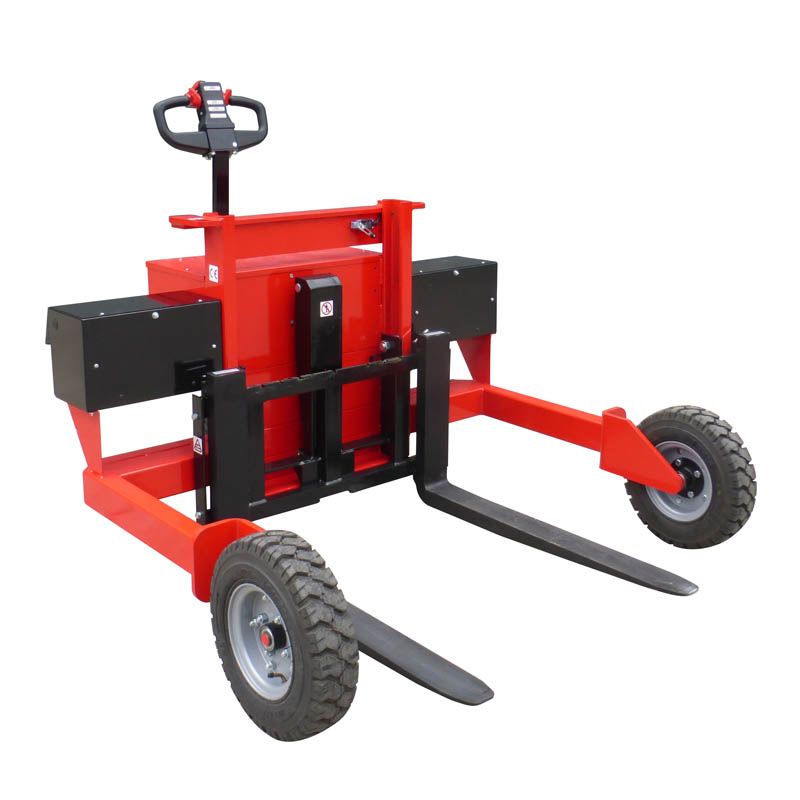
The Hall-Fast Electric Rough Terrain Pallet Truck HFLIFT581
The HFLIFT581 from Hall-Fast Industrial Supplies is a purpose-built electric rough terrain pallet truck designed to bring powered, efficient pallet handling to outdoor and semi-outdoor environments where standard equipment cannot operate effectively. It combines heavy-duty construction with practical electric operation to deliver a solution that is capable, reliable, and economical to run.
Built for Genuine Rough Terrain Operation
The HFLIFT581 is not an adapted warehouse pallet truck — it is engineered from the ground up for rough terrain duty. Large-format tyres provide the flotation and traction needed on soft, loose, and uneven surfaces. The robust welded steel chassis is designed to absorb the stresses of rough terrain operation without the flex and fatigue that would compromise a lighter-built machine. Ground clearance is engineered to match real-world outdoor conditions rather than the optimised-for-smooth-floors approach of warehouse variants.
Electric Operation: Clean, Quiet, and Cost-Effective
The HFLIFT581's electric drivetrain delivers significant operational advantages over diesel or LPG alternatives. It produces zero direct emissions at the point of use — critical for operations in food production areas, enclosed spaces, urban environments, and any site where air quality is a concern. It operates at significantly lower noise levels than combustion-engine alternatives, which matters in residential areas, event venues, and noise-sensitive environments. And it is considerably cheaper to run per hour than a diesel or LPG machine, with electricity costs a fraction of fuel costs even at current energy prices.
Maintenance costs are also reduced — electric drivetrains have fewer moving parts than combustion engines, require no engine oil changes, no fuel filter replacement, no engine servicing, and no exhaust system maintenance. The primary maintenance requirements relate to the battery, tyres, and hydraulic system — all straightforward and well-understood.
Operator Convenience and Ergonomics
A rough terrain pallet truck that is difficult or tiring to operate will not be used effectively, and operator fatigue increases accident risk. The HFLIFT581 is designed with practical operator ergonomics in mind — control inputs are intuitively positioned, the speed and lift controls are responsive and progressive, and the machine's handling on rough terrain is predictable and manageable. These characteristics make a significant difference to productivity and safety in real-world operation.
Why Source from Hall-Fast?
Hall-Fast Industrial Supplies is a well-established UK industrial supply company with a strong reputation for product quality, technical expertise, and customer support. ISO 9001 certified, Hall-Fast brings the same rigour to its material handling product range as to every other element of its catalogue. The HFLIFT581 is supported by Hall-Fast's knowledgeable team, who can provide technical guidance on specification, application, and maintenance.
To view full specifications, pricing, and availability for the HFLIFT581, visit the Hall-Fast Electric Rough Terrain Pallet Truck HFLIFT581 product page on the Hall-Fast website, or contact the Hall-Fast team at 01623 645645 or sales@hall-fast.com.
Electric vs Diesel vs Manual: Choosing the Right Rough Terrain Pallet Solution
When evaluating rough terrain pallet handling equipment, buyers often compare electric models with diesel-powered or manual alternatives. Understanding the genuine trade-offs across these three approaches is essential for making an informed decision.
Electric Rough Terrain Pallet Trucks
Electric rough terrain pallet trucks offer the best combination of performance, operating cost, and environmental credentials for the majority of applications. They provide powered lift and drive that eliminates the physical strain of manual handling, deliver zero direct emissions that makes them suitable for enclosed and sensitive environments, and operate at noise levels compatible with most working environments.
The main consideration is battery range — for multi-shift operations or sites without convenient charging infrastructure, battery planning is required. Modern lithium-ion battery technology increasingly mitigates this concern, with opportunity charging during breaks enabling continuous operation.
Diesel and LPG Rough Terrain Pallet Trucks
Diesel and LPG rough terrain pallet trucks offer unrestricted range — refuelling takes minutes rather than hours — and are appropriate for remote sites without electricity supply or for operations demanding extremely long continuous operating periods. However, they produce direct emissions that preclude indoor use, are significantly noisier, require more frequent servicing, and are considerably more expensive to operate per hour. For operations with reliable electricity supply and a working day of 8 hours or less, the electric solution will almost invariably prove more economical and practical.
Manual Rough Terrain Pallet Trucks
Manual rough terrain pallet trucks — essentially heavy-duty pallet jacks with large pneumatic tyres — are a low-cost entry point for rough terrain pallet handling. They are appropriate for occasional use with lighter loads on relatively manageable surfaces. However, they impose significant physical demands on operators, create manual handling injury risks, are limited in payload by operator strength, and become impractical on significant gradients or over longer distances. For any regular or demanding rough terrain pallet movement, an electric machine provides a safer, more efficient, and ultimately more economical solution when total cost of ownership is considered.
Total cost of ownership note: The higher initial purchase price of an electric rough terrain pallet truck compared to a manual alternative is typically recovered within 12-24 months of regular use through reduced operator time, lower manual handling injury risk, and improved throughput efficiency.
Safety Requirements and Compliance for Electric Rough Terrain Pallet Trucks
Any powered material handling equipment used in UK workplaces is subject to legal requirements governing its safe use, operator competence, and maintenance. Understanding these requirements is essential for any organisation deploying an electric rough terrain pallet truck.
PUWER: Provision and Use of Work Equipment Regulations 1998
PUWER places duties on employers to ensure that work equipment — including all powered pallet trucks — is suitable for its intended use, maintained in a safe condition, inspected regularly, and used only by people who have received adequate information, instruction, and training. For electric rough terrain pallet trucks, PUWER compliance requires a documented pre-use inspection regime, scheduled maintenance by a competent person, and records of both.
LOLER: Lifting Operations and Lifting Equipment Regulations 1998
LOLER applies to lifting equipment and accessories, which includes powered pallet trucks when they are used to lift loads. LOLER requires that lifting equipment is sufficiently strong and stable for its intended use, that lifting operations are properly planned, that equipment is subject to regular thorough examination by a competent person, and that examination reports are maintained. For most pallet trucks, LOLER examinations are required at least every 12 months (or six-monthly if the equipment is used to carry people, which does not apply to standard pallet truck operation).
Operator Training and Competence
No employer should allow an employee to operate a powered pallet truck — including an electric rough terrain variant — without appropriate training. The HSE is clear that operator training for powered pallet trucks must cover the safe operation of the specific machine type, load handling, pre-use inspection, battery charging and maintenance, and emergency procedures. Training should be provided by a competent instructor and records of training maintained.
For rough terrain operation, training should additionally cover the specific hazards of outdoor and uneven surface use — managing gradients, avoiding instability on soft ground, recognising ground conditions that exceed the machine's capability, and procedures for getting a machine unstuck or supported on soft ground.
Pre-Use Checks
Before every operating shift, operators should conduct a formal pre-use inspection covering:
• Tyre condition and pressure (for pneumatic-tyred machines) — check for damage, embedded objects, and correct inflation.
• Battery charge level — confirm sufficient charge for the intended work period.
• Fork condition — check for cracks, bends, or damage that could affect load security.
• Hydraulic system — check for leaks and confirm lift and lowering function.
• Controls — confirm all drive, lift, and emergency stop functions operate correctly.
• Lights and warning devices — check that any fitted lights, horns, or warning devices are operational.
• General condition — check for damage, loose components, or anything that might affect safe operation.
Safe Operating Practices for Rough Terrain
Operating an electric pallet truck on rough terrain introduces hazards not present in standard warehouse operation. The following safe operating practices are fundamental:
• Always assess the ground conditions before committing to a route — look for soft areas, hidden dips, drainage channels, or obstacles that could cause instability.
• Travel at reduced speeds on rough terrain — the faster the speed, the greater the risk from surface irregularities.
• Carry loads as low as possible — travel with the load just clear of the ground rather than elevated, to maintain the lowest possible centre of gravity.
• Approach gradients squarely — never cross a gradient at an angle, which creates lateral tipping risk.
• Descend gradients with the load leading — maintain load control on descent by positioning the machine with the forks pointing downhill.
• Be aware of the machine's turning characteristics on rough terrain — turning radius and stability characteristics differ from smooth surface operation.
• Never exceed the rated load capacity — on rough terrain, a marginal overload that might be manageable on a flat floor becomes a serious tipping risk.
Battery Care and Charging for Outdoor Electric Pallet Trucks
The battery system is the heart of an electric rough terrain pallet truck and represents a significant proportion of the machine's total value. Correct battery care and charging practice is essential both for operational reliability and for achieving the maximum serviceable life of the battery.
Lead-Acid Battery Care
Traditional flooded lead-acid (FLA) batteries are the most common battery type in industrial pallet truck applications. They are robust, well-understood, and supported by widely available charging equipment. Key care requirements include: charging after every shift to prevent deep discharge; maintaining correct electrolyte levels by topping up with distilled water (not tap water) at regular intervals; keeping battery terminals clean and free of corrosion; and storing fully charged if the machine is to be idle for extended periods.
For outdoor use, it is important to protect lead-acid batteries from extreme cold — battery capacity reduces significantly at low temperatures, and a battery that provides a full shift of operation in summer may struggle to complete half a shift in winter. In cold environments, store charged batteries in an insulated or heated location where possible.
Lithium-Ion Battery Advantages
Lithium-ion (Li-ion) battery packs are increasingly available as an alternative to lead-acid in industrial pallet truck applications, including rough terrain variants. Li-ion offers genuine operational advantages: faster charging (typically 1-2 hours for a full charge versus 6-8 hours for lead-acid); higher energy density (more usable capacity in a lighter, smaller package); longer cycle life (2,000-3,000 cycles versus 300-800 for lead-acid); and no maintenance requirements (no electrolyte topping, no equalisation charging). For operations that run multiple shifts or where charging time is a constraint, Li-ion is increasingly the preferred choice.
Charging Infrastructure for Outdoor Operations
Outdoor and site-based operations present specific challenges for battery charging. For construction sites or rural operations without permanent electrical infrastructure, charging options include temporary power supplies from site generators, mobile charging units, or solar-assisted charging systems. Planning the charging infrastructure is an important part of deploying an electric rough terrain pallet truck in off-grid or semi-off-grid environments.
Maintenance and Servicing Requirements
A properly maintained electric rough terrain pallet truck will provide many years of reliable service. Understanding the maintenance requirements allows operators and fleet managers to plan servicing correctly and avoid the operational disruptions caused by unplanned breakdowns.
Routine Maintenance Tasks
The following maintenance tasks should be performed at the intervals specified in the manufacturer's documentation:
• Tyre inspection and pressure checking (for pneumatic tyres) — weekly or as required by operating conditions. Construction site debris, agricultural materials, and outdoor debris all create puncture and sidewall damage risks.
• Fork inspection — monthly check for visible cracks, deformation, or wear. Forks should be replaced if any structural compromise is identified.
• Hydraulic oil level and condition — check monthly, change as per manufacturer's schedule or if contaminated.
• Battery electrolyte level (lead-acid) — check and top up weekly during regular operation.
• Electrical connection inspection — check terminals and connectors for corrosion, particularly important in outdoor environments where moisture and temperature cycling accelerate corrosion.
• Drive wheel and castor wheel inspection — check for wear, damage, and bearing condition.
• Control system function check — verify all controls operate correctly and emergency stop functions correctly.
Scheduled Service Intervals
In addition to routine maintenance, electric rough terrain pallet trucks should be subject to a formal service by a competent technician. Service intervals vary by manufacturer and usage intensity — typically every 250-500 operating hours or annually, whichever occurs first. Heavy outdoor use — particularly in muddy, wet, or dusty conditions — may justify more frequent servicing intervals.
LOLER Thorough Examination
As noted in the safety section, LOLER requires that lifting equipment (including pallet trucks) undergoes thorough examination at statutory intervals. This examination must be carried out by a person with appropriate expertise and competence — typically an engineer from a specialist inspection organisation or an accredited lifting equipment inspection scheme. The examination report must be retained and any defects or required remediation noted must be acted upon.
Electric Rough Terrain Pallet Trucks vs Telehandlers and Forklifts
When organisations first consider rough terrain pallet handling, they often ask why they should not simply use a telehandler or a rough terrain forklift instead. This is a reasonable question, and the answer lies in understanding the different capabilities and economics of each machine type.
Telehandlers
Telehandlers (telescopic handlers) are versatile machines capable of lifting pallets to significant heights, handling loads at extended reach, and crossing very rough terrain including gradients that would challenge any pallet truck. They are genuinely capable in demanding environments. However, they are also much larger, considerably more expensive to purchase and operate, require licensed and trained operators, are not suitable for enclosed or tight spaces, and represent major capital equipment investments. For short-range pallet movements on moderately rough terrain, deploying a telehandler is using a sledgehammer to crack a nut — economically inefficient and operationally inflexible.
Rough Terrain Forklifts
Rough terrain forklifts offer high lift heights, significant payload capacity, and excellent ground clearance. For operations that need to lift pallets to height — loading lorries, stacking in outdoor storage areas, or working in elevated racking — a rough terrain forklift is the right tool. But for ground-level pallet transport across a site — moving pallets from a delivery vehicle to a storage area, for example — a rough terrain forklift is again significantly over-specified, expensive, and difficult to manoeuvre in tight spaces.
The Case for the Electric Rough Terrain Pallet Truck
The electric rough terrain pallet truck occupies a distinct and valuable operational niche. It provides powered pallet handling — eliminating manual handling risks and increasing throughput — on surfaces that defeat standard equipment, at a cost that is a fraction of a forklift or telehandler, with dimensions that allow operation in tight spaces and enclosed areas, and with zero direct emissions that permit use across a wide range of environments. For any operation where pallets need to be moved rather than stacked to height, the electric rough terrain pallet truck is typically the most economical and practical solution.
Total Cost of Ownership: Making the Financial Case
When evaluating the purchase of an electric rough terrain pallet truck, it is important to look beyond the purchase price and consider the total cost of ownership (TCO) over the machine's operational life. This fuller picture frequently makes the case for investment more compelling than a simple purchase price comparison might suggest.
Capital Cost
The purchase price of an electric rough terrain pallet truck is higher than a standard electric pallet truck and higher than a manual rough terrain equivalent, but significantly lower than a rough terrain forklift or telehandler. For UK businesses, the HFLIFT581 from Hall-Fast represents a competitively priced entry into powered all-terrain pallet handling.
Operating Cost
Electric running costs are a significant advantage over diesel or LPG alternatives. The energy cost per operating hour for an electric pallet truck is typically 70-85% lower than the fuel cost for an equivalent diesel machine at current UK energy and diesel prices. Over a five-year ownership period, these operating cost savings frequently exceed the initial purchase price differential.
Maintenance Cost
Electric drivetrains have lower maintenance costs than combustion engines — no engine servicing, no oil changes, no fuel system maintenance. Tyres represent the most significant maintenance cost item for rough terrain variants, and the tyre life is affected by operating surface and the care taken during operation.
Productivity Value
Perhaps the most significant financial factor is the productivity improvement enabled by powered rough terrain pallet handling compared to manual alternatives. A single operator with an electric rough terrain pallet truck can move significantly more pallet-loads per hour than with a manual equivalent, particularly on gradients or over longer distances. The time freed up represents direct labour cost saving or redeployment to higher-value activities.
Manual Handling Injury Risk Reduction
Manual handling injuries are among the most common and costly workplace injuries in the UK, and pallet handling is a significant contributor. The HSE reports that manual handling accounts for approximately one third of all workplace injuries. The financial cost of a single serious manual handling injury — through sick pay, lost productivity, potential legal costs, and regulatory consequence — can exceed the purchase price of a powered pallet truck many times over. The risk reduction delivered by transitioning from manual to powered pallet handling is a significant and often underweighted element of the investment case.
Selecting the Right Electric Rough Terrain Pallet Truck: A Decision Framework
Having worked through the technical, safety, and financial considerations, the following decision framework helps organisations select the right electric rough terrain pallet truck for their specific application.
Step 1: Define Your Surface Conditions
Conduct a site survey of all surfaces the machine will be required to operate on. Classify them by type (concrete, gravel, compacted earth, grass, tarmac), condition (sound, uneven, soft, wet), and gradient. This survey will determine the minimum tyre specification, ground clearance requirement, and gradient capability needed.
Step 2: Define Your Load Profile
Establish the range of loads the machine will handle — minimum and maximum weights, pallet formats used, and load height. This defines the minimum payload capacity and fork specification. Consider whether loads have unusual centres of gravity (tall, dense, or off-centre loads) that may require higher capacity than the nominal weight alone would suggest.
Step 3: Define Your Operating Pattern
How many operating hours per day? How many days per week? Is the operation single-shift or multi-shift? This defines the battery capacity requirement and charging regime needed. For multi-shift operations, consider whether a second battery pack or fast-charge capability is required.
Step 4: Define Your Operating Environment
Will the machine operate in wet conditions? In dusty environments? At low temperatures? In food-production adjacent areas? These factors influence IP rating requirements, tyre specification (foam-filled vs pneumatic in hazardous debris environments), battery type, and any food-safe lubrication requirements.
Step 5: Define Your Space Constraints
What is the minimum aisle or access width the machine must navigate? Are there height restrictions — doorways, sheeting, or structures it must pass under? These constraints define maximum machine dimensions. For operations where the rough terrain machine must occasionally work in semi-indoor environments, this dimension constraint may be significant.
Step 6: Contact Hall-Fast
With your operational requirements defined, contact Hall-Fast to discuss the HFLIFT581 and confirm it meets your specification. The Hall-Fast team can provide detailed technical information, assist with application-specific queries, and arrange supply. Visit the Hall-Fast Electric Rough Terrain Pallet Truck HFLIFT581 page for full product details, or call Hall-Fast on 01623 645645 to speak with an industrial equipment specialist.
FAQs: Electric Rough Terrain Pallet Trucks
Can an electric rough terrain pallet truck be used indoors?
Yes — in most cases, an electric rough terrain pallet truck can be used indoors as well as outdoors. The key considerations are ceiling height clearance (the larger tyre diameter increases overall machine height slightly), aisle width (larger tyres increase the machine's overall width), and floor type (large pneumatic tyres can leave marks on polished or sensitive floors). For operations that require the machine to work across both indoor and outdoor environments, this versatility is a significant advantage over fixed-environment alternatives.
What is the battery life of an electric rough terrain pallet truck?
Battery life depends on the battery capacity, the intensity of use (number of lifts, distances travelled, gradients encountered), and environmental conditions (cold weather reduces battery capacity). A correctly specified battery for the application should provide at least a full eight-hour shift between charges under typical operating conditions. Battery service life — the number of charge-discharge cycles before capacity falls below a useful threshold — typically ranges from 300-800 cycles for lead-acid and 1,500-3,000 cycles for lithium-ion.
How do I charge an electric rough terrain pallet truck on a remote site?
For sites with a mains electricity supply, charging from a standard 240V socket is typically straightforward, particularly if the machine includes an integrated onboard charger. For truly remote sites without mains power, options include site generator-based charging (provided the generator output is stable enough for battery charging), mobile battery charging units, and — increasingly — solar charging systems. Plan charging infrastructure before deployment and factor charging requirements into site electrical planning.
What maintenance does an electric rough terrain pallet truck require?
Key maintenance requirements include regular tyre inspection and pressure checks (pneumatic tyres), battery electrolyte maintenance (lead-acid batteries), hydraulic fluid level and condition monitoring, fork inspection, electrical connection corrosion checks, and scheduled servicing by a competent technician. LOLER thorough examination is required at statutory intervals. Full maintenance schedules are provided in the machine's documentation.
Is operator training required for electric rough terrain pallet trucks?
Yes — PUWER requires that all operators of powered work equipment receive appropriate training before use. Training should cover the safe operation of the specific machine, load handling, pre-use checks, battery charging, and emergency procedures, with additional content covering the specific hazards of rough terrain operation. Training records should be maintained and refresher training considered periodically.
How does the HFLIFT581 compare to other rough terrain pallet trucks?
The HFLIFT581 from Hall-Fast is engineered for genuine rough terrain duty with a robust construction, appropriate tyre specification, and a reliable electric drivetrain. It offers the backing of Hall-Fast's established supply and technical support capability. For a full comparison against specific alternatives or for a detailed specification review for your application, contact the Hall-Fast team directly.
Conclusion: Powering Pallet Handling Beyond the Warehouse
The electric rough terrain pallet truck represents one of the most practical and cost-effective investments an organisation can make when its pallet handling needs extend beyond the smooth floors of a standard warehouse environment. It eliminates the manual handling risks of traditional approaches, delivers powered efficiency that transforms operational throughput, and does so at a running cost that makes the financial case compelling.
Whether you are moving building materials on a construction site, delivering agricultural supplies across a farmyard, managing logistics at an outdoor event, or keeping a busy industrial yard running efficiently, an electric rough terrain pallet truck provides the capability you need in a package that is manageable, economical, and compliant with all relevant UK safety legislation.
The HFLIFT581 from Hall-Fast Industrial Supplies brings all of these qualities together in a proven, well-supported package, backed by a trusted UK industrial supplier with decades of experience helping businesses find the right equipment for demanding applications.
Explore the full specification and place your order at the Hall-Fast Electric Rough Terrain Pallet Truck HFLIFT581 product page on the Hall-Fast website. For expert guidance, technical support, or to discuss your specific requirements, call Hall-Fast on 01623 645645 or email sales@hall-fast.com.
—
About Hall-Fast Industrial Supplies: Hall-Fast is a leading UK industrial supplies company offering a comprehensive range of material handling, fasteners, PPE, workwear, and industrial equipment. ISO 9001 certified and dedicated to expert customer service. | Tel: 01623 645645 | Email: sales@hall-fast.com |
Product page: https://www.hall-fast.com/electric-rough-terrain-pallet-truck-hflift581