


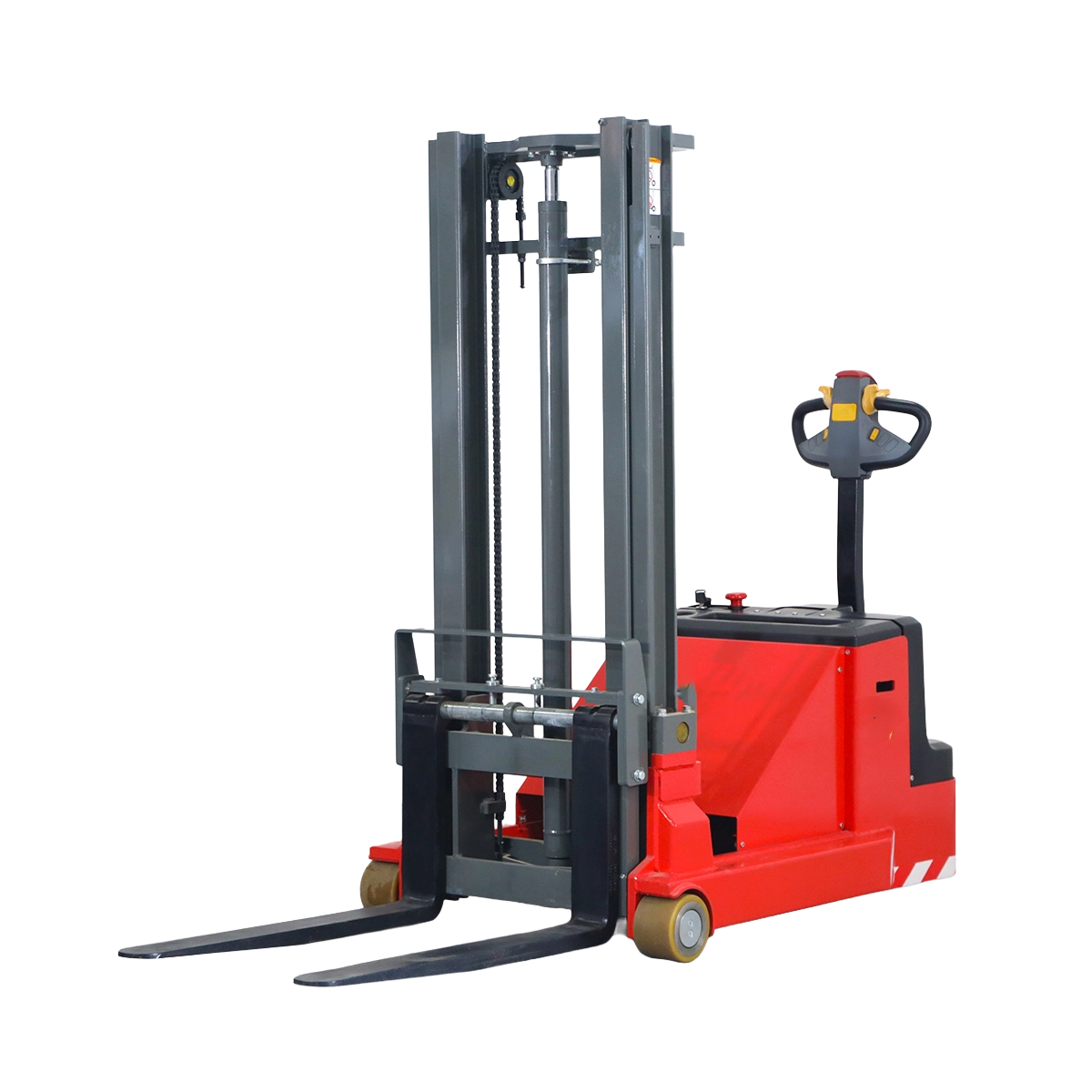
If you manage a warehouse, stockroom, workshop, or retail operation and you need a practical way to lift and stack palletised loads without the expense and complexity of a full forklift truck, a 900kg pedestrian counterbalance stacker could be exactly the right piece of equipment. This guide explains everything you need to know before buying: what a pedestrian counterbalance stacker is, how it works, what sets the counterbalance design apart from conventional straddle stackers, what a 900kg capacity means in practical terms, and how to decide whether this type of machine is the right fit for your operation.
Whether you are replacing manual handling methods, upgrading from a basic stacker, or looking for a cost-effective alternative to a sit-on forklift, the information in this guide will help you make a confident, informed decision.
What Is a Pedestrian Counterbalance Stacker?
A pedestrian counterbalance stacker is a battery-powered, walk-behind lifting machine that uses an integrated counterweight to balance loads carried on its forks. The operator walks behind the unit, controlling travel, steering, and mast lift via a tiller handle. Unlike a sit-on forklift, there is no cab, no seat, and no overhead guard – the machine is compact enough to operate in confined spaces where a larger vehicle would be impractical.
The term “counterbalance” refers to the way the stacker maintains stability. A heavy counterweight is built into the rear of the chassis, offsetting the weight of the load on the forks at the front. This is the same fundamental principle used in full-size counterbalance forklift trucks. The key benefit is that the forks and the area directly in front of them remain completely clear – there are no straddle legs, outrigger arms, or base plates extending forward beneath the load.
This seemingly simple design difference has major practical consequences for the types of loads the stacker can handle, the environments it can work in, and the flexibility it offers to operators. We will explore these advantages in detail throughout this guide.
Key Characteristics of a Pedestrian Counterbalance Stacker
• Walk-behind operation: The operator stands behind the stacker and walks alongside it, controlling all functions through the tiller handle. There is no riding platform or seat.
• Electric battery power: The stacker runs on a rechargeable battery, producing zero direct emissions and minimal noise. This makes it suitable for indoor use in environments where air quality matters.
• Counterbalanced stability: An internal counterweight balances the load, eliminating the need for straddle legs or outrigger supports that extend beneath or around the pallet.
• Powered mast lift: A hydraulic mast raises and lowers the forks under power, reducing operator effort compared to manually pumped alternatives.
• Compact footprint: Without a cab, seat, or straddle legs, the overall dimensions remain small enough to navigate tight aisles, narrow doorways, and confined storage areas.
How Does a Counterbalance Stacker Work?
To understand why the counterbalance design matters, it helps to know how the physics of load handling work on this type of machine.
Every stacker or forklift has to deal with the same basic challenge: when you place a heavy load on the forks at the front of the machine, it creates a tipping moment that tries to pitch the vehicle forward. The further the load’s centre of gravity sits from the front axle, and the heavier the load, the greater this tipping force becomes. Without something to counteract it, the machine would simply topple forward under load.
The Counterweight Principle
A counterbalance stacker solves this problem by placing a substantial weight at the rear of the chassis, behind the drive wheels or rear axle. This counterweight creates an opposing moment that keeps the machine stable when carrying a load. The design calculates the balance point so that the stacker remains upright and planted throughout the full range of lifting and lowering operations, provided the load does not exceed the machine’s rated capacity.
The counterweight is typically a dense metal block integrated into the body of the stacker. It adds to the overall weight of the machine, which is why counterbalance stackers are heavier than equivalent-capacity straddle stackers. However, this additional weight is precisely the mechanism that allows the stacker to work without legs – it is a deliberate engineering trade-off, not a disadvantage.
Load Centre and Rated Capacity
The rated capacity of any stacker or forklift is measured at a specific load centre distance – the horizontal distance from the face of the forks to the centre of gravity of the load. For most pedestrian stackers, this is 500mm (sometimes written as 500C). This means a 900kg pedestrian counterbalance stacker can safely lift and carry a load weighing up to 900kg, provided the load’s centre of gravity is no more than 500mm from the fork face.
If a load’s centre of gravity is further forward than 500mm – for example, if you are carrying a particularly deep pallet or an unevenly distributed load – the effective safe capacity is reduced. This is a universal principle that applies to all forklifts and stackers, not just counterbalance models. Operators should always check that the load weight and distribution fall within the machine’s rated parameters before lifting.
Mast and Lift Mechanism
The mast is the vertical structure at the front of the stacker that raises and lowers the forks. On a powered stacker, this is driven by a hydraulic cylinder and pump, supplied by the onboard battery. The operator controls the lift function through buttons or a lever on the tiller handle, and the forks travel smoothly up and down the mast rails.
Mast types vary. A simplex mast has a single lifting stage, while a duplex or triplex mast uses two or three telescoping stages to achieve greater lift heights without increasing the overall collapsed height of the machine. The collapsed height matters because it determines whether the stacker can pass through low doorways, enter shipping containers, or operate under mezzanine floors.
For a 900kg pedestrian counterbalance stacker, typical lift heights range from around 2,500mm to 3,500mm depending on the specific model and mast configuration. This is sufficient for stacking pallets two or three high in standard racking or ground-level storage.
Counterbalance Stacker vs Straddle Stacker: What Is the Difference?
This is one of the most important distinctions in the pedestrian stacker market, and understanding it is essential to choosing the right machine for your operation.
How a Straddle Stacker Works
A straddle stacker – sometimes called a straddle-leg stacker or walkie stacker – uses two wide legs that extend forward from the base of the machine, straddling the pallet on both sides. These legs sit flat on the floor and pass underneath the pallet, providing the stability needed to lift and carry loads. The pallet sits between (or on top of) these legs.
Straddle stackers are the most common type of pedestrian stacker in the UK market. They are generally lighter, less expensive, and simpler than counterbalance models. For many applications, they work perfectly well.
The Limitations of Straddle Legs
However, the straddle leg design comes with inherent restrictions that can be significant depending on your workload and pallet types.
• Closed-bottom pallets: Straddle legs need to slide underneath the pallet. If the pallet has a solid, closed bottom – as many plastic pallets, metal stillages, and some euro pallets do – the legs cannot get beneath it, and the stacker cannot pick it up.
• Pallets on the ground: If a pallet is sitting flush on the floor with no clearance beneath it, straddle legs may not be able to engage. The pallet needs sufficient underside clearance for the legs to enter.
• Approach direction: Straddle legs limit which sides of the pallet the stacker can approach from. If a pallet is positioned against a wall or inside a narrow bay, the legs may not have room to straddle it.
• Racking approach: The legs can prevent the stacker from getting close enough to racking uprights or walls, limiting how tightly you can pack your storage layout.
• Stillages and containers: Metal stillages, plastic bins, and containers with solid or irregular bases are often impossible to handle with a straddle stacker.
How the Counterbalance Design Solves These Problems
A counterbalance stacker eliminates every one of these restrictions. Because there are no legs extending forward, the forks can approach and engage any pallet type from any direction. Closed-bottom pallets, euro pallets turned on the short side, metal stillages, plastic containers, and loads sitting flush on the floor are all accessible. The operator simply drives the forks under or into the load and lifts – with no concern about whether the legs will fit.
This makes the counterbalance stacker significantly more versatile in mixed-use environments where operators handle a variety of pallet types and container formats throughout the day. It also makes the stacker more manoeuvrable in tight spaces, because the turning radius is not increased by wide straddle legs.
Side-by-Side Comparison
|
Feature |
Counterbalance Stacker |
Straddle Stacker |
|
Straddle legs |
None – forks only |
Two wide legs extend forward |
|
Closed-bottom pallets |
Yes – handles all pallet types |
No – cannot engage closed bases |
|
Stillages / containers |
Yes |
Limited or impossible |
|
Approach direction |
Any side |
Restricted by leg width |
|
Racking proximity |
Can drive up close |
Legs may obstruct uprights |
|
Overall weight |
Heavier (counterweight) |
Lighter |
|
Typical cost |
Higher |
Lower |
|
Best suited for |
Mixed pallets, confined spaces |
Open-bottom pallets, budget use |
For operations that exclusively use standard open-bottom timber pallets and have no need to handle stillages or containers, a straddle stacker may be the more economical choice. For operations with mixed pallet types, closed-bottom containers, or tight access requirements, the counterbalance stacker is the more capable and flexible machine.
Why 900kg? Understanding the Capacity
Load capacity is one of the first specifications buyers look at, and 900kg sits at a specific point in the market that deserves explanation.
What 900kg Means in Practice
A 900kg rated capacity means the stacker can safely lift, carry, and stack loads weighing up to 900 kilograms (0.9 tonnes) when the load’s centre of gravity is at or within the standard 500mm load centre. To put this in practical terms, here are some typical load weights you might encounter in a warehouse or stockroom environment:
• Standard pallet of boxed retail goods: typically 400–700kg depending on product density and pallet dimensions.
• Pallet of bottled beverages: typically 600–900kg for a full pallet of water, soft drinks, or beer.
• Wrapped pallet of printed materials: typically 500–800kg depending on paper weight and stack height.
• Small engineering components on a stillage: typically 200–600kg depending on material and volume.
• Drum of liquid (200-litre): typically 150–250kg per drum, so three or four drums on a pallet.
• Standard euro pallet of mixed goods: typically 300–800kg in most distribution environments.
As these examples show, a 900kg capacity comfortably covers the vast majority of standard palletised loads found in general warehousing, retail, light manufacturing, and distribution. It is not designed for heavy industrial work – loads like full pallets of steel, concrete products, or industrial machinery often exceed one tonne – but for typical mixed-goods handling, 900kg provides a practical working envelope.
Rated Capacity vs Working Capacity
It is important to understand that the 900kg figure is the machine’s maximum rated capacity, not a target weight for every lift. In practice, most loads handled by the stacker will be well below 900kg. Operating consistently near the maximum rated capacity puts greater stress on the machine’s components and battery, and it reduces the margin of safety. Good practice is to select a stacker with a rated capacity that comfortably exceeds your heaviest typical load, rather than one that matches it exactly.
If your operation regularly handles loads in the 800–900kg range, you may want to consider the 1000kg model instead, which provides a useful additional margin. If your loads rarely exceed 600–700kg, the 900kg stacker is well suited and cost-effective.
When 900kg Is Not Enough
If you regularly need to handle loads above 900kg, a pedestrian counterbalance stacker at this capacity is not the right choice. Options for heavier loads include the 1000kg pedestrian counterbalance stacker (a modest step up), a powered stacker with a higher rating, or a sit-on electric forklift truck – such as the 1000kg or 1500kg electric forklifts in the Hall-Fast range – which offer significantly greater capacity and lift height.
Key Features of the 900kg Pedestrian Counterbalance Stacker
Beyond the headline capacity and counterbalance design, there are several features that make this stacker a practical choice for daily use.
Electric Battery Power
The stacker is powered by a rechargeable battery, which drives both the traction motor (for travel) and the hydraulic pump (for lifting). Electric power delivers several advantages over manual or internal combustion alternatives. There are no exhaust emissions, which means the stacker can operate indoors without ventilation concerns. Noise levels are significantly lower than diesel or LPG equipment, reducing operator fatigue and making the stacker suitable for noise-sensitive environments such as offices adjacent to stockrooms, retail trading floors, or healthcare facilities.
Battery charging is straightforward: connect the stacker to a standard charging unit overnight or during breaks, and it is ready for the next shift. Running costs are a fraction of what you would pay for fuel on an internal combustion machine, and there are no oil changes, exhaust filters, or fuel system maintenance to worry about.
Ergonomic Tiller Handle
The tiller handle is the operator’s primary interface with the stacker. A well-designed tiller provides comfortable grip positions, intuitive controls for travel speed and direction, and easy-reach buttons or levers for mast lift and lowering. The tiller also acts as a safety mechanism: it is hinged so that if it is pushed fully upright or pressed flat against the stacker, the machine stops – preventing the operator from being trapped between the stacker and an obstacle.
Ergonomic design matters because operators use the tiller for every movement throughout the working day. Poorly positioned controls, stiff mechanisms, or uncomfortable grips lead to fatigue, slower operation, and potentially unsafe handling. The 900kg pedestrian counterbalance stacker is designed for daily shift use, with controls that remain comfortable over extended periods.
Compact Dimensions
Without straddle legs, a cab, or a seat, the overall footprint of this stacker is remarkably small. It can pass through standard single doorways, fit inside goods lifts, navigate narrow stockroom aisles, and turn in confined spaces that would be impossible for a sit-on forklift. For businesses operating in older buildings, converted retail spaces, or purpose-built facilities with limited floor area, the compact dimensions are not just convenient – they can be the deciding factor in whether powered stacking is feasible at all.
Powered Lift and Lowering
Both the lift and lowering functions are powered, giving the operator smooth, controlled movement of the forks at all heights. This is a significant improvement over manual hydraulic stackers, where the operator has to repeatedly pump a handle to raise the forks – a process that becomes physically demanding when stacking at height or handling heavy loads repeatedly throughout a shift.
Powered lift also improves safety, because the operator can maintain full control of the tiller and the stacker’s position while simultaneously raising or lowering the load. There is no need to take a hand off the controls to pump a manual handle.
Low Maintenance Requirements
Compared to a forklift truck, a pedestrian stacker has far fewer components that require regular servicing. There is no internal combustion engine, no gearbox, no exhaust system, no cooling system, and no fuel delivery mechanism. The primary maintenance items are battery care (topping up cells if applicable, keeping connections clean), hydraulic fluid checks, chain or cylinder inspections, and wheel or castor replacement as they wear. A simple planned maintenance schedule – typically a thorough inspection every six to twelve months depending on usage intensity – keeps the stacker in safe, reliable working order.
Applications: Where a 900kg Pedestrian Counterbalance Stacker Excels
The versatility of this stacker makes it suitable for a wide range of industries and working environments. Below are some of the most common applications, along with the specific advantages the counterbalance design brings to each.
Warehousing and Storage
The most obvious application is general warehousing: receiving goods, putting pallets into storage locations, picking orders, and loading vehicles for dispatch. The 900kg capacity handles standard pallets of mixed goods, and the counterbalance design allows operators to work with whatever pallet format arrives on incoming deliveries – whether that is a standard timber pallet, a plastic pallet, a euro pallet, or a metal stillage. In smaller warehouses where aisle widths are limited, the compact footprint is a major advantage.
Retail Stockrooms and Back-of-Store
Retail operations often have small, cramped stockrooms accessed through standard doors or goods lifts. A pedestrian stacker fits these environments perfectly, and the counterbalance design allows it to handle the varied container types common in retail – including roll cages, plastic totes, and supplier-specific pallet formats that straddle stackers cannot engage with. Quiet electric operation means the stacker can be used during trading hours without disturbing customers.
Light Manufacturing and Workshops
Manufacturing environments use stackers to move raw materials, work-in-progress components, and finished goods between workstations, storage areas, and loading bays. The 900kg capacity covers most light manufacturing loads, and the zero-emission electric drive makes the stacker suitable for enclosed workshops where air quality is a concern. The ability to handle stillages and custom containers is particularly valuable in manufacturing, where non-standard load carriers are common.
Food and Beverage
Hygiene-sensitive food storage and processing environments require equipment that produces no exhaust emissions and can be cleaned easily. Electric pedestrian stackers meet these requirements. In cold store and chilled warehouse environments, the compact dimensions allow the stacker to operate in narrow cold store aisles, and the quick-cycle operation minimises the time the cold store door needs to be open.
Pharmaceutical and Healthcare
Pharmaceutical warehouses and hospital stores handle sensitive, high-value products in controlled environments. Zero emissions, low noise, and precise handling are all important. The counterbalance design also proves useful in pharmaceutical settings because it allows the stacker to handle the proprietary pallet and container formats often used for pharmaceutical distribution, which may not be compatible with straddle-leg stackers.
Print, Packaging, and Paper Handling
Print and packaging operations handle heavy paper reels, carton stacks, and banded pallet loads that can be awkward for straddle stackers due to their weight distribution and base profile. A counterbalance stacker can approach these loads cleanly, with no legs to obstruct, and the 900kg capacity covers most standard reel and carton pallet weights.
Trade Counters and Builders’ Merchants
Trade counter environments need quick, responsive pallet handling to serve walk-in customers. The stacker’s pedestrian operation means any trained member of staff can use it without needing a full forklift licence, and the counterbalance design handles the varied pallet types and stillages common in building supplies – including heavy bags, timber packs, and metal fixings on closed-bottom stillages.
Benefits of Electric Power: Why Battery-Powered Matters
The shift toward electric-powered handling equipment is well established in the UK, driven by a combination of regulatory pressure, environmental targets, cost savings, and practical workplace advantages. Here is why battery power matters for a pedestrian counterbalance stacker.
Zero Direct Emissions
An electric stacker produces no exhaust gases at the point of use. This is not just an environmental benefit – it is a practical workplace health requirement. UK Health and Safety Executive guidance is clear that internal combustion engines should not be used in enclosed or poorly ventilated spaces without adequate exhaust extraction, due to the risks of carbon monoxide, nitrogen oxides, and diesel particulate exposure. An electric stacker eliminates this concern entirely, allowing unrestricted indoor use.
Low Noise
Electric motors and hydraulic systems are significantly quieter than internal combustion engines. A typical electric pedestrian stacker operates at around 65–70 dB, compared to 85–95 dB for a diesel forklift. Lower noise means less hearing protection is needed, conversations can take place at normal volume, and the stacker can be used near customer-facing areas, offices, or healthcare environments without causing disturbance.
Reduced Running Costs
Electricity is substantially cheaper than diesel or LPG per unit of energy delivered. A pedestrian stacker battery might cost a few pence to charge from empty to full, compared to several pounds per shift for a diesel or gas-powered machine. Over a year of regular use, the energy cost savings alone can be significant. When you add the elimination of engine oil changes, fuel filters, exhaust maintenance, and emission testing, the total cost of ownership for an electric stacker is considerably lower than an internal combustion equivalent.
Simpler Maintenance
An electric motor has far fewer moving parts than a combustion engine. There are no spark plugs, no injectors, no turbochargers, no exhaust systems, no fuel pumps, and no cooling radiators to service. The primary maintenance items – battery condition, hydraulic fluid, chains, and tyres – are straightforward and inexpensive. This translates to less downtime and lower annual servicing costs.
Regulatory Compliance
UK workplace regulations increasingly favour low-emission equipment. The Clean Air Strategy, workplace air quality standards, and employer duty-of-care obligations all push toward electric alternatives for indoor handling equipment. Investing in electric stackers now positions your business ahead of tightening regulations and demonstrates a commitment to employee health and environmental responsibility.
Choosing the Right Machine: 900kg Stacker, 1000kg Stacker, or Electric Forklift?
One of the most common questions buyers face is which type and capacity of machine to choose. Here is a framework for making that decision.
When a 900kg Pedestrian Counterbalance Stacker Is the Right Choice
• Your typical loads weigh 300–750kg, with occasional loads up to 850–900kg.
• You need to handle a mix of pallet types including closed-bottom pallets, stillages, and containers.
• Your working environment is compact: narrow aisles, standard doorways, goods lifts, or limited turning space.
• You do not need to stack higher than approximately 3,000–3,500mm.
• Your throughput is light to moderate – not high-volume, continuous-cycle operation.
• You want to replace manual handling or a basic manual stacker with something safer and more productive.
• Budget is a consideration: you need powered stacking capability without the cost of a forklift.
When to Step Up to a 1000kg Counterbalance Stacker
• Your loads regularly reach or exceed 850kg, and you want a comfortable safety margin.
• You handle variable-weight stock where some pallets may approach the one-tonne mark.
• You want the same counterbalanced, walk-behind format but with additional capacity headroom.
The 1000kg model shares the same design principles as the 900kg – counterbalanced chassis, pedestrian operation, electric power – but with a higher rated capacity. It is a modest step up in specification and cost, and Hall-Fast stocks both models for direct comparison.
When You Need an Electric Forklift Instead
• Your loads regularly exceed one tonne.
• You need to stack above 3,500mm, particularly onto high racking systems.
• You require fast travel speeds for long-distance movement across large warehouse floors.
• Your operation involves continuous, high-cycle handling throughout the shift.
• You need the operator to ride on the machine for efficiency.
Electric forklifts – such as the 1000kg, 1500kg, and 1500kg triplex mast models in the Hall-Fast range – offer higher capacities, greater lift heights, faster travel, and operator ride-on convenience. They cost more to buy and operate, require more training, and take up more space, but for high-volume or heavy-duty applications, they are the appropriate tool.
Decision Summary Table
|
Criterion |
900kg Ped. C/B Stacker |
1000kg Ped. C/B Stacker |
Electric Forklift |
|
Typical load weight |
Up to 900kg |
Up to 1,000kg |
Up to 1,500kg+ |
|
Lift height |
Up to ~3,500mm |
Up to ~3,500mm |
Up to 4,500mm+ |
|
Operator position |
Walk-behind |
Walk-behind |
February 13, 2026
|
View: 187
Hire Building Equipment in West Burton
June 17, 2026
Hire Building Equipment in Ravenshead
June 17, 2026
Hire Building Equipment in the East Midlands
June 17, 2026
Hire Building Equipment in Nottinghamshire
June 17, 2026
Hire Building Equipment in Nottingham
June 17, 2026

WELDING FUME EXTRACTION - HSE Bulletin No. STSU1-2019
February 14, 2019
Best Karcher Model for Driveway Cleaning
March 6, 2025
|

