Your Definitive UK Buyer’s Guide to the Maximum-Capacity Walk-Behind Counterbalanced Stacker – Two-Tonne Forklift Performance in a Pedestrian Format
Introduction: Two-Tonne Capability Without the Forklift
The 2000kg pedestrian counterbalance stacker represents the absolute pinnacle of walk-behind stacking technology. At two tonnes of rated capacity, it matches the lifting power of a full-sized counterbalance forklift truck while retaining the compact dimensions, zero-emission electric operation, walk-behind simplicity, and dramatically lower operating costs that define the pedestrian stacker category. For UK businesses that need to handle the heaviest standard palletised loads but want to avoid the size, expense, complexity, and regulatory burden of a forklift fleet, the 2000kg pedestrian counterbalance stacker is the definitive answer.
Two tonnes is a critical threshold in material handling. It covers the full weight range of standard palletised goods in virtually every UK industry: fully loaded pallets of beverages, building materials, automotive components, industrial consumables, paper stock, agricultural supplies, and heavy retail merchandise all fall within or below this capacity. By specifying a 2000kg pedestrian counterbalance stacker, operators and procurement managers eliminate the need to weigh and calculate every load before lifting—the machine handles everything within the standard pallet weight range with a comfortable margin of safety.
This comprehensive guide examines the 2000kg pedestrian counterbalance stacker from every angle. From the engineering principles that enable two-tonne capacity in a walk-behind format, through detailed technical specifications, mast options, electronic power steering, side-shift and tilt functionality, UK regulatory requirements, industry applications, maintenance strategies, and total cost of ownership, this article provides the complete information you need to make a confident purchasing decision. Whether you are replacing a forklift, upgrading from a lighter stacker, or equipping a new operation for the first time, this guide will demonstrate why the 2000kg pedestrian counterbalance stacker is the most powerful and practical walk-behind material handling investment available.
What Is a 2000kg Pedestrian Counterbalance Stacker?
Operating Principle and Legless Design
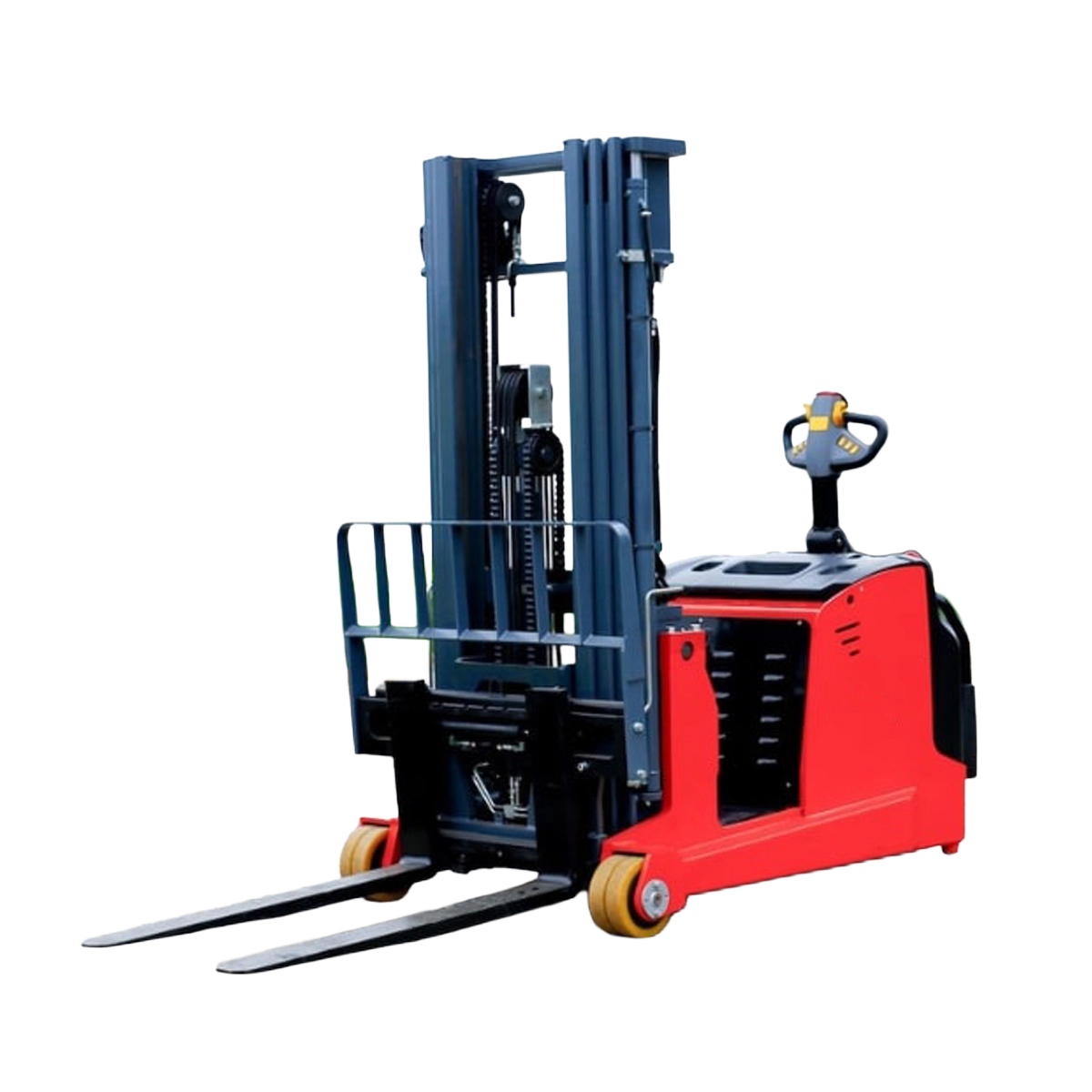
A 2000kg pedestrian counterbalance stacker is a battery-powered, walk-behind lifting machine designed to raise, lower, transport, and stack loads weighing up to 2,000 kilograms. The operator walks behind or alongside the machine, controlling movement and hydraulic functions through an ergonomic tiller arm equipped with proportional speed control, lift and lower buttons, horn, and emergency stop. There is no cab, seat, or riding platform—the operator remains on foot at all times.
The counterbalance principle is the same engineering foundation used in full-sized counterbalance forklift trucks. A substantial integrated counterweight at the rear of the chassis offsets the turning moment created by the load on the forks at the front. At the two-tonne capacity level, the counterweight is considerably heavier than on lighter models, resulting in a machine service weight typically between 2,200kg and 2,800kg. This additional mass provides the stability needed to handle loads at the very top of the pedestrian stacker capacity range while maintaining the safety margins required by European design standards.
The legless front profile is the defining physical characteristic of the counterbalance configuration. Without straddle legs extending forward, the 2000kg pedestrian counterbalance stacker can lift and stack every type of pallet and load carrier in circulation: open-bottomed timber pallets, closed-bottomed plastic pallets, Euro pallets, UK standard pallets, non-standard pallets, stillages, metal bins, plastic containers, crates, and custom load platforms. This universal pallet compatibility is not merely a convenience—in operations that receive goods from multiple suppliers on varied load carriers, it is a fundamental requirement that straddle stackers cannot fulfil.
The Two-Tonne Threshold: Why It Matters
Two tonnes represents the practical ceiling of the pedestrian counterbalance stacker format and the point at which the machine directly overlaps with the capacity range of small counterbalance forklift trucks. A standard 2-tonne forklift and a 2000kg pedestrian counterbalance stacker share identical rated capacity, yet the pedestrian stacker achieves this in a machine that is substantially smaller, significantly less expensive to purchase and operate, simpler to train operators on, and requires none of the infrastructure—dedicated charging bays, wider aisles, operator licensing, and extensive risk assessment documentation—that a forklift demands.
The two-tonne threshold also has practical significance in daily operations. It provides sufficient capacity to handle every standard palletised load encountered in UK warehousing, distribution, manufacturing, and retail without the operator needing to verify the weight of each load before lifting. A UK standard pallet of bottled beverages weighs approximately 1,200kg to 1,600kg. A pallet of canned goods can weigh 1,400kg to 1,800kg. A pallet of paper stock or printed materials commonly reaches 1,500kg to 1,900kg. The 2,000kg rated capacity encompasses all of these with a reassuring safety margin, eliminating the constant capacity calculations that operators of lighter 1,000kg or 1,200kg stackers must perform.
Counterbalance Versus Straddle: The Decisive Advantage
Straddle stackers use forward-projecting outrigger legs that straddle the pallet to provide stability. This design restricts the machine to open-bottomed pallets with sufficient ground clearance for the legs to pass beneath, increases the overall width and length of the machine, and creates practical problems in environments where the legs can foul on racking uprights, dock edges, floor-level fixtures, or irregular surfaces.
The 2000kg pedestrian counterbalance stacker eliminates every one of these limitations. Its legless front profile approaches pallets from the front without obstruction, handles closed-bottom pallets and non-standard containers without adaptation, and accesses loads positioned against walls, in corners, and in tight spaces where straddle legs would be unable to fit. In cluttered workshops, congested loading bays, retail stockrooms, and multi-use facilities where the variety of load carriers and the unpredictability of floor conditions make straddle operation impractical, the counterbalance configuration provides decisive operational superiority.
The counterbalance stacker’s longer rear chassis, necessitated by the heavier counterweight, results in a turning radius of approximately 1,750mm to 2,100mm at the two-tonne capacity level. While this is larger than lighter pedestrian stackers, it remains considerably tighter than a full 2-tonne counterbalance forklift and is compatible with the aisle widths found in the majority of UK warehouse and stockroom layouts.
Technical Specifications and Features
Comprehensive Specifications
|
Specification |
Typical Range |
|
Rated Load Capacity |
2,000 kg at 500 mm load centre |
|
Mast Type |
Duplex (standard) or Triplex full free lift |
|
Maximum Lift Height (Duplex) |
2,500 mm – 4,500 mm |
|
Maximum Lift Height (Triplex) |
3,700 mm – 5,500 mm |
|
Free Lift (Triplex) |
Full free lift – forks rise before mast extends |
|
Max Travel Speed |
5.0 – 6.0 km/h |
|
Max Lift Speed (Laden) |
90 – 130 mm/s |
|
Turning Radius |
1,750 mm – 2,100 mm |
|
Steering |
Electronic power steering (standard) |
|
Drive Motor |
AC motor technology |
|
Battery |
24V, 300–500 Ah (lead-acid or Li-ion) |
|
Overall Width |
950 mm – 1,100 mm |
|
Overall Length (incl. forks) |
2,600 mm – 3,000 mm |
|
Lowered Mast Height (Duplex) |
2,000 mm – 2,400 mm |
|
Service Weight (incl. battery) |
2,200 kg – 2,800 kg |
|
Fork Length |
1,000 mm – 1,150 mm |
|
Fork Width |
Adjustable to suit all standard pallets |
|
Tilt Function |
Forward and backward mast tilt (standard) |
|
Side Shift |
Hydraulic side shift (standard on many models) |
|
Safety Systems |
Emergency stop, auto deceleration, cornering speed reduction, lift height speed limiter |
Electronic Power Steering: Essential at Two Tonnes
At a service weight of 2,200kg to 2,800kg—plus a load of up to 2,000kg on the forks—the combined mass that the operator must steer through the tiller arm can approach five tonnes. Without electronic power steering, the physical effort required to manoeuvre this mass through tight turns, right-angle stacking approaches, and confined aisle navigation would be exhausting and impractical for sustained operation. Electronic power steering is therefore not an optional enhancement at the two-tonne level—it is an absolute necessity, and it comes as standard equipment on the 2000kg pedestrian counterbalance stacker.
The system uses a dedicated electric motor to amplify the operator’s steering input through the tiller arm, delivering fingertip-light control regardless of the load weight, surface condition, or manoeuvre being performed. The proportional assistance matches the operator’s input precisely, providing natural, predictable steering behaviour that enables smooth and accurate positioning even in the tightest spaces. Over a full shift, the elimination of manual steering effort preserves operator energy, maintains consistent performance accuracy, and prevents the musculoskeletal strain that would otherwise accumulate from repeatedly wrestling a heavy machine through its turning arc.
Tilt and Side Shift: Standard Forklift Functionality
The 2000kg pedestrian counterbalance stacker incorporates tilt and side-shift functions that have traditionally been the exclusive preserve of full counterbalance forklift trucks. The tilt function allows the operator to angle the mast and forks forward or backward through a controlled arc. Backward tilt cradles the load against the mast during transport, improving stability and preventing the load from sliding forward on the forks. Forward tilt assists with precise placement of loads onto racking beams, ensuring the pallet sits squarely and securely.
The hydraulic side-shift function allows the operator to move the fork carriage laterally—left or right—without repositioning the stacker itself. This capability is enormously valuable when placing pallets accurately onto racking beams, aligning loads within shipping containers, or positioning pallets in tight bays where there is insufficient room to reposition the entire machine. Side shift saves time on every stacking cycle by eliminating the need to reverse, realign, and re-approach when the initial positioning is slightly off-centre. At the two-tonne capacity level, where the loads are heavy and the consequences of inaccurate placement are significant, side shift transforms operational precision and efficiency.
Duplex and Triplex Mast Configurations
The 2000kg pedestrian counterbalance stacker offers both duplex and triplex mast configurations. The standard duplex mast provides maximum lift heights from 2,500mm to 4,500mm, covering the requirements of two to three-tier racking systems. The triplex mast with full free lift extends the reach to 3,700mm through to 5,500mm, enabling access to higher racking tiers while maintaining a collapsed mast height significantly lower than a duplex mast reaching equivalent elevation.
The full free-lift function on the triplex mast is particularly important for the 2000kg pedestrian counterbalance stacker’s role in container loading. The forks rise to their maximum free-lift height before the outer mast sections begin to extend, enabling double-stacking of pallets inside shipping containers without the mast exceeding the container’s internal ceiling height. Given that the 2,000kg capacity is ideally matched to the heaviest container loading applications, the triplex mast with full free lift is a popular configuration for import/export operations, freight forwarding depots, and distribution centres with significant container throughput.
AC Motor Technology and Regenerative Braking
The AC motor technology fitted to the 2000kg pedestrian counterbalance stacker delivers smooth, efficient, and maintenance-free performance. The brushless AC drive motor provides consistent torque across the entire speed range, ensuring the stacker maintains full performance under maximum load. The AC hydraulic pump motor delivers proportional lift and lower speeds for precise load positioning at any height. Compared to older DC motor designs, the AC system consumes less energy, generates less heat, eliminates brush maintenance entirely, and provides more responsive speed control.
Many models incorporate regenerative braking, which recovers kinetic energy during deceleration and braking and returns it to the battery. Over the course of a full shift, this energy recovery extends the effective battery life and reduces the electricity consumption per operating hour. In intensive operations with frequent stop-start cycles, regenerative braking can extend battery run time by 10 to 15 percent compared to conventional resistive braking systems.
Advanced Safety Systems
The 2000kg pedestrian counterbalance stacker incorporates comprehensive safety systems that protect the operator, the load, and the surrounding environment. Automatic mast deceleration progressively reduces lift speed as the forks approach the upper limit of mast travel, preventing sudden stops at height that could destabilise the load. Automatic truck deceleration reduces travel speed when the forks are elevated above a specified height, ensuring stability during high-level transport. Cornering speed reduction detects steering input during turns and limits travel speed to prevent the load from shifting through excessive lateral force.
An emergency stop button on the tiller arm provides immediate shutdown in any critical situation. The tiller arm itself functions as a safety device: releasing the tiller or pushing it to the fully vertical position activates the brake and stops all machine movement, preventing uncontrolled travel if the operator loses contact. A reverse safety switch or bumper at the rear of the machine detects obstructions behind the stacker and halts rearward travel, protecting the operator from being trapped between the machine and a wall, racking upright, or other fixed object. These systems work in concert to create a comprehensive safety architecture around the machine’s operation.
Key Advantages of the 2000kg Pedestrian Counterbalance Stacker
Maximum Capacity in the Pedestrian Format
At 2,000 kilograms, the pedestrian counterbalance stacker reaches the absolute ceiling of the walk-behind stacking format. No standard pedestrian stacker offers higher capacity. This means operators never encounter a standard palletised load that exceeds the machine’s capability. The complete elimination of capacity-related refusals, delays, and workarounds—which are a daily reality for operations using 1,000kg or 1,200kg stackers—improves operational fluency and removes a persistent source of frustration and inefficiency.
Direct Forklift Replacement
The 2000kg pedestrian counterbalance stacker is the only pedestrian stacker format that directly matches the rated capacity of the most popular small counterbalance forklift trucks. A 2-tonne electric counterbalance forklift and a 2000kg pedestrian counterbalance stacker share identical rated capacity, yet the pedestrian stacker costs substantially less to purchase, consumes far less energy, requires simpler and less expensive operator training, occupies less floor space, needs no dedicated charging infrastructure, and has lower maintenance requirements. For every indoor operation where the forklift’s higher travel speed and seated operator position are not essential requirements, the pedestrian stacker delivers the same handling capability at dramatically lower total cost.
Universal Pallet and Load Carrier Compatibility
The legless counterbalance design handles every pallet type, container format, and load carrier in circulation without restriction. Open-bottomed and closed-bottomed pallets, Euro and UK standard sizes, non-standard custom pallets, stillages, metal bins, plastic containers, crates, and specialist load platforms are all accessible. In mixed operations receiving goods from diverse suppliers—third-party logistics, contract warehousing, wholesale distribution, and multi-client facilities—this universal compatibility is not a marginal benefit but a fundamental operational requirement.
Complete Forklift Feature Set: Tilt, Side Shift, and Power Steering
Unlike lighter pedestrian stackers that offer basic lift-and-lower functionality, the 2000kg pedestrian counterbalance stacker comes equipped with the complete feature set traditionally associated with counterbalance forklift trucks. Electronic power steering delivers effortless manoeuvrability. Mast tilt provides load security during transport and precision during placement. Hydraulic side shift enables lateral fork adjustment without repositioning the machine. Together, these features give the operator the same handling precision available on a forklift, enabling accurate pallet placement at height, efficient container loading, and fast, damage-free stacking cycles.
Zero Emissions, Low Noise, Indoor Air Quality Compliance
The electric powertrain produces zero direct emissions during operation. In food and beverage warehousing, pharmaceutical storage, clean room environments, and temperature-controlled facilities where air quality is both a regulatory requirement and a product integrity concern, the 2000kg pedestrian counterbalance stacker operates without restriction. The absence of exhaust fumes eliminates the need for forced ventilation systems and protects the respiratory health of operators and co-workers.
Noise levels remain low even under heavy load, typically below 75 decibels, enabling operations during noise-sensitive hours and in proximity to offices, customer areas, and residential boundaries. For businesses operating in shared buildings, urban locations, or extended trading hours, the quiet electric operation avoids the noise complaints and operational restrictions that diesel or LPG-powered equipment would generate.
Dramatically Lower Total Cost of Ownership
The financial advantage of the 2000kg pedestrian counterbalance stacker over a 2-tonne forklift is substantial across every element of ownership cost. The acquisition price is significantly lower. Energy consumption is a fraction of the forklift’s requirement. Maintenance costs are reduced by the simpler construction, fewer moving parts, and AC motor technology that eliminates brush servicing. Operator training takes one to two days instead of three to five. Insurance premiums are lower. Floor space requirements are minimal. And the absence of dedicated charging bays, fuel storage, and exhaust extraction infrastructure eliminates entire categories of facility cost. Across a typical five-year ownership period, these savings compound to a total cost of ownership that is 50 to 70 percent lower than operating an equivalent forklift.
Applications and Industries
Heavy-Duty Warehousing and Distribution
The 2000kg pedestrian counterbalance stacker serves as either a primary handling machine in small to medium warehouses or a versatile supplementary workhorse in larger distribution centres. Its two-tonne capacity handles the heaviest standard palletised loads without limitation, including fully loaded pallets of beverages, canned goods, bottled products, building materials, and heavy industrial consumables. The combination of high capacity, duplex or triplex mast, tilt, and side shift enables professional, high-throughput pallet handling that rivals the performance of a forklift in a fraction of the space.
In multi-tier racking environments, the triplex mast extends the stacker’s reach to 5,500mm, covering four to five standard racking tiers. The full free-lift function ensures compatibility with restricted-headroom areas including mezzanine floors and dock canopies. For distribution operations processing high volumes of heavy pallets across multiple racking levels, the 2000kg pedestrian counterbalance stacker provides the capacity and reach to keep goods flowing without the expense and footprint of a forklift fleet.
Manufacturing and Heavy Industry
Manufacturing facilities processing heavy raw materials, metal components, automotive parts, aerospace assemblies, and industrial consumables generate some of the heaviest palletised loads in the material handling spectrum. The 2000kg pedestrian counterbalance stacker handles these loads with authority, providing the capacity to move fully loaded pallets of steel plate, aluminium billets, machined components, and packaged finished goods throughout the production environment.
The legless design enables the stacker to approach machine tools, workstations, inspection benches, and storage racking without straddle legs fouling on floor-mounted fixtures, cable runs, or drainage channels. The zero-emission operation maintains air quality in enclosed production spaces, while the low noise output supports the concentration and communication essential to precision manufacturing processes. For facilities that currently use a forklift for internal material movement but struggle with its size in confined production areas, the 2000kg pedestrian counterbalance stacker offers equivalent capacity in a significantly more manoeuvrable format.
Container Loading and Unloading
Container loading and unloading places unique demands on material handling equipment: the machine must fit through a container opening of approximately 2,340mm width, operate in the confined space within the container, lift loads to double-stacking height without the mast exceeding the container’s internal ceiling, and handle the heaviest pallets commonly shipped in containerised freight. The 2000kg pedestrian counterbalance stacker with triplex mast and full free lift meets every one of these demands.
The compact overall width of 950mm to 1,100mm passes comfortably through the container doorway. The full free-lift function raises pallets for double-stacking without the mast top exceeding the container’s internal height of approximately 2,390mm for standard containers or 2,695mm for high-cube variants. And the 2,000kg capacity handles the heaviest single pallets typically loaded into shipping containers. For import/export operations, freight forwarding depots, and distribution centres with significant container throughput, the 2000kg pedestrian counterbalance stacker is the ideal containerised freight handling machine.
Food, Beverage, and Cold Storage
The food and beverage industry handles some of the heaviest palletised loads in commercial warehousing. Pallets of bottled water, soft drinks, canned goods, packaged foods, and dairy products routinely weigh between 1,200kg and 1,800kg. The 2000kg pedestrian counterbalance stacker handles all of these with ample capacity margin, while its zero-emission operation complies with the stringent air quality requirements of food-grade storage environments.
In cold storage and chilled distribution, the stacker’s electric operation avoids the condensation, icing, and exhaust contamination problems associated with internal combustion engines. The sealed electronics and robust construction tolerate temperature differentials encountered when moving between ambient and chilled zones. For operations requiring extended cold-store duty, cold-specification packages with heated operator controls, condensation-resistant electronics, anti-fog work lights, and low-temperature lubricants are available from some manufacturers.
Wholesale, Cash-and-Carry, and Bulk Retail
Wholesale depots, cash-and-carry outlets, and bulk retail operations handle high volumes of heavy pallets in environments that combine storage, customer access, and despatch functions. The 2000kg pedestrian counterbalance stacker’s combination of high capacity, compact dimensions, quiet operation, and zero emissions makes it uniquely suited to these mixed-use environments. It can operate safely in areas where customers or staff are present, handle the heaviest wholesale pallets without restriction, and navigate the constrained layouts typical of cash-and-carry premises.
Third-Party Logistics and Contract Warehousing
Third-party logistics providers serve multiple clients with diverse product types, pallet specifications, and weight profiles. The 2000kg pedestrian counterbalance stacker’s combination of maximum capacity and universal pallet compatibility provides the operational flexibility these businesses need. Whatever the client’s load specification—heavy pallets of building materials from one client, lightweight consumer goods from another, closed-bottom plastic pallets from a third—the stacker handles them all without adaptation, changeover, or compromise.
Printing, Paper, and Packaging
The printing and paper industry generates some of the densest and heaviest palletised loads encountered in commercial handling. Pallets of virgin paper stock, printed publications, and packaging materials commonly weigh between 1,500kg and 2,000kg. The 2000kg pedestrian counterbalance stacker is specifically suited to these heavy loads, providing the capacity to handle fully laden paper pallets while the emission-free operation protects printed products from exhaust contamination. The adjustable forks accommodate the varied widths of paper pallets, reel carriers, and publication bundles.
UK Regulations and Legal Compliance
Health and Safety at Work Act 1974
Employers must ensure the health, safety, and welfare of employees when operating the 2000kg pedestrian counterbalance stacker. This includes conducting thorough risk assessments for all stacking operations, implementing control measures proportionate to the identified risks, ensuring the equipment is properly maintained, and providing adequate training to all operators. At the two-tonne capacity level, the risk assessment should give particular attention to the consequences of load drops, tip-over events, and crush injuries, as the energy involved in incidents with heavy loads is significantly greater than with lighter equipment.
LOLER 1998: Thorough Examinations
The Lifting Operations and Lifting Equipment Regulations 1998 require the 2000kg pedestrian counterbalance stacker to undergo thorough examination by a competent person at intervals not exceeding 12 months. At this capacity level, the examination must give particular attention to the mast structure, forks, carriage, counterweight attachment, hydraulic cylinders, lift chains and anchor points, and all load-bearing components. The heavier loads handled by the 2000kg model place greater stress on these components, making the integrity of the examination and the prompt rectification of any defects especially important.
PUWER 1998: Equipment Suitability and Maintenance
PUWER requires the stacker to be suitable for its intended purpose, maintained in safe condition, and operated only by trained persons. Employers must keep documented records of all maintenance, inspections, and repairs. The regulations also require that the machine’s safety devices—including the emergency stop, automatic deceleration systems, cornering speed reduction, and reverse safety switch—are tested regularly and maintained in full working order.
Operator Training
All operators must complete a recognised training programme specific to pedestrian stacker operation before using the 2000kg pedestrian counterbalance stacker. Training typically lasts one to two days for novice operators and covers pre-operational checks, safe operating procedures, load assessment, capacity awareness, stacking and de-stacking techniques, battery charging safety, and emergency protocols. At the two-tonne capacity level, particular emphasis should be placed on load weight verification, the consequences of overloading, the effects of elevated load centres, and the additional stability considerations that apply when handling loads at the maximum rated capacity.
Refresher training should be arranged at intervals of three to five years, or sooner if the operator changes role, moves to different equipment, or is involved in a near-miss or incident. All training must be documented and records retained to demonstrate compliance with PUWER and the Health and Safety at Work Act.
Battery Safety and Charging Compliance
The larger battery packs fitted to the 2000kg pedestrian counterbalance stacker—typically 24V with 300Ah to 500Ah capacity—require careful attention to charging procedures. Charging should take place in a designated, well-ventilated area free from trip hazards and ignition sources. Sealed maintenance-free batteries present minimal risk, but operators should be trained to recognise abnormal conditions including excessive heat, swelling, or unusual odour. For lithium-ion battery options, only the manufacturer-specified charger should be used, and the battery management system’s warnings and fault codes should be understood and observed.
Choosing the Right 2000kg Pedestrian Counterbalance Stacker
Confirming the Need for Two-Tonne Capacity
The 2000kg pedestrian counterbalance stacker is the right choice when your operation regularly handles loads weighing between 1,200kg and 2,000kg, or when the unpredictable nature of your load profile means that occasional two-tonne loads must be accommodated without delay or alternative arrangements. If your loads consistently remain below 1,200kg, a lighter 1,000kg or 1,200kg model may provide better manoeuvrability at lower cost. If your loads frequently exceed 2,000kg, a full counterbalance forklift truck is required.
Measuring Your Operating Environment
The 2000kg pedestrian counterbalance stacker’s turning radius of 1,750mm to 2,100mm determines the minimum aisle width for right-angle stacking operations. Measure your working aisles, doorways, goods lift openings, container access points, and any pinch points to confirm compatibility. The overall width of 950mm to 1,100mm passes through most standard commercial doorways, but verify against actual measurements, allowing clearance for the operator and the tiller arm. For container loading, confirm the container doorway width against the stacker’s overall width plus operator clearance.
Mast Selection: Duplex or Triplex
For operations stacking to 3,500mm or below with no overhead clearance restrictions, the standard duplex mast provides reliable performance at the lowest cost and weight. For operations requiring access to higher racking tiers, working under mezzanine floors, or loading and unloading shipping containers, the triplex mast with full free lift provides the additional capability. Remember that higher mast specifications increase the collapsed mast height, machine weight, and cost—specify only the lift height you genuinely require.
Battery Specification
The 2000kg pedestrian counterbalance stacker’s larger motors and heavier loads consume more energy per operating hour than lighter models, making battery capacity selection particularly important. For single-shift operations with overnight charging, a standard 24V sealed lead-acid battery with 300Ah to 400Ah capacity typically provides adequate endurance. For multi-shift operations, intensive use, or environments where the stacker must be available throughout extended hours, a higher-capacity battery or lithium-ion option with opportunity charging capability is recommended.
Optional Equipment and Accessories
Beyond the standard tilt, side shift, and electronic power steering, optional equipment may include LED work lights for improved visibility in dimly lit areas, audible reversing alarms, blue spot safety lights for pedestrian warning, non-marking tyre compounds for hygiene-sensitive environments, cold-storage specification packages, integrated weighing systems for load verification, and fold-down operator platforms for occasional longer-distance transport runs. Assess which options will deliver genuine operational benefit in your specific environment before specifying.
Maintenance and Servicing
Daily Pre-Operational Checks
The operator should conduct a thorough pre-operational check before each shift. This inspection covers the forks for cracks, bending, or wear; the mast for smooth and unrestricted travel through its full range; the electronic power steering for correct and proportional response; the tilt and side-shift functions for smooth operation without hesitation or drift; the horn and all warning systems; all wheels for damage or excessive wear; the service brake and parking brake; the tiller arm controls; and the battery charge level. Any defects must be reported immediately and the stacker withdrawn from service until the issue is resolved.
Scheduled Preventive Maintenance
Follow the manufacturer’s service schedule, typically specifying intervals at every 500 to 1,000 operating hours. Preventive maintenance should include inspection and lubrication of mast chains, rollers, and guide channels; hydraulic system inspection including all cylinders, hoses, fluid level, and filter condition; testing of the braking system; inspection of all electrical connections, the controller, and the AC motor components; verification of battery and charger function; calibration check of the electronic power steering and the side-shift mechanism; and comprehensive testing of all safety systems.
The AC motor technology reduces maintenance compared to DC designs, eliminating brush inspection and replacement. However, at the two-tonne capacity level, the mast chains, hydraulic components, and structural elements are subject to greater loads and correspondingly higher stress. Timely maintenance of these components is essential to prevent premature wear and ensure continued safe operation.
LOLER Thorough Examinations
The 12-monthly thorough examination under LOLER must be conducted by a competent person and includes detailed assessment of the mast structure, all telescopic stages, forks, carriage, counterweight attachment, every hydraulic cylinder and mounting, all lift chains and anchor points, the side-shift mechanism, the tilt cylinders, and all safety devices. The examination report must be retained and defects rectified within the specified timeframe before the stacker is returned to service.
Total Cost of Ownership: The Definitive Financial Comparison
The financial case for the 2000kg pedestrian counterbalance stacker versus a 2-tonne counterbalance forklift is the most compelling in the entire pedestrian stacker category, precisely because the capacity match is exact. Every cost advantage of the pedestrian format applies at full force without any capacity compromise.
|
Cost Element |
2000kg Ped. CB Stacker |
2t CB Forklift (Electric) |
|
Acquisition Cost |
Significantly lower |
Substantially higher |
|
Annual Energy |
£200 – £500 |
£1,000 – £2,000 |
|
Annual Maintenance |
£300 – £750 |
£800 – £2,000 |
|
Operator Training |
1–2 days |
3–5 days |
|
Insurance |
Lower premiums |
Higher premiums |
|
Infrastructure |
Standard mains socket |
Dedicated bay, charger, wider aisles |
|
5-Year Running Cost |
£2,500 – £6,250 |
£9,000 – £20,000 |
Across a five-year ownership period, the 2000kg pedestrian counterbalance stacker delivers total running costs that are typically 50 to 70 percent lower than an equivalent electric counterbalance forklift. When the lower acquisition cost is included, the lifetime financial advantage is even greater. For any indoor operation where the two-tonne capacity is required but the forklift’s higher travel speed and seated operator position are not, the pedestrian stacker is the clear financial winner.
Residual Value and Long-Term Return
A well-maintained 2000kg pedestrian counterbalance stacker delivers reliable service for many years. The robust chassis, heavy-duty counterweight, and AC motor technology contribute to a long and predictable service life. Battery replacement is the largest recurring maintenance cost: sealed lead-acid batteries typically require replacement every three to five years, while lithium-ion options offer significantly longer cycle life. The UK used equipment market for pedestrian stackers is active, and two-tonne models in good condition retain strong resale value, further enhancing the lifetime return on investment.
Safety Best Practices for Two-Tonne Operations
Load Assessment and Capacity Awareness
While the 2,000kg capacity covers the vast majority of standard palletised loads, operators should remain aware that the rated capacity is measured at a specific load centre distance, typically 500mm. Loads