Your Definitive UK Buyer’s Guide to Walk-Behind, Legless Counterbalanced Stacking for Small Warehouses, Stockrooms, and Compact Operations
Introduction: Why the 1000kg Pedestrian Counterbalance Stacker Is the Smart Alternative to a Forklift
The 1000kg pedestrian counterbalance stacker occupies a uniquely valuable position in the material handling equipment market. For thousands of UK businesses operating in small warehouses, retail stockrooms, workshops, production lines, and compact storage facilities, it provides exactly the right combination of lifting capability, manoeuvrability, and affordability—without the size, cost, or complexity of a full counterbalance forklift truck.
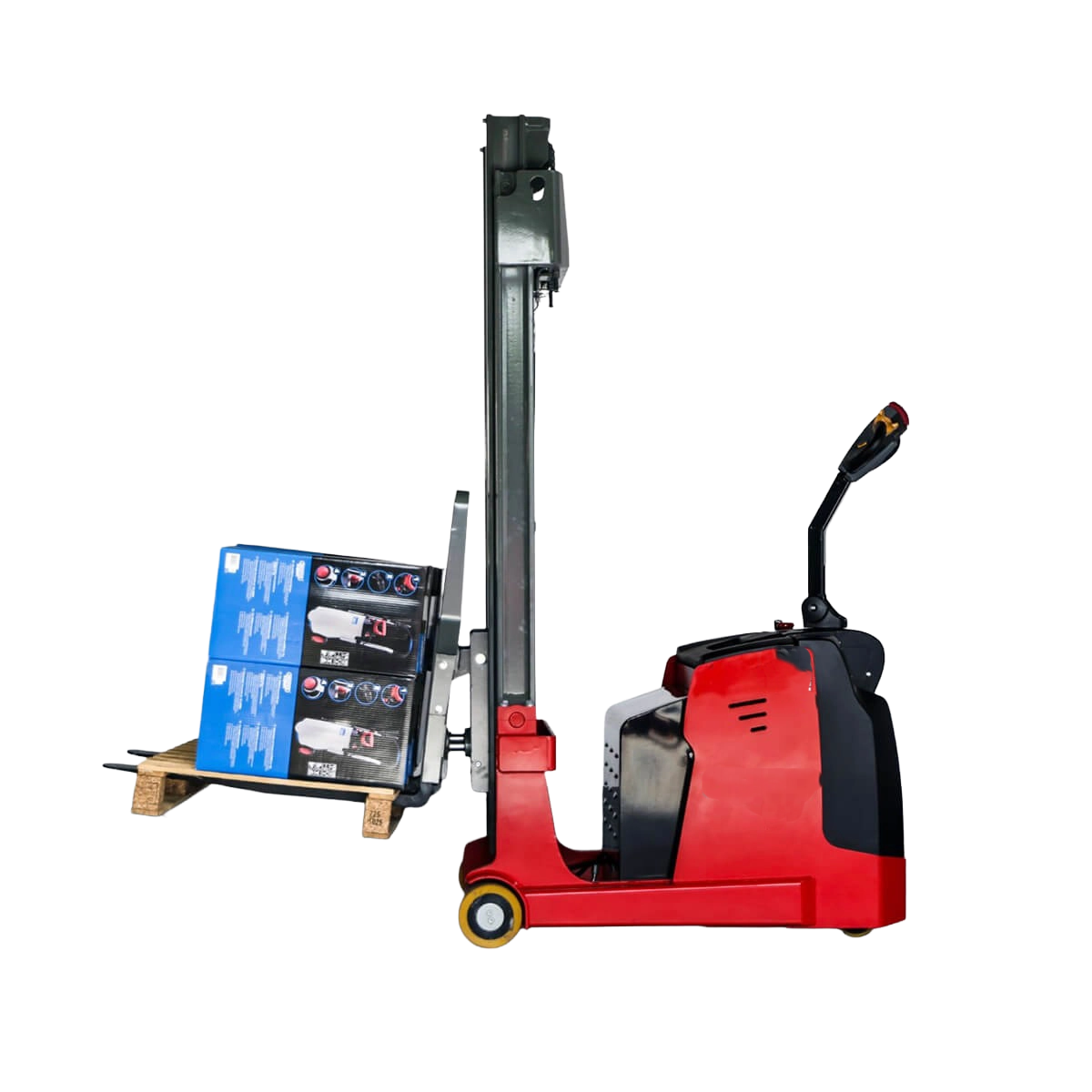
What distinguishes the pedestrian counterbalance stacker from other types of powered stacker is its legless design. Unlike straddle stackers, which rely on outrigger legs that extend forward beneath the load to provide stability, the counterbalance stacker uses an integrated counterweight at the rear of the machine to offset the weight of the load on the forks. This seemingly simple difference has profound practical implications: the 1000kg pedestrian counterbalance stacker can lift and stack every type of pallet—open-bottomed, closed-bottomed, Euro, UK standard, and non-standard—without restriction, and it can approach pallets and racking from the front without its legs fouling on the bottom beams of racking, dock edges, or irregular floor surfaces.
In this comprehensive guide, we explore every aspect of the 1000kg pedestrian counterbalance stacker in detail. From core specifications, counterbalance engineering, and battery technology through to UK regulatory requirements, operator training, applications, maintenance strategies, and total cost of ownership, this article provides everything you need to make a confident and informed purchasing decision. Whether you are looking for an affordable first powered stacker or a versatile addition to an existing fleet, this guide will help you understand exactly why the 1000kg pedestrian counterbalance stacker is one of the most practical material handling investments available to UK businesses.
What Is a 1000kg Pedestrian Counterbalance Stacker?
Definition and Operating Principle
A 1000kg pedestrian counterbalance stacker is a battery-powered, walk-behind lifting machine designed to raise, lower, transport, and stack loads weighing up to 1,000 kilograms. The operator walks behind or alongside the machine, controlling its movement and hydraulic functions through a tiller arm that incorporates the drive controls, lift and lower buttons, horn, and emergency stop. There is no cab, seat, or ride-on platform; the operator remains on foot at all times, maintaining close proximity to the machine and full situational awareness of the surrounding environment.
The counterbalance principle is the same engineering concept used in full-sized counterbalance forklift trucks. A heavy counterweight, typically integrated into the rear chassis of the machine, offsets the moment created by the load carried on the forks at the front. This balance of forces keeps the stacker stable during lifting, lowering, and transport without the need for external stabilising legs or straddle arms. The result is a machine with a compact, unobstructed front profile that can approach any pallet type from any direction and work in spaces where straddling legs would be impractical.
How the Counterbalance Stacker Differs from Straddle and Reach Stackers
Understanding the differences between the main types of pedestrian stacker is essential for selecting the right machine. Straddle stackers use two outrigger legs that extend forward beneath the forks and straddle the pallet on either side. These legs provide excellent stability but limit the stacker to pallets with open bottoms and sufficient ground clearance for the legs to pass beneath. They also increase the overall width and length of the machine, and the legs can interfere with the bottom beams of racking systems, dock edges, and other floor-level obstructions.
Reach stackers add a pantographic or scissor mechanism that allows the mast and forks to extend forward, placing loads into deep racking bays without the stacker itself entering the bay. While highly effective for specific applications, reach stackers are more complex, more expensive, and typically larger than counterbalance models.
The 1000kg pedestrian counterbalance stacker eliminates both the straddle legs and the reach mechanism. Its forks project directly from the front of the machine, supported entirely by the counterweight at the rear. This legless design means the stacker can handle closed-bottom pallets, non-standard containers, stillages, crates, and any other load that would be inaccessible to a straddle stacker. It can also approach loads and racking from the front without the legs fouling on floor-level obstacles—a decisive advantage in cluttered workshops, production areas, and irregular storage environments.
The trade-off for the counterbalance design is that the machine is typically longer than an equivalent straddle stacker, as the counterweight extends the rear of the chassis. This results in a larger turning circle, which must be considered when assessing aisle width requirements. However, for the majority of operations where pallet versatility and front-approach access are priorities, the counterbalance configuration is the superior choice.
Pedestrian Operation: Walk-Behind Simplicity
The pedestrian operating mode is a defining characteristic that separates this class of machine from ride-on stackers and sit-down forklifts. The operator walks behind the 1000kg pedestrian counterbalance stacker, guiding it with the tiller arm and controlling all functions from an upright position. Travel speeds are limited to walking pace, typically 4 to 6 kilometres per hour, ensuring that the operator can maintain control and stop the machine quickly in the event of an obstruction or hazard.
This walk-behind format delivers several important advantages. The training requirements for pedestrian-operated stackers are significantly simpler and shorter than for ride-on forklifts, reducing the time and cost of bringing new operators up to competency. The lower travel speeds and the operator’s ability to step aside from the machine in an emergency inherently reduce the severity of potential incidents. The absence of a cab or platform reduces the overall dimensions of the machine, improving its ability to navigate confined spaces and pass through narrow doorways.
Key Features and Technical Specifications
Load Capacity and Stability
The 1000kg rated load capacity is measured at a standard load centre distance, typically 400mm to 500mm from the vertical face of the forks to the centre of gravity of the load. This capacity is well-matched to the requirements of small to medium-sized operations handling partially loaded pallets, lightweight consumer goods, packaged products, retail stock, pharmaceutical supplies, printed materials, and a wide range of boxed or shrink-wrapped merchandise.
Stability is maintained through the counterbalance principle: the integrated counterweight at the rear of the chassis offsets the load moment at the front. Provided the operator respects the rated capacity, positions the load centrally on the forks, and observes correct operating procedures on level surfaces, the 1000kg pedestrian counterbalance stacker provides a stable and predictable lifting platform throughout its full range of mast travel.
Mast Configurations and Lift Heights
The 1000kg pedestrian counterbalance stacker is typically available with duplex mast configurations offering maximum lift heights from 2,500mm to 3,300mm. Some models offer triplex mast options extending to 3,500mm or beyond, though the additional height increases the collapsed mast height and the overall weight of the machine.
Free-lift capability is available on many models, allowing the forks to rise to a specified height—often 140mm to 1,500mm depending on the mast type—before the outer mast section begins to extend. This feature is particularly valuable when operating under mezzanine floors, inside shipping containers, or in areas with restricted overhead clearance. With free lift, the operator can raise and position loads without the mast top exceeding the available headroom.
Typical Specifications Overview
|
Specification |
Typical Range |
|
Rated Load Capacity |
1,000 kg at 400–500mm load centre |
|
Mast Type |
Duplex (standard) or Triplex (optional) |
|
Maximum Lift Height |
2,500 mm – 3,300 mm |
|
Free Lift Height |
140 mm – 1,500 mm (model-dependent) |
|
Max Travel Speed |
4.5 – 6.0 km/h |
|
Max Lift Speed (Laden) |
100 – 150 mm/s |
|
Turning Radius |
1,550 mm – 1,800 mm |
|
Battery Type |
Maintenance-free lead-acid or Li-ion (24V) |
|
Overall Width |
800 mm – 900 mm |
|
Overall Length (incl. forks) |
2,100 mm – 2,400 mm |
|
Lowered Mast Height |
1,860 mm – 2,100 mm |
|
Service Weight (incl. battery) |
850 kg – 1,200 kg |
|
Fork Length |
800 mm – 1,150 mm |
|
Fork Width (adjustable) |
Adjustable to suit standard pallets |
|
Charger |
Built-in or external (12hr automatic) |
Compact Dimensions and Legless Design
The most distinctive physical characteristic of the 1000kg pedestrian counterbalance stacker is its legless front profile. Without straddle arms extending forward, the overall width is typically just 800mm to 900mm, making it one of the narrowest powered stackers available. This compact width allows the machine to pass through standard doorways, enter goods lifts, navigate narrow stockroom aisles, and operate in confined spaces that would be impassable for straddle-legged alternatives.
The overall length, including forks, typically ranges from 2,100mm to 2,400mm. While this is longer than an equivalent straddle stacker due to the rear counterweight, the absence of forward-projecting legs means the machine presents a clean, unobstructed approach to pallets and racking. Operators can drive directly up to a pallet, insert the forks, lift, and reverse away without needing to align straddle legs around the pallet or check for floor-level obstructions.
Battery Technology and Built-In Charging
The 1000kg pedestrian counterbalance stacker is powered by a rechargeable battery pack, typically operating at 24V with capacities ranging from 100Ah to 210Ah depending on the model and specification. Maintenance-free sealed lead-acid batteries are the most common standard fitment, offering reliable performance with no requirement for electrolyte checks or water top-ups.
Lithium-ion battery options are increasingly available, offering faster charging times, opportunity charging capability during natural breaks, longer cycle life, and lighter weight. The weight saving from a lithium-ion battery can be significant in a pedestrian stacker, as every kilogram saved from the battery must be compensated by additional counterweight to maintain stability—meaning lithium-ion models may have a slightly different weight distribution profile.
Many models feature a built-in charger that plugs directly into a standard mains socket, eliminating the need for separate charging infrastructure. This convenience is particularly valuable for small businesses and operations where the stacker is used intermittently throughout the day and can be plugged in during idle periods. A full charge typically takes eight to twelve hours with a standard charger, making overnight charging the norm for daily operations.
Adjustable Forks and Ergonomic Controls
The forks on the 1000kg pedestrian counterbalance stacker are typically adjustable in width, allowing the operator to set the fork spacing to match different pallet sizes and load configurations. Sleeve-type adjustable forks can be repositioned manually to accommodate Euro pallets, UK standard pallets, and non-standard loads. This versatility is a significant advantage for operations handling a mix of pallet types and sizes.
The tiller arm incorporates all the controls the operator needs: proportional drive speed control, lift and lower buttons or levers, horn, and emergency stop. The tiller design allows the operator to control the machine with one hand while maintaining clear visibility of the load and the surrounding area. The tiller arm also functions as a safety device: releasing the tiller or pushing it fully vertical activates the brake and stops the machine, preventing uncontrolled movement if the operator loses contact.
Advantages of the 1000kg Pedestrian Counterbalance Stacker
Universal Pallet Compatibility
The single most important advantage of the counterbalance design is its ability to handle every type of pallet and load base. Open-bottomed pallets, closed-bottomed pallets, Euro pallets, UK standard pallets, stillages, plastic containers, metal bins, crates, and custom load carriers can all be lifted and stacked without restriction. Straddle stackers, by contrast, require pallets with open bottoms and sufficient ground clearance for the straddle legs to pass beneath—a limitation that excludes a significant proportion of the pallet types commonly encountered in UK operations.
This universal compatibility makes the 1000kg pedestrian counterbalance stacker the default choice for any operation where the pallet mix is varied, unpredictable, or includes closed-bottom containers. In third-party logistics, contract warehousing, and mixed retail operations where goods arrive on different pallet types from multiple suppliers, the counterbalance stacker’s ability to handle any load base without adaptation is invaluable.
Affordable Alternative to a Full Forklift
The 1000kg pedestrian counterbalance stacker delivers genuine forklift-style capability—front-approach pallet handling, adjustable forks, powered lift to racking height, and counterbalanced stability—at a fraction of the purchase price of a full counterbalance forklift truck. For small businesses, start-up operations, and departments within larger organisations that need occasional pallet stacking but cannot justify the capital expenditure of a forklift, the pedestrian counterbalance stacker provides an outstanding return on investment.
The lower acquisition cost is complemented by lower ongoing expenses across every dimension of ownership. Energy costs are minimal, as the small 24V battery consumes very little electricity per charge cycle. Maintenance costs are low, with fewer moving parts and simpler systems than a forklift. Operator training is faster and less expensive. Insurance premiums are typically lower. And the compact dimensions mean the machine does not require dedicated parking or charging infrastructure, further reducing the total cost of deployment.
Zero Emissions and Quiet Operation
The electric powertrain of the 1000kg pedestrian counterbalance stacker produces zero direct emissions during operation. This makes it suitable for indoor use in warehouses, stockrooms, retail environments, food storage facilities, pharmaceutical operations, and any other enclosed space where air quality is a concern. The absence of exhaust fumes eliminates the need for ventilation systems and protects the health of operators and nearby workers.
Noise levels are extremely low, typically well below 70 decibels, enabling the stacker to be used during any hours without generating disturbance. In retail environments where stock replenishment takes place during trading hours, or in office-adjacent stockrooms where noise must be minimised, the quiet operation of the pedestrian counterbalance stacker is a significant practical advantage.
The environmental credentials of the 1000kg pedestrian counterbalance stacker also support corporate sustainability objectives. With zero direct carbon emissions and extremely low energy consumption, the electric pedestrian stacker contributes measurably to a business’s greenhouse gas reduction targets. For organisations pursuing ISO 14001 environmental certification, B Corp accreditation, or reporting under ESG frameworks, the adoption of zero-emission material handling equipment provides tangible, auditable evidence of environmental commitment.
Simplified Operator Training
While all powered stacker operators in the UK require appropriate training, the pedestrian counterbalance stacker’s walk-behind format, limited travel speed, and intuitive controls make operator training significantly faster and simpler than for ride-on forklifts. A competent operator can typically be trained on a pedestrian stacker in one to two days, compared to three to five days for a counterbalance forklift. This reduced training burden makes it practical to train multiple team members, providing operational flexibility and resilience.
The lower travel speed and the operator’s position on foot behind the machine also contribute to inherently safer operation. The operator maintains full visibility of the surrounding environment, can step aside from the machine in an emergency, and is not exposed to the tip-over and entrapment risks associated with ride-on equipment. These characteristics make the 1000kg pedestrian counterbalance stacker a particularly appropriate choice for environments where personnel have limited material handling experience.
Compact Footprint for Maximum Space Utilisation
The narrow profile of the 1000kg pedestrian counterbalance stacker—typically just 800mm to 900mm wide—allows it to operate in aisles, doorways, and passageways that would be inaccessible to wider equipment. It can pass through standard single doorways, enter commercial goods lifts, and navigate the narrow aisles commonly found in small warehouses, retail stockrooms, and back-of-house areas.
When not in use, the compact dimensions allow the stacker to be parked in a small area without consuming valuable floor space. The built-in charger means it can be plugged into any convenient mains socket—no dedicated charging bay or bunded fuel storage is required. For businesses operating in leased premises where every square metre has a cost, this minimal spatial footprint is a tangible commercial benefit.
Ideal Applications and Industries
Small Warehouses and Distribution Operations
The 1000kg pedestrian counterbalance stacker is an ideal primary handling machine for small warehouses and distribution operations where loads are moderate, aisle widths are constrained, and the investment in a full forklift cannot be justified. It handles the complete range of daily stacking tasks including goods-in receipt, pallet putaway to racking, order picking support, stock rotation, and despatch preparation. For operations handling up to approximately 20 to 30 pallets per shift, the pedestrian counterbalance stacker provides more than adequate throughput while keeping operating costs to a minimum.
In start-up businesses, growing e-commerce operations, and organisations transitioning from purely manual handling to powered equipment, the 1000kg pedestrian counterbalance stacker represents the natural first step. It eliminates the manual lifting, carrying, and stacking that contributes to musculoskeletal injuries—the single largest category of workplace injury in the UK—while keeping the investment affordable and the operational complexity low. As the business grows, the pedestrian counterbalance stacker remains a valuable complement to any larger equipment that may be added to the fleet.
Retail Stockrooms and Back-of-House Operations
Retail businesses, supermarkets, department stores, and high-street shops frequently need to move palletised stock from delivery vehicles to stockrooms and onwards to the shop floor. The 1000kg pedestrian counterbalance stacker handles these tasks efficiently, quietly, and safely within the typically compact and cluttered stockroom environments found in retail premises. Its ability to handle closed-bottom pallets and plastic containers is particularly valuable in retail, where goods arrive on a wide variety of load carriers from different suppliers.
The quiet, emission-free operation allows stock replenishment to take place during trading hours without disturbing customers or generating air quality concerns. The compact dimensions enable the stacker to navigate between shelving runs, display fixtures, and other obstacles in the back-of-house environment, reaching storage areas that would be inaccessible to larger material handling equipment.
Manufacturing, Assembly, and Workshops
Manufacturing workshops and assembly lines handling components, sub-assemblies, raw materials, and finished products weighing up to 1,000kg benefit from the precision and versatility of the pedestrian counterbalance stacker. The legless design allows the stacker to approach workbenches, machinery, and storage racking without the obstruction of straddle legs, while the adjustable forks accommodate the varied load carriers found in production environments. The zero-emission, low-noise operation supports comfortable working conditions in enclosed manufacturing spaces.
Printing, Publishing, and Paper Handling
The printing and publishing industry handles paper reels, printed materials, and palletised publications that frequently fall within the 1000kg capacity range. The pedestrian counterbalance stacker provides the controlled, emission-free handling needed to protect printed products from contamination. Its compact dimensions suit the typically tight layouts of print workshops, where floor space is shared between printing presses, finishing equipment, and storage racking.
Food, Beverage, and Pharmaceutical Storage
In food storage, beverage warehousing, and pharmaceutical environments, the 1000kg pedestrian counterbalance stacker meets strict hygiene and air quality requirements. The absence of exhaust fumes eliminates product contamination risk, while the low noise levels support comfortable working in temperature-controlled spaces. The ability to handle closed-bottom plastic containers and hygienic pallet types without restriction makes the counterbalance design particularly well-suited to these regulated environments.
E-Commerce, Parcel, and Fulfilment Operations
Small to medium e-commerce fulfilment operations handling lightweight, high-volume orders benefit from the manoeuvrability and low operating cost of the pedestrian counterbalance stacker. Its compact size navigates the narrow aisles typical of fulfilment centres optimised for high storage density, while the 1,000kg capacity handles the majority of outbound pallet builds and inbound stock replenishment tasks.
Educational, Healthcare, and Institutional Facilities
Universities, hospitals, research laboratories, and other institutional settings have material handling requirements that are well-matched to the pedestrian counterbalance stacker’s capabilities. Moving supplies, equipment, furniture, and materials within buildings where quiet operation, zero emissions, and compact dimensions are essential makes this the natural equipment choice. The stacker’s ability to enter goods lifts and pass through standard corridors gives it access throughout multi-storey institutional buildings.
Mezzanine Floor Operations
The 1000kg pedestrian counterbalance stacker is one of the few powered stacking machines suitable for use on mezzanine floors. Its relatively low service weight of 850kg to 1,200kg, combined with the distributed load pattern of its counterbalance design, means it can operate on mezzanine floors with standard structural ratings without requiring reinforcement. The compact dimensions allow it to be transported to the mezzanine level via a goods lift, while the free-lift mast function enables operation beneath the mezzanine’s restricted headroom. This application is particularly common in retail, e-commerce, and light industrial operations where mezzanine floors provide additional storage capacity within existing buildings.
Before deploying any powered equipment on a mezzanine floor, employers should verify the floor’s load rating against the combined weight of the stacker plus its maximum load. The point-load characteristics of the stacker’s wheels should also be considered, particularly if the mezzanine decking is constructed from lightweight materials. Consulting the mezzanine manufacturer’s technical documentation or engaging a structural engineer is strongly recommended.
UK Regulations and Legal Requirements
Health and Safety at Work Act 1974
The Health and Safety at Work Act 1974 places a general duty on employers to ensure the health, safety, and welfare of their employees so far as is reasonably practicable. This duty encompasses all equipment used in the workplace, including the 1000kg pedestrian counterbalance stacker. Employers must assess the risks associated with stacker operations, implement appropriate control measures, ensure equipment is properly maintained, and provide adequate training for all operators.
LOLER: Lifting Operations and Lifting Equipment Regulations 1998
LOLER applies to the 1000kg pedestrian counterbalance stacker and requires that all lifting operations are properly planned, supervised, and carried out safely. The regulations mandate that the stacker undergoes a thorough examination by a competent person at intervals not exceeding 12 months. This examination assesses the structural integrity of the mast, forks, carriage, chassis, and all load-bearing components. Employers must retain the examination reports and act promptly on any defects identified.
PUWER: Provision and Use of Work Equipment Regulations 1998
PUWER requires that the 1000kg pedestrian counterbalance stacker is suitable for its intended use, maintained in a safe condition, inspected at appropriate intervals, and operated only by persons who have received adequate training. Employers must maintain documented records of all maintenance, inspections, and repairs. The regulations also require that the machine is fitted with appropriate safety devices, including an emergency stop, audible warning device, and braking system.
Operator Training Requirements
UK law requires that all operators of powered stackers receive adequate training before using the equipment in the workplace. While pedestrian stackers do not require the same category of training as counterbalance forklift trucks, operators must still complete a recognised training programme covering pre-operational checks, safe operating procedures, load assessment, stacking and de-stacking techniques, battery charging safety, and emergency protocols.
Training for pedestrian-operated stackers is typically shorter than for ride-on forklifts, with courses generally lasting one to two days for novice operators. Experienced operators converting from other equipment types may complete training in a single day. Employers are advised to arrange refresher training at intervals of three to five years to maintain operator competency. Training should be provided by an accredited organisation and documented to demonstrate compliance in the event of an HSE inspection or workplace incident.
Battery Charging Safety
Battery charging for the 1000kg pedestrian counterbalance stacker should follow the manufacturer’s documented procedures. Sealed maintenance-free batteries present minimal risk during charging, but the charging area should still be designated, accessible, and free from trip hazards. For models with lead-acid batteries that produce hydrogen gas during charging, adequate ventilation and fire safety provisions are required. The built-in charger found on many models simplifies the charging process, but operators should still be trained to connect and disconnect the charging cable safely and to recognise any abnormal conditions during charging.
How to Choose the Right 1000kg Pedestrian Counterbalance Stacker
Assessing Your Load Profile
Begin by documenting the weights, dimensions, and pallet types of the loads you handle most frequently. If your loads consistently weigh below 1,000kg and you handle a mix of pallet types including closed-bottom containers, the 1000kg pedestrian counterbalance stacker is an excellent match. If you regularly encounter loads approaching or exceeding 1,000kg, consider a higher-capacity model to provide a safety margin.
Measuring Your Facility
The turning radius of the 1000kg pedestrian counterbalance stacker is typically 1,550mm to 1,800mm, which determines the minimum aisle width for right-angle stacking. Measure your aisles, doorways, lift openings, and any other access points to confirm compatibility. The machine’s overall width of 800mm to 900mm will pass through most standard single doorways, but confirm this against your actual measurements, allowing clearance for the operator walking alongside.
Selecting the Right Mast Height
Choose a mast configuration that provides sufficient lift height for your highest racking beam plus adequate clearance to deposit and retrieve pallets safely. Over-specifying the mast height adds unnecessary weight and cost, while under-specifying may limit your ability to use the full capacity of your racking system. A duplex mast offering 2,500mm to 3,000mm lift height covers the requirements of the majority of small to medium warehouse operations.
Battery Capacity and Charging Considerations
Match the battery capacity to your expected daily duty cycle. For operations using the stacker intermittently throughout a single shift, a standard 24V maintenance-free battery with a built-in charger provides ample energy. For more intensive operations, a higher-capacity battery or lithium-ion option may be appropriate. The ability to opportunity-charge during breaks extends the effective range of any battery specification.
Optional Features and Accessories
Available options on many 1000kg pedestrian counterbalance stacker models include adjustable fork width, free-lift mast function, integrated weighing systems, LED work lights, audible reversing alarms, and non-marking tyre compounds. For operations requiring precise load placement, a tilt function provides hydraulic forward and backward tilt of the mast, improving stability during transport and accuracy during stacking.
Maintenance and Care for Long-Term Reliability
Daily Pre-Operational Checks
Every operating session should begin with a structured pre-operational check. The operator should visually inspect the forks for cracks, bending, or wear; test the mast for smooth, unrestricted travel; check the tiller arm controls for correct function; verify the horn and any warning lights; inspect the wheels for damage or excessive wear; test the service brake and parking brake; and confirm the battery charge level is adequate for the planned work. Any defects should be reported immediately and the stacker withdrawn from service until the issue is resolved.
Scheduled Preventive Maintenance
The manufacturer’s recommended maintenance schedule should be followed rigorously. Service intervals typically fall at every 500 to 1,000 operating hours, or at least annually for machines with lower utilisation. Preventive maintenance should include inspection and lubrication of the mast chains, rollers, and guides; inspection of the hydraulic system including cylinder, hoses, and fluid level; testing of the braking system; inspection of all electrical connections and wiring; verification of the battery and charger function; and a comprehensive check of all safety systems.
The simplicity of the pedestrian counterbalance stacker’s design means that maintenance costs are inherently low. The electric drive system has very few moving parts compared to an internal combustion engine, and the absence of fuel, oil, exhaust, and transmission components eliminates entire categories of maintenance activity. Battery care is the most important ongoing maintenance task: keeping the battery clean, ensuring correct charging practices, and monitoring for any signs of degradation will maximise battery life and maintain consistent performance.
LOLER Thorough Examinations
The mandatory thorough examination under LOLER must be carried out by a competent person at intervals not exceeding 12 months. This examination goes beyond routine servicing and includes a detailed assessment of the mast structure, forks, carriage, load-bearing components, hydraulic system, chains, and all safety devices. The competent person issues a written report that must be retained by the employer, and any defects identified must be rectified within the specified timeframe before the stacker is returned to service.
Total Cost of Ownership: Understanding the Financial Case
Acquisition Cost
The 1000kg pedestrian counterbalance stacker is one of the most affordable categories of powered stacking equipment. Purchase prices are typically a fraction of the cost of a full counterbalance forklift truck, making it accessible to small businesses, start-ups, and operations with limited capital budgets. The lower initial investment also means that the machine can deliver a positive return on investment very quickly, often within months of deployment through the elimination of manual handling, the reduction of product damage, and the improvement of stacking efficiency.
Running Cost Comparison
|
Cost Factor |
Pedestrian CB Stacker |
Counterbalance Forklift |
|
Typical Purchase Price |
Significantly lower |
Substantially higher |
|
Annual Energy Cost |
£100 – £300 |
£750 – £1,500 (electric) |
|
Annual Maintenance |
£200 – £500 |
£500 – £1,200 |
|
Operator Training |
1–2 days |
3–5 days |
|
Insurance |
Lower premiums |
Higher premiums |
|
Floor Space Required |
Minimal |
Larger parking/charging area |
The cumulative effect of lower acquisition cost, minimal energy consumption, reduced maintenance expenditure, shorter training periods, and lower insurance premiums makes the 1000kg pedestrian counterbalance stacker one of the most cost-effective material handling investments available. For operations where the 1,000kg capacity and pedestrian-speed throughput are sufficient, it delivers a total cost of ownership that is typically 40 to 60 percent lower than operating an equivalent counterbalance forklift.
Residual Value and Lifespan
A well-maintained 1000kg pedestrian counterbalance stacker delivers reliable service for many years. The relatively simple construction, robust chassis, and low-stress operating environment contribute to a long service life. Battery replacement, the single largest maintenance cost over the machine’s life, is typically required every three to five years for lead-acid batteries or significantly longer for lithium-ion. The used equipment market for pedestrian stackers is active, and machines in good condition retain reasonable resale value.
Safety Best Practices
Operator Conduct
Safe operation of the 1000kg pedestrian counterbalance stacker depends on the operator’s training, attentiveness, and adherence to established procedures. Operators should always maintain a clear line of sight in the direction of travel, keep hands on the tiller arm controls, sound the horn at blind corners and intersections, observe any posted speed limits, and never leave the stacker unattended with the forks raised or the key in the ignition.
Load Handling and Stability
Operators should verify that the load weight is within the rated capacity before lifting. Loads should be centred on the forks, with the forks fully inserted under the pallet or load carrier. During transport, the load should be carried as low as practical to maximise stability. When stacking, the operator should approach the racking squarely, raise the load to the required height, and deposit it carefully onto the racking beams. Loads should never be raised or lowered while the stacker is in motion.
Pedestrian and Environmental Safety
The 1000kg pedestrian counterbalance stacker operates at walking speed, which inherently reduces the risk and severity of collisions. However, operators should remain vigilant for pedestrians, particularly when reversing or operating in shared-use areas. Audible warning devices should be used when approaching blind spots. Operating surfaces should be level, clean, and free from obstructions, loose materials, and excessive gradients. The stacker should not be operated on slopes exceeding the manufacturer’s specified gradeability limit.
Battery and Charging Safety
Charging should take place in a designated area with the mains socket accessible and free from trip hazards. The charger should be connected and disconnected with dry hands, following the manufacturer’s procedures. The stacker should not be operated while connected to the charger. Any signs of battery damage, swelling, excessive heat, or unusual odour should be reported immediately and the stacker taken out of service.
Why Buy Your 1000kg Pedestrian Counterbalance Stacker from Hall-Fast
Hall-Fast is a well-established and trusted supplier of industrial and commercial equipment to businesses throughout the United Kingdom. With decades of experience in the material handling sector and a commitment to providing expert advice, competitive pricing, and reliable nationwide delivery, Hall-Fast is the ideal partner for your 1000kg pedestrian counterbalance stacker purchase.
When you buy from Hall-Fast, you gain access to a knowledgeable team that understands the practical requirements of pedestrian material handling operations. Whether you need guidance on selecting the right mast height, choosing between battery technologies, assessing your facility’s compatibility, or identifying the most appropriate optional equipment, Hall-Fast’s specialists are available to help you make the right decision with confidence.
Hall-Fast’s comprehensive product range extends well beyond stackers to encompass the full spectrum of handling and lifting equipment, including pallet trucks, forklifts, platform trucks, safety cages, and warehouse safety products. This means you can source your complete material handling solution from a single trusted supplier, simplifying procurement and ensuring compatibility across your operation. With competitive pricing, responsive customer service, and the reassurance of dealing with a long-established UK supplier, Hall-Fast is the natural choice for your next investment in material handling equipment.
Frequently Asked Questions
What is the difference between a counterbalance stacker and a straddle stacker?
A counterbalance stacker uses an integrated counterweight to balance the load, eliminating the need for straddle legs. This legless design allows it to handle all pallet types including closed-bottom containers and approach loads and racking without obstruction. A straddle stacker uses outrigger legs that extend forward and straddle the pallet, providing stability but limiting compatibility to open-bottom pallets with sufficient ground clearance.
Can a 1000kg pedestrian counterbalance stacker handle Euro pallets?
Yes. The adjustable forks accommodate Euro pallets, UK standard pallets, and most other pallet sizes. The counterbalance design handles both open and closed-bottom pallets without restriction, making it one of the most versatile pedestrian stackers available.
What training is required to operate a pedestrian counterbalance stacker in the UK?
All operators must complete a recognised training programme covering safe operating procedures, pre-operational checks, load assessment, and emergency protocols. Training typically takes one to two days for novice operators. While not the same certification category as a counterbalance forklift, the training must be documented and refreshed at intervals of three to five years.
Can the stacker be used on a mezzanine floor?
Yes. The relatively low service weight of 850kg to 1,200kg and compact dimensions make the 1000kg pedestrian counterbalance stacker suitable for many mezzanine floor installations. Confirm the mezzanine’s structural rating against the combined weight of the stacker and its maximum load before deployment.
How long does the battery last on a single charge?
A fully charged 24V maintenance-free battery typically supports four to eight hours of intermittent use, depending on the intensity of operation and the frequency of lifting cycles. Overnight charging via the built-in charger restores full capacity for the following day’s operations.
Is the 1000kg pedestrian counterbalance stacker suitable for outdoor use?
The pedestrian counterbalance stacker is primarily designed for indoor use on smooth, level surfaces. While it can be used