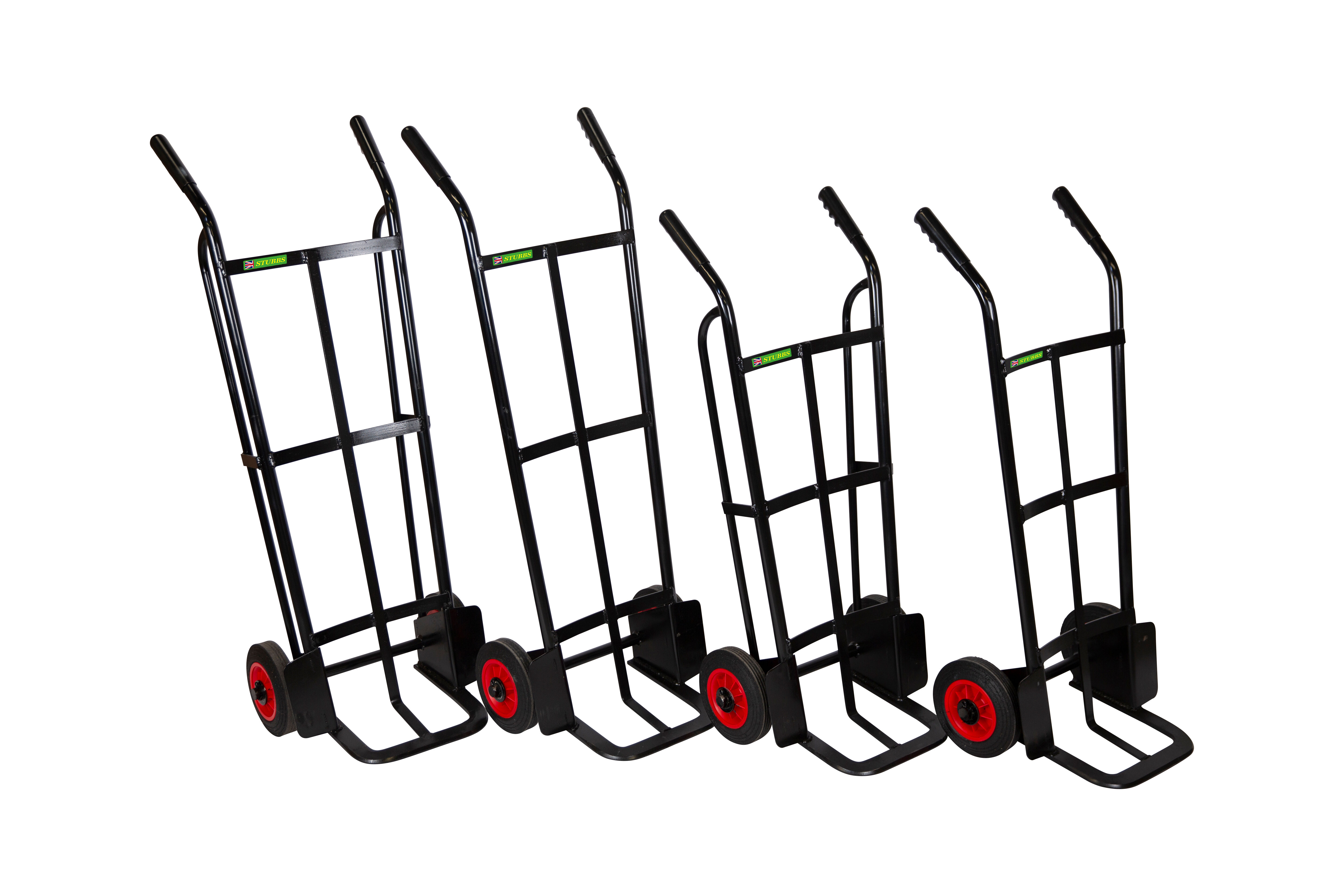
When it comes to moving heavy loads safely and efficiently, the sack truck remains one of the most essential pieces of handling equipment in any workplace. But not all sack trucks are built to the same standard. Stubbs sack trucks, manufactured by WB Stubbs (Hawksworth) Ltd since 1836, represent the pinnacle of British engineering in manual handling equipment. Built from heavy-gauge steel with hot-forged components and finished in the brand's iconic enamel coating, a Stubbs sack truck is not simply a tool — it is an investment in decades of reliable, day-in, day-out performance.
Whether you run a busy warehouse, manage an equestrian yard, operate a farm, or oversee deliveries in a commercial setting, choosing the right sack truck can make the difference between a workforce that moves freely and efficiently and one that struggles with inadequate equipment. This comprehensive guide explores the complete range of Stubbs sack trucks, examines what sets them apart from the competition, and provides the practical knowledge you need to select the perfect model for your operation. Available to purchase from Hall-Fast Industrial Supplies, every Stubbs sack truck carries with it nearly two centuries of manufacturing expertise and an uncompromising commitment to quality.
## The Stubbs Story: Nearly 190 Years of British Manufacturing
Understanding why Stubbs sack trucks command such respect in the handling equipment industry requires a look at the remarkable story behind the brand. WB Stubbs (Hawksworth) Ltd was established in 1836, when Thomas Wade set up his workshop in the village of Hawksworth, Nottinghamshire. What began as a small operation producing agricultural implements has grown, across nearly two centuries and multiple generations, into one of Britain's most respected manufacturers of handling equipment and equestrian products.
The company takes its name from Sarah Stubbs, Thomas Wade's partner, whose family were well-known blacksmiths and carpenters throughout south Nottinghamshire. When their son William Blount Stubbs took over the business as the second generation, the modern name WB Stubbs was formally adopted, and it has endured ever since. What is believed to be Thomas Wade's original workshop still stands in Hawksworth today, complete with its forge — a physical reminder of the craftsmanship tradition that runs through every product the company manufactures.
By 1886, the company published its first 100-page catalogue with a bold claim that remains true today: that Stubbs makes a larger variety of trucks, hand carts, trolleys, sack trucks, and dock trucks than any other firm in the United Kingdom. Throughout the decades that followed, the company evolved with its customers. Agricultural implements gave way to an expanded portfolio of industrial trucks, trolleys, and trailers. The equestrian division grew to become world-renowned, with Stubbs stable and tack room equipment found in leading yards from Australia to Zimbabwe.
The resilience and loyalty at the heart of the company was demonstrated on 15th May 1969, when a devastating fire badly damaged the Hawksworth premises. At the height of the blaze, 40 firefighters worked to bring the fire under control, and employees arrived voluntarily to help with salvage work. Remarkably, every employee reported for work the following weekend — refusing pay — to create temporary workspace, and production restarted on the Monday morning. That spirit of determination continues to define the company. Average staff service at Stubbs still exceeds 20 years, with several team members having served for more than four decades. That devotion is reflected directly in the attention to detail visible in every sack truck that leaves the factory.
Today, every Stubbs product continues to be manufactured at Progress Works in Hawksworth, Nottinghamshire. The company's manufacturing skills span welding and fabrication, plastic moulding, sheet metal work, plastic coating, and joinery — all performed in-house. This vertical integration gives Stubbs complete control over quality at every stage of production, from raw material selection through to the final inspection before dispatch. When you purchase a Stubbs sack truck, you are buying a product that has been entirely conceived, designed, and built in the heart of England by skilled craftspeople whose expertise has been refined across generations.
## What Makes a Sack Truck "Heavy Duty"?
Before examining the specific Stubbs sack truck models in detail, it is worth understanding what separates a genuinely heavy-duty sack truck from the cheaper alternatives that flood the market. The term "heavy duty" is used liberally across the handling equipment industry, but the differences between a premium sack truck and a budget alternative become apparent very quickly in demanding working environments.
The frame is the most critical component. Budget sack trucks typically use thin-walled tubular steel that flexes under load and fatigues over time. Stubbs sack trucks are constructed from angle iron — steel formed into an L-shaped cross-section that delivers exceptional rigidity and resistance to bending forces. This construction method has been used by Stubbs for decades because angle iron provides a significantly superior strength-to-weight ratio compared with tubular alternatives. When you are regularly moving loads of 200 to 300 kilograms, that structural integrity is not a luxury — it is a necessity.
The foot iron, sometimes called the toe plate, is the component that slides beneath the load and bears the brunt of the weight. On cheaper sack trucks, the foot iron is often a thin pressed steel plate that bends and deforms after relatively little use. Stubbs takes a fundamentally different approach: the foot iron on a Stubbs sack truck is hot-forged. Hot forging involves heating steel to extremely high temperatures and then shaping it under immense pressure. This process aligns the grain structure of the metal, eliminating internal weaknesses and producing a component that is dramatically stronger and more durable than one that has simply been stamped or pressed from sheet steel. A hot-forged foot iron will withstand years of heavy use without bending, cracking, or deforming — exactly the kind of durability that professional users demand.
The wheels are another area where quality differences become stark. Stubbs sack trucks are fitted with properly sized wheels — typically 200mm in diameter — mounted on robust axles with quality bearings. This combination ensures smooth rolling under heavy loads, reduced physical effort for the operator, and reliable performance across various floor surfaces. Budget sack trucks often feature smaller wheels with cheap plastic bushings instead of proper bearings, making them harder to push and far more likely to seize or fail under load.
Finally, the finish matters far more than most people realise. Stubbs sack trucks are finished in the brand's distinctive baked enamel coating. This is not simply decorative — it provides genuine protection against corrosion, impacts, and chemical exposure. In demanding environments where equipment is exposed to moisture, cleaning agents, animal waste, or general rough treatment, a quality enamel finish can add years to the working life of a sack truck. Cheaper powder coatings tend to chip and flake far more readily, allowing rust to take hold and eventually compromise the structural integrity of the frame.
## The Stubbs Sack Truck Range: Models and Specifications
Stubbs produces several distinct sack truck models, each designed to address specific handling requirements. Understanding the differences between them is key to selecting the right tool for your operation.
### Stubbs Sack/Bale Truck (S2302)
The Stubbs Sack/Bale Truck is the foundational model in the range and has been described by the manufacturer as a stalwart product for over 50 years. This alone speaks volumes about its proven reliability and enduring design. Constructed from enamelled steel with the classic Stubbs finish, this model exemplifies the core principles that define the brand: straightforward design, premium materials, and construction methods that deliver exceptional longevity.
The S2302 features a hot-forged foot iron measuring 15 centimetres in length, providing a solid, reliable platform for sliding beneath loads and supporting them during transport. The frame is built to support a maximum capacity of 200 kilograms, which comfortably covers the handling requirements of most workplace scenarios involving sacked goods, boxed items, and general freight. The truck rides on 20-centimetre rubber-tyred wheels that deliver smooth, controlled movement across warehouse floors, yard surfaces, and similar environments.
The overall dimensions of the S2302 are a height of 107 centimetres, a width of 46 centimetres, and a depth of 40 centimetres. The truck weighs 13.5 kilograms, making it substantial enough to feel solid and stable under load, yet light enough for one person to lift and position easily when empty. These dimensions make the S2302 a particularly versatile choice for environments where manoeuvrability is important, such as narrow aisles, tight storerooms, and areas with restricted access.
This model has established itself as particularly popular within the equestrian sector, where it is used daily for moving bales of hay and straw, sacks of feed, bedding, and other bulky stable yard supplies. The robust construction and corrosion-resistant finish make it ideally suited to the often harsh conditions found in equestrian environments, where equipment is regularly exposed to moisture, dust, and general rough handling. However, its capabilities extend far beyond the yard — the S2302 performs equally well in warehousing, retail, agriculture, education, and any other setting where reliable load movement is a daily requirement.
### Stubbs Folding Sack Truck (S2299)
For users who need the reliability of a Stubbs sack truck but also require portability and compact storage, the Stubbs Folding Sack Truck offers an elegant solution. This model features a lightweight yet strong tubular steel construction that folds flat when not in use, making it ideal for situations where storage space is limited or where the truck needs to be transported between locations.
The S2299 is mounted on 15-centimetre rubber-tyred wheels and supports a maximum load capacity of 100 kilograms. While this is a lower capacity than the full-size models, it is more than sufficient for a wide range of everyday handling tasks. The truck is finished in a durable powder-coated blue finish that provides weather resistance and maintains a smart, professional appearance.
The overall dimensions are a height of 99 centimetres, a width of 49 centimetres, and a projection of just 18 centimetres when folded. The truck weighs only 7 kilograms, making it exceptionally easy to carry, store in a vehicle, or hang on a wall-mounted bracket. This portability makes the S2299 particularly popular for use at equestrian shows and events, where competitors and exhibitors need a reliable way to move equipment and supplies around temporary venues. It is equally useful for delivery drivers, tradespeople, market stallholders, and anyone else who needs a dependable sack truck that can travel with them.
Despite its lighter build, the Folding Sack Truck does not compromise on the Stubbs commitment to quality. The tubular construction is engineered to provide genuine strength despite the reduced weight, and the folding mechanism is designed to operate smoothly and lock securely in both the open and folded positions. This is a truck that can be relied upon to perform consistently, whether it is used every day or kept in reserve for occasional heavy lifting tasks.
### Stubbs Heavy Duty Steel Angle Iron Sack Truck (300kg)
For operations that demand maximum load capacity and the most robust construction available, Stubbs produces a range of heavy-duty steel angle iron sack trucks rated to 300 kilograms. These are the workhorses of the Stubbs sack truck family, designed for environments where heavy loads are moved frequently and equipment must withstand sustained, demanding use without faltering.
The angle iron frame construction is the defining feature of these models. By using angle steel rather than tubular steel for the main frame members, Stubbs creates a sack truck with exceptional rigidity that resists the twisting and flexing forces that can gradually fatigue and eventually break cheaper alternatives. The angle iron design also provides a flat bearing surface against the load, which helps to distribute weight more evenly and prevents the kind of localised pressure points that can damage both the truck and the items being transported.
These heavy-duty models are available with standard handles fitted with knuckle guard hand grips that protect the operator's fingers from impacts against doorframes, walls, and other obstacles during transit. The knuckle guards are a small but significant safety feature that is often absent from budget sack trucks, and anyone who has crushed their knuckles against a concrete doorframe while manoeuvring a heavily loaded truck will appreciate their inclusion.
Variants within the heavy-duty range include models with different handle configurations and back heights to suit specific handling requirements, including high-back versions that provide additional support for taller loads and help to prevent items from toppling backwards during transport.
### Stubbs Heavy Duty Steel Sack Truck with Solid Toe Plate and Looped Handles (300kg)
The premium model in the Stubbs sack truck range combines a heavy-duty angle iron frame with a solid toe plate and looped handles to create the most versatile and capable sack truck in the line-up. The solid toe plate provides a larger, more stable platform for loads compared with a standard foot iron, making it particularly effective for moving items with flat bases such as boxes, crates, and machinery components.
The looped handles represent an alternative ergonomic approach to the standard straight-grip design. Loop handles allow the operator to vary their hand position during use, which can reduce fatigue during extended periods of operation. They also provide a natural hooking point that makes it easier to manoeuvre the truck in tight spaces and to apply the precise leverage needed when navigating doorways, ramps, and other obstacles.
Like all models in the heavy-duty range, this truck is rated to a maximum capacity of 300 kilograms and is constructed from angle iron with the distinctive Stubbs enamel finish. It is fitted with 200-millimetre wheels that deliver smooth, controlled movement even under maximum load. This is the model of choice for professional users who require the highest capacity and the most refined handling characteristics available in a two-wheeled sack truck.
### Stubbs High Back Heavy Duty Steel Angle Iron Sack Truck (300kg)
The high-back variant of the Stubbs heavy-duty sack truck extends the frame height above the standard model, providing additional support for tall or irregularly shaped loads. This extra height is particularly valuable when moving stacked items such as multiple boxes, tall equipment, or any load that extends above the operator's waist height. The extended back prevents items from sliding backwards off the truck during the tipping motion used to balance the load on the wheels.
Available with both standard hand grips (with knuckle guards) and pneumatic wheel options, the high-back model offers the same 300-kilogram capacity and angle iron construction as the standard heavy-duty models. Multiple variants are available to suit different operational requirements, with wheel options including solid rubber and pneumatic tyres. The choice between these depends on the operating environment: solid rubber wheels are maintenance-free and ideal for smooth indoor surfaces, while pneumatic tyres provide superior shock absorption and traction on rough outdoor terrain, cobbled yards, and uneven surfaces.
### Stubbs Bale, Hay and Feed Trolley (400kg)
While technically classified as a specialist trolley rather than a traditional sack truck, the Stubbs Bale, Hay and Feed Trolley deserves mention here as it addresses the same fundamental need — moving heavy loads efficiently by hand. This model is purpose-designed for the agricultural and equestrian sectors, with a construction that allows bales and sacks to bed into the frame bars, improving load stability during transport.
With an impressive 400-kilogram capacity, this trolley is built to handle the heaviest loads encountered in yard and farm environments. The design is described by the manufacturer as incredibly light to handle despite its near half-tonne carrying capacity, a testament to the thoughtful engineering that balances structural strength with practical usability. Fitted with pneumatic wheels and knuckle guard hand grips, this is a specialist tool for operations where large volumes of feed, bedding, and agricultural supplies must be moved regularly and efficiently.
## Choosing the Right Stubbs Sack Truck
Selecting the optimal Stubbs sack truck for your operation requires consideration of several key factors. Getting this decision right ensures you have the right tool for the job, while avoiding both under-specification (which compromises safety and efficiency) and over-specification (which means spending more than necessary).
### Load Weight and Type
The most fundamental consideration is the weight and nature of the items you need to move. Stubbs sack trucks are available with capacities ranging from 100 kilograms for the folding model up to 400 kilograms for the specialist bale and feed trolley. When assessing your requirements, it is important to consider not just the average load weight but the heaviest load you are likely to encounter. A sensible approach is to select a sack truck with a capacity that exceeds your maximum expected load by at least 25 per cent. This provides a safety margin that accounts for variations in load weight, dynamic forces during movement, and the general principle that handling equipment should never be operated at its absolute maximum capacity on a routine basis.
The shape and consistency of your typical loads also matters. Flat-bottomed items such as boxes and crates work well with solid toe plates, while irregular items like sacks and bales may be better served by a standard foot iron. If you regularly move tall or stacked loads, a high-back model provides the additional support needed to prevent items from toppling.
### Operating Environment
The surfaces across which you will be moving loads significantly influence your choice of wheel type. For smooth indoor environments such as warehouse floors, office buildings, and retail stockrooms, solid rubber wheels provide maintenance-free, predictable performance. For outdoor use, rough terrain, cobbled yard surfaces, or environments where the truck must negotiate kerbs and uneven ground, pneumatic tyres are the superior choice. Their air-filled construction absorbs shocks and vibrations that would jar both the load and the operator with solid wheels, and they provide better traction on loose or irregular surfaces.
If your operation involves both indoor and outdoor use, pneumatic wheels are generally the more versatile option. While they do require occasional pressure checks and are theoretically susceptible to punctures, the broader range of surfaces they can handle makes them the default choice for mixed-environment operations. For operations that want the benefits of pneumatic-style performance without the maintenance concern, puncture-proof alternatives may also be available.
### Frequency of Use
How often the sack truck will be used is a significant factor in determining the appropriate level of investment. For occasional use — perhaps moving a few loads per week in a small office or retail environment — the Stubbs Folding Sack Truck may provide all the capability you need at a lower price point, with the added benefit of compact storage.
For daily use in demanding environments such as warehouses, distribution centres, agricultural yards, and equestrian facilities, the heavy-duty models rated to 300 kilograms represent the most appropriate choice. The angle iron construction, hot-forged foot iron, and enamel finish on these models are specifically designed to withstand the sustained use that daily operations demand. Investing in the right specification for heavy use pays dividends through reduced maintenance, fewer replacements, and lower long-term operating costs.
### Storage and Portability
If storage space is limited, or if the sack truck needs to be transported between sites, the folding model's ability to collapse flat is a significant advantage. At just 18 centimetres in depth when folded and weighing only 7 kilograms, it can be stored in a cupboard, hung on a wall, or carried in a vehicle boot without difficulty.
The full-size models, while not foldable, are designed to stand upright when not in use and occupy a relatively small footprint. In most commercial and industrial environments, storing a full-size sack truck is straightforward, and the superior capacity and durability of these models more than justify the modest storage space they require.
## Stubbs Sack Trucks and UK Manual Handling Regulations
Investing in quality sack trucks is not simply a matter of operational efficiency — it is also a legal obligation for UK employers. The Manual Handling Operations Regulations 1992 (MHOR) establish clear duties for employers to avoid hazardous manual handling operations where reasonably practicable, to assess the risks of any manual handling that cannot be avoided, and to reduce the risk of injury to the lowest level reasonably practicable.
According to HSE statistics, musculoskeletal disorders remain one of the most common categories of workplace ill health in the United Kingdom. Hundreds of thousands of workers suffer from work-related musculoskeletal conditions each year, with the back being the most commonly affected area. Poor manual handling practices, working in awkward positions, and repetitive lifting are among the primary contributing factors. For businesses, this translates into millions of lost working days annually and significant costs associated with absenteeism, recruitment of temporary cover, and potential legal liability.
The Health and Safety at Work Act 1974 provides the overarching framework, requiring employers to ensure the health, safety, and welfare of their employees so far as is reasonably practicable. The Management of Health and Safety at Work Regulations 1999 reinforces this by mandating risk assessments for all workplace activities. Within this framework, providing appropriate handling equipment such as quality sack trucks is one of the most effective measures an employer can take to discharge their legal duties.
Stubbs sack trucks directly support regulatory compliance in several important ways. Their generous load capacities — up to 300 kilograms in the standard range — allow workers to move heavy items without resorting to manual lifting. The ergonomic handle designs, including knuckle guards and looped grips, reduce the risk of hand and wrist injuries during operation. The quality wheel and bearing assemblies minimise the pushing and pulling forces required, reducing the strain on the operator's musculoskeletal system. And the overall build quality ensures that the equipment performs reliably and safely throughout its working life, without the sudden failures or progressive deterioration that can turn a routine handling task into a hazardous one.
When conducting manual handling risk assessments — a requirement under MHOR for any handling task that cannot be eliminated — the provision of Stubbs sack trucks demonstrates a genuine commitment to providing the best available control measures. This is precisely the kind of proactive approach that the Health and Safety Executive expects to see from responsible employers.
## Industry Applications for Stubbs Sack Trucks
The versatility of Stubbs sack trucks means they find application across an extraordinarily wide range of industries and settings. Here are some of the most common applications where these trucks deliver exceptional value.
### Equestrian and Agriculture
This is the sector where the Stubbs name is perhaps most widely recognised, and for good reason. Equestrian yards and agricultural operations present some of the most demanding conditions for handling equipment: heavy loads of feed, bedding, and supplies must be moved across rough yard surfaces, often in wet or muddy conditions, multiple times per day. The combination of robust angle iron construction, hot-forged components, weather-resistant enamel finish, and pneumatic tyre options makes Stubbs sack trucks ideally suited to these environments.
Typical loads in equestrian settings include bales of hay and straw (which can weigh 20 to 30 kilograms each, and significantly more for large round bales), sacks of horse feed (typically 20 to 25 kilograms each), bags of bedding, buckets of water and supplements, and miscellaneous stable equipment. A heavy-duty Stubbs sack truck can move multiple bales or sacks in a single trip, dramatically reducing the physical effort required to manage daily yard operations.
### Warehousing and Distribution
In warehouse environments, sack trucks are among the most frequently used pieces of handling equipment. They are faster and more manoeuvrable than platform trolleys for moving individual pallets of boxed goods, and they can access narrow aisles and tight spaces that larger equipment cannot reach. The 300-kilogram capacity of the Stubbs heavy-duty models comfortably handles the vast majority of boxed and sacked goods encountered in warehousing operations, while the knuckle guard handles protect operators working in close proximity to racking, walls, and doorframes.
The high-back variants are particularly valuable in distribution settings where goods are frequently stacked for transport. The extended frame provides a secure backrest for stacked boxes, reducing the risk of the load toppling during movement and improving overall handling efficiency.
### Retail and Hospitality
Back-of-house operations in retail stores, restaurants, hotels, and pubs generate constant handling requirements. Deliveries must be moved from loading areas to stockrooms, supplies must be distributed throughout the premises, and waste must be collected and transported to disposal points. A Stubbs sack truck provides a reliable, durable solution for all of these tasks, with the quality construction ensuring years of dependable service even with daily use.
The folding model is particularly popular in hospitality settings where storage space behind the bar or in the kitchen is at a premium. It can be deployed quickly when deliveries arrive and folded away immediately afterwards, occupying minimal space when not in use.
### Construction and Trades
Tradespeople and construction workers regularly need to move heavy materials such as bags of cement, plaster, tile adhesive, and other building supplies. The rough terrain capabilities of the pneumatic-tyred Stubbs models make them effective on construction sites where ground surfaces are uneven, muddy, or strewn with debris. The heavy-duty capacity handles the substantial weight of building materials with ease, and the robust construction survives the inevitably rough treatment that equipment receives on active construction sites.
### Education and Healthcare
Schools, colleges, universities, and healthcare facilities all have regular handling needs — from moving supplies and equipment between departments to managing deliveries and waste. Stubbs sack trucks provide a safe, reliable handling solution that helps these organisations meet their duty of care obligations while maintaining operational efficiency. The quality construction reduces maintenance requirements, which is particularly valuable for organisations that may not have dedicated equipment maintenance teams.
## Maintenance and Care for Long-Term Performance
One of the key advantages of investing in a Stubbs sack truck is the exceptionally long service life these machines deliver when properly maintained. Many Stubbs trucks remain in active service for decades, and with basic care, yours can do the same.
Regular inspection should be part of your routine. Before each use, or at least weekly for trucks in daily service, check the wheels for damage, excessive wear, or bearing roughness. Spin each wheel and listen for grinding or clicking sounds that might indicate bearing deterioration. For pneumatic tyres, check the pressure regularly and inflate to the manufacturer's recommended level — under-inflated tyres increase rolling resistance, make the truck harder to push, and can cause uneven tyre wear.
Inspect the frame for any signs of cracking, bending, or damage, paying particular attention to the joints between the handles and the main frame, and the connection between the frame and the foot iron. While Stubbs sack trucks are built to withstand heavy use, any equipment can be damaged by overloading, dropping, or impact with fixed objects, and early detection of damage allows for repair before the truck becomes unsafe.
The enamel finish should be cleaned periodically to remove dirt, grease, and corrosive substances. A wipe down with a damp cloth and mild detergent is usually sufficient. If the finish becomes chipped or scratched, touching up with an appropriate paint can help prevent corrosion from taking hold at the damaged point. In environments where the truck is exposed to corrosive chemicals or frequent washing, more regular cleaning and inspection of the finish is advisable.
One of the significant advantages of Stubbs products is the availability of replacement components. Wheels, tyres, bearings, and other wear parts can be obtained and fitted as needed, extending the life of the truck far beyond the point at which a cheaper alternative would have been consigned to the scrap heap. This repairability is a core part of the Stubbs value proposition — rather than buying a cheap truck every year or two, you invest once in a Stubbs and maintain it for decades.
Check all bolts and fasteners periodically for tightness. Vibration during use can gradually loosen fixings over time, and retightening them is a simple task that prevents more serious problems from developing. If any bolts show signs of corrosion or thread damage, replace them promptly with fasteners of equivalent grade and specification.
## The Total Cost of Ownership Argument
When comparing Stubbs sack trucks with cheaper alternatives, the initial purchase price is the most visible difference. Stubbs sack trucks represent a premium investment, and there is no denying that budget alternatives can be purchased for significantly less. However, the initial price is only one component of the total cost of ownership, and when viewed over the full life cycle of the equipment, the Stubbs proposition becomes far more compelling.
A typical budget sack truck might last two to three years under heavy daily use before the frame fatigues, the wheels fail, or the toe plate bends beyond use. Some cheaper models fail within months when subjected to genuinely demanding conditions. Each replacement incurs not only the cost of the new truck itself but also the cost of disposal of the old one, the time spent researching and ordering a replacement, and the operational disruption caused by being without a working truck during the changeover period.
A Stubbs sack truck, properly maintained, can reasonably be expected to provide fifteen to twenty years of service or more — and there are examples in the field that have been working reliably for considerably longer than that. When you divide the purchase cost across this extended service life, the annual cost of ownership is typically lower than that of repeatedly purchasing budget alternatives. And this calculation does not even account for the reduced maintenance costs, the superior safety performance, the improved operator comfort, and the simple peace of mind that comes from knowing your handling equipment will work reliably every single day.
For businesses that take a long-term view of equipment investment, the case for Stubbs is straightforward: buy once, buy well, and benefit for decades.
## Frequently Asked Questions About Stubbs Sack Trucks
**Where are Stubbs sack trucks manufactured?**
All Stubbs sack trucks are manufactured at Progress Works in Hawksworth, Nottinghamshire, England. The company has been manufacturing at this location since 1836, and every product continues to be entirely produced in the UK. This British manufacturing heritage ensures consistent quality control and supports local skilled employment.
**What is the maximum weight capacity of a Stubbs sack truck?**
The standard Stubbs Sack/Bale Truck (S2302) has a capacity of 200 kilograms. The heavy-duty angle iron models are rated to 300 kilograms. The specialist Bale, Hay and Feed Trolley offers a capacity of 400 kilograms. Always select a model with a capacity that comfortably exceeds your maximum expected load weight.
**What does "hot-forged foot iron" mean?**
Hot forging is a metalworking process in which steel is heated to very high temperatures and then shaped under extreme pressure. This process aligns the internal grain structure of the metal, producing a component that is significantly stronger and more resistant to bending, cracking, and fatigue than one produced by cold pressing or stamping. The hot-forged foot iron on a Stubbs sack truck is designed to maintain its shape and integrity through years of heavy use.
**Should I choose pneumatic or solid rubber wheels?**
Solid rubber wheels are maintenance-free and ideal for smooth indoor surfaces such as warehouse floors, offices, and retail environments. Pneumatic (air-filled) tyres provide better shock absorption and traction on rough or uneven outdoor surfaces, making them the better choice for construction sites, agricultural yards, and equestrian environments. If your operation involves both indoor and outdoor use, pneumatic tyres offer the greater versatility.
**How long will a Stubbs sack truck last?**
With proper maintenance, a Stubbs sack truck can provide fifteen to twenty years of reliable service or more, even under demanding daily use. The combination of angle iron construction, hot-forged components, quality bearings, and durable enamel finish ensures exceptional longevity. Replacement parts such as wheels and tyres are available to extend the service life further.
**Can I get replacement parts for my Stubbs sack truck?**
Yes. Stubbs supports its products with replacement components including wheels, tyres, and bearings. This repairability is a significant advantage over budget alternatives that are typically disposed of when any component fails. The ability to replace wear parts means your initial investment is protected for the long term.
**Are Stubbs sack trucks suitable for outdoor use?**
Absolutely. Stubbs sack trucks are built with corrosion-resistant enamel finishes and are available with pneumatic tyres specifically designed for outdoor and rough terrain use. They are widely used in equestrian yards, farms, construction sites, and other outdoor environments where equipment must withstand exposure to the elements.
**What is the difference between the standard and high-back models?**
The high-back models feature an extended frame height that provides additional support for tall or stacked loads. If you regularly move multiple stacked boxes, tall equipment, or items that extend above the standard frame height, the high-back model helps prevent loads from toppling backwards during transport. For shorter, more compact loads, the standard height model is perfectly adequate.
**Do Stubbs sack trucks come assembled?**
Assembly requirements vary by model. Some models arrive fully assembled and ready to use, while others may require minimal assembly such as fitting the wheels. No specialist tools or skills are required, and assembly can typically be completed in a matter of minutes using basic hand tools.
**Can I use a Stubbs sack truck on stairs and ramps?**
Sack trucks can be used on ramps and gentle inclines, though care should be taken to maintain control of the load on slopes. For regular stair use, specialised stair-climbing sack trucks with tri-star wheel systems are generally more appropriate. Stubbs sack trucks are designed for level and gently sloping surfaces, which covers the vast majority of handling situations in normal working environments.
**How does a Stubbs sack truck compare with cheaper alternatives?**
Stubbs sack trucks differ from budget alternatives in several fundamental ways: the use of angle iron rather than thin tubular steel for the frame, hot-forged rather than pressed foot irons, quality bearings rather than plastic bushings in the wheels, and baked enamel rather than basic powder-coated finishes. These differences translate directly into superior load capacity, greater durability, better handling characteristics, and a dramatically longer working life. While the initial cost is higher, the total cost of ownership over the full life cycle is typically lower.
**Why should I buy from Hall-Fast?**
Hall-Fast Industrial Supplies is an established supplier of professional-grade industrial equipment with extensive product knowledge and a commitment to customer service. Hall-Fast holds ISO 9001:2015 certification, demonstrating a systematic approach to quality management across all aspects of the business. Their team can provide expert guidance on selecting the right Stubbs sack truck for your specific requirements, and they offer competitive pricing with reliable delivery across the UK.
## Why Professionals Choose Stubbs Over Other Sack Truck Brands
The UK sack truck market is crowded with options, from budget imports available for under fifty pounds to mid-range domestic brands and premium manufacturers. Professionals who have experience with multiple brands consistently gravitate towards Stubbs, and the reasons are rooted in tangible differences rather than brand loyalty alone.
Unlike mass-produced alternatives manufactured overseas, every Stubbs sack truck undergoes quality control by the same team that built it. The vertically integrated manufacturing process at Hawksworth means that any issue identified during inspection can be traced directly back to the specific production step and corrected immediately. This closed-loop quality system simply does not exist with imported products, where the retailer has no visibility of or control over the manufacturing process.
The use of angle iron construction in the heavy-duty range is a deliberate engineering choice that distinguishes Stubbs from competitors who rely on tubular steel. Angle iron provides superior torsional rigidity — it resists the twisting forces that occur when a loaded sack truck is manoeuvred around corners, over kerbs, or across uneven ground. Tubular frames, while lighter, are more susceptible to these forces and can develop fatigue cracks at weld points over time. For light, occasional use this may never become an issue; for daily professional use, it is a meaningful difference in long-term reliability.
The hot-forged foot iron is another distinction that is unique to premium manufacturers. The forging process creates a component with a continuous, aligned grain structure that is inherently stronger than pressed or stamped alternatives. This is the same manufacturing principle used for high-stress components in aerospace and automotive engineering, applied here to create a foot iron that will maintain its shape through thousands of loading cycles without bending or cracking.
Finally, the Stubbs warranty of quality is backed by a company that has been in continuous operation since 1836. When you buy from an established British manufacturer, you know that spare parts, technical support, and product knowledge will be available for years to come. The same cannot always be said for imported products from manufacturers that may change their product lines, rebrand, or cease trading altogether.
## Buy Your Stubbs Sack Truck from Hall-Fast
Stubbs sack trucks represent the finest heavy-duty hand trucks manufactured in Britain, combining nearly 190 years of engineering heritage with materials and construction methods that are simply not available from budget manufacturers. Whether you need the compact portability of the Folding Sack Truck, the proven all-round capability of the classic Sack/Bale Truck, or the maximum capacity and durability of the heavy-duty 300-kilogram angle iron models, there is a Stubbs sack truck designed to meet your exact requirements.
Hall-Fast Industrial Supplies is proud to offer the complete range of Stubbs sack trucks, backed by expert product advice and the service standards that have earned the company its ISO 9001:2015 accreditation. Whether you are equipping a warehouse, outfitting a new equestrian yard, upgrading handling equipment across a retail chain, or simply replacing a worn-out sack truck with something that will genuinely last, the team at Hall-Fast can help you find the right solution.
To discuss your requirements, request a quotation, or place an order, contact Hall-Fast today on 01623 645645, by email at sales@hall-fast.com, or browse the complete Stubbs sack truck range online at hall-fast.com. Invest in a Stubbs sack truck, and invest in handling equipment that will serve you faithfully for decades to come.