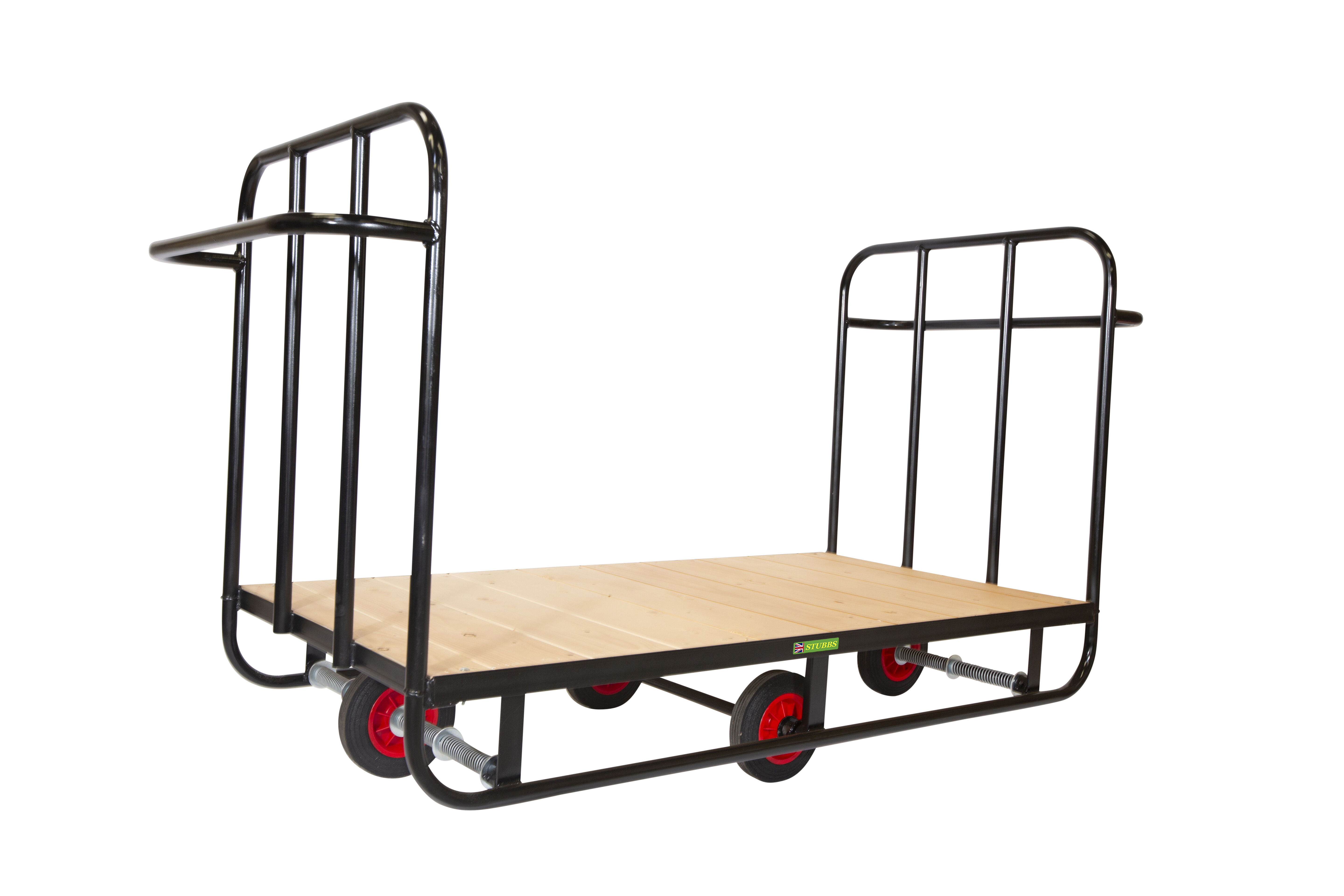
Everything you need to know about the UK's most trusted easy steer platform trucks — features, specifications, applications, and how to choose the right model for your operation.
Introduction: Why the Right Load Truck Makes All the Difference
In any warehouse, factory, school, or commercial environment, the equipment your team uses to move heavy loads has a direct impact on productivity, safety, and operating costs. The wrong truck slows people down. It causes frustration. It leads to strain injuries, damaged goods, and wasted time. The right truck does the opposite — it makes heavy work feel manageable, keeps materials moving efficiently, and helps your operation run the way it should.
That is exactly where the Stubbs Heavy Duty Easy Steer Load Truck earns its reputation. Manufactured in the United Kingdom by a brand with roots stretching back to 1836, these platform trucks combine serious load-bearing capability with a turntable steering system that transforms the way operators navigate tight spaces, congested aisles, and complex internal routes. With a load capacity of up to 600kg and a choice of wheel configurations to suit virtually any surface, the Stubbs Easy Steer has become a go-to choice for procurement managers, facilities teams, and operations directors across the UK.
This guide covers everything you need to know before purchasing. We will walk through the key features and specifications, explain how the turntable steering mechanism works and why it matters, compare the Easy Steer with standard load trucks, explore applications across different industries, and offer practical advice on choosing the right model for your specific needs. Whether you are replacing worn-out equipment or specifying trucks for a new facility, this article will give you the information you need to make a confident, well-informed decision.
What Is an Easy Steer Load Truck?
Before diving into the specifics of the Stubbs range, it is worth understanding what separates an easy steer load truck from a standard platform truck — and why that distinction matters in practice.
A standard platform truck, sometimes called a flatbed trolley or warehouse truck, typically has four wheels mounted on fixed axles. The operator pushes or pulls the truck in a straight line, and changing direction requires physically manoeuvring the entire unit. With light loads on smooth, open floors, this is manageable. But when loads are heavy, spaces are cramped, or routes involve frequent turns, a fixed-axle truck becomes difficult and tiring to control. Operators end up wrestling with the equipment rather than using it as the labour-saving tool it is supposed to be.
An easy steer load truck solves this problem with a turntable steering mechanism. The front axle is mounted on a rotating turntable, connected to the pull handle. When the operator changes the angle of the handle, the front wheels follow, allowing the truck to be guided smoothly around corners, through doorways, and along winding routes without the need to reposition the entire truck manually. The result is a dramatic improvement in manoeuvrability, especially under heavy loads, and a significant reduction in the physical effort required to navigate complex environments.
For any operation where loads regularly exceed 200kg, where routes involve more than straightforward point-to-point transport, or where multiple operators of varying physical capabilities need to use the same equipment, the easy steer design offers a measurable advantage over standard platform trucks.
Stubbs: A Heritage of British Manufacturing Excellence
The Stubbs name carries real weight in the UK industrial equipment market. Founded in 1836, Stubbs has been manufacturing robust, practical equipment for nearly two centuries. The brand originally established itself in the agricultural sector, producing durable goods for farms and rural estates, before expanding into equestrian equipment and industrial handling products.
What has remained constant throughout this long history is a commitment to quality British manufacturing. Every Stubbs Heavy Duty Easy Steer Load Truck is designed and built in the UK, using materials and processes that reflect decades of accumulated expertise. This is not a brand that outsources production to cut costs. It is a manufacturer that takes pride in the durability, fit, and finish of every product that leaves its factory.
For buyers, this heritage translates into tangible benefits. UK manufacturing means shorter lead times, consistent quality standards, and a product that has been engineered specifically for British working conditions — from the climate and terrain to the health and safety regulations that govern UK workplaces. When you invest in a Stubbs truck, you are buying equipment backed by a manufacturer with a genuine track record of performance and reliability.
The brand's long-standing presence in sectors like education, local government, agriculture, and industry also means that Stubbs understands the real-world demands these environments place on handling equipment. The Easy Steer Load Truck is not a product designed in isolation. It is the result of continuous refinement, informed by feedback from the operators, facilities managers, and procurement teams who use Stubbs equipment every day.
Key Features and Specifications of the Stubbs Heavy Duty Easy Steer Load Truck
Understanding the features and specifications of the Stubbs Easy Steer Load Truck in detail will help you assess whether it is the right fit for your operation. Here is a thorough breakdown of what this truck offers.
Load Capacity: Up to 600kg
The Stubbs Easy Steer is rated for loads of up to 600kg, placing it comfortably in the heavy-duty category. This capacity is sufficient for the vast majority of manual material handling tasks encountered in warehouses, factories, schools, retail stockrooms, and public sector facilities. It accommodates everything from stacked boxes and packaged goods to tools, furniture, catering supplies, and maintenance equipment.
A 600kg capacity also provides a practical safety margin. In day-to-day use, operators are unlikely to load the truck to its absolute maximum on every trip. Having headroom above typical load weights means the truck operates within a comfortable range, reducing stress on the frame, wheels, and steering mechanism and extending the working life of the equipment.
Turntable Steering Mechanism
The centrepiece of the Easy Steer design is its turntable steering system. The front axle is mounted on a rotating plate that is mechanically linked to the pull handle. As the operator adjusts the handle angle, the front wheels pivot accordingly, allowing the truck to follow curved paths, navigate tight turns, and thread through narrow gaps that would be difficult or impossible with a fixed-axle truck.
This is not a gimmick or a minor convenience feature. In environments where space is limited — between racking rows, through standard-width doorways, along corridors, around parked vehicles or other equipment — turntable steering is a genuine productivity enhancer. It allows operators to maintain forward momentum through turns rather than stopping, repositioning, and restarting. Over the course of a shift, this translates into meaningful time savings and significantly less physical fatigue.
Robust Angle Steel Frame
The truck's chassis is constructed from angle steel, providing a rigid, strong framework that resists bending, twisting, and impact damage. Angle steel is a proven material choice for heavy-duty handling equipment — it offers excellent strength-to-weight characteristics and can be welded and finished to a high standard. The frame is designed to distribute loads evenly across the platform, preventing localised stress points that could lead to premature wear or failure.
Durable Enamel Paint Finish
The steel frame is protected with a hardwearing enamel paint finish, typically in the distinctive Stubbs dark green colour. This coating provides effective protection against corrosion, scratches, and general wear, ensuring the truck maintains both its structural integrity and its professional appearance through years of demanding use. For environments where trucks are used outdoors or in damp conditions, this corrosion resistance is particularly valuable.
Timber Deck Platform
The load platform features a timber deck, providing a flat, stable surface that accommodates a wide range of load types. Timber offers several practical advantages for a platform truck deck: it provides natural grip that helps prevent loads from sliding, it absorbs minor impacts without transferring excessive vibration, and it can be replaced relatively easily if it becomes damaged after years of heavy use.
The timber deck is securely mounted to the steel frame, creating a solid, rattle-free platform that feels stable and dependable even when carrying heavy loads at speed.
Folding Handle
The ergonomic pull handle is designed for comfortable operation and folds down flat when the truck is not in use. This folding feature is more important than it might initially appear. In busy workplaces where floor space is at a premium — or in storerooms and equipment cupboards where trucks need to be parked compactly between uses — a folding handle can make the difference between convenient storage and an awkward obstruction.
The handle itself is positioned and angled to provide a natural, comfortable grip for operators of different heights, reducing wrist and shoulder strain during extended use.
Choice of Wheel Types
The Stubbs Easy Steer is available with two main wheel options, each suited to different operating environments:
Solid Cushioned Rubber Wheels — These wheels are made from solid rubber, meaning they cannot puncture, go flat, or require inflation. They provide a smooth, quiet ride on hard, even surfaces such as warehouse concrete, factory floors, tiled corridors, and tarmac. For purely indoor operations, or environments where puncture risk is a concern, solid rubber wheels are the low-maintenance, zero-downtime choice.
Pneumatic Wheels — Pneumatic (air-filled) wheels offer superior shock absorption and a softer ride, making them the preferred option for outdoor use and rough or uneven surfaces. They handle gravel, grass, compacted earth, construction debris, and paved surfaces with ease, cushioning the load and reducing vibration. The trade-off is that pneumatic tyres can puncture, although quality pneumatic wheels on a truck of this calibre are robust and punctures are relatively uncommon in normal use.
Selecting the right wheel type for your primary operating environment is one of the most important decisions you will make when specifying your truck. If your operation involves both indoor and outdoor use, pneumatic wheels are generally the more versatile choice, as they perform adequately on smooth indoor surfaces while excelling outdoors.
How Turntable Steering Works — And Why It Matters
The turntable steering mechanism is the feature that elevates the Stubbs Easy Steer above standard platform trucks, so it is worth understanding how it works and what benefits it delivers in practical terms.
The Mechanics
In a turntable steering system, the front axle of the truck is not rigidly fixed to the chassis. Instead, it sits on a circular turntable plate — a rotating disc that allows the axle to pivot freely relative to the main frame. The pull handle is connected to this turntable, so when the operator changes the direction of the handle, the front axle and wheels rotate to match.
The effect is similar to the front-wheel steering on a car. The rear wheels maintain a stable, straight track, while the front wheels turn to guide the truck along the desired path. This gives the operator precise, intuitive control over the truck's direction of travel, even when the platform is carrying a heavy load.
Benefits in Practice
The practical advantages of turntable steering become most apparent in the environments and situations where standard trucks struggle:
Tight corners and narrow aisles. In warehouses with closely spaced racking, or in older buildings with narrow corridors and doorways, a fixed-axle truck often requires a multi-point turn to change direction. A turntable truck sweeps through the same turn in one smooth motion.
Congested work areas. Factory floors, loading bays, and retail stockrooms are frequently cluttered with other equipment, pallets, and obstacles. Turntable steering allows operators to weave through these spaces with confidence, reducing the risk of collisions and the time spent navigating around obstructions.
Frequent direction changes. If your material handling routes involve multiple turns — for example, moving goods from a delivery bay, through corridors, into a lift, along another corridor, and into a storage area — the cumulative benefit of easier steering is substantial. Each turn that takes less effort and less time adds up over the course of a shift.
Reduced operator fatigue. Perhaps the most significant long-term benefit is the reduction in physical effort. Manoeuvring a heavy, fixed-axle truck through turns requires considerable upper body strength and can strain the shoulders, back, and wrists. Turntable steering eliminates much of this effort, making the truck accessible to a wider range of operators and reducing the risk of musculoskeletal injuries.
Fewer goods in transit incidents. Better control means fewer accidental collisions with walls, racking, doorframes, and other infrastructure. This protects both the goods being transported and the building itself, reducing damage costs and keeping your operation running smoothly.
Stubbs Easy Steer vs Standard Load Trucks: A Detailed Comparison
If you are deciding between the Stubbs Heavy Duty Easy Steer Load Truck and a standard Stubbs Heavy Duty Load Truck (or similar fixed-axle platform trucks from other manufacturers), this comparison will help clarify which option best suits your needs.
Steering and Manoeuvrability
The most obvious difference is the steering system. The Easy Steer's turntable mechanism provides significantly better manoeuvrability, particularly in tight spaces and around corners. Standard load trucks rely on the operator physically pushing or pulling the entire truck into a new direction, which becomes increasingly difficult as load weight increases.
Choose Easy Steer if: Your routes involve multiple turns, narrow spaces, or congested areas. Choose Standard if: Your routes are primarily straight, open, and unobstructed.
Load Capacity
The Easy Steer offers a 600kg load capacity, while the standard Stubbs Heavy Duty Load Truck is typically rated at up to 500kg. If your operation regularly handles loads in the 500 to 600kg range, the Easy Steer provides additional capacity alongside its superior steering.
Choose Easy Steer if: You need to move loads above 500kg or want additional capacity headroom. Choose Standard if: Your typical loads are comfortably below 500kg.
Operator Comfort and Fatigue
For operators making multiple trips per shift — particularly trips involving directional changes — the Easy Steer reduces cumulative physical strain considerably. The turntable mechanism means less wrestling with the truck, less upper body effort, and less risk of repetitive strain injury. If you have a diverse workforce including operators of varying physical strength and fitness, the Easy Steer is the more inclusive choice.
Choose Easy Steer if: Operator wellbeing and manual handling risk reduction are priorities. Choose Standard if: Trips are short, infrequent, and primarily straight-line.
Price
The Easy Steer typically costs more than a standard load truck due to the additional engineering of the turntable mechanism. However, for operations where the enhanced manoeuvrability delivers genuine productivity gains and helps prevent workplace injuries, the additional investment pays for itself quickly. Reduced operator fatigue means fewer sick days. Better control means fewer damage incidents. Faster navigation means more trips per shift.
Choose Easy Steer if: The total cost of ownership matters more than the upfront purchase price. Choose Standard if: Budget is the overriding factor and your environment does not demand advanced steering.
Summary Table
| Feature | Easy Steer | Standard |
|---|---|---|
| Steering type | Turntable | Fixed axle |
| Load capacity | Up to 600kg | Up to 500kg |
| Manoeuvrability | Excellent | Moderate |
| Tight space performance | Excellent | Limited |
| Operator fatigue | Lower | Higher |
| Storage (folding handle) | Yes | Yes |
| Wheel options | Solid rubber / Pneumatic | Solid rubber / Pneumatic |
| UK manufactured | Yes | Yes |
| Best for | Complex routes, tight spaces, heavy loads | Open spaces, straight routes, lighter loads |
Industry Applications: Where Stubbs Easy Steer Load Trucks Excel
One of the strengths of the Stubbs Easy Steer is its versatility. The combination of heavy-duty construction, generous load capacity, and exceptional manoeuvrability makes it suitable for a wide range of industries and environments. Below we explore the most common applications in detail.
Warehousing and Distribution
Warehouses are arguably the environment where easy steer trucks deliver the greatest return on investment. Narrow aisles between racking systems, busy loading bays with multiple vehicles being unloaded simultaneously, and complex internal routes between receiving, storage, picking, and dispatch areas all benefit from turntable steering.
Operators in distribution centres frequently make dozens or even hundreds of trips per shift, often carrying loads that approach the truck's maximum capacity. The Easy Steer's 600kg capacity and smooth steering reduce the time taken per trip and the physical toll on the operator. Over the course of a year, this can translate into measurable productivity improvements and a reduction in manual handling-related absence.
For warehouses operating just-in-time logistics or fast-turnaround order fulfilment, any equipment that shaves seconds off each movement contributes to meeting tight dispatch windows and maintaining service levels.
Manufacturing and Production
Factory environments present their own set of challenges for material handling. Production lines often create narrow corridors between machinery. Work-in-progress materials need to move between stations on specific routes. Finished goods must be transported to packing areas and then to dispatch, often through spaces that were not designed with large handling equipment in mind.
The Stubbs Easy Steer is well suited to this environment. Its ability to navigate around machinery, through fire doors, and along corridors without the operator needing to perform awkward multi-point turns keeps production flowing. The robust steel frame and timber deck can handle the kind of loads typical in manufacturing — metal components, heavy tooling, packaged products, and raw materials.
For lean manufacturing operations that rely on efficient material flow to minimise waste and maximise throughput, the Easy Steer is a practical tool that supports continuous improvement objectives.
Education — Schools, Colleges, and Universities
Educational establishments have increasingly become significant users of heavy-duty handling equipment. Schools and colleges need to move furniture for exams and events, transport catering supplies between kitchens and dining halls, shift IT equipment between classrooms, and support grounds maintenance teams with tool and material transport.
The Stubbs Easy Steer is particularly well suited to educational settings because it is easy enough for any member of staff to operate — from caretakers and facilities managers to teaching assistants helping with event setup. The turntable steering makes it straightforward to navigate through corridors, around corners, and through standard-width doors, which are common features in school buildings that were not designed for industrial-scale material handling.
The choice of pneumatic wheels also makes these trucks invaluable for grounds maintenance teams who need to move equipment, plants, fencing, and materials across playing fields, courtyards, and pathways.
Local Authorities and Public Sector
Councils, housing associations, NHS trusts, and other public sector organisations manage large estates with diverse material handling requirements. Parks and recreation teams need to move equipment and supplies across open green spaces. Maintenance teams need to transport tools and materials between buildings and across campuses. Estates managers need to shift furniture, archives, and supplies during office relocations and refurbishments.
Stubbs trucks are a common sight in public sector environments across the UK, and the Easy Steer variant is increasingly popular because it allows smaller teams to handle heavier tasks without requiring powered equipment or additional personnel. The robust construction and UK manufacturing also align well with public sector procurement requirements around quality, durability, and domestic sourcing.
Construction and Building Sites
Construction sites are demanding environments for any piece of equipment. Surfaces are uneven, debris is common, loads are heavy, and space can be tight — particularly during the later stages of a build when internal walls and partitions are in place.
The Stubbs Easy Steer Load Truck with pneumatic wheels handles construction site conditions effectively. The air-filled tyres absorb the bumps and vibrations of rough terrain, while the turntable steering allows operators to navigate around scaffolding, material stacks, and partially completed structures. The 600kg capacity covers most construction material handling tasks that would otherwise require multiple trips with a lighter truck.
For site managers focused on efficiency and safety, providing the right handling equipment helps keep the project on schedule and reduces the risk of manual handling injuries that can lead to costly delays and compensation claims.
Retail and Hospitality
Behind the scenes of every retail store, supermarket, hotel, and event venue is a logistics operation that relies on efficient material handling. Stock deliveries need to be moved from loading bays to stockrooms and then to the shop floor. Furniture and equipment need to be rearranged for events. Catering supplies need to move between storage, kitchens, and service areas.
The Easy Steer truck's ability to navigate the narrow corridors and tight storage areas typical of retail and hospitality environments makes it a practical choice for these sectors. The folding handle allows the truck to be stored compactly when not in use, which is important in establishments where back-of-house space is limited.
Agriculture and Horticulture
Given Stubbs' agricultural heritage, it is fitting that the Easy Steer Load Truck is also well suited to farming, garden centre, and horticultural environments. Moving sacks of feed, trays of plants, fencing materials, tools, and equipment across yards, between outbuildings, and along uneven paths are all tasks that benefit from the combination of heavy-duty construction, large wheels, and easy steering.
For garden centres and nurseries, the truck can also serve as a practical way to move display stock, bulk compost deliveries, and seasonal merchandise around the site.
Manual Handling Regulations and Risk Reduction
Investing in the right handling equipment is not just a matter of operational efficiency — it is also a legal and moral obligation. The Manual Handling Operations Regulations 1992 (as amended) require UK employers to avoid hazardous manual handling operations where reasonably practicable, assess risks that cannot be avoided, and reduce the risk of injury as far as reasonably practicable.
The Health and Safety Executive (HSE) consistently identifies manual handling as one of the leading causes of workplace injury in the UK, with musculoskeletal disorders accounting for a significant proportion of working days lost each year. Back injuries, shoulder strain, and repetitive strain injuries are all common among workers who regularly push, pull, or carry heavy loads without appropriate equipment.
The Stubbs Heavy Duty Easy Steer Load Truck directly addresses these risks in several ways.
Eliminating unnecessary lifting. The low-level timber deck allows loads to be placed directly onto the platform without excessive lifting, bending, or twisting.
Reducing push and pull forces. The turntable steering mechanism and quality wheel bearings minimise the force required to move and steer the truck, even at full load. This is particularly important given that HSE guidance identifies excessive push and pull forces as a significant manual handling risk factor.
Improving control. Better steering control means operators are less likely to lose control of a loaded truck on slopes, around corners, or in congested areas, reducing the risk of sudden, uncontrolled movements that can cause injury.
Enabling a wider range of operators. Because the Easy Steer requires less physical effort than a fixed-axle truck, it can be used safely by operators of varying physical capabilities, reducing the risk that specific tasks are only manageable for the strongest members of the team.
For employers conducting manual handling risk assessments, specifying equipment like the Stubbs Easy Steer demonstrates a proactive approach to risk reduction and provides evidence of compliance with regulatory requirements.
Choosing the Right Stubbs Easy Steer Load Truck: A Practical Buying Guide
Selecting the right specification of Easy Steer truck ensures you get the best possible performance and value from your investment. Here are the key factors to consider.
Assess Your Typical Loads
Start by understanding what you will actually be carrying. Consider both the weight and the physical characteristics of your typical loads. Heavy, compact items like stacked boxes stress the platform differently from large, awkward items like furniture or long materials. While the 600kg load capacity provides generous headroom, it is good practice to ensure your heaviest regular loads fall comfortably within the rated capacity rather than pushing it to the limit.
Think also about load security. If you regularly carry items that could shift or slide during transport, you may want to consider whether the flat timber deck alone is sufficient, or whether you need to add straps, edge rails, or other load retention accessories.
Evaluate Your Routes and Environment
The characteristics of your internal transport routes are the most important factor in determining whether the Easy Steer is the right choice (as opposed to a standard truck) and which wheel type you need.
Walk the routes your operators actually use. Note the width of corridors and doorways. Identify tight corners, ramps, and transitions between different floor surfaces. Check for obstacles, pinch points, and areas where congestion regularly occurs. If your routes involve multiple turns, narrow sections, or shared spaces with pedestrians and other traffic, the turntable steering of the Easy Steer will deliver clear benefits.
For wheel selection, assess the surfaces your truck will operate on. Smooth, hard indoor floors suit solid rubber wheels. Outdoor routes, rough surfaces, gravel, or grass call for pneumatic wheels. If you operate across both indoor and outdoor environments, pneumatic wheels offer the greatest versatility.
Consider Your Operators
Think about who will be using the truck. If you have a diverse team with varying levels of physical fitness and strength, the Easy Steer's reduced effort requirements make it a more inclusive choice. If operators work long shifts with frequent material handling tasks, the ergonomic benefits of turntable steering become increasingly important over the course of the day.
Training requirements are minimal for the Easy Steer — the controls are intuitive, and most operators can become proficient within minutes. However, it is still good practice to provide basic training on safe loading, maximum capacity, and correct steering technique, particularly for operators who are unfamiliar with turntable trucks.
Factor in Total Cost of Ownership
The purchase price of the truck is only one component of its total cost over its working life. Consider also:
Maintenance costs. Stubbs trucks are built for durability with minimal maintenance requirements. Solid rubber wheels need no inflation or puncture repair. Pneumatic wheels may occasionally require attention but are robust in normal use. The steel frame and enamel finish resist corrosion and wear.
Downtime costs. A truck that breaks down or needs frequent repair costs far more in lost productivity than the repair itself. Stubbs trucks are designed for continuous, heavy-duty use and are built to last for years.
Injury-related costs. Manual handling injuries carry direct costs (sick pay, medical treatment, temporary staff cover) and indirect costs (lost productivity, reduced morale, potential HSE investigation). Equipment that reduces injury risk delivers a return that far exceeds its purchase price.
Replacement cycle. A cheap truck that needs replacing after two years costs more over ten years than a quality truck that lasts for eight. Stubbs trucks are built to provide years of reliable service, making them a sound long-term investment.
Think About Storage
If storage space is limited in your facility, the folding handle of the Easy Steer is a valuable feature. Measure your available storage area and confirm that the truck (with handle folded) will fit. In very tight storage situations, consider whether you could wall-mount hooks or use vertical storage methods to keep the truck accessible without consuming floor space.
Maintenance and Care: Getting the Most from Your Stubbs Easy Steer
One of the advantages of the Stubbs Easy Steer Load Truck is its straightforward, low-maintenance design. However, like any piece of industrial equipment, a small amount of regular attention will help maximise its performance and working life.
Regular Inspections
Establish a simple routine inspection schedule. Before each shift, operators should carry out a quick visual check of the truck, looking for obvious damage to the frame, deck, wheels, and handle. Any loose bolts, cracked timber, damaged wheels, or steering issues should be reported and addressed before the truck is used.
On a monthly or quarterly basis, conduct a more thorough inspection. Check the turntable mechanism for smooth, free movement. Inspect wheel bearings for wear or excessive play. Examine the timber deck for cracks, splinters, or warping. Check the handle hinge mechanism for tightness and correct operation.
Wheel Maintenance
Solid rubber wheels require virtually no maintenance. Periodically check that they are securely mounted and that the rubber is not excessively worn or cracked. On hard surfaces, solid rubber wheels will last for years under normal use.
Pneumatic wheels should be checked regularly for correct inflation pressure (refer to the manufacturer's specifications). Under-inflated tyres increase rolling resistance, making the truck harder to push, and increase the risk of tyre damage. Inspect pneumatic tyres for cuts, punctures, and general tread wear. Keep a puncture repair kit or spare inner tubes on hand to minimise downtime if a puncture occurs.
Turntable Mechanism
The turntable steering should operate smoothly and freely. If you notice any stiffness, grinding, or resistance when steering, clean the turntable area to remove debris and apply a suitable lubricant as recommended by the manufacturer. Do not allow dirt, grit, or debris to accumulate around the turntable, as this can cause premature wear and impair steering performance.
Timber Deck
Inspect the timber deck periodically for damage. Minor surface wear is normal and does not affect performance. However, if the timber becomes cracked, heavily splintered, or warped, it should be replaced to maintain a safe, stable loading surface. The deck is designed to be replaceable, so this is a relatively straightforward maintenance task that extends the overall life of the truck.
Paint and Finish
The enamel paint finish protects the steel frame from corrosion. If the paint becomes chipped or scratched through heavy use, touch up the affected areas with a suitable metal paint to maintain the protective barrier. This is particularly important for trucks that are used outdoors or in damp environments where exposed steel would be vulnerable to rust.
Record Keeping
Maintaining a simple log of inspections, maintenance actions, and any repairs helps you track the condition of your trucks over time, plan replacement cycles, and demonstrate compliance with workplace equipment regulations. It also helps identify recurring issues that might indicate a need to adjust how the truck is being used or stored.
The ROI of Investing in Quality Handling Equipment
For budget-conscious procurement managers, it can be tempting to opt for the cheapest available platform truck. However, the total return on investment from quality handling equipment like the Stubbs Easy Steer frequently outweighs the initial price difference. Here is how the numbers work in practice.
Productivity Gains
Consider a warehouse operation where an operator makes 40 internal trips per shift, each involving at least one tight turn. If the Easy Steer saves just 15 seconds per trip compared to a standard fixed-axle truck (a conservative estimate given the manoeuvrability advantage), that adds up to 10 minutes per shift, 50 minutes per five-day week, and over 43 hours per year — per operator. Multiply that across a team of five operators, and you are recovering over 215 hours of productive time annually. At an average labour cost of £15 per hour, that represents over £3,200 in recovered productivity from a single equipment investment.
Injury Reduction
The HSE estimates that the average cost of a workplace musculoskeletal disorder to a UK employer is several thousand pounds when you factor in sick pay, temporary cover, reduced productivity during recovery, and potential increases in insurance premiums. Even one prevented injury per year can offset the cost of upgrading to Easy Steer trucks across an entire operation.
Equipment Longevity
Stubbs trucks are built to last. While cheap platform trucks from unbranded or overseas manufacturers may need replacing every two to three years, a well-maintained Stubbs Easy Steer can provide reliable service for five to ten years or more. Over a decade, the Stubbs truck often works out cheaper per year of service than its budget alternatives — before you even factor in the productivity and safety benefits.
Reduced Damage Costs
Better steering control means fewer accidental collisions with walls, doorframes, racking, and other infrastructure. It also means fewer incidents of goods being damaged in transit. For operations handling high-value products or fragile materials, the improved control offered by turntable steering can prevent costly damage incidents that would otherwise erode your margins.
Frequently Asked Questions About Stubbs Heavy Duty Easy Steer Load Trucks
What is the maximum load capacity of the Stubbs Easy Steer Load Truck?
The Stubbs Heavy Duty Easy Steer Load Truck is rated for loads of up to 600kg. This capacity is suitable for the vast majority of manual material handling tasks in warehouses, factories, schools, retail environments, and public sector facilities.
How does the turntable steering work?
The turntable steering uses a rotating plate mounted between the front axle and the main chassis. The pull handle is connected to this turntable, so when the operator changes the angle of the handle, the front wheels pivot to follow. This gives the operator smooth, intuitive directional control without needing to reposition the entire truck.
What wheel options are available?
The Stubbs Easy Steer is available with solid cushioned rubber wheels (ideal for indoor use on smooth surfaces) or pneumatic wheels (better suited to outdoor use and rough or uneven terrain). Your choice should be based on the primary surfaces your truck will operate on.
Is the Stubbs Easy Steer Load Truck manufactured in the UK?
Yes. All Stubbs products are designed and manufactured in the United Kingdom. The brand has been producing quality equipment in Britain since 1836.
Does the handle fold down for storage?
Yes. The ergonomic pull handle folds flat when the truck is not in use, allowing for compact storage in equipment cupboards, storerooms, or against walls.
How does the Easy Steer compare to a standard Stubbs Load Truck?
The Easy Steer offers turntable steering for superior manoeuvrability, a higher load capacity of 600kg (compared to 500kg on the standard model), and reduced operator fatigue. The standard model is a simpler, more affordable option suited to straightforward, open-route transport where advanced steering is not required.
What maintenance does the Easy Steer require?
Maintenance requirements are minimal. Regular visual inspections, periodic checking of wheel condition and turntable mechanism, and basic care of the timber deck and paint finish are all that is typically needed. Pneumatic wheels may occasionally require inflation or puncture repair.
Can the Easy Steer handle outdoor use?
Yes, particularly when fitted with pneumatic wheels. The robust construction and large wheels allow it to handle grass, gravel, compacted earth, and other outdoor surfaces commonly found on school grounds, parks, construction sites, and agricultural settings.
Is any training required to operate the truck?
The Easy Steer is intuitive to operate, and most people can use it effectively within minutes. However, it is good practice to provide basic training on safe loading, maximum capacity, correct steering technique, and pre-use inspection. This helps ensure safe operation and extends the life of the equipment.
How long will a Stubbs Easy Steer Load Truck last?
With normal use and basic maintenance, a Stubbs truck is built to provide many years of reliable service. The robust steel frame, durable enamel finish, and quality components are designed for long-term, heavy-duty use. Many Stubbs trucks remain in active service for a decade or more.
Where can I buy Stubbs Easy Steer Load Trucks?
Stubbs Heavy Duty Easy Steer Load Trucks are available from Hall-Fast, one of the UK's leading industrial supplies specialists. You can order online, call the sales team on 01623 645645, or email sales@hall-fast.com for expert advice and a competitive quote.
Why Buy Your Stubbs Easy Steer Load Truck from Hall-Fast?
Hall-Fast is one of the UK's most established and respected industrial equipment suppliers, with decades of experience helping businesses, public sector organisations, and educational institutions find the right equipment for their needs. Here is what sets Hall-Fast apart as your supplier of choice for Stubbs handling equipment.
Genuine Stubbs Products at Competitive Prices
Hall-Fast is an authorised stockist of Stubbs products, meaning you receive genuine, UK-manufactured equipment with full manufacturer backing. Pricing is competitive, and the team is always happy to provide quotes for larger orders or ongoing supply requirements.
Expert Product Advice
The Hall-Fast sales team has extensive knowledge of the handling and lifting equipment market. If you are unsure which Stubbs model, wheel type, or configuration is right for your application, they can provide practical, experience-based guidance to help you make the right choice. This is not a faceless online retailer — it is a team of people who understand industrial equipment and are genuinely invested in helping you find the best solution.
Fast UK Delivery
Hall-Fast offers delivery across the UK mainland, with many items available for quick dispatch. For Stubbs trucks, which are made to order, the team can provide accurate lead times and keep you informed throughout the ordering process.
ISO 9001:2015 Certified
Hall-Fast operates to ISO 9001:2015 quality management standards, giving you confidence that every aspect of the purchasing process — from order accuracy to product quality to after-sales support — meets a consistently high standard.
A Complete Industrial Supplies Partner
Beyond Stubbs trucks, Hall-Fast offers an extensive range of industrial and commercial equipment, from platform trucks and sack trucks to workwear, PPE, fasteners, tools, and storage solutions. This means you can consolidate your equipment purchasing with a single, trusted supplier, simplifying procurement and often unlocking better terms.
Sustainability and Environmental Considerations
In an era where businesses are increasingly expected to demonstrate environmental responsibility, the sourcing and longevity of your equipment matters. Choosing a Stubbs Heavy Duty Easy Steer Load Truck aligns with several sustainability principles that are worth highlighting.
UK Manufacturing Reduces Transport Emissions
Every Stubbs truck is manufactured in the United Kingdom. Compared to equivalent products shipped from factories in Asia or Eastern Europe, UK-manufactured equipment carries a significantly lower carbon footprint from transportation alone. There are no container ships crossing oceans, no lengthy road haulage journeys from distant ports, and no complex international supply chains contributing to unnecessary emissions. For organisations that report on Scope 3 emissions or that are working towards net zero targets, sourcing UK-manufactured equipment is a straightforward way to reduce the environmental impact of procurement.
Built to Last, Not to Replace
The single most sustainable piece of equipment is one that does not need to be replaced. Cheap, poorly made platform trucks that fail after two or three years create waste — both the discarded truck itself and the resources consumed in manufacturing and shipping its replacement. A Stubbs Easy Steer truck, built to last a decade or more, represents a fundamentally more sustainable approach. The longer the equipment remains in service, the lower its environmental impact per year of use.
Repairable, Not Disposable
The Stubbs Easy Steer is designed with repairability in mind. The timber deck can be replaced if damaged. Wheels can be swapped out when worn. The steel frame can be repainted to restore corrosion protection. This modular approach to maintenance means that individual components can be renewed without scrapping the entire truck — a contrast to budget alternatives where a single failure often means the whole unit is discarded.
Recyclable Materials
At the end of its long working life, the Stubbs Easy Steer is constructed from materials that are widely recyclable. Steel, timber, and rubber all have established recycling pathways in the UK. This means that when the truck eventually does reach the end of its service, its materials can re-enter the manufacturing cycle rather than going to landfill.
For procurement teams writing sustainability reports or demonstrating compliance with environmental management systems such as ISO 14001, choosing durable, UK-manufactured, repairable equipment from established brands like Stubbs is a decision that supports your environmental objectives as well as your operational ones.
Common Mistakes to Avoid When Buying Platform Trucks
Over the years, Hall-Fast's sales team has seen many customers make purchasing decisions they later regret. Here are some of the most common mistakes — and how to avoid them.
Buying on Price Alone
The cheapest truck is almost never the best value. Low-cost platform trucks often use thinner steel, inferior wheel bearings, flimsy decks, and poor-quality paint finishes. They wear out faster, require more frequent repair, and provide a worse experience for operators. Always consider the total cost of ownership over the expected life of the equipment, not just the purchase price.
Ignoring the Operating Environment
A truck that performs perfectly on a smooth warehouse floor may be completely inadequate on a gravel path or a construction site. Before purchasing, map out the actual routes and surfaces your truck will need to handle. If there is any outdoor use, any rough surfaces, or any significant slopes, make sure your wheel selection and truck specification can cope.
Underestimating the Importance of Steering
Many buyers default to standard fixed-axle trucks without considering how much time and effort their operators spend manoeuvring around obstacles. If your environment involves anything more than straight-line transport on open floors, the turntable steering of the Easy Steer will deliver meaningful benefits. Spend a day observing how your team actually uses their current trucks before deciding what to replace them with.
Overlooking Operator Feedback
The people who use the trucks every day are the best source of information about what works and what does not. Before specifying new equipment, ask your operators what frustrates them about their current trucks. Are they difficult to steer? Too heavy to push? Do the wheels get stuck? Do the handles cause discomfort? This feedback will guide you towards the right specification far more effectively than a product catalogue alone.
Forgetting About Storage
Platform trucks are large pieces of equipment. If you do not have a plan f