In a busy warehouse, the steel uprights of your pallet racking are constantly at risk. Forklifts, pallet trucks, and reach trucks operate within centimetres of the racking thousands of times a day, and even the most careful drivers cannot always avoid the occasional contact. When that contact happens, an unprotected upright can be bent, kinked, or written off in a single moment — taking the bay out of service, requiring expensive repair or replacement, and potentially compromising the structural integrity of the entire racking run. Rack armour guards are the proven solution: polymer-based upright guards that absorb the impact energy and protect the steel behind them, keeping your warehouse safe, certified, and operational.
Hall-Fast Industrial Supplies is one of the UK's leading distributors of authentic Rack Armour rack guards. Browse our full range on the Rack Armour brand page, learn about Hall-Fast on the About page, or get in touch via the contact page. Our price promise applies to every authentic Rack Armour product we supply: if you find a better price anywhere on the internet or receive a quotation, let us know and we will match it.
What are rack armour guards?
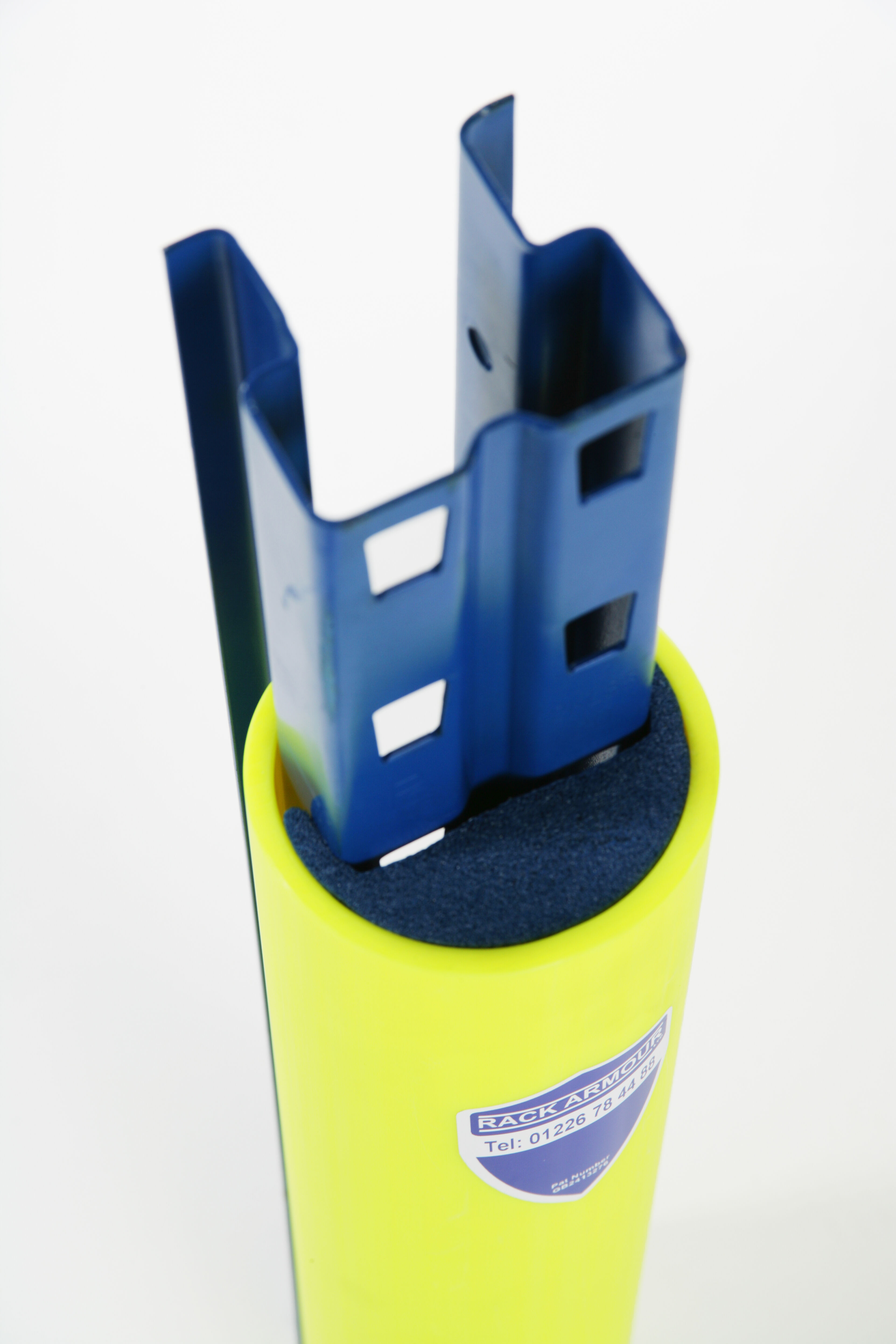
Rack armour guards — also called upright protectors, rack guards, or column guards — are protective covers that fit over the lower portion of pallet racking uprights. They are designed to take the impact when a forklift or pallet truck makes contact with the racking, dissipating the energy through the polymer body of the guard rather than allowing it to be transferred into the steel of the upright behind. The result is that the steel stays straight and structurally sound, the bay stays in service, and the warehouse keeps running.
Rack Armour is the brand name of the UK's leading rack guard product, manufactured in the United Kingdom from a proprietary polymer compound and supplied in five sizes — Small, Medium, Large, XL, and XXL — to fit the full range of standard pallet racking upright sections. The guard is designed to absorb impact energy by deforming elastically, then returning to its original shape, ready to absorb the next impact. Unlike steel guards which transfer impact energy into the floor and concrete fixings, polymer rack armour guards dissipate the energy thermally within the polymer, leaving no damage to either the guard or the surrounding warehouse structure.
The full Rack Armour range is available on the Hall-Fast Rack Armour page — five sizes, two colour finishes (safety yellow and hi-vis yellow), with UK stock for fast despatch and our price promise on every order.
Why your warehouse needs rack armour guards
Pallet racking is engineered to be light, material-efficient, and economical. Modern cold-formed steel sections give an excellent strength-to-weight ratio for vertical loading — the load case the racking is designed to handle — but the same sections are not engineered to resist sideways impact loads of the kind delivered by forklifts. A modest forklift contact at just a few miles per hour can deliver enough energy to bend an upright outside its allowable damage tolerance, requiring de-loading and replacement under SEMA guidelines.
The cost of a single damaged upright
When an upright is damaged badly enough to require replacement, the costs add up quickly. The bay must be de-loaded — labour and time, plus alternative storage for the displaced pallets. The damaged upright must be cut out and the new section installed, typically by a specialist racking contractor with an out-of-hours premium. The bay is out of service for the duration — lost capacity in a warehouse that is probably already running near full. There may be associated damage to beams or bracing that needs replacement too. And there is the audit and insurance impact — the inspector flags the damage in the report, the insurer wants to know what happened. The total cost of one damaged upright easily runs to several hundred pounds, and severe cases reach four figures.
The frequency of impacts in busy warehouses
How often does a forklift contact a rack upright? In a high-throughput warehouse, the answer is more often than most managers think. Most contacts are minor enough to leave no visible mark on the steel, but the cumulative wear adds up — and the rare significant impact is a near-certain occurrence in any operation handling pallets at scale. Industry research suggests that an unprotected warehouse running multi-shift forklift operations can expect at least one significant upright damage incident per year per several hundred bays, and frequently more. Rack armour guards intervene to absorb those impacts before they damage the steel.
The risk of catastrophic failure
Beyond the cost of repair, undamaged uprights matter for safety. A pallet racking system relies on every upright doing its job — supporting the vertical loads of the pallets above and resisting the horizontal forces from bracing and beam connections. A weakened upright can buckle under load, and a buckling upright can cascade into adjacent bays, potentially collapsing an entire racking run. Catastrophic racking collapses are rare but not unheard of, and the consequences — damage to stock, damage to the building, and most seriously injury or fatality — can be devastating. Rack armour guards help maintain the integrity of every upright by preventing the slow accumulation of impact damage that ultimately leads to upright failure.
How rack armour guards work
The science behind rack armour guards is impact-energy management. When a forklift or pallet truck contacts the guard, kinetic energy from the moving vehicle is transferred into the polymer. The polymer deforms elastically, absorbing the energy and converting much of it to heat within the polymer matrix. As the deformation peaks and reverses, the polymer returns to its original shape, dissipating the remaining energy and resetting itself ready for the next impact. Critically, the impact energy never reaches the steel upright behind the guard — or if it does, it has been so attenuated that the steel can absorb it elastically without permanent deformation.
The polymer chemistry
Rack Armour uses a proprietary polymer compound engineered specifically for high-energy-absorption, recoverable-deformation impact applications. The compound balances three properties: stiffness sufficient to spread the impact load across the full guard body rather than concentrating it at the contact point, elasticity sufficient to recover from impact without permanent deformation, and damping sufficient to convert kinetic energy into heat rather than rebounding it back into the forklift. Achieving all three simultaneously is the engineering challenge that distinguishes a high-performance rack guard from a generic plastic cover.
The geometry
The Rack Armour guard wraps around three faces of the upright section — the front and the two sides — leaving the back open to mount over the upright in retrofit. The guard is taller than the typical impact zone, so contact anywhere from floor level up to mid-bay height is covered. The cross-section is engineered to match the upright section profile precisely, ensuring full contact between guard and steel for efficient load transfer in the rare case of an impact severe enough to deform the polymer fully and start to bear on the steel directly.
The fitting mechanism
Rack armour guards are installed using a dedicated installation tool that compresses the rear flanges of the polymer body together, allowing the guard to slide over the upright. Once in position, the flanges spring back to grip the rear of the upright, mechanically locking the guard in place. The installed guard cannot rotate, slip down, or fall off in normal warehouse operation — it stays where you put it for years, ready for any impact that comes.
The five sizes of rack armour guards
Rack armour guards are supplied in five sizes to fit the full range of standard pallet racking upright section depths used across the UK and European warehouse landscape.
Small rack armour guards
The Small size suits the slimmest upright sections, typically those used in lighter-duty pallet racking, archive storage racking, and smaller stand-alone warehouse racking. Small fits uprights at the lower end of the standard depth range.
Available in two colour finishes: Small Rack Armour in safety yellow and Small Rack Armour in hi-vis yellow.
Medium rack armour guards
Medium is the most commonly specified size in UK warehouses, fitting the upright section depth used in the majority of general-purpose pallet racking systems. If you have standard general-purpose racking and have not yet measured, Medium is statistically the most likely size — though we always recommend measuring before ordering.
Available in: Medium Rack Armour in safety yellow and Medium Rack Armour in hi-vis yellow.
Large rack armour guards
Large rack armour guards fit the upright depths used in heavier-duty racking — heavy general racking, drive-in racking, and high-bay distribution centre racking where the upright section is engineered for greater vertical load and lateral stability.
Available in: Large Rack Armour in safety yellow and Large Rack Armour in hi-vis yellow.
XL rack armour guards
Extra Large rack armour guards fit the deeper upright sections used in very-heavy-duty industrial racking, very-tall high-bay racking, and certain specialist racking configurations including some cantilever and drive-through systems.
Available in: XL Rack Armour in safety yellow and XL Rack Armour in hi-vis yellow.
XXL rack armour guards
Extra Extra Large rack armour guards are the largest in the range, engineered for the deepest upright sections used in the heaviest-duty industrial racking installations. The XXL is supplied in hi-vis yellow as standard.
Available in: XXL Rack Armour in hi-vis yellow.
How to choose the right size of rack armour guard
Choosing the right size is the single most important decision when specifying rack armour guards. The wrong size will not fit properly and will not deliver the impact protection you need. Fortunately, getting the size right is straightforward — it just requires measuring.
Step 1: Measure the upright depth
Take a tape measure or steel rule and measure the depth of an upright at floor level. The 'depth' is the dimension from the front face of the upright (facing the aisle) to the back face (facing the back of the rack). Common measurements range from approximately 70 mm (typical of light-duty racking) to 130 mm or more (heavy-duty and high-bay racking). Make a note of the measurement and the location of the upright you measured.
Step 2: Sample multiple uprights
If your warehouse has racking from multiple manufacturers or installed at different times, the upright section depth may vary across the warehouse. Take measurements from a sample upright in each distinct racking type. You may need different sizes of rack armour guard for different parts of the warehouse — that is fine, and we can supply mixed quantities in a single order.
Step 3: Match to the size guide
Match your measurement to the rack armour size guide on the Hall-Fast Rack Armour brand page. Each size has a defined depth range, and your upright should fit comfortably within the range of the corresponding size. If your measurement is right at a boundary between two sizes, contact us before ordering — sometimes a photograph of the section profile helps us advise on the best fit.
Step 4: Confirm with Hall-Fast
If you are at all unsure, contact us via the Hall-Fast contact page before ordering. Send us your measurement, ideally with a photograph of the upright section, and we will confirm the right size for your racking. There is no charge for the specification advice and it saves the inconvenience of receiving the wrong size.
Choosing the right colour finish for your rack armour guards
Most rack armour guard sizes are available in two colour finishes — safety yellow and hi-vis yellow. The choice depends on your warehouse lighting, shift pattern, operational risk, and visual standards.
Safety yellow rack armour guards
Safety yellow is the conventional industrial yellow used widely on warehouse signage, walkway markings, and equipment-warning indicators. It is bright enough to stand out clearly in well-lit warehouses, it is the colour your forklift drivers will instinctively associate with caution, and it is the most economical option in the rack armour range. For warehouses with consistent overhead lighting and predominantly day-shift operation, safety yellow is an excellent choice.
Hi-vis yellow rack armour guards
Hi-vis yellow is a brighter, more fluorescent shade designed to maximise visibility in challenging conditions. It is more visible in shadowed aisles, mixed-lighting environments, dawn/dusk shift transitions, and night-shift operations. Hi-vis is recommended for cold stores (where lighting is often lower than ambient warehouse), for automated warehouses (where pedestrian visibility of forklift activity is essential), and for high-throughput distribution centres (where missed visual cues can have serious consequences). Many warehouses use hi-vis on their priority high-risk bays and safety yellow on the rest.
Mixing colours strategically
There is no rule against mixing the two colours within a single warehouse. A common pattern is to use hi-vis on the highest-risk bays — end-of-aisle, intersections, narrow aisles, and pedestrian crossings — and safety yellow on the bulk of the racking. The colour difference itself becomes a visual cue, marking the high-risk zones for forklift drivers.
Installing rack armour guards: the practicalities
One of the strengths of rack armour guards is that the installation is straightforward and can be completed by your own warehouse team without specialist contractors. The key requirements are the right tool, a sensible installation plan, and a brief period of access to each upright.
The dedicated installation tools
Rack armour guards are installed using a dedicated tool that snaps the polymer flanges into position around the upright. There are two tools — one for the smaller sizes and one for the larger sizes.
For Small and Medium guards, order the Small to Medium installation tool. For Large, XL, and XXL guards, order the Large to Extra Large installation tool. Each tool is a one-off purchase that lasts the lifetime of the warehouse and works on every guard of the relevant size, so the per-unit cost effectively reduces to zero after the first few installations.
The installation procedure
To install a rack armour guard, position the unit at the bottom of the upright with the open side of the guard facing the upright section. Slide the guard up so that the bottom of the guard is in contact with the floor — this places the protector at exactly the height where forklift contact is most likely. Use the installation tool to compress the rear flanges of the polymer together until the guard snaps into its installed position. The guard is now mechanically locked onto the upright. Inspect to confirm even contact between guard and steel on all sides, and the unit is ready for service.
Phasing the installation across a large warehouse
For comprehensive installation across a large warehouse, plan the work in phases. Most warehouses install in aisle batches — one aisle is taken offline for an hour or two while the team installs guards on every upright in the aisle, then operations resume in that aisle and the team moves to the next. Some operations install during night-shift quiet periods, others use weekend windows, and others build the install into a planned racking inspection or re-configuration. The flexibility of the snap-on retrofit installation means it can adapt to almost any operational pattern.
Installation time per bay
With practice, a two-person team can install rack armour guards on the uprights of a typical warehouse bay in just a few minutes. The first few are slower as the team learns the technique, but the rate accelerates quickly. A rough planning estimate is around half a day per 30 to 50 bays for a competent two-person team, depending on the configuration and access.
Maintaining and inspecting rack armour guards
Rack armour guards are essentially maintenance-free, but they should be included in the routine racking inspection regime to confirm the protection is still in good order.
Quarterly visual checks
The SEMA Code of Practice recommends quarterly visual checks of pallet racking by warehouse staff. Add a quick check of the rack armour guards to the same inspection. Look for any units that show signs of severe impact damage — visible deformation that does not recover, large scuffs or punctures, or signs that the unit has slipped or rotated on the upright. Most impacts leave no visible mark on the polymer, so most quarterly checks will find no action needed.
Annual independent rack inspections
The SEMA-approved annual rack safety audit by an independent inspector should also note the presence and condition of rack armour guards. A reputable inspector will record the protection in the inspection report, which supports your insurance and audit position. If any guards are noted as damaged in the inspection, replace them promptly.
Replacement of damaged guards
In the rare case where a guard is so badly damaged it needs replacement, the procedure is straightforward — the damaged unit is removed and a new one is snapped into position using the installation tool. The cost of a replacement guard is a tiny fraction of the cost of replacing a damaged steel upright, so prompt replacement is good economics. Many warehouses keep a small stock of replacement guards on site for quick refits.
Cleaning
The polymer surface of rack armour guards is washable and can be wiped down as part of normal warehouse cleaning. In food-grade or pharmaceutical environments where hygiene matters, the guards can be cleaned to the same standard as other warehouse surfaces. The colour finish is colour-stable and resistant to the cleaning chemicals typically used in warehouse environments.
Where rack armour guards are most valuable
Rack armour guards deliver value across virtually every warehouse, but the economic case is particularly strong for certain configurations and use cases.
End-of-aisle bays
End-of-aisle bays are statistically the most likely to suffer impact damage, because forklifts turn into and out of the aisle at this point. The geometry of the turn makes contact with the end upright a near-routine occurrence in busy operations. End-of-aisle uprights almost always benefit from rack armour guard protection, and many warehouses prioritise these bays in any phased rollout.
Narrow-aisle racking
Narrow-aisle racking — where the aisle width is just enough for the truck plus tolerance — relies on precision driving to avoid contact with the racking on either side. Even small deviations result in contact with the upright. Narrow-aisle warehouses see particularly high benefit from comprehensive rack armour guard installation.
Drive-in and drive-through racking
Drive-in and drive-through racking systems require forklifts to enter the rack to deposit and retrieve pallets, with the truck operating between rack uprights for several metres. Contact with the uprights is more likely than in standard selective racking, and the consequences of damage are amplified because drive-in systems often have less structural redundancy. Rack armour guards are strongly recommended for drive-in entry uprights and the internal columns.
Cold-store racking
Cold-store racking combines low ambient temperature, often-restricted lighting, and tight forklift operating tolerances. The combination raises the impact risk and amplifies the case for rack armour guard protection. The polymer compound used in Rack Armour is engineered to retain its impact-absorbing properties at chilled and frozen temperatures, and the hi-vis yellow finish is particularly effective in low-light cold-store environments.
High-bay distribution centre racking
High-bay distribution centres operate with very tall racking, very heavy bay loads, and very high pallet movement rates. The economic and safety case for rack armour guards is particularly compelling because the consequences of a collapsed bay in high-bay racking are severe. Most large UK distribution centres specify rack armour guards comprehensively across their high-bay zones.
Pedestrian-shared zones
Where pedestrians and forklifts share warehouse zones — picking aisles in low-MHE warehouses, marshalling areas, goods-in or goods-out zones — the visibility benefit of rack armour guards adds to the protection benefit. The bright yellow polymer marks the upright base clearly for pedestrian awareness as well as forklift driver awareness.
The economics of rack armour guards
The economic case for rack armour guards is straightforward and compelling. The protection cost per upright is small, the cost of even a single avoided upright replacement covers the protection of dozens of uprights, and the service life of the guards runs to a decade or more.
Cost per bay
The cost of fitting rack armour guards to all the uprights in a typical warehouse bay is modest — a few tens of pounds depending on size and colour choice. For exact current pricing, visit the Hall-Fast Rack Armour page or contact us for a quotation. Across an entire warehouse the total spend is usually a small fraction of the original racking installation cost.
Avoided cost per damage incident
The cost of one significant upright damage incident is typically several hundred pounds at minimum, and severe cases reach into four-figure totals. The avoided cost of just one incident usually covers the rack armour guard protection for many bays. Across the multi-year service life of the guards, the cumulative avoided cost typically runs to multiples of the original protection investment.
Indirect economic benefits
Beyond the direct repair savings, rack armour guards deliver several indirect economic benefits. The visible protection supports better insurance terms at renewal. Pallet racking inspection reports note the protection favourably. Audits in regulated industries (food, pharma) record the warehouse condition more positively. Operational disruption from unexpected racking outages is reduced. And the workforce — particularly forklift drivers — operates more confidently when they can see the protection clearly at every upright base.
Total cost of ownership over 10 years
Over a typical 10-year warehouse occupancy, the total cost of ownership analysis strongly favours rack armour guards. The one-time installation cost (guards plus tool plus labour) is paid back many times over by avoided damage costs, reduced insurance premiums, fewer audit findings, and better operational continuity. Most warehouses report a payback period of well under one year, with the residual nine-plus years of guard service delivering pure positive return.
Hall-Fast and the price promise
Hall-Fast operates a comprehensive price promise on every authentic Rack Armour product. If you find a better price anywhere on the internet, or if you receive a quotation from another supplier that beats ours, let us know and we will match the price. The promise applies to all five sizes of rack armour guards, both colour finishes, the installation tools, and bulk orders. There is no need to shop around — Hall-Fast will match the best price you can find.
Why we can offer the price promise
Hall-Fast is one of the largest distributors of Rack Armour in the UK, with significant order volumes that allow us to negotiate the strongest pricing from the manufacturer. Our pricing reflects that buying scale and our efficient distribution operation. The price promise is our commitment that you will not pay more by ordering through us — we will match any genuine competing offer on authentic UK-manufactured product.
Stock availability and despatch
Hall-Fast holds stock of every size and colour of rack armour guard at our UK warehouse, supporting fast despatch on every order. Most orders ship within one to two working days. For larger orders or new-build warehouse fit-outs we can usually quote a firm delivery date at the point of order. If you have an urgent requirement — perhaps a pre-audit deadline or a recent serious damage incident — let us know and we will do everything we can to expedite delivery.
Specifier support and technical advice
Our team has specified rack armour guards for warehouses across the UK, from small single-aisle operations to multi-acre distribution centres. We can advise on size, colour, quantity, phasing, and the installation tool requirement. If you can send us a measurement or a photograph of your upright, we can confirm the size you need before you place the order — there is no need to guess and no need to risk ordering the wrong product.
Wider Hall-Fast brand portfolio
If you are specifying rack armour guards as part of a wider warehouse-protection or warehouse-equipment programme, Hall-Fast can supply many related products from the same order. Browse our full brand portfolio to see the range we supply alongside Rack Armour, including warehouse safety equipment, racking accessories, PPE, signage, and many other industrial products.
Frequently asked questions about rack armour guards
What is the difference between rack armour guards and other types of rack protector?
Rack armour guards are polymer-based protectors that absorb impact energy through controlled deformation of the polymer body. Alternative protectors include bolt-down steel guards, which transfer impact energy into the floor and concrete fixings, and A-frame floor barriers, which keep traffic away from the racking entirely. Each has its place — A-frames at aisle-end pedestrian zones, steel guards in extreme-load applications — but for the vast majority of warehouse upright protection requirements, polymer rack armour guards are the most cost-effective solution because they protect the upright, recover from impact, install onto loaded racking without specialist contractors, and have a service life of a decade or more.
Will rack armour guards stop a forklift from hitting the racking?
Rack armour guards do not physically stop a forklift in its tracks — they absorb the impact energy when contact does occur, preventing damage to the steel upright. Stopping the forklift entirely would require a much heavier barrier and would in any case transfer the impact into the building structure. The polymer guard is the right answer because it protects the racking from the impact while remaining itself reusable for the next impact, in a continuous cycle over the life of the warehouse.
How thick is the polymer in a rack armour guard?
The polymer wall thickness in Rack Armour is engineered specifically to balance impact-absorbing performance, recovery characteristics, and installed footprint. The exact thickness varies across the body of the guard — thicker where the impact loading is highest, thinner where the geometry allows. The proprietary polymer compound and the engineered cross-section together deliver impact-absorbing performance that has been validated through SEMA-witnessed testing.
Are rack armour guards UK-manufactured?
Yes. Rack Armour is manufactured in the United Kingdom from the proprietary polymer compound. UK manufacturing means consistent quality control, full traceability, short supply chain, and compliance with UK product-stewardship and environmental requirements. The UK manufacturing also means short replenishment lead times — Hall-Fast stock can be replenished from the manufacturer quickly, so we maintain availability across all sizes and colours throughout the year.
Are rack armour guards SEMA approved?
Rack Armour has been independently impact-tested under SEMA-witnessed conditions, with the test results validating the impact-absorbing performance of the product. SEMA — the Storage Equipment Manufacturers' Association — is the UK industry body for storage equipment, and SEMA-witnessed testing is the recognised standard for validating rack protection performance. The test results give specifiers confidence that the published performance claims are independently verified.
Can rack armour guards be removed and re-used?
Yes. The installation tool can be used in reverse to remove a rack armour guard, and the removed guard can be re-installed on a different upright if the racking layout changes. Many warehouses re-use their rack armour guards when reconfiguring racking, getting many years of service from each unit across multiple racking layouts.
Are rack armour guards recyclable?
Yes. The polymer used in Rack Armour is recyclable in standard polymer-recycling streams. At the end of the very long service life of a guard, the polymer can be recycled rather than landfilled. The combination of long service life, refurbishment of damaged steel uprights avoided, and end-of-life recycling gives rack armour guards a strong sustainability profile.
How do I order rack armour guards from Hall-Fast?
There are two ways to order. You can buy online through the Hall-Fast Rack Armour brand page — choose the size, colour, and quantity, and check out as normal. Or contact us via the contact page or by phone or email for a personalised quotation, particularly for larger orders or if you want help with size specification. Either way the price promise applies and stock typically ships within one to two working days.
Specification checklist for rack armour guards
To make ordering rack armour guards as efficient as possible, work through this checklist before contacting us or placing your order.
• Measure the depth of a sample upright at floor level. Record the measurement in millimetres.
• If you have multiple racking types, measure each. Note any differences in upright section depth.
• Count the number of uprights you want to protect. Bear in mind that most bays have two front uprights — one at each end of the bay — and you may want to protect the back uprights too in drive-in or drive-through racking.
• Decide your colour preference: safety yellow, hi-vis yellow, or a mix based on bay risk profile.
• Identify the highest-risk bays — end-of-aisle, narrow aisle, intersections, drive-in entries, pedestrian-shared zones — and consider phasing them first.
• Add the appropriate installation tool to your order: Small/Medium tool or Large/XL tool, depending on the guard sizes you are ordering.
• Check whether you want to add any complementary protection products from the wider Hall-Fast range — A-frame barriers, bollards, signage, walkway markings.
• Get in touch with Hall-Fast for a quotation if your order qualifies for volume pricing or if you want help with the specification.
About Hall-Fast Industrial Supplies
Hall-Fast Industrial Supplies is a long-established UK distributor of industrial products to warehouses, factories, distribution centres, and other industrial users across the United Kingdom. Find out more about us on the About Hall-Fast page. Rack Armour is one of our flagship product lines, and we hold meaningful stock of every size and colour at our UK warehouse to support fast despatch on every order.
Our service is built on three commitments. First, stock availability — we hold genuine UK-manufactured Rack Armour in every size and colour to support same-week despatch on most orders. Second, expert specification support — our team can help you identify the right size, colour, and quantity for your specific warehouse, and confirm the right installation tool to add to the order. Third, competitive pricing — our price promise means we will match any genuine competing offer on authentic Rack Armour product, so you can be confident you are getting the best deal in the market.
Browse the full Rack Armour range, explore the wider Hall-Fast brand portfolio, or contact us via the contact page to discuss your warehouse protection requirement. Whether you are protecting a single high-risk aisle or specifying a comprehensive new-build warehouse fit-out, our team can help you specify, order, and install the right rack armour guards for your operation.
Conclusion
Rack armour guards are the proven, cost-effective, low-maintenance solution to one of the most persistent and economically damaging problems in warehouse operation: forklift impact damage to pallet racking uprights. Engineered from a proprietary polymer compound, manufactured in the United Kingdom, supplied in five sizes and two colour finishes to fit every standard pallet racking system, and installed using a dedicated tool that allows retrofit onto loaded racking without specialist contractors — rack armour guards deliver the protection that keeps your warehouse safe, certified, and operational.
The economic case for fitting rack armour guards is overwhelming. The cost of the protection is a small fraction of the cost of even one avoided upright replacement. The service life runs to a decade or more, with minimal maintenance. The wider benefits — better insurance terms, cleaner inspection reports, stronger audit outcomes, more confident forklift operators — add to the direct economic return. And the Hall-Fast price promise means you get authentic UK-manufactured product at the most competitive price in the market.
Order today through the Hall-Fast Rack Armour brand page, learn more about Hall-Fast on the About page, or get in touch via the contact page. Hall-Fast Industrial Supplies — your trusted partner for rack armour guards in the United Kingdom.