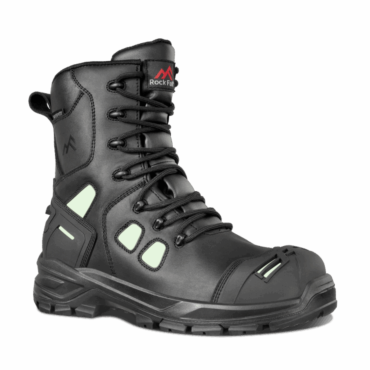
Donning and doffing your safety boots might not sound like a safety issue in itself. But if you work in shift-based environments where you're changing in and out of PPE multiple times a day, or in sectors where you move between different controlled zones, those laces represent a surprisingly meaningful friction point. Every moment spent fumbling with laces in a dark locker room, muddy changing area or cramped site cabin is time wasted – and a minor inconvenience that compounds into genuine frustration over weeks and months.
The Rock Fall RF604 Canopus VizLite Safety Boot solves this with one feature that no other safety boot in its visibility class offers: a side zip fastening. Combined with all the structural safety of traditional lace-up boots, the zip entry on the RF604 Canopus transforms the daily donning ritual into a three-second task. On, zipped, ready. Off, zipped, done.
But ease of entry is only the beginning of the RF604 Canopus story. Like its sibling the RF603 Sirius, the Canopus is built around Coats® Signal™ Lucence™ dual-technology visibility panels – a combination of glow-in-the-dark phosphorescent material and high-performance reflective coating that keeps the wearer visible in low-light and dark working environments without batteries, wires or maintenance. Layer on a fibreglass toecap, composite anti-perforation insert, fully waterproof construction, LWG Gold-certified leather, and a suite of sustainability credentials, and the RF604 Canopus is one of the most comprehensively specified safety boots available in the UK market today.
This article covers every aspect of the RF604 Canopus in depth: the technology, the safety specification, the comfort engineering, the sustainability story, and who this boot is built for. Whether you are a worker choosing your own safety footwear or a safety manager specifying PPE for a team, this guide gives you everything you need to make the right decision.
"The Rock Fall RF604 Canopus VizLite combines glow-in-the-dark visibility, full S3 WR HRO SRC safety specification and the convenience of a side zip fastening – a combination that simply doesn't exist elsewhere in the market."
1. Why Visibility at Foot Level Is a Critical and Overlooked Safety Issue
The Blind Spot in Workplace Safety Planning
Walk around any well-managed construction site, road maintenance operation or utilities worksite in the UK today, and you will see high-visibility workwear everywhere. Orange vests, yellow jackets, reflective trousers – the visual language of occupational safety is well established. The Health and Safety Executive's guidance on high-visibility clothing is broadly followed, and most employers take their obligations seriously.
Yet there is a persistent gap in how we think about worker visibility: we focus on the torso and almost entirely ignore the feet. Consider the geometry of a reversing construction vehicle or a site dumper. The driver's mirrors show them the area from bumper height upwards. The area directly behind the vehicle, at ground level, is a blind spot. A worker crouching, kneeling or working close to the ground – in precisely the zone most dangerous to them – is invisible to the driver regardless of how bright their hi-vis jacket is.
Now apply that same logic to underground environments: drainage tunnels, utility vaults, cable tunnels, mine entries. In these spaces, overhead lighting is often directional, patchy or absent. Standard reflective materials only work if there is a light source aimed at them. If the light is above the worker, their feet – again, the most vulnerable part of their body in terms of crush injuries, vehicle proximity and trip hazards – are in darkness.
Low-Light Incidents: The Scale of the Problem
The Health and Safety Executive publishes annual statistics on workplace injuries in Great Britain. Construction consistently accounts for a disproportionate number of fatal and major injuries relative to its workforce size. A significant proportion of these occur in low-light conditions: early morning site starts before adequate artificial lighting is established, winter working where natural light is limited to a narrow window, night shifts and underground environments where darkness is a constant.
Foot and lower limb injuries from struck-by incidents and run-over events in vehicle-pedestrian interface zones are among the most severe and preventable categories. The argument for improving foot-level visibility is not theoretical – it is grounded in documented incident patterns across UK industry.
The RF604 Canopus: Addressing the Gap
The Rock Fall RF604 Canopus VizLite is a direct response to this visibility gap. By integrating Coats® Signal™ Lucence™ dual-technology panels into a premium, fully-specified safety boot, Rock Fall has created footwear that works as active PPE – not just structural protection for the foot, but a visibility tool that extends the safety perimeter of the worker to include their feet in all light conditions.
Safety Manager Note: When conducting site PPE audits, check whether your high-visibility footwear policy addresses low-light conditions and underground environments specifically. Standard safety boots provide zero visibility benefit in darkness.
2. The RF604 Canopus's Defining Feature: Side Zip Fastening
Why a Zip Matters More Than You Think
The side zip fastening on the RF604 Canopus is not simply a convenience feature – for certain workers and working environments, it is a material safety and efficiency requirement that lace-up boots cannot match.
Consider the emergency services context. Firefighters, paramedics and emergency response personnel who may need to don PPE quickly in high-pressure situations have long understood the value of rapid-entry footwear. The same principle applies on worksites where shift patterns, clean-zone protocols or frequent boot changes are part of daily operations. A side zip means the boot is on and secured in seconds, every time.
For workers with mobility limitations, arthritis, hand injuries or reduced dexterity from working in cold conditions, lacing a safety boot can be a genuine practical challenge. The zip fastening removes this barrier entirely, making the RF604 Canopus accessible to a broader range of workers without any compromise on the structural integrity or support of the boot.
Structural Integrity: Does the Zip Compromise the Boot?
A common concern about zip-fastening safety boots is whether the zip mechanism introduces a weakness into the upper construction. Rock Fall's engineers have addressed this directly. The zip on the RF604 Canopus is integrated into a reinforced panel with the lacing system retained to provide structural support and a precise, adjustable fit. The zip enables fast entry and exit; the lacing ensures the boot holds the foot securely and maintains the ankle support that is critical for safety in dynamic working environments.
The TPU scuff cap and heel counter are both present and fully functional on the RF604, providing the same reinforcement of high-wear zones as on lace-only models. The zip does not pass through or compromise either of these structural elements.
Who Benefits Most from the Zip Entry?
The zip fastening on the RF604 Canopus makes it the preferred choice for several specific worker groups:
- Workers who don and doff their boots multiple times per shift – including those working across clean and dirty zones in utilities, food production sites or healthcare environments
- Shift workers who may be putting on or removing boots in dark, cramped or cold conditions where fine motor tasks like lacing are more difficult
- Workers with hand or wrist conditions – arthritis, Raynaud's syndrome or previous injuries – that make fine manipulation of laces uncomfortable
- Older workers or those returning from injury who benefit from simplified boot management
- Supervisors and site visitors who move between areas rapidly and value efficient transitions
"Three seconds from sock to safe. The RF604 Canopus's side zip transforms the daily routine of every worker who wears it."
3. Coats® Signal™ Lucence™: How the RF604 Canopus Lights Up the Dark
A Dual-Technology Approach to Visibility
The visibility system at the heart of the RF604 Canopus is Coats® Signal™ Lucence™ – a material technology developed by Coats®, one of the world's leading industrial thread and technical materials companies. Signal™ Lucence™ is not a reflective strip with a glow-in-the-dark coating applied on top. It is a genuinely dual-technology material in which both properties are intrinsic to the panel's construction.
The two technologies complement each other perfectly, covering the scenarios where single-technology solutions fall short. Reflective-only materials require an active light source aimed at them – they provide no benefit when there is no light, or when the light is positioned behind rather than in front of the worker. Glow-in-the-dark-only materials are highly effective in complete darkness after charging but do not enhance visibility in partially lit conditions. Signal™ Lucence™ provides both, simultaneously and passively, without the worker needing to do anything beyond wearing the boot.
The Phosphorescent Component: Glow That Lasts for Hours
The phosphorescent element of Signal™ Lucence™ works on the same fundamental principle as safety-critical glow-in-the-dark materials used in emergency exit signage, life jacket marking and marine safety equipment – sectors where reliable passive luminescence is a genuine life-safety requirement.
Photons from ambient light – whether sunlight or artificial lighting – are absorbed by the material and stored at a molecular level. When the ambient light dims or disappears, the stored energy is released gradually as visible green-white light. On the RF604 Canopus, the panels require just five minutes of exposure to natural daylight, or ten minutes under artificial light, to reach a full charge. After charging, the glow persists for hours – more than sufficient to cover an entire shift in low-light conditions.
The practical implication is straightforward: a worker who walks to site or through a lit building before starting an underground shift, a night shift or an early morning start in winter darkness arrives at their workstation with fully charged boots, ready to be seen without any additional action or thought.
The Reflective Component: Instant Visibility in Headlights and Torches
The reflective component of the Signal™ Lucence™ panels provides retroreflective performance – meaning it returns light directly back towards its source rather than scattering it. In practical terms, this means that a vehicle's headlights, a supervisor's torch or a site floodlight aimed at the worker's feet produces a bright, unmistakable return signal that is highly visible even at distance.
This retroreflective property is particularly valuable in the road-working environment, where vehicle headlights are the primary light source and workers need to be visible to approaching drivers from the maximum possible distance. It is equally valuable in warehouse and logistics environments, where counterbalance forklift operators rely on headlights to identify pedestrians in dimly lit aisles and bays.
Panel Placement on the RF604 Canopus
The Signal™ Lucence™ panels on the RF604 Canopus are positioned on the toe cap and the side quarters of the boot. The toe cap placement ensures the boot is visible to any vehicle or machinery approaching from the front. The side quarter panels provide lateral visibility, ensuring that workers are seen from the side – the angle from which most vehicle-pedestrian interface incidents occur on busy sites.
Together, these placements create near-360-degree visibility at foot level. The boot is visible from the front, from both sides, and at angles of approach that hi-vis clothing at torso level cannot address.
No Batteries, No Wires, No Maintenance Required
The entire Signal™ Lucence™ system is passive – it contains no electronic components, no power source and no moving parts. There is nothing to charge via cable, nothing to replace, nothing that can fail in wet conditions or under physical stress. The panels are built into the boot's construction and are designed to perform throughout the working life of the footwear.
Maintenance requirements are minimal: keep the panels clean (heavy mud or grease build-up over the panels will reduce glow performance) and avoid using abrasive materials or solvent-based cleaners on the panel surface. Standard boot cleaning is entirely sufficient.
Visibility Tip: To maximise glow duration before an underground or night shift, charge the RF604 Canopus panels under artificial lighting for the recommended ten minutes before entering low-light conditions.
4. Safety Specification: Comprehensive Protection from Toe to Sole
Fibreglass Toecap: Serious Protection Without Serious Weight
The toecap on the RF604 Canopus is manufactured from fibreglass – a material that has become the preferred choice for premium safety footwear for good reason. Fibreglass provides the same certified 200-joule impact protection and 15-kiloNewton compression resistance as traditional steel toecaps, but at a fraction of the weight. Over the course of an eight or twelve-hour shift, the weight difference between a steel and fibreglass toecap is a meaningful contributor to fatigue levels and long-term musculoskeletal health.
The fibreglass toecap is also completely non-metallic, which has significant practical advantages for workers in security-screened environments, around sensitive electronic equipment or in any workplace where metal-detection protocols are in operation. There is no need for exemption certificates, no delays at security checkpoints and no risk of interference with sensitive instrumentation.
PS-Rated Anti-Perforation Insert: Full Underfoot Coverage
The risk of underfoot penetration from nails, rebar, broken glass, sharp stone or other debris is a constant in construction, demolition, utilities and outdoor working environments. The RF604 Canopus incorporates an exclusively crafted anti-perforation midsole developed by Activ-Step®, rated to PS standard under EN ISO 20345:2022. This insert provides certified full-length protection against penetration, covering the entire surface area of the foot.
The insert is composite construction – lightweight and flexible enough to allow natural foot movement, without the rigidity and weight penalty of older-style steel inserts. Workers who spend all day on their feet appreciate the difference that a flexible, lightweight protective insert makes compared to the stiff, heavy alternatives that characterised earlier generations of safety footwear.
TPU Scuff Cap and Heel Counter: Protecting the High-Wear Zones
The two areas of a safety boot upper that take the most punishment are the toe and the heel – the toe from contact with materials, scaffolding, tools and rough ground, the heel from repeated entry and exit and from abrasion on steps, ladders and surfaces. The RF604 Canopus reinforces both zones with tough thermoplastic polyurethane (TPU) components.
The TPU scuff cap wraps the toe, acting as a hard shield that absorbs and deflects physical impacts before they can damage the underlying leather. The TPU heel counter provides structural rigidity to the heel cup, maintaining the supportive fit of the boot and preventing the heel collapse that affects lesser footwear after months of heavy use. Both components are bonded into the boot's construction, not surface-applied, ensuring they remain integral to the boot throughout its working life.
Anti-Static Rating: Protection for Sensitive Environments
The RF604 Canopus carries an anti-static rating, providing certified electrostatic discharge (ESD) protection. This is a mandatory requirement for workers in environments where static build-up could damage sensitive electronic equipment – including electronics manufacturing, data centre work, defence electronics and medical device production. It is also important in environments where static discharge could provide an ignition source, including fuel handling and chemical processing.
Complete Safety Ratings at a Glance
Rating / Feature | What It Means for You |
Fibreglass Toecap (200J) | Lightweight impact & compression protection – no metal, no extra weight |
PS Penetration Resistant | Activ-Step® composite midsole – full-length, flexible, certified |
Anti-Static (ESD) | Certified electrostatic discharge protection for sensitive environments |
SR Slip Resistant | Certified slip resistance on wet and contaminated surfaces |
HRO Heat Resistant Outsole | Contact heat resistance to 300°C |
Heat Insulation (Outsole) | Ground heat insulation to 150°C |
Fuel & Oil Resistant | Outsole resists petrochemical degradation |
Fully Waterproof | Sustained wet condition protection with 60% recycled polyester membrane |
Water Repellent Upper | LWG Gold leather sheds surface moisture and dirt |
Ladder Grip | Outsole profile engineered for safe contact with ladder rungs |
100% Non-Metallic | Compatible with security screening and magnetically sensitive environments |
Zip Fastening | Side zip for rapid, lace-free entry and exit |
5. All-Day Comfort: Engineered for Long Shifts on Hard Ground
Activ-Step® Comfort Footbed: Shock Absorption for the Long Haul
A safety boot that protects your feet from external hazards but destroys them through internal discomfort is only doing half the job. Rock Fall understands this, which is why the RF604 Canopus is fitted with the Activ-Step® Comfort Footbed – a precision-engineered insole designed specifically for the demands of full-day, every-day safety boot wear.
The Activ-Step® footbed delivers multi-zone shock absorption, targeting the two areas that bear the greatest impact loading during walking and standing: the heel and the forefoot. By absorbing and dissipating the energy of each footfall before it transmits up through the ankle, knee and hip, the footbed measurably reduces fatigue and joint loading over the course of a long shift. Workers who have made the transition to properly cushioned safety footwear consistently report reduced end-of-shift fatigue and improved long-term comfort.
The footbed also incorporates moisture management properties, wicking perspiration away from the foot surface and contributing to a more comfortable internal climate throughout the day. This is particularly important in a waterproof boot, where the sealed construction that keeps water out also limits ventilation – moisture management becomes essential to prevent the build-up of internal humidity that leads to discomfort and, over time, hygiene issues.
Ankle Support: Stability for Dynamic, Uneven Ground
The RF604 Canopus is designed as a cut above ankle boot with a supportive collar that holds the ankle joint in place during the constant micro-adjustments required by uneven ground, ladder climbing, step negotiation and load carrying. Ankle injuries – specifically lateral sprains from unexpected ground surface changes – are among the most common lower limb injuries in construction and outdoor working environments, and are most likely to occur when muscles are fatigued late in a shift.
The structural ankle support of the RF604, provided by the combination of the high-cut upper, padded collar and rigid TPU heel counter, reduces this risk by providing mechanical support that does not rely entirely on muscle function. The boot holds the ankle in place even when tired muscles are no longer providing their full protective contribution.
Nitrile Rubber Outsole: Traction, Thermal Performance and Longevity
The outsole of the RF604 Canopus is manufactured from nitrile rubber, a compound that offers a specific combination of properties that general-purpose rubber cannot match. Nitrile rubber provides excellent grip on a wide range of surfaces – the SR-rated tread pattern is certified for slip resistance on wet and oily surfaces under EN ISO 13287. The ladder grip profile ensures secure footing on the narrow rungs of site ladders and scaffolding access points.
Thermally, the nitrile outsole resists contact heat up to 300°C and provides insulation against ground heat up to 150°C – essential for workers on recently laid asphalt, in proximity to hot surfaces in industrial environments, or working near welding and hot-cutting operations. The outsole is also fuel and oil resistant, maintaining its structural integrity in petrochemical environments where standard rubber compounds will swell and delaminate.
Durability is the final advantage of nitrile rubber. It resists the abrasion and fatigue that rapidly degrades softer or cheaper outsole materials, maintaining its grip characteristics and structural integrity across the full working life of the boot.
Comfort Note: The Activ-Step® footbed in the RF604 Canopus is removable, allowing workers with custom orthotics to substitute their prescribed insoles without compromising the boot's other protective features.
6. Materials and Build Quality: LWG Gold Leather and Waterproof Construction
LWG Gold Certified Leather: What the Certification Actually Means
The upper of the RF604 Canopus is constructed from leather sourced exclusively from a Leather Working Group (LWG) Gold-certified tannery. For buyers unfamiliar with LWG certification, it is worth understanding what this actually means in practice.
The Leather Working Group is an international multi-stakeholder organisation that audits leather tanneries against a rigorous environmental and social performance framework. The Gold certification – the highest tier in the LWG system – requires the tannery to demonstrate best practice across water usage and treatment, energy consumption, solid waste management, chemical compliance and environmental management systems. It is not a self-certification or a marketing claim; it is an independent, audited standard with a defined scoring methodology.
For the wearer of the RF604 Canopus, LWG Gold certification means the leather on their boot has been produced responsibly and to a consistently high quality standard. Tanneries that achieve Gold certification produce more uniform, higher-quality hides as a by-product of the rigorous process controls required by the certification. The leather is genuinely more durable, more resistant to cracking and more consistent in its water-repellency performance than leather from uncertified sources.
Waterproof Construction with Recycled Membrane
The RF604 Canopus goes a step further in its sustainability commitment than simply using water-repellent leather: the fully waterproof membrane construction uses 60% recycled post-consumer polyester. This is a meaningful technical achievement – waterproof membranes have historically been manufactured exclusively from virgin synthetic materials, and the integration of certified recycled content into a functional waterproof membrane represents a genuine advance in sustainable safety footwear construction.
In performance terms, the waterproofing is absolute. In sustained wet conditions – standing water, heavy rain, drainage work – the foot remains dry throughout. For workers who routinely face wet working conditions in the UK's climate, waterproofing is not an optional extra; it is a fundamental health requirement. Cold, wet feet are a direct route to conditions including trench foot, peripheral neuropathy and general systemic cold stress, all of which have been formally recognised as occupational health conditions in prolonged outdoor working environments.
Recycled Post-Consumer Polyester: GRS Certified
The textile components of the RF604 Canopus – linings, webbing and laces – are manufactured from post-consumer recycled polyester certified to the Global Recycled Standard (GRS). The GRS provides third-party verification of recycled content through an audited chain of custody, from waste collection through processing to the finished component.
This matters because recycled content claims in the textile and footwear industry are not always independently verified. GRS certification removes ambiguity: the recycled polyester in the RF604 Canopus is traceable, audited and genuinely post-consumer in origin, contributing to reduced demand for virgin polyester production and the associated reduction in petroleum consumption, energy use and carbon emissions.
60% Recycled TPU Internal Heel Stiffener
The internal heel stiffener – a structural component that provides shape and rigidity to the heel cup and is never visible to the end user – is manufactured with 60% recycled thermoplastic polyurethane. This decision reflects Rock Fall's approach to sustainability: it is applied to every component of the boot, not just the elements that are visible or marketable. The recycled TPU heel stiffener reduces the overall virgin polymer content of the boot and demonstrates a commitment to waste reduction across the entire supply chain.
"The RF604 Canopus's waterproof membrane uses 60% recycled post-consumer polyester – technical performance and environmental responsibility built into the same layer of the boot."
7. Who Is the Rock Fall RF604 Canopus VizLite Built For?
Construction Workers: Visibility Where It Counts Most
Construction sites in the UK operate across an enormous range of light conditions. Early morning starts in winter can begin in complete darkness. Underground foundations work, basement construction and services installation take place in artificially lit environments that leave the ground level in shadow. Night-shift concreting and road-level work happen in conditions where artificial lighting is deployed but rarely comprehensive.
For construction workers in all of these scenarios, the RF604 Canopus's Signal™ Lucence™ panels provide the one protection that their hi-vis jacket cannot: foot-level visibility. The fibreglass toecap protects against the dropped tools, materials and heavy objects that are omnipresent on construction sites. The anti-perforation insert handles the nails, rebar and sharp debris embedded in the ground. And the side zip means that the boot goes on cleanly and efficiently at the start of each shift, regardless of conditions.
Utilities and Infrastructure Workers: Road-Level Safety
Gas engineers, water utility teams, electricity distribution crews and telecoms workers share a common working environment: they are frequently at ground level, often adjacent to live traffic, working in conditions that range from poorly lit residential streets at night to underground chambers with no natural light whatsoever.
The retroreflective capability of the Signal™ Lucence™ panels is directly relevant here: vehicle headlights are the primary light source in road-working environments, and a material that returns that light directly to the driver maximises the distance at which a worker's feet are visible to approaching traffic. Combined with the mandatory hi-vis workwear that utilities workers already wear, the RF604 Canopus extends the visibility perimeter of these workers to the ground level where the greatest injury risk exists.
The heat-resistant outsole (300°C contact, 150°C insulation) is also specifically relevant for utilities workers involved in hot-works permits, road resurfacing coordination and working near recently deposited asphalt.
Mining and Tunnelling: Darkness as the Default Condition
No working environment tests visibility technology more rigorously than underground mining and tunnelling. In these environments, darkness is not an occasional condition to be managed – it is the default state, interrupted only by directed artificial lighting. Workers in tunnels, mine entries, shafts and underground chambers depend entirely on their lighting systems for visibility.
The glow-in-the-dark capability of the Signal™ Lucence™ panels is specifically designed for precisely this scenario. A five-minute charge before descending underground provides hours of visible glow at foot level in conditions where standard reflective materials are completely inert. In emergencies – lighting failures, power outages, evacuation scenarios – a boot that continues to glow autonomously could contribute meaningfully to worker safety.
The 100% non-metallic construction of the RF604 Canopus is also relevant in mining contexts where metal-detection processes or electromagnetic sensitivity requirements restrict the use of metal-containing equipment.
Shift Workers and Multi-Zone Environments
Any worker who operates across multiple zones – clean rooms, dirty areas, security-controlled zones, sterile environments – and transitions between them repeatedly during a shift will understand the value of the RF604's zip fastening. The ability to remove and replace boots rapidly at zone boundaries without the time and effort of re-lacing makes the Canopus a genuinely practical choice for these environments. The anti-static rating makes it suitable for electronics manufacturing, semiconductor processing and similar controlled environments.
Workers with Mobility or Dexterity Considerations
Safety managers responsible for ensuring inclusive PPE provision often find that standard lace-up safety boots present a genuine challenge for workers with arthritis, hand injuries, reduced manual dexterity from nerve damage, or age-related changes in fine motor function. The RF604 Canopus's zip entry removes this barrier without any reduction in the structural integrity, support or protection of the boot. It is genuinely accessible PPE for the full range of workers who need it.
HR & Occupational Health Note: The RF604 Canopus's zip fastening makes it compliant with reasonable adjustments under the Equality Act 2010 for workers with dexterity-related conditions, without requiring custom or specialist footwear.
8. Sustainability in Every Layer: Rock Fall's Environmental Commitment
Building Sustainability Into the Core, Not the Marketing
The safety footwear sector has been slow to embrace genuine sustainability. Boots are worn hard, discarded frequently and manufactured from a mixture of leather, synthetic rubber and polymer materials that have historically carried significant environmental footprints. Token gestures – a recyclable swing tag, a box made from recycled cardboard – are common. Substantive integration of recycled and responsibly sourced materials throughout the boot's construction is rare.
Rock Fall's approach with the RF604 Canopus is different. Recycled and responsibly sourced materials are present in the leather, the membrane, the textiles, the laces, the webbing and the internal structural components. Every element of the boot that could accommodate a more sustainable material without compromising performance has been updated accordingly.
The Supply Chain in Detail
Starting at the outside: the leather upper comes from a Leather Working Group Gold-certified tannery, the highest standard in responsible leather production. The waterproof membrane incorporates 60% recycled post-consumer polyester – a technical achievement that reduces virgin polymer demand in a component where it has traditionally been unavoidable. The lining textiles, webbing and laces are manufactured from GRS-certified recycled polyester, with an independently audited chain of custody from waste collection to finished component.
Inside the boot, the heel stiffener uses 60% recycled TPU, reducing the overall virgin polymer content of the structural components. The packaging – box, tissue, any inserts – is fully sustainable. There are no elements of the RF604 Canopus where a cheaper, less sustainable material has been retained for cost reasons when a better option was available.
What This Means for Corporate Procurement
For procurement managers working within corporate sustainability frameworks – TCFD reporting, Net Zero commitments, Scope 3 emissions targets, ISO 14001 environmental management systems – the ability to document the sustainability credentials of PPE purchases is increasingly important. The RF604 Canopus provides a portfolio of independently certified, auditable credentials: LWG Gold leather, GRS-certified recycled polyester, documented recycled TPU content and sustainable packaging. These can be documented in sustainability reports, supplier assessments and ESG disclosures.
For individual workers who care about the environmental impact of their purchasing decisions, the RF604 Canopus offers a credible, verifiable alternative to standard safety footwear where sustainability credentials are either absent or unverifiable.
9. RF604 Canopus vs RF603 Sirius: How to Choose Between Rock Fall's VizLite Boots
The Core Difference: Zip Entry
The RF604 Canopus and the RF603 Sirius share the same Coats® Signal™ Lucence™ visibility technology, the same fibreglass toecap, the same safety rating specification and the same sustainability commitments. The defining difference between the two boots is the RF604's side zip fastening.
If your working environment or personal circumstances make rapid donning and doffing important – if you transition between zones regularly, if you work shift patterns that require frequent boot changes, if you have any dexterity considerations, or if you simply prefer the convenience of a zip – the RF604 Canopus is the right choice. If you prefer a traditional lace-only construction or your working environment requires maximum upper rigidity, the RF603 Sirius is the alternative.
Both boots represent the same commitment to visibility, safety and sustainability. The choice between them is a practical one based on the specific requirements of the wearer.
Feature | RF604 Canopus VizLite | RF603 Sirius VizLite |
Visibility Technology | Coats® Signal™ Lucence™ | Coats® Signal™ Lucence™ |
Entry System | Side zip + lacing | Lacing only |
Toecap | Fibreglass 200J | Fibreglass 200J |
Anti-Perforation | PS rated Activ-Step® | PS rated composite |
Waterproofing | Fully waterproof (60% recycled membrane) | Fully waterproof |
Anti-Static | ✓ | ✓ |
100% Non-Metallic | ✓ | ✓ |
Heat Resistant Outsole | 300°C | 300°C |
Ladder Grip | ✓ | ✓ |
LWG Gold Leather | ✓ | ✓ |
GRS Recycled Polyester | ✓ | ✓ |
Recycled TPU Heel | 60% | 60% |
Sustainable Packaging | ✓ | ✓ |
10. Buying the RF604 Canopus: Sizing, VAT and What to Expect
Getting the Right Fit
Safety boot fit is not simply a matter of comfort – it directly affects the boot's protective performance. A boot that is too large allows the foot to move inside, reducing the effectiveness of the ankle support system and increasing the risk of blisters and fatigue. A boot that is too small compresses the toes against the toecap, negating the clearance the toecap is designed to provide and contributing to long-term toe health issues.
For the RF604 Canopus, the recommended approach to sizing is: try the boot with the weight of sock you intend to wear on site, ideally in the afternoon when your feet are naturally at their largest (feet swell during the day), and ensure a thumb's width of clearance between your longest toe and the end of the boot interior. The Activ-Step® footbed adds a small amount of volume to the boot, so workers who are borderline between sizes should generally size up.
The zip entry makes initial fitting easier – the boot opens wider than a lace-up, allowing the foot to enter without force and the zip to close snugly to the true shape of the ankle and lower leg.
VAT-Free Purchase for Personal Use
Under HMRC regulations, safety boots purchased for personal use in the UK are zero-rated for VAT. Individual workers buying the RF604 Canopus for their own use can purchase online without paying the standard 20% VAT rate, making a premium safety boot significantly more accessible. VAT is removed automatically in the online checkout process for personal purchases.
Business and Employer Purchases
The VAT exemption for safety boots is specifically limited to personal use. Employers purchasing safety boots to issue to employees are required to pay VAT on those purchases to comply with HMRC rules. If you are a company, an employer or a procurement manager buying boots for your workforce, you should not use the standard online checkout. Contact the supplier directly to place a business order – the team can assist with bulk quantities, invoicing requirements, delivery logistics and any specific documentation needed for your procurement process.
Caring for Your RF604 Canopus
The RF604 Canopus will perform best and last longest with regular basic maintenance. After each shift, remove heavy mud and dirt with a brush or damp cloth. Allow the boot to dry naturally away from direct heat – never dry safety boots on radiators or with heat guns, as this can crack the leather, damage the waterproof membrane and affect the adhesive bonds within the construction.
Once dry, apply a leather conditioner or dubbin to the upper to maintain suppleness and water repellency. Pay particular attention to the zip mechanism – keep it clean and apply a zipper lubricant (beeswax or a dedicated zip lubricant) periodically to maintain smooth operation and protect the zip from corrosion. Replace boots when the outsole tread is worn, the waterproofing fails or any structural damage to the toecap area is observed.
Maintenance Tip: A small application of beeswax or zipper lubricant to the RF604's zip twice a year will maintain smooth operation and significantly extend the zip mechanism's service life.
11. FAQ: Everything You Need to Know About the Rock Fall RF604 Canopus
Q: How is the RF604 Canopus different from a standard safety boot?
A: The RF604 Canopus offers three capabilities that standard safety boots do not: glow-in-the-dark and reflective foot-level visibility through Coats® Signal™ Lucence™ panels, a side zip fastening for rapid entry and exit, and a certified sustainable supply chain including LWG Gold leather and GRS-certified recycled polyester. In terms of pure safety specification, the RF604 exceeds the standard entry-level S1P rating with waterproofing, heat resistance, fuel-oil resistance, anti-static protection and SR-rated slip resistance.
Q: Does the zip fastening make the RF604 less structurally sound than a lace-up safety boot?
A: No. The zip on the RF604 Canopus is integrated into a reinforced panel alongside the lacing system, which provides the structural support and precise adjustable fit. The zip enables rapid entry; the lacing maintains the structural integrity, ankle support and custom fit. The TPU scuff cap and heel counter are both fully present and functional on the Canopus, providing the same high-impact zone reinforcement as on standard lace-up designs.
Q: How long does the glow-in-the-dark panel charge last?
A: The Coats® Signal™ Lucence™ panels charge to full capacity in five minutes of natural daylight or ten minutes of artificial light. After charging, the phosphorescent element continues to emit visible light for several hours – more than sufficient for a full shift in low-light conditions. The reflective element provides instantaneous visibility whenever a light source is present, without requiring any charge.
Q: Is the RF604 Canopus suitable for underground or tunnel work?
A: Yes. The glow-in-the-dark capability of the Signal™ Lucence™ panels is specifically valuable in underground environments where standard reflective materials are ineffective without a direct light source. A brief charge before descending provides hours of autonomous glow. The 100% non-metallic construction is also relevant for underground environments where metal-detection protocols may apply.
Q: Can I buy the RF604 Canopus VAT free?
A: Yes, if you are purchasing for personal use. Safety boots are zero-rated for VAT in the UK when purchased by an individual for their own use. VAT is automatically removed in the online checkout for personal purchases. Employers buying boots for employees must pay VAT and should contact the supplier to place a business order.
Q: Is the RF604 Canopus an environmentally sustainable product?
A: Rock Fall has built genuine, certified sustainability credentials into the RF604 Canopus at every level of construction. The leather is sourced from an LWG Gold-certified tannery. The waterproof membrane uses 60% recycled post-consumer polyester. Textiles, webbing and laces are GRS-certified recycled polyester. The internal heel stiffener uses 60% recycled TPU. All packaging is fully sustainable. These credentials are independently certified and auditable.
Q: Does the anti-perforation insert in the RF604 affect flexibility?
A: The Activ-Step®-developed composite anti-perforation midsole is significantly more flexible than older-generation steel inserts while still meeting the PS standard under EN ISO 20345:2022. Workers will notice a marked improvement in natural foot movement compared to steel insert alternatives, without any reduction in certified penetration protection.
Conclusion: The RF604 Canopus VizLite Is the Future of Safety Footwear
The safety footwear market has, for the better part of its history, asked workers to choose between protection and convenience. Heavy, rigid, uncomfortable boots that kept feet safe but punished the person wearing them. Lighter, more comfortable alternatives that compromised on protection. And across every category, an almost complete absence of any capability to address the fundamental visibility gap at foot level.
The Rock Fall RF604 Canopus VizLite closes all three of these gaps simultaneously. The Coats® Signal™ Lucence™ panels provide glow-in-the-dark and reflective visibility that extends the protective envelope of PPE to foot level – where it has always been needed and never been provided. The side zip fastening transforms the daily experience of wearing safety boots, removing one of the most persistent minor frustrations of working life and opening the boot to workers for whom lacing has been a genuine barrier. The full S3 WR HRO SRC safety specification ensures that the protection delivered matches the most demanding requirements of construction, mining, utilities, highways and every other sector where safety boots are mandatory.
Add the sustainability story – LWG Gold leather, 60% recycled membrane, GRS-certified recycled polyester, 60% recycled TPU, fully sustainable packaging – and the RF604 Canopus represents not just the best available option in its market segment today, but a genuine indication of where responsible, thoughtful safety footwear design is heading.
If you work in low-light conditions, if you value the convenience of a zip entry, if you care about what goes into your PPE and where it comes from, and if you want to be certain that every element of your safety footwear is doing everything it possibly can to protect you – the Rock Fall RF604 Canopus VizLite Safety Boot is your answer.