In today's complex industrial landscape, safe and efficient height access is non-negotiable. Industrial ladders represent a critical investment for facilities across manufacturing, warehousing, construction, maintenance, and numerous other sectors. This comprehensive guide explores everything professionals need to know about selecting, using, and maintaining industrial ladders to maximize both safety and productivity in workplace environments.
Understanding Industrial Ladders: Beyond Basic Access
Industrial ladders are vastly different from their residential counterparts, engineered specifically to withstand the demanding conditions of professional environments while providing enhanced safety features for daily use. Understanding these fundamental differences is essential for organizations looking to make informed equipment decisions.
Defining Characteristics of Industrial Ladders
Several key characteristics distinguish truly industrial-grade ladders from standard commercial or residential options:
Superior Load Capacity
Industrial ladders typically feature significantly higher weight ratings—usually starting at 150kg (330lbs) and extending to 200kg (440lbs) or more for specialized applications. This enhanced capacity accommodates not only the worker but also the tools, materials, and equipment they must carry.
Reinforced Construction
The structural components of industrial ladders utilize heavier gauge materials, additional bracing, and specialized joining techniques to create a more robust framework. This reinforced construction prevents the flexing and degradation that would quickly render lighter-duty equipment unsafe in industrial settings.
Enhanced Stability Features
Recognizing that workplace accidents often result from ladder instability, industrial models incorporate numerous design elements focused on creating a secure working platform:
- Wider base sections that increase the support footprint
- Deep serrated rungs that provide superior foot grip
- Integrated stabilizer bars that prevent lateral movement
- Adjustable legs for adaptation to uneven surfaces
- Specialized feet designed for specific surface types
These stability enhancements directly address the environmental variables present in industrial settings—uneven floors, slippery surfaces, and dynamic work conditions.
Durability Considerations
Industrial environments expose equipment to conditions not typically encountered in other settings: chemical exposure, temperature extremes, abrasive contaminants, and frequent transportation between sites. Industrial ladders utilize materials and finishes specifically selected to withstand these challenges:
- Anodized finishes that resist corrosion
- Sealed components that prevent contamination of moving parts
- Impact-resistant materials at high-contact points
- UV-stabilized components for outdoor applications
- Replaceable wear items for extended service life
This focus on durability ensures that industrial ladders maintain their safety characteristics despite the harsh conditions they regularly encounter.
Compliance with Industrial Standards
Perhaps most importantly, genuine industrial ladders are designed and manufactured to meet or exceed rigorous safety standards specific to workplace applications. These standards encompass load testing, stability requirements, dimensional specifications, and material performance criteria far more demanding than those applied to non-industrial products.
Industrial Ladder Types: Specialized Tools for Specific Applications
The industrial ladder category encompasses numerous specialized designs, each engineered to address particular access challenges. Understanding the capabilities and limitations of each type is essential for selecting the appropriate equipment for specific applications.
Extension Ladders: Maximum Reach with Minimal Footprint
Industrial extension ladders provide access to elevated areas where freestanding equipment isn't practical due to space constraints or the need to position against a supporting structure.
Key Features of Industrial Extension Ladders
- Interlocking rung joints that create exceptional rigidity
- Heavy-duty pulley systems for smooth height adjustment
- Rope-operated extension mechanisms on larger models
- D-shaped rungs that provide secure footing and reduce fatigue
- Swivel safety feet that adapt to different surface conditions
- Maximum extended heights typically ranging from 3.5m to over 10m
Optimal Applications
Industrial extension ladders excel in scenarios requiring:
- Access to elevated external areas like building facades
- Reaching upper levels in warehouses or production facilities
- Maintenance of wall-mounted equipment or systems
- Work in confined areas where freestanding equipment is impractical
- Applications where equipment must be positioned against supporting structures
Safety Considerations
When using industrial extension ladders, several safety practices are essential:
- Maintaining the correct 75-degree angle of inclination
- Extending the ladder at least 1 meter above the landing point
- Securing the ladder at both top and bottom when possible
- Implementing proper three-point contact during ascent and descent
- Considering wind loads and overhead obstructions in outdoor applications
Platform Ladders: Stability and Working Comfort
Platform ladders feature a stable standing area at the top, providing users with a secure surface from which to perform extended tasks at height.
Key Features of Industrial Platform Ladders
- Generous platform dimensions (typically 400mm x 400mm or larger)
- Guardrails that provide additional security for the user
- Deep, serrated steps that offer superior grip
- Easy mobility through quality casters or wheels (on some models)
- Access gates that facilitate safe transition onto the platform
- Wide base design that maximizes stability during use
Optimal Applications
Platform ladders are particularly valuable for operations requiring:
- Extended working periods at a fixed height
- Use of both hands for task completion
- Carrying and utilizing tools or materials while at height
- Multiple repositioning during task completion
- Maximum stability for precision work
Safety Considerations
To maximize the safety benefits of platform ladders:
- Always fully deploy stabilizing features before ascending
- Maintain proper weight distribution on the platform
- Lock wheels or casters before climbing
- Keep the platform free of tools or materials that could create tripping hazards
- Adhere to capacity ratings that may differ between the ladder and platform
Step Ladders: Versatility and Portability
Industrial step ladders provide self-supporting access with the advantage of easy repositioning, making them essential for maintenance operations and tasks requiring mobility.
Key Features of Industrial Step Ladders
- Extra-wide steps (typically 80mm or greater) for comfortable standing
- Heavy-duty top caps designed to support tools and materials
- Reinforced rear legs that prevent splaying under load
- Non-marring feet that protect finished surfaces
- Spreader arms with multiple bracing points
- Available heights typically ranging from 0.5m to 4m
Optimal Applications
Industrial step ladders are particularly suited for:
- General maintenance and repair operations
- Electrical and mechanical installations
- Inventory management activities
- Light fixture maintenance and installation
- Applications requiring frequent repositioning
- Situations where quick deployment is necessary
Safety Considerations
Effective use of step ladders depends on several important practices:
- Always fully opening the ladder to engage spreader locks
- Positioning the ladder to avoid leaning or reaching
- Maintaining centre of gravity between the side rails
- Using only on flat, level surfaces
- Avoiding use in doorways or high-traffic areas without proper safeguards
Combination Ladders: Multiple Configurations in One Unit
One of the most versatile options in the industrial ladder category, combination ladders offer multiple positioning possibilities from a single unit, providing excellent value for operations with diverse access requirements.
Key Features of Industrial Combination Ladders
- Articulated joints that allow multiple configurations
- Quick-release hinges and locks for rapid adjustment
- Telescopic leg sections for uneven surface compensation
- Platform options for enhanced stability in certain configurations
- Compact storage dimensions despite configuration versatility
- Typical maximum working heights from 3m to 7m depending on configuration
Optimal Applications
Combination ladders provide exceptional value for:
- Mobile maintenance teams handling diverse access challenges
- Operations with limited storage space for multiple ladder types
- Facilities with varied height access requirements
- Applications involving both freestanding and supported positioning
- Situations requiring adaptation to changing work environments
Safety Considerations
The versatility of combination ladders demands attention to several specific safety factors:
- Verifying complete engagement of all locking mechanisms after reconfiguration
- Understanding the different capacity ratings for various configurations
- Ensuring proper positioning for each specific configuration
- Inspecting articulation points regularly for wear or damage
- Following manufacturer guidelines for each possible arrangement
Telescopic Ladders: Compact Storage with Full Functionality
Industrial telescopic ladders utilize nested sections that extend to full working height while collapsing to minimal storage dimensions, offering an excellent solution where transport or storage space is limited.
Key Features of Industrial Telescopic Ladders
- Increment-by-increment height adjustment
- Individual rung locking mechanisms for customized extension
- Anodized finishes for corrosion resistance
- Compact collapsed dimensions for easy transport and storage
- Typical extended heights from 2.5m to 4.5m
- Some models include stabilizer bars for enhanced safety
Optimal Applications
Telescopic ladders excel in scenarios involving:
- Service vehicles with limited storage capacity
- Multiple-location maintenance operations
- Facilities with restricted storage space
- Applications requiring varied working heights
- Situations where equipment must be carried through confined areas
Safety Considerations
The unique design of telescopic ladders requires attention to specific safety practices:
- Verifying complete engagement of all locking mechanisms
- Following the specific extension sequence recommended by the manufacturer
- Implementing regular inspection of locking components
- Avoiding use when fully extended in windy conditions
- Ensuring hands are clear of closing sections during collapse
Mobile Tower Ladders: Maximum Height with Enhanced Stability
For applications requiring significant working heights with superior stability, mobile tower ladders combine the accessibility of traditional ladders with the security of scaffold-type platforms.
Key Features of Industrial Mobile Tower Ladders
- Generous working platforms (typically 600mm x 600mm or larger)
- 360-degree guardrail protection on the platform
- Access ladders integrated into the structure
- Heavy-duty locking casters for mobility and stability
- Outriggers or stabilizers that increase the effective base width
- Typical working heights from 3m to over 8m
Optimal Applications
Mobile tower ladders provide optimal solutions for:
- Extended working periods at significant heights
- Applications requiring maximum stability
- Situations needing a larger working platform
- Tasks involving tools and materials that must remain at height
- Multi-person access requirements (on larger models)
Safety Considerations
These sophisticated access systems require specific safety protocols:
- Always deploying outriggers and stabilizers before ascent
- Locking all casters before climbing
- Moving the tower only when unoccupied
- Maintaining proper weight distribution on the platform
- Adhering to wind speed limitations (typically lower than other ladder types)
Selecting the Right Industrial Ladder: Critical Considerations
Choosing the appropriate industrial ladder involves evaluating numerous factors beyond simple height requirements. A systematic assessment of these considerations ensures the selected equipment provides both the necessary functionality and optimal safety for specific applications.
Primary Assessment Factors
Height Requirements and Working Reach
Perhaps the most fundamental consideration is understanding the relationship between ladder height and actual working reach—a calculation that varies depending on ladder type:
- For extension ladders: Maximum safe working height is typically 4 rungs (about 1m) below the total ladder height
- For step ladders: Working height equals the ladder height plus approximately 1.2-1.5m (depending on user height)
- For platform ladders: Working height typically equals platform height plus 1.5m
- For specialized equipment: Consult manufacturer specifications for working height guidelines
Always select equipment that provides the necessary working height without requiring users to stand above the recommended highest standing level—a common cause of workplace accidents.
Weight Capacity Requirements
Industrial ladders carry specific duty ratings that indicate their load-bearing capacity:
- Class 1: Industrial Heavy Duty (typically 175kg capacity)
- Class 2: Industrial Medium Duty (typically 150kg capacity)
- Class 3: Domestic Heavy Duty (typically 115kg capacity)
- EN131 Professional: European standard for industrial use (typically 150kg capacity)
When assessing required weight capacity, consider:
- Weight of the heaviest potential user
- Combined weight of necessary tools and materials
- Safety margin for dynamic loading during use
- Future application requirements that might increase load demands
Always select equipment rated for loads greater than your maximum anticipated requirements to provide an adequate safety margin.
Material Considerations for Specific Applications
Different industrial environments present unique challenges that influence the optimal ladder material:
Aluminum Construction
- Advantages: Lightweight (typically 30-40% lighter than fiberglass), corrosion-resistant, doesn't require painting, recyclable
- Limitations: Conducts electricity, can be damaged by certain chemicals, higher thermal conductivity
- Best applications: General industrial use, environments requiring frequent repositioning, non-electrical applications
Fiberglass Construction
- Advantages: Non-conductive properties (when clean and dry), chemical resistance, lower thermal conductivity, durability
- Limitations: Heavier than aluminum, can degrade from UV exposure without proper maintenance, higher initial cost
- Best applications: Electrical work, environments with chemical exposure, applications near heat sources
Steel Construction
- Advantages: Maximum durability, highest weight capacity, resistance to abuse
- Limitations: Heaviest option, susceptible to corrosion without proper finishing, difficult to transport
- Best applications: Fixed installations, harsh environments, applications requiring maximum strength
Wood Construction (Limited Industrial Applications)
- Advantages: Natural insulation properties, comfortable in temperature extremes
- Limitations: Susceptible to moisture damage, requires regular maintenance, inconsistent material properties
- Best applications: Specialized historical restoration, environments with temperature extremes
Mobility and Storage Requirements
The practical aspects of equipment handling significantly impact both safety and productivity:
- Frequency of repositioning during typical use
- Transportation requirements between work sites
- Available storage space when not in use
- Number of users who must handle the equipment
- Access constraints in typical work environments
For operations requiring frequent movement, lighter materials and designs with integrated mobility features (handles, wheels, or carrying systems) provide significant advantages. Conversely, fixed locations might benefit from heavier, more durable options optimized for stationary use.
Environmental Factors
The specific conditions in which equipment will be used must influence selection decisions:
- Chemical exposure that might degrade certain materials
- Temperature extremes that affect material performance
- Electrical hazards requiring non-conductive equipment
- Surface conditions that impact stability requirements
- Indoor vs. outdoor usage patterns
- Corrosive atmospheres requiring specialized finishes
These environmental factors often eliminate certain ladder types from consideration, regardless of their other characteristics.
Frequency of Use
Expected usage patterns significantly impact the appropriate quality level and durability requirements:
- Daily use in demanding environments requires the highest quality industrial-grade equipment
- Weekly use in moderate conditions allows for mid-range industrial options
- Occasional use might permit lighter-duty industrial equipment
- Emergency-only applications have unique storage and reliability requirements
Higher frequency applications justify greater investment in premium equipment that offers enhanced durability, user comfort, and safety features.
Advanced Selection Considerations
Beyond these primary factors, several additional considerations can influence optimal equipment selection:
Regulatory Compliance Requirements
Different industries and applications fall under specific regulatory frameworks that may mandate certain equipment characteristics:
- Construction sites often require equipment meeting specific fall protection standards
- Food processing environments may need equipment suitable for sanitation procedures
- Pharmaceutical manufacturing might require non-contaminating materials
- Explosive atmospheres demand non-sparking equipment options
- Certain work permits may specify particular equipment certifications
Understanding these regulatory requirements is essential for both compliance and safety.
Ergonomic Considerations
For applications involving frequent or extended use, ergonomic factors become increasingly important:
- Rung spacing and depth that reduces fatigue during climbing
- Platform dimensions that allow comfortable positioning
- Handrail designs that facilitate natural grip positions
- Weight distribution that enables easier handling
- Features that minimize physical strain during setup and transport
These ergonomic elements contribute significantly to both user safety and productivity, particularly in high-frequency applications.
Total Cost of Ownership
While initial purchase price often drives purchasing decisions, the total lifecycle cost provides a more accurate picture of equipment value:
- Expected service life based on construction quality
- Maintenance requirements and associated costs
- Productivity impacts of different design features
- Replacement parts availability and cost
- Resale or residual value at end of service life
Premium industrial ladders typically deliver lower total ownership costs despite higher initial investment, particularly in demanding applications with frequent use.
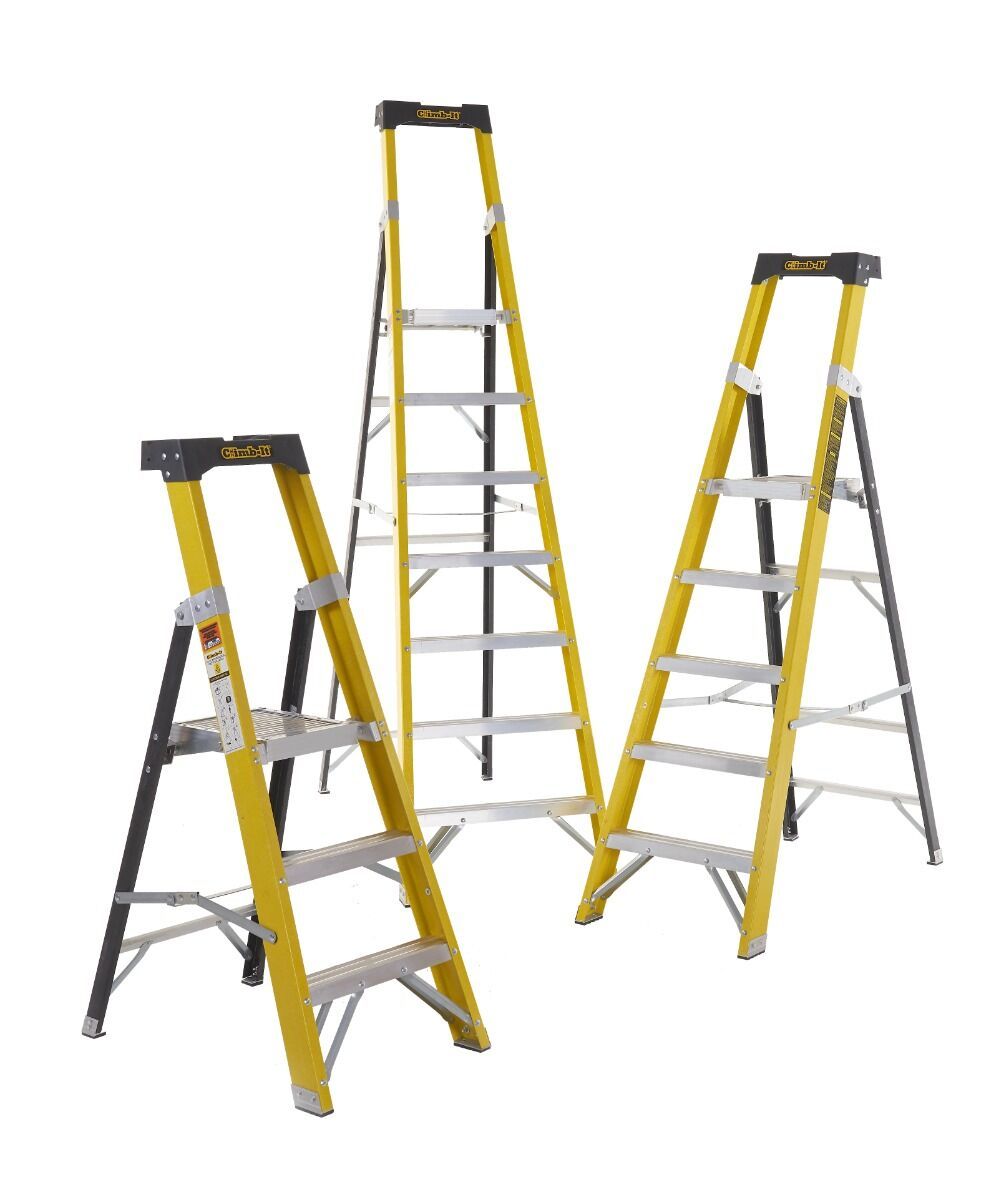
Climb-It Ladders: Setting the Standard for Industrial Access Equipment
When evaluating industrial ladder options, Climb-It stands as a recognized leader in quality, innovation, and safety compliance. Available exclusively through Hall-Fast Industrial Supplies, the Climb-It range represents the pinnacle of industrial access solutions.
The Climb-It Advantage
Several factors distinguish Climb-It products within the competitive industrial ladder market:
Engineered for Industrial Reality
Climb-It products are designed by engineers with extensive experience in industrial environments. This practical knowledge translates into equipment that addresses real-world challenges:
- Reinforced stress points that prevent common failure modes
- Optimized weight distribution that enhances both portability and stability
- Thoughtful feature integration based on user feedback
- Material selection tailored to specific application requirements
- Design elements that anticipate typical usage patterns
This application-specific engineering approach creates equipment that doesn't merely meet minimum standards but excels in practical industrial use.
Comprehensive Quality Control
Climb-It implements rigorous quality management throughout the manufacturing process:
- Incoming material verification ensures consistent performance
- Multiple inspection points during production identify issues early
- Finished product testing exceeds regulatory requirements
- Batch traceability enables continuous improvement
- Regular design reviews incorporate field experience
This comprehensive approach to quality results in products with exceptional consistency and reliability—critical factors for safety equipment.
Innovation Focus
Rather than simply meeting established standards, Climb-It actively pursues innovations that enhance both safety and functionality:
- Advanced alloy compositions that optimize strength-to-weight ratios
- Ergonomic design elements that reduce user fatigue
- Integration of new materials that improve performance characteristics
- Modular components that enhance versatility
- User-Centered features developed through field research
This commitment to continuous improvement keeps Climb-It at the forefront of industrial access technology, delivering advantages that translate directly to workplace safety and efficiency.
Comprehensive Product Range
Climb-It offers one of the most complete industrial ladder lineups available, ensuring the perfect solution for virtually any access challenge:
- Extension ladders in heights from 2m to 12m
- Step ladders ranging from 2-step utility models to heavy-duty 12-step platforms
- Combination ladders with multiple configuration options
- Speciality equipment for unique industrial applications
- Comprehensive accessories that enhance functionality and safety
This extensive range eliminates the need to compromise on specifications, allowing organizations to select equipment precisely matched to their requirements.
Climb-It Industrial Ladder Categories
The Climb-It industrial range encompasses several distinct product categories, each addressing specific application needs:
Professional Extension Ladders
The Climb-It extension ladder series combines exceptional reach with outstanding stability and durability:
- Interlocking C-section stiles that resist twisting under load
- Deep D-shaped rungs that provide superior foot grip and comfort
- Precision rung-to-stile joints that maintain integrity under stress
- High-visibility components that enhance awareness in busy environments
- Guide brackets engineered for smooth extension operation
- Duty ratings exceeding relevant standards
These professional-grade extension ladders excel in applications where maximum reach with minimal footprint is essential, such as building maintenance, construction, and industrial installations.
Heavy-Duty Step Ladders
Climb-It step ladders deliver exceptional stability with features designed specifically for industrial applications:
- Extra-wide steps that reduce fatigue during extended use
- Tool trays integrated into the top cap for convenience
- Reinforced rear legs that prevent splaying under load
- Heavy-gauge bracing that maintains structural integrity
- Non-marring feet that protect finished surfaces
- Serrated steps that provide traction even when contaminated
These robust step ladders provide ideal solutions for maintenance operations, mechanical installations, and numerous other industrial applications requiring frequent repositioning.
Multi-Function Combination Ladders
The Climb-It combination ladder series offers unmatched versatility through multiple configuration options:
- Articulated joints with precision locking mechanisms
- Telescopic sections that allow length customization
- Platform options for enhanced working stability
- Multiple positioning possibilities from a single unit
- Compact storage dimensions despite configuration flexibility
- Reinforced stress points at articulation locations
These adaptable systems provide exceptional value for operations with diverse access challenges or limited storage space for multiple ladder types.
Specialized Access Solutions
Beyond these core categories, Climb-It offers specialized access solutions for unique industrial requirements:
- Telescopic ladders for situations requiring minimal storage dimensions
- Platform towers for extended working at fixed heights
- Podium steps for maximum stability and safety
- Work platforms designed for specific industrial applications
- Custom solutions for unique access challenges
This comprehensive approach ensures that regardless of the specific height access requirement, Climb-It offers a solution designed explicitly for that application.
Safety Regulations and Compliance: Understanding the Legal Framework
Industrial ladder users operate within a comprehensive regulatory framework designed to minimize workplace accidents and ensure proper equipment selection, use, and maintenance. Understanding these requirements is essential for both compliance and safety.
Key Regulatory Standards
Several important standards govern industrial ladder design, testing, and usage:
EN131 European Standard
This comprehensive standard establishes requirements for portable ladders, including:
- Dimensional specifications
- Load testing protocols
- Stability requirements
- Material performance criteria
- Labelling and marking guidelines
EN131 now distinguishes between "Professional" and "Non-Professional" use, with enhanced requirements for ladders intended for workplace applications.
BS 2037 and BS 1129 British Standards
These established standards classify ladders into three duty ratings:
- Class 1: Industrial Heavy Duty
- Class 2: Industrial Light Duty
- Class 3: Domestic Duty
While gradually being superseded by EN131, these classifications remain widely referenced in workplace safety documentation.
Working at Height Regulations
These comprehensive regulations establish the legal framework for all height access activities, mandating:
- Hierarchy of controls for working at height
- Risk assessment requirements
- Equipment inspection protocols
- Training requirements for users
- Documentation and record-keeping standards
These regulations apply to all workplace height access, including industrial ladder use.
Employer Responsibilities
Organizations utilizing industrial ladders have specific legal obligations:
Risk Assessment Requirements
Before any work at height, employers must conduct and document proper risk assessments:
- Identifying all potential hazards associated with the task
- Assessing the probability and severity of potential accidents
- Determining appropriate control measures
- Selecting suitable access equipment for specific applications
- Documenting assessment findings and implementation measures
These assessments must be reviewed regularly and updated whenever conditions change.
Training Obligations
Employers must ensure all ladder users receive appropriate training:
- Selection of appropriate equipment for specific tasks
- Proper inspection procedures before use
- Correct setup and positioning techniques
- Safe climbing and working practices
- Understanding of weight limitations and other restrictions
This training must be documented and refreshed periodically to ensure continued competence.
Inspection and Maintenance Programs
Regular inspection and maintenance programs are legally required:
- Pre-use visual inspection by the operator
- Detailed periodic inspections by competent persons
- Documentation of inspection findings
- Tagging systems to identify equipment status
- Removal from service of any damaged equipment
- Proper repair protocols by qualified personnel
These programs must be formalized, with clear responsibilities and documentation requirements.
User Responsibilities
Individual ladder users also have specific obligations:
- Conducting pre-use visual inspections
- Following established setup and usage protocols
- Respecting weight limitations and other restrictions
- Reporting any equipment damage or defects
- Using only equipment they are trained and authorized to operate
- Implementing proper housekeeping around access equipment
These individual responsibilities complement organizational programs in creating a comprehensive safety system.
Why Choose Hall-Fast for Industrial Ladders
Hall-Fast Industrial Supplies has established itself as a premier provider of quality industrial equipment since its founding in 2006. Their impressive growth from a home-based startup to an internationally recognized supplier demonstrates their commitment to excellence in industrial supply.
The Hall-Fast Difference
Several factors distinguish Hall-Fast in the competitive industrial supply market:
Product Expertise and Selection
Hall-Fast combines product knowledge with an extensive selection:
- Comprehensive understanding of industrial ladder applications
- Ability to match specific requirements with appropriate equipment
- Access to the complete Climb-It industrial range
- Alternatives at various price points to accommodate different budgets
- Special order capabilities for unique requirements
This combination of expertise and selection ensures clients find the optimal solution for their specific needs.
Customer-Centric Approach
Hall-Fast's customer service philosophy places client needs at the centre of every interaction:
- Consultative sales process that focuses on understanding requirements
- Technical guidance that helps clients make informed decisions
- Responsive communication throughout the purchasing process
- After-sale support that ensures continued satisfaction
- Problem-solving orientation that addresses challenges proactively
This approach creates long-term relationships based on trust and mutual benefit.
Efficient Logistics and Delivery
Understanding that equipment availability directly impacts client operations, Hall-Fast implements efficient supply chain processes:
- Substantial inventory of commonly requested items
- Rapid processing of new orders
- Multiple delivery options to accommodate varying urgency
- Real-time tracking of order status
- Proactive communication regarding delivery timelines
These logistics capabilities minimize downtime and ensure clients receive equipment when needed.
Commitment to Value
While not always the lowest initial price, Hall-Fast focuses on delivering superior value:
- Quality products that provide lower lifetime costs
- Competitive pricing on premium equipment
- Bundle options that enhance overall value
- Special programs for volume purchasers
- Guidance that prevents costly equipment mismatches
This value orientation ensures clients receive the best possible return on their equipment investment.
Industry Recognition
Hall-Fast's commitment to excellence has earned them numerous accolades throughout their history. These awards recognize their business practices, customer service, growth, and community involvement.
Their impressive list of recognitions demonstrates the company's standing as an industry leader in the supply of quality industrial equipment. For details on their various achievements, visit their Awards page.
Community Engagement
Beyond commercial activities, Hall-Fast demonstrates remarkable dedication to community involvement. Their charitable initiatives have supported numerous worthy causes, contributing significantly to community development and wellbeing.
Some highlights of their community engagement include:
- Supporting local sports teams and youth development
- Participating in charitable fundraising events
- Sponsoring community improvement initiatives
- Contributing to educational programs
- Supporting health and wellness causes
These efforts reflect the company's understanding that business success and community vitality are deeply interconnected. Learn more about their impressive community contributions on their Community page.
Additional Brands and Options
While Climb-It represents a premier choice for industrial ladders, Hall-Fast stocks a diverse selection of access equipment from multiple manufacturers. This comprehensive approach ensures clients can explore alternatives that might better suit specific requirements or budgetary considerations.
Visit their Brands page to explore the complete range of quality access solutions available through their catalogue.
Maintaining Industrial Ladders: Best Practices for Extended Service Life
Proper maintenance significantly impacts both the safety and longevity of industrial ladders. Implementing these best practices ensures equipment remains in optimal condition throughout its service life.
Regular Inspection Protocols
Establishing systematic inspection routines is fundamental to industrial ladder safety:
Pre-Use Visual Inspection
Before each use, operators should verify:
- Structural integrity with no visible damage
- Proper function of all moving parts
- Secure connections between components
- Clean, undamaged rungs or steps
- Stable, undamaged feet
- Legible safety labels and markings
Any deficiencies identified during this visual inspection should result in immediate removal from service.
Periodic Detailed Inspection
At regular intervals (typically quarterly), a more comprehensive inspection should include:
- Close examination of all structural elements
- Testing of all locking mechanisms
- Verification of proper alignment
- Assessment of wear on high-contact areas
- Examination of all fasteners and connections
- Confirmation of label legibility
These detailed inspections should be documented with records maintained for the equipment's service life.
Annual Certified Inspection
Many organizations implement annual inspections by qualified personnel:
- Thorough evaluation against manufacturer specifications
- Compliance verification with current standards
- Detailed documentation for regulatory purposes
- Professional assessment of remaining service life
- Recommendations for replacement or repairs
These certified inspections provide an additional safety layer and often satisfy insurance or regulatory requirements.
Cleaning and Maintenance Procedures
Proper cleaning and maintenance directly impact equipment longevity:
Cleaning Best Practices
- Remove surface contaminants with mild soap and water
- Avoid harsh chemicals that might damage protective finishes
- Pay special attention to moving parts and locking mechanisms
- Ensure complete drying before storage
- Remove any oil, grease, or slippery substances immediately
- Address any paint or material transfer that might hide damage
Regular cleaning not only preserves the ladder but also makes damage or defects more visible during inspections.
Preventative Maintenance
Proactive maintenance prevents premature deterioration:
- Lubricate moving parts according to manufacturer recommendations
- Tighten any loose fasteners (without over-tightening)
- Replace worn or damaged feet before they compromise stability
- Address minor damage before it progresses
- Apply appropriate protectants for equipment stored outdoors
- Implement protective measures for equipment transported frequently
These preventative measures significantly extend service life while maintaining safety characteristics.
Storage Considerations
Proper storage prevents unnecessary damage during periods of non-use:
- Store in ventilated areas away from direct sunlight
- Maintain proper support to prevent warping
- Protect from exposure to extreme temperatures
- Secure against unauthorized use
- Shield from chemicals or corrosive atmospheres
- Implement appropriate stacking protocols for multiple units
Following these storage practices prevents the deterioration that often occurs during non-use periods.
Transportation Best Practices
When moving industrial ladders between locations, proper handling prevents damage:
- Secure ladders properly during transport to prevent shifting
- Use appropriate padding at contact points
- Avoid over-stacking or placing excessive weight on ladders
- Implement proper lifting techniques to prevent structural damage
- Consider dedicated transport racks for frequent movement
These precautions prevent the structural damage that commonly occurs during transportation.
Expert Consultation Available
Uncertain which industrial ladder best suits your specific requirements? The knowledgeable team at Hall-Fast provides personalized guidance to ensure you select the perfect solution. Their consultative approach helps organizations navigate the complexities of industrial ladder selection, ensuring optimal safety and productivity.
Contact their specialists for professional advice tailored to your unique application. Their expertise can help you identify the ideal equipment for your specific needs, whether standard products or customized solutions.
Conclusion: Making the Right Investment
Industrial ladders represent a critical investment in both workplace safety and operational efficiency. By selecting equipment properly matched to specific applications, organizations not only protect their most valuable asset—their people—but also enhance productivity through purpose-designed access solutions.
Climb-It's comprehensive range of professional-grade ladders, available exclusively through Hall-Fast Industrial Supplies, offers the perfect combination of safety, durability, and functionality. Their commitment to quality engineering and manufacturing excellence creates equipment that professionals can rely on in the most demanding applications.
Shop Industrial Ladders Now and experience the difference that professional-grade equipment makes to your operations. With competitive pricing, expert guidance, and efficient delivery, Hall-Fast makes it simple to equip your team with industry-leading access solutions that enhance both safety and productivity.
Your team deserves industrial ladders they can trust—make the investment in their safety and efficiency today with Climb-It Ladders from Hall-Fast Industrial Supplies.