Browse the full range: Gardening & Landscaping Tools Hire – Hall-Fast
Professional Garden Machinery Hire for West Burton and the Trent Valley
West Burton is a small, historically significant village in North Nottinghamshire, set within the broad, fertile corridor of the River Trent and within easy reach of Gainsborough to the north, Retford to the south-west, and Newark-on-Trent to the south. Perhaps best known beyond the immediate area for West Burton Power Station — a defining landmark in the Trent Valley skyline whose cooling towers have stood as a backdrop to rural life here for decades — the village and its surrounding communities represent a way of living that the county's cities and larger towns cannot offer: space, openness, and a strong connection to the working land.
Properties in and around West Burton reflect that rural character. Gardens are larger than urban equivalents. Many households have smallholdings, paddocks, productive growing areas, extensive hedging, and boundary fencing that runs over significant distances. Alluvial river valley soils support vigorous plant growth that rewards careful management. And the open, flat landscape means that outdoor maintenance work takes place at a scale and pace shaped by real agricultural and rural tradition.
For these customers, professional-grade petrol-powered garden and landscaping machinery makes an enormous practical difference. But owning that machinery outright — a turf cutter used twice in a decade, a post hole borer needed for a single fencing project, a tiller at the start of each growing season — makes little financial sense for most households. Hiring the right machine for the right project is the more intelligent approach.
Hall-Fast provides flexible weekly hire of a comprehensive range of professional petrol garden machinery, serving customers in West Burton and across the wider Trent Valley and North Nottinghamshire area. Every machine is fully serviced before dispatch, backed by Hall-Fast's genuine price promise, and supported by expert advice from a team that knows the products and the local area well.
Why West Burton and the Trent Valley Is Different
Before covering the hire range in detail, it is worth understanding what makes this part of Nottinghamshire distinctive as a gardening and land management environment — because that local character shapes which machines are most useful and most in demand here.
The Trent Valley's Alluvial Soils
The land around West Burton was shaped over centuries by the River Trent and its periodic flooding. The result is a broad corridor of alluvial soil — typically rich, well-structured, and highly productive when managed well. These soils have real advantages: they warm relatively quickly in spring, hold moisture through dry spells, and can produce outstanding crop and garden yields. They also have characteristics that require thoughtful management.
Alluvial soils compact readily under wet conditions and foot traffic. A growing area that was in good condition at the end of the previous season can be significantly compacted by the time spring arrives, particularly if it was walked on while wet during the autumn and winter. A petrol tiller, run over the area when conditions are right — when the soil has some moisture but is not waterlogged — restores the open, aerated structure that productive growing requires, far more effectively and quickly than hand digging with a fork.
Alluvial soils also support vigorous vegetation growth. Lawns grow quickly and densely through the spring and summer months. Hedge growth is strong and sustained. Uncultivated corners and rough ground can become dense with rank grass, nettles, brambles, and coarse weeds within a single growing season. Staying on top of this growth requires effective machinery — and the right machinery changes what is achievable in a day.
Large, Open Properties with Substantial Grounds
Rural properties in West Burton and the surrounding Trent Valley villages do not have the compact garden footprints typical of urban housing. The house plots here tend to be larger, garden areas more generous, and in many cases there is additional land — paddocks, productive plots, rough grass areas, orchard space — beyond the formal garden. Managing all of this well through a growing season requires a range of machinery that simply would not be necessary on a typical city garden.
A domestic electric mower cannot cover a lawn of several hundred square metres efficiently. A domestic battery strimmer cannot manage a paddock rough or ditch edge. A hand spade cannot turn over a large kitchen garden plot in the same session that a petrol tiller can. Hiring the right machine for each task changes what one person can achieve in a day, and makes the maintenance of a larger rural property genuinely achievable without a professional contractor on every occasion.
Agricultural and Equestrian Use
The landscape around West Burton is agricultural and semi-agricultural. Paddock management, field boundary fencing, gate post installation, and seasonal rough grass clearance are regular maintenance requirements for the smallholdings and equestrian properties that form part of the community here. Hall-Fast's post hole borer and brush cutter are among the most consistently useful hires for customers with this kind of land management need.
Riparian Land Ownership and Watercourse Obligations
Many properties in the Trent Valley have land that runs to the river bank or to managed drainage channels. Riparian landowners have obligations to maintain their stretch of watercourse — keeping banks clear, ensuring flow is not obstructed, and managing bank vegetation. The Hall-Fast brush cutter is directly relevant to this kind of maintenance work: capable of cutting bank and margin vegetation cleanly, handling the coarse grasses and edge-of-water growth that a domestic strimmer would struggle with.
The Complete Hire Range for West Burton Customers
1. Petrol Lawnmower Hire (HFHIRE003)
Properties in the West Burton area with substantial lawns — and there are many — need a petrol mower rather than a domestic electric machine. The Hall-Fast four-stroke petrol lawnmower (HFHIRE003) is built for this scale of work: more power, no cable to manage, and consistent cutting performance across however much ground needs to be covered.
The four-stroke engine runs on straight petrol, requires no oil mixing, and delivers more torque and better fuel efficiency than two-stroke alternatives. It handles the full range of grass conditions typical of Trent Valley properties — from the fine established lawn of a maintained garden to the longer, coarser growth of an area that has been left for several weeks during a wet growing season.
Adjustable cutting heights allow you to match the cut to current conditions. For a first spring cut on lawn that has grown vigorously over winter, set high to avoid scalping. Reduce the height for subsequent cuts as the lawn comes under control. The integrated grass collection box catches clippings without raking — empty it onto the compost heap as you go. Foldable handles make loading the machine into a van or car boot simple.
Who needs this in West Burton: Any property with a lawn exceeding 200 square metres (common in this area), rural and semi-rural properties with amenity grass areas, catch-up mowing after holiday absence, gardening contractors covering multiple properties in the Trent Valley.
In practice: A typical rural garden in this area with 400–600 square metres of lawn can be mown with the HFHIRE003 in 2–3 hours. The same area with a domestic electric mower — if cable reach even permits it — might take twice as long, with poorer results on thicker grass.
2. Petrol Hedge Trimmer Hire (HFHIRE004)
Rural North Nottinghamshire has more than its share of hedging — established boundary hedges in hawthorn, blackthorn, beech, and mixed native species, garden hedging in privet, hornbeam, and box, and the kind of long-established mixed species hedgerows that mark the field boundaries and lane edges of this agricultural landscape. The HFHIRE004 two-stroke petrol hedge trimmer is the right machine for all of it.
Two-stroke petrol delivers strong, sustained cutting torque that handles thick, woody, established growth without slowing. No cable to manage means you can work the full length of a long boundary hedge without interruption — critical on rural properties where the nearest power socket may be many metres away from the far end of the hedge line. And unlike battery trimmers, runtime is limited only by fuel, not charge.
For most West Burton properties, hedge cutting is a twice-yearly event — a formal cut after the nesting season (June/July) and an autumn tidy-up (September/October). Hiring the right machine for those two visits, rather than owning and maintaining a petrol trimmer year-round, is the sensible approach.
Who needs this in West Burton: All properties with garden or boundary hedging. Properties with long boundary runs in the Trent Valley agricultural fringe. Professional gardeners covering rural clients in the North Nottinghamshire area.
Technique note: Work bottom-up on hedge sides before tackling the top. Use a cane and line for formal hedges to keep the top level consistent. On established hawthorn or mixed native boundary hedges, a first cut before the main growth hardens off (May/early June) and a second after the season's growth is complete (September/October) gives good results.
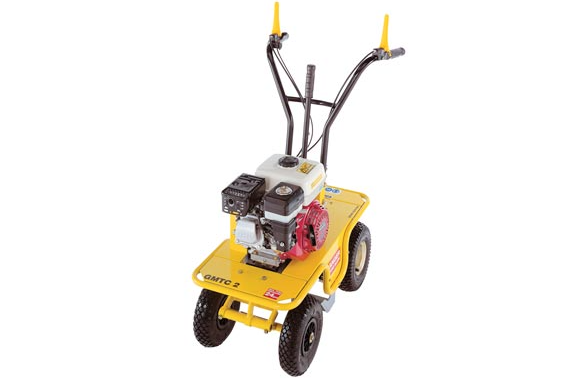
3. Turf Cutter / Stripper Hire (HFHIRE005)
Removing an existing lawn by hand — cutting under the roots with a spade, rolling and stacking each strip — is one of the most physically demanding jobs in any garden renovation project. On the alluvial soils of the Trent Valley, which can produce particularly deep-rooted, dense turf, the challenge is even greater than on lighter soils. The Hall-Fast self-propelled turf cutter (HFHIRE005) removes the physical burden from this task almost entirely.
The machine drives itself forward under self-propelled power while a hardened steel blade cuts cleanly through the turf and root zone at the depth selected on the variable depth control. The result is uniform strips of cut turf that peel away cleanly, with no heavy spade work and no inconsistent depth. The variable depth control is one of the most important features: set it shallow (around 25–30mm) to lift just the grass and root mat for composting or relay, or set it deeper (50mm or more) for projects where the surface level needs to drop for paving, hard standing, or significant grading work. Foldable handlebars make the machine manageable for transport.
Who needs this in West Burton: Anyone planning a garden renovation, new patio, or hard landscaping project. Customers establishing new kitchen garden or allotment areas. New homeowners redesigning inherited garden layouts. Contractors undertaking lawn renovation projects in the Trent Valley area.
In practice: A garden renovation removing 150 square metres of existing lawn — a modest project by the standards of this area — might take two people three heavy days by spade. The HFHIRE005 achieves the same result in a single morning. The case for hiring is particularly strong for a machine of this kind, which is expensive to buy (£1,500–£3,000) and used infrequently.
4. Petrol Tiller / Cultivator Hire (HFHIRE009)
Hire a Petrol Tiller / Cultivator
The alluvial soils of the Trent Valley are potentially very productive — but realising that potential requires regular cultivation to maintain good structure and incorporate organic matter. The Hall-Fast petrol tiller (HFHIRE009) makes that cultivation fast, thorough, and far less demanding than it would be with a fork and spade.
The HFHIRE009's rotating blades work to a 20cm digging depth, turning and aerating the soil as they go. A compacted, winter-hard vegetable plot becomes loose, friable, aerated growing medium in a single pass. Run the tiller again after spreading compost, well-rotted manure, or a green manure chop and it will blend those amendments thoroughly into the soil profile — much more effectively than hand turning.
Adjustable handlebars set the machine at a comfortable working height for the operator. Tine guards protect from soil debris thrown by the rotating blades. A large, rugged transport wheel makes moving the machine across a garden or between sites practical. The light-duty petrol engine is well matched to the scale of typical garden cultivation — for 20cm depth work across domestic and allotment-scale plots, it delivers outstanding performance.
Who needs this in West Burton: Kitchen gardeners and productive plot owners across the Trent Valley. Allotment holders in the North Nottinghamshire area. Anyone establishing a new growing area from bare or compacted ground. Property owners incorporating a delivery of compost or manure. New homeowners beginning to develop a garden from scratch.
In practice: A large vegetable area of 300 square metres — not unusual on a rural West Burton property — can be tilled to the full 20cm depth in 4–5 hours, including time for a second pass to incorporate compost. Hand digging the same area to the same depth would take two people several days and produce a less even result.
5. Post Hole Borer Hire (HFHIRE001)
In rural North Nottinghamshire, the need for post holes arises regularly — paddock boundary fencing, agricultural gates, garden boundary posts, pergola uprights, washing line posts, equestrian school markers, signage posts. On a property with a paddock and a full garden boundary, a single fencing project can require 50 or more post holes. Digging those holes by hand — with a manual post hole digger or a breaker bar and spade — is slow, exhausting, and produces inconsistent results.
The Hall-Fast petrol post hole borer (HFHIRE001) transforms fencing and structural projects by sinking clean, consistent, vertical holes at speed. The 150mm earth auger bit is the standard size for timber and metal fence posts, and the two-stroke petrol engine provides the torque needed to drive it through the varied ground conditions of the Trent Valley — from the softer alluvial soils close to the river to the firmer, sometimes heavier ground further from the flood plain.
A single operator runs the machine throughout, boring multiple holes in quick succession. Each hole is consistently 150mm in diameter and sunk to the depth set by the operator — ready for the post to be placed and set with concrete or sharp sand immediately. For a fencing project with 50 post holes, an operator in reasonable ground can complete the boring in half a day, leaving the afternoon free for post setting and panel fitting.
Who needs this in West Burton: Equestrian property owners installing or replacing paddock fencing. Agricultural landowners replacing field boundaries or installing new gating. Domestic homeowners replacing garden boundary fencing or installing a new gate. Contractors undertaking fencing and landscaping projects across North Nottinghamshire.
Safety reminder: Before using the post hole borer on any established property, confirm the location of underground services. In the Trent Valley area, agricultural drainage tiles may be present below garden and paddock areas — these can be damaged by auger boring and are often not mapped. Call Dial Before You Dig on 0800 096 8950 if there is any doubt.
6. Brush Cutter / Strimmer Hire (HFHIRE002)
Hire a Brush Cutter / Strimmer
For customers in West Burton and the Trent Valley, the brush cutter is arguably the most widely useful single piece of hired garden machinery available. The rural and semi-rural landscape here produces an abundance of areas that a lawnmower cannot access — ditch margins, river bank edges, paddock roughs and corners, slopes and embankments, fence line growth, rough grass around outbuildings, and neglected patches that develop rapidly in the Trent Valley's fertile growing conditions.
The Hall-Fast brush cutter (HFHIRE002) is a two-stroke petrol shoulder-carried machine with interchangeable cutting heads. The nylon cord head cuts grass and light vegetation — lawns edges, fence line tidy-ups, tree base circles, and areas where the mower cannot work. The steel blade head converts the machine into a genuine cutter for heavy vegetation — brambles, nettles, dense rank grass, woody brush, and the vigorous scrubby growth that develops quickly on unchecked Trent Valley ground.
The adjustable handlebar positions the cutting head correctly for the operator's working height. The included balance harness distributes the machine's weight across the shoulder and body for comfortable extended use across larger areas. The two-stroke petrol engine removes all cable and battery constraints — the machine can go anywhere on the property, from the garden lawn edge to the far end of a paddock ditch, without interruption.
Who needs this in West Burton: Equestrian and smallholding property owners managing paddock roughs and rough grass areas. Riparian landowners managing bank and watercourse edge vegetation. Domestic homeowners finishing lawn edges and clearing overgrown corners. Contractors doing ground maintenance and clearance across North Nottinghamshire rural properties.
Practical tip on interchangeable heads: When the cord head is in use, stand and move to keep the cord head slightly inclined so the leading edge cuts rather than the full length of cord — this reduces cord wear and gives a cleaner cut. When the blade head is in use, maintain a steady pace and let the blade do the work — do not force it into dense material, as the machine's balance harness lets you control cut height and angle more precisely with a steady movement than with jerky forcing.
The Financial Case for Hiring in West Burton
For rural and semi-rural property owners in the West Burton area, the hire versus own decision is straightforward for most pieces of specialist equipment. Consider:
The turf cutter: Costs £1,500–£3,000 to buy. Used perhaps once in ten years on a typical rural property. Hire cost for a project: a fraction of purchase cost. Hire wins decisively.
The post hole borer: Costs £350–£700 to buy. Used for specific fencing projects — perhaps every 3–5 years on a typical rural property. Hire wins.
The petrol tiller: Costs £400–£900 to buy. Used once or twice a year on a productive growing area. Service and maintenance costs add £50–£100 per year. Hire is competitive, particularly for less frequent users.
The petrol lawnmower: Costs £350–£700 to buy. Used 15–25 times per year through the growing season. If you have a large lawn and mow regularly, this is the machine where ownership starts to make sense — but for catch-up sessions, emergency cover, or gardens at the larger end of the scale, hire still offers excellent value.
The hedge trimmer: Costs £175–£450 to buy. Used twice a year. Hire wins.
The brush cutter: Costs £250–£600 to buy. For frequent paddock and rough grass management, ownership may make sense. For occasional clearance and edge work, hire is the rational choice.
Hall-Fast's Price Promise
Hall-Fast's price commitment applies to everything in the hire range:
"We will not be beaten on price on any authentic product. If you find a better price anywhere on the internet or receive a quotation, please let us know and we will match it."
Hire with confidence. If any competitor quotes a lower price for an equivalent machine, Hall-Fast will match it.
Seasonal Hire Calendar for the Trent Valley
Spring (March – May): Petrol tiller and lawnmower demand peaks as growing season begins. Book early — spring is the busiest period for garden machinery hire.
Summer (June – August): Lawnmower and brush cutter are in highest demand. Hedge trimmer peaks June/July. Ideal time for post hole borer hire on fencing projects.
Autumn (September – November): Hedge trimmer peak again in September/October. Tiller demand continues for autumn soil preparation. Ideal for completing fencing projects before winter.
Winter (December – February): Brush cutter and post hole borer used during mild spells. Advance spring bookings accepted from January.
Safety Guidance for Rural Property Machinery Use
Underground services and agricultural drainage: Rural properties in the Trent Valley may have agricultural drainage tiles beneath garden and paddock areas that are not mapped. Before using the post hole borer or tiller, call Dial Before You Dig (0800 096 8950) and check with your local Internal Drainage Board if relevant.
Watercourse management: Riparian owners clearing ditch or bank vegetation should ensure clearance does not obstruct the watercourse or violate any Environment Agency or IDB requirements. Check your obligations before undertaking significant bank clearance.
PPE: Safety glasses or visor, hearing protection, steel-capped footwear, and gloves as a minimum for all machinery operation. Full face visor and leg protection when operating the brush cutter with the steel blade head.
Animals: Move livestock away from all working areas before starting any petrol machinery. Keep horses and cattle well away from the noise and movement of any operating machine.
About Hall-Fast Industrial Supplies
Hall-Fast Industrial Supplies Limited is an established East Midlands supplier serving trade and domestic customers across a wide product range. Beyond gardening and landscaping hire, the company provides access equipment hire, building equipment hire, genie lifts hire, lifting equipment hire, pressure washer hire, and handling equipment hire. See the full brands range on the website.
Contact Hall-Fast to Arrange Your West Burton Hire
???? Call: 01623 645645 ✉️ Email: sales@hall-fast.com ???? Online: www.hall-fast.com/contact
Full hire range: www.hall-fast.com/hire/gardening-landscaping-tools-hire
All Product Hire Pages
- Petrol Lawnmower Hire – HFHIRE003
- Petrol Hedge Trimmer / Cutter Hire – HFHIRE004
- Turf Cutter / Stripper Hire – HFHIRE005
- Petrol Tiller / Cultivator Hire – HFHIRE009
- Post Hole Borer Hire – HFHIRE001
- Brush Cutter / Strimmer Hire – HFHIRE002
Hall-Fast Industrial Supplies Limited. Price promise: we will not be beaten on price on any authentic product. If you find a better price anywhere on the internet or receive a quotation, please let us know and we will match it.
Working With Trent Valley Soil: Technical Notes for West Burton Customers
Getting the most from hired garden machinery on the alluvial soils of the Trent Valley requires a little understanding of how these soils behave through the seasons. The following guidance is specific to the conditions most West Burton customers will encounter.
When to Till
Alluvial soils respond best to cultivation when they have a workable moisture content — not saturated, not bone dry. After a wet winter, soils in the Trent Valley flood plain can hold significant moisture well into March. Tilling wet soil compacts it rather than aerating it, and the result is large, sticky clods that are difficult to break down and slow to produce a workable seedbed.
Wait until the soil passes the "squeeze test" before tilling: pick up a handful and squeeze firmly. If water runs freely from your fist, the soil is too wet. If the ball of soil breaks apart cleanly when you release it, the moisture level is right for cultivation. If the ball remains intact and doesn't crumble, it is still slightly wet — allow another day or two.
In practice, for most West Burton properties, the right window for spring tilling falls between late March and mid-April in a typical year — later after a cold, wet winter, earlier in a dry spring.
Compaction Management
Alluvial soils are naturally cohesive and can develop a compaction layer — sometimes called a plough pan — at the depth of regular shallow cultivation. Over several years of shallow tillage (less than 15cm), this compaction layer can restrict drainage and root development. The HFHIRE009 tilled to its full 20cm depth breaks through a compaction layer and restores drainage and root penetration below the compacted zone.
For vegetable plots that have been cultivated at the same shallow depth for several years, a deep autumn till to 20cm is a worthwhile annual investment. Do this in September or October after the summer crops are cleared, then allow the winter frost to work the tilth down further before spring planting preparation begins.
Organic Matter Incorporation
The alluvial soils of the Trent Valley respond very well to organic matter — well-rotted manure, finished compost, leaf mould, or spent mushroom compost. The petrol tiller makes organic matter incorporation not just possible but efficient: spread the material over the surface at the recommended application rate, then make a tilling pass to work it into the soil profile. A single tiller pass incorporates organic matter to the full 20cm depth, distributing it through the soil in a way that takes hours of hand forking to achieve manually.
For productive growing areas on Trent Valley properties — kitchen gardens, vegetable plots, allotment plots — an annual autumn application of 5–10cm of well-rotted manure incorporated by tiller is one of the highest-return investments in soil health that a grower can make.
Flood Plain Awareness
West Burton sits within or adjacent to the Trent flood plain. In wet winters, parts of the flood plain can experience inundation — and even properties that don't flood directly can experience waterlogging of their gardens and growing areas in extended wet periods. Planning outdoor projects around the flood risk calendar is sensible:
- Major garden earthworks and cultivation projects are best completed by mid-October, before the winter flood risk period begins
- Avoid breaking ground for new beds or planting areas in periods when the water table is high — the resulting compaction can take months to recover from
- Turf cutting and post hole boring on saturated ground is difficult and unproductive — wait for conditions to allow
The Hall-Fast team can advise on the best timing for your specific project if you are uncertain.
Combining Machines for Major Projects
West Burton customers undertaking larger rural property projects — a kitchen garden establishment, a full paddock fencing replacement, a garden renovation — may benefit from hiring multiple machines in a planned sequence. A typical major project sequence might look like this:
Week one — Clearance: Brush cutter to clear overgrown areas and rough vegetation from the project site. Turf cutter to remove existing lawn or turf from areas destined for hard landscaping, new planting, or cultivated growing areas.
Week two — Cultivation and structure: Petrol tiller to cultivate all exposed soil areas, incorporating organic matter. Post hole borer to sink all fence, gate, or structural posts needed for the project.
Week three — Establishment and maintenance: Lawnmower for the first cut on any areas being maintained as lawn. Hedge trimmer to bring in any boundary hedging now that the project area is clear.
Contact Hall-Fast to discuss sequenced hiring arrangements for larger projects — the team can advise on machine availability and help you plan the most efficient hiring schedule.
Hall-Fast Industrial Supplies Limited. Price promise: we will not be beaten on price on any authentic product. If you find a better price anywhere on the internet or receive a quotation, please let us know and we will match it.