In today's fast-paced industrial environments, warehouse safety has become increasingly critical as operations scale up and automation becomes more prevalent. One area that deserves particular attention is impact protection—the systems designed to prevent and mitigate collision damage between vehicles, equipment, and structural elements. This article explores the evolution of impact protection technology, with a special focus on flexible impact protection systems that are transforming safety standards in modern facilities.
The Hidden Costs of Industrial Impacts
Before diving into protection solutions, it's important to understand the true cost of impact incidents in industrial settings. Research from the Health and Safety Executive (HSE) indicates that forklift-related accidents alone account for nearly 1,000 serious injuries annually in the UK. What's more concerning is that the direct costs of equipment repairs and replacements represent only about 30% of the total financial impact of these incidents.
The remaining 70% comes from indirect costs including:
- Operational downtime during incident investigation and cleanup
- Reduced productivity during repairs
- Administrative costs for accident reporting
- Potential regulatory fines and increased insurance premiums
- Worker compensation and potential litigation expenses
- Retraining and replacement worker costs
When analysed comprehensively, even minor collision incidents can cost facilities tens of thousands of pounds, while major structural impacts can easily exceed six-figure sums when all associated costs are calculated.
The Evolution of Impact Protection Technology
Industrial impact protection has evolved dramatically over the past several decades. Understanding this evolution helps facility managers appreciate the significant advantages offered by modern systems.
First Generation: Fixed Steel Barriers
The earliest formal impact protection consisted of fixed steel barriers—essentially rigid posts and rails designed to physically block vehicles from contacting vulnerable structures. While offering basic protection, these systems had significant drawbacks:
- They transferred impact energy directly to both the barrier and the colliding vehicle
- Collisions often resulted in damage to the protection system itself
- Impacts could cause injury to vehicle operators due to sudden deceleration
- Repairs or replacements were frequently required after significant impacts
Second Generation: Plastic-Coated Steel Systems
The next evolution introduced plastic coating over steel cores. These systems offered modest improvements:
- Slightly reduced impact forces through minimal energy absorption
- Decreased damage to colliding vehicles
- Improved visibility through bright coloration
- Reduced maintenance requirements compared to bare steel
However, these systems still relied primarily on rigid resistance rather than energy management, limiting their effectiveness for higher-speed impacts.
Third Generation: Flexible Polymer-Based Systems
The most recent advancement in impact protection technology has been the development of flexible, polymer-based systems that fundamentally rethink how impact energy should be managed. Rather than simply blocking movement through rigid resistance, these systems work by:
- Flexing upon impact to extend the deceleration time
- Absorbing and dissipating kinetic energy throughout the entire structure
- Returning to their original shape after impact (within design parameters)
- Reducing peak forces experienced by both the structure and the colliding vehicle
Understanding the Physics of Flexible Impact Protection
The effectiveness of modern flexible impact protection can be understood through basic physics principles. When a moving object (like a forklift) collides with a barrier, the force generated is determined by the rate of deceleration. Rigid barriers cause nearly instantaneous deceleration, creating extremely high peak forces that damage both the vehicle and potentially the barrier itself.
Flexible systems, by contrast, extend the deceleration period from milliseconds to hundreds of milliseconds or even seconds. This dramatically reduces peak forces while absorbing the same total energy. To illustrate with simplified numbers:
- A 2,000 kg forklift moving at 5 km/h carries approximately 5,400 joules of kinetic energy
- If stopped by a rigid barrier in 0.01 seconds, it generates over 54,000 newtons of force
- If decelerated by a flexible system over 0.5 seconds, the peak force drops to approximately 1,080 newtons—a 98% reduction
This significant force reduction explains why flexible systems can prevent damage even while appearing to move substantially during impact.
The Black Bull Flex Impact Protection System: A Case Study in Advanced Design
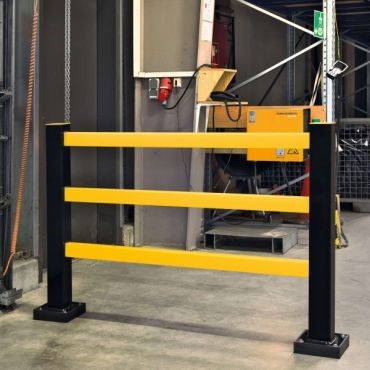
Among the leading examples of this third-generation technology is the Black Bull Flex Impact Protection System Hybrid Set, which demonstrates several key advancements in flexible protection design.
This system utilizes a specialized polyurethane (PU) flex pad as part of its 1,000 x 2,000mm hybrid configuration. The design exemplifies several key principles that facility safety managers should understand when evaluating impact protection solutions:
Material Science Innovation
The polyurethane components in advanced systems like the Black Bull Flex represent significant materials science research. These specialized polymers offer:
- High energy absorption capacity per unit volume
- Exceptional tear and abrasion resistance
- Excellent memory properties (returning to original shape)
- Resistance to environmental degradation from UV exposure, moisture, and common industrial chemicals
- Consistent performance across a wide temperature range (-30°C to +50°C in most cases)
The molecular structure of these engineered polymers allows them to deform under load, absorbing energy through molecular friction, then return to their original configuration once the load is removed.
System-Level Engineering
While the material properties are crucial, equally important is how these materials are incorporated into complete protection systems. The Black Bull Flex system demonstrates advanced engineering through:
- Strategic distribution of flexible and semi-rigid components to manage different types of impacts
- Carefully designed mounting systems that allow controlled movement without compromising structural integrity
- Load distribution mechanisms that spread impact forces across larger areas
- Progressive resistance that increases as deformation increases, providing appropriate responses to both minor and major impacts
- Modular design allowing customization for specific facility requirements
Real-World Performance Metrics
What truly separates advanced flexible systems from their predecessors is their performance under actual impact conditions. Testing of systems like the Black Bull Flex typically demonstrates:
- Ability to absorb impacts from vehicles weighing up to 3,500 kg at speeds of 5-10 km/h without permanent deformation
- Reduction of peak impact forces by 80-90% compared to rigid systems
- Service life spanning hundreds of minor impacts or dozens of major impacts before replacement is necessary
- Minimal maintenance requirements beyond periodic inspection
Implementation Considerations for Facility Managers
Understanding the technology is only the first step in improving facility safety. Effective implementation requires careful planning and assessment:
Risk Assessment and Protection Zoning
Before selecting impact protection, facility managers should conduct a thorough risk assessment that:
- Identifies high-traffic areas where vehicle movement creates collision risks
- Assesses the types of vehicles operating in each area and their typical speeds
- Evaluates the potential consequences of impacts at each location
- Prioritizes protection needs based on both probability and potential severity
This assessment allows for protection zoning, where different levels of protection are implemented based on the specific risks present in each area.
Integration with Existing Safety Systems
Impact protection should be viewed as one component in a comprehensive safety ecosystem that includes:
- Traffic management systems (floor marking, signage, designated routes)
- Driver training programs emphasizing collision avoidance
- Visibility enhancements at blind corners and intersections
- Speed control measures in high-risk areas
The most effective implementations coordinate these elements to prevent incidents rather than simply mitigating their consequences.
Return on Investment Calculation
While advanced systems like the Black Bull Flex represent a higher initial investment than traditional steel barriers, the total cost of ownership is typically lower when accounting for:
- Reduced repair/replacement frequency due to higher durability
- Decreased damage to vehicles and equipment during collisions
- Minimized operational disruption after impacts
- Lower injury risks and associated costs
Facility managers’ report typical ROI periods of 12-24 months for facilities with moderate to high traffic volumes, with the most significant savings realized in high-throughput environments where collision risks are elevated.
Future Trends in Impact Protection Technology
As industrial operations continue to evolve, impact protection technology is advancing in parallel. Several emerging trends are worth monitoring:
Smart Impact Protection Systems
The next generation of protection systems will likely incorporate sensing and monitoring capabilities that:
- Detect and record impact events for analysis
- Assess the severity of impacts to determine if inspection is needed
- Integrate with facility management systems to report incidents automatically
- Provide data for improving traffic management and driver training
Customized Energy Absorption Profiles
As computational modelling becomes more sophisticated, protection systems are increasingly being designed with customized energy absorption profiles tailored to specific:
- Vehicle types and weights common in particular facilities
- Impact angles based on traffic flow analysis
- Speed ranges typical in different operational zones
This customization optimizes protection performance for the exact conditions present in each facility rather than relying on generalized designs.
Sustainability Improvements
Newer protection systems are also addressing sustainability concerns through:
- Increased use of recycled materials in production
- Design for eventual recyclability at end of life
- Extended service life reducing replacement frequency
- Reduced damage to other equipment, decreasing overall resource consumption
Conclusion: The Strategic Value of Advanced Impact Protection
As industrial operations become increasingly automated and high-velocity, the strategic importance of effective impact protection continues to grow. Systems like the Black Bull Flex Impact Protection System represent a fundamental shift from passive barriers to engineered energy management solutions.
Facility managers who understand the physics, materials science, and system-level engineering behind these advanced protection systems can make more informed decisions about safety infrastructure investments. In environments where operational continuity and worker safety are paramount, the evolution from rigid barriers to flexible, energy-absorbing systems represents not merely a technical improvement but a strategic advantage.
By implementing properly engineered flexible impact protection, facilities can simultaneously enhance safety, reduce operational disruptions, extend equipment life, and improve their overall bottom line—a rare combination of benefits that explains why these systems are rapidly becoming standard in forward-thinking industrial facilities worldwide.