Safe Extension Procedures for Professional Height Access
Properly extending a Climb-It ladder is critical for both safety and functionality when working at height. Available through Hall-Fast Industrial Supplies via their dedicated website, Climb-It extension ladders incorporate specialized mechanisms designed for smooth, controlled height adjustment. This comprehensive guide provides detailed instructions for correctly extending various Climb-It ladder models, ensuring safe deployment while maximizing the ladder's functional capabilities.
Preparation Before Extension
Several important steps should precede any extension operation:
Initial Safety Assessment
Before beginning the extension process, complete these essential checks:
- Verify the work area is free from overhead electrical hazards
- Ensure the ground surface is firm, level, and clear of debris
- Check weather conditions are suitable for ladder work
- Confirm sufficient clearance exists for the fully extended ladder
- Verify the ladder is positioned away from doorways or traffic areas
- Ensure the ladder is clean and free from contaminants
- Inspect the ladder for any damage or defects before use
This preliminary assessment ensures the working environment is appropriate for safe ladder deployment before beginning the extension process.
Ladder Positioning Fundamentals
Proper initial positioning is critical for stable extension:
- Place the ladder with its feet firmly on level ground
- Position the ladder base approximately 1/4 of the working height away from the supporting structure
- Ensure both feet are making full contact with the ground
- Verify the ladder is directly in line with the intended work area
- Check for hazards in the extension path
- Position with the fly section (extending part) facing away from the wall
- Ensure stabilizer bars are deployed if equipped
These positioning fundamentals establish the proper foundation for safe ladder extension, creating stable geometry for both the extension process and subsequent use.
Extension Procedures for Different Climb-It Ladder Types
Extension techniques vary depending on the specific Climb-It ladder model:
Standard Double-Section Extension Ladder
For conventional two-section Climb-It extension ladders:
- Position the ladder horizontally on the ground if possible
- Locate the extension rope and pulley system
- Ensure the rope is free from tangles or knots
- Pull the rope smoothly to begin raising the fly section
- Maintain control of the rope throughout the extension process
- Guide the fly section as it rises to prevent binding
- Continue pulling until desired height is reached
- Ensure rung hooks engage securely over rungs on the base section
- Check that the rope is secured to prevent accidental retraction
- Verify proper overlap between sections (minimum 3 rungs)
This controlled extension process ensures smooth movement while maintaining proper alignment between sections.
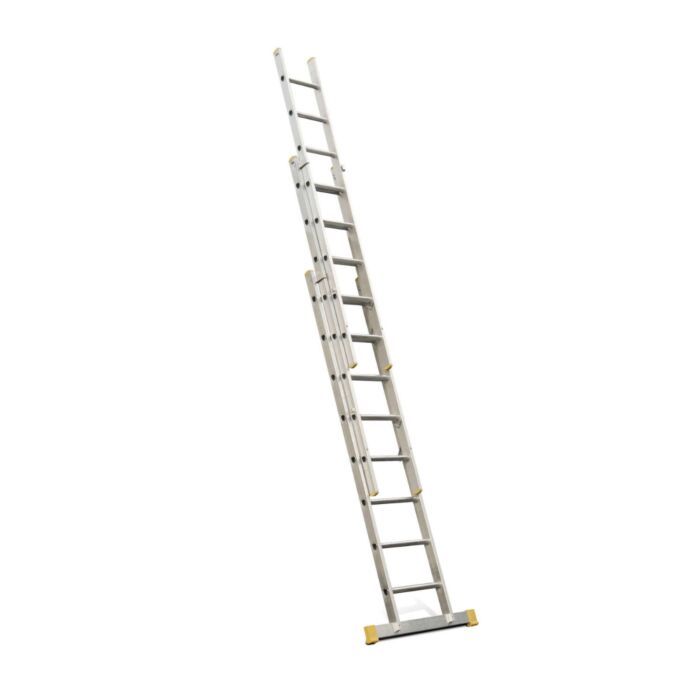
Triple-Section Extension Ladder
For Climb-It triple extension ladders with three sections:
- Begin with the ladder horizontal if possible
- Extend the middle section first using the primary rope
- Ensure middle section rung hooks engage properly
- Secure the first rope to maintain middle section position
- Use the secondary rope to extend the top section
- Guide the top section to prevent binding or misalignment
- Extend to desired height while maintaining control
- Verify both sets of rung hooks are fully engaged
- Secure both ropes according to manufacturer instructions
- Check for proper overlap between all three sections
This sequential extension approach ensures controlled deployment of complex triple-section ladders while maintaining proper alignment and security.
Telescopic Extension Ladder
For Climb-It telescopic extension ladders:
- Position the ladder vertically against the supporting structure
- Begin extension from the top section downward
- Unlock each section according to the specific locking mechanism design
- Extend one section at a time while maintaining control
- Listen for the "click" confirming each section is locked
- Visually verify locking indicators show secure engagement
- Continue sequential extension until desired height is reached
- Verify all sections are fully locked before use
- Check that no pinch points are accessible during use
- Confirm extension height is appropriate for the task
This section-by-section extension method ensures proper deployment of telescopic designs, with particular attention to the critical locking mechanisms that secure each section.
Positioning and Securing the Extended Ladder
After extension, proper positioning is critical for safe use:
Final Positioning Procedures
Once extended, complete these essential positioning steps:
- Raise the extended ladder to vertical position if extended horizontally
- Walk the ladder up gradually using proper lifting technique
- Position against the supporting structure at the correct angle (75° or 1:4 ratio)
- Ensure both feet are making full contact with the ground
- Check the ladder is directly in line with the work area
- Verify the ladder extends at least 1 meter (3 feet) above any landing point
- Deploy stabilizer bars if equipped
- Confirm proper positioning angle using built-in indicators if available
These positioning procedures ensure the extended ladder is correctly situated for safe access to the work area.
Securing the Extended Ladder
Several measures enhance stability of the extended ladder:
- Consider securing the base with stakes for soft ground
- Use ladder levellers if ground is slightly uneven
- Tie off the top of the ladder if possible
- Ensure any standoff devices are properly positioned
- Consider having a second person foot the ladder during ascent
- Verify stabilizer bars are fully deployed and locked
- Check that the ladder is clear of any overhead obstructions
These security measures provide additional stability for the extended ladder, particularly in challenging environments or when working at substantial heights.
Retraction Procedures and Storage
Safe retraction is equally important as proper extension:
Controlled Retraction Process
When work is complete, retract the ladder carefully:
- Ensure no tools or materials remain on the ladder
- Verify the ladder is clear of obstructions
- Maintain firm control of the extension rope
- For rope-operated ladders, gradually ease the rope to control descent
- Guide the sliding section to prevent binding or pinching
- For telescopic models, follow manufacturer's specific unlocking sequence
- Maintain control of all sections during retraction
- Ensure fingers are clear of potential pinch points
- Verify complete closure before transport
- Secure any loose ropes or components
This controlled retraction process prevents damage to the ladder while ensuring user safety throughout the procedure.
Hall-Fast: Your Source for Climb-It Extension Ladders
Founded in 2006, Hall-Fast Industrial Supplies has established itself as a trusted supplier of quality access equipment including the comprehensive Climb-It ladder range. Their extensive experience in the industrial supply sector provides valuable expertise regarding ladder extension procedures and safe usage techniques.
As detailed on their About Us page, Hall-Fast has grown from humble beginnings to become an award-winning supplier with an extensive product range and commitment to customer service. Their expertise ensures customers receive appropriate guidance when selecting and using extension ladders for specific applications.
To explore the Climb-It extension ladder range, visit the dedicated Climb-It page or contact Hall-Fast's team through their website contact form.
Hall-Fast - Whatever Your Industry Needs Worldwide!